Five Flute’s pitch deck focuses on a highly specific vertical: issue tracking for physical product developers. By identifying a gap in the workflow of mechanical and electrical engineers—who often have to leave their primary CAD environments to document bugs or design changes—Five Flute positions itself as a 'CAD-native' solution. The deck effectively uses a complex product development timeline to illustrate the longevity of the problem and identifies a clear $1.95B beachhead market within the SolidWorks ecosystem. While the provided slides lack a formal team biography or specific financial a…
Key takeaways
- The company defines its product as 'Issue Tracking SaaS for Physical Product Developers' on slide 1.
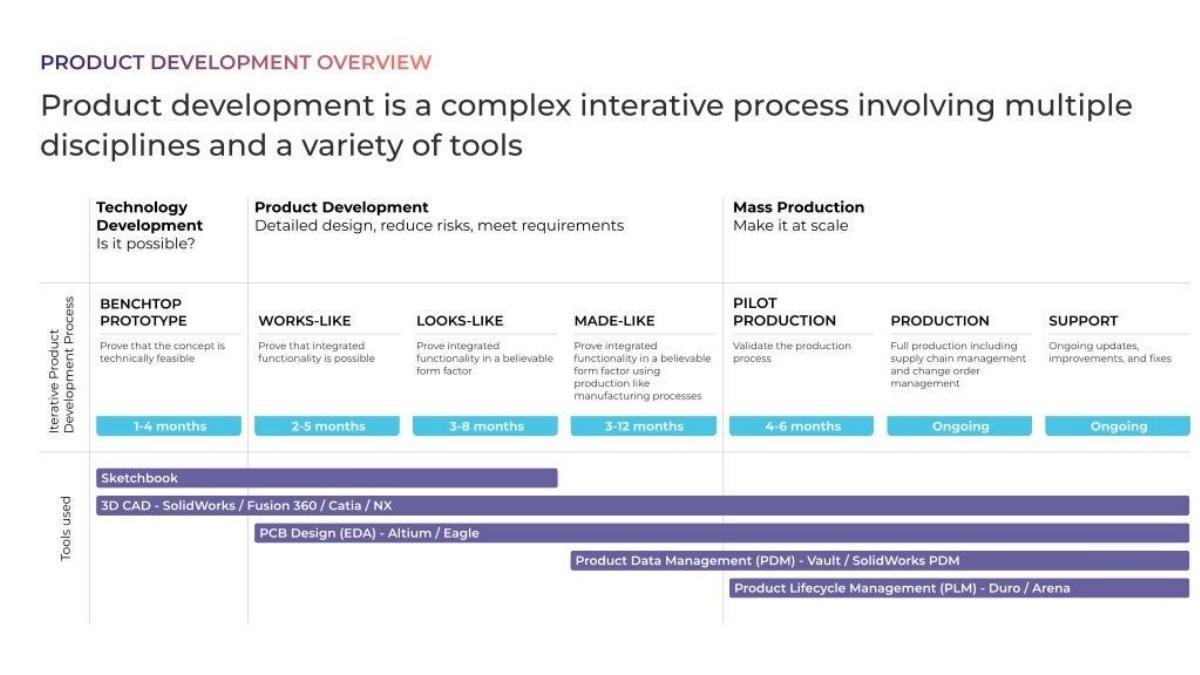
- Slide 2 maps out a product development lifecycle spanning from 1-4 month benchtop prototypes to ongoing production support.
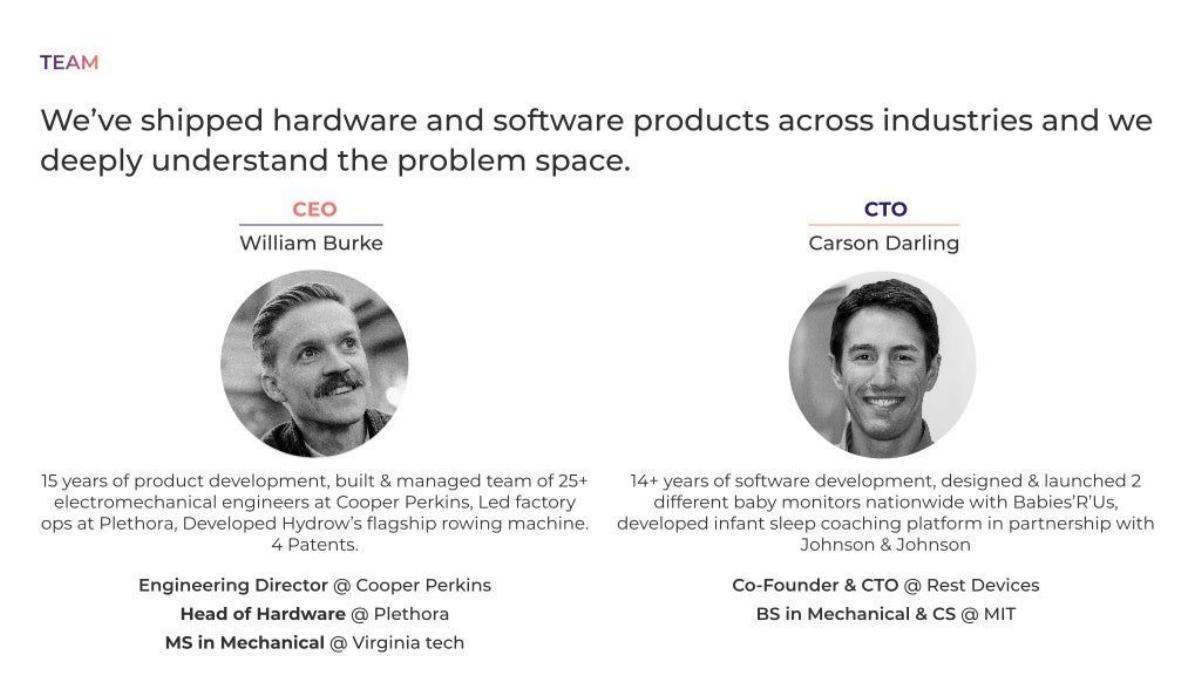
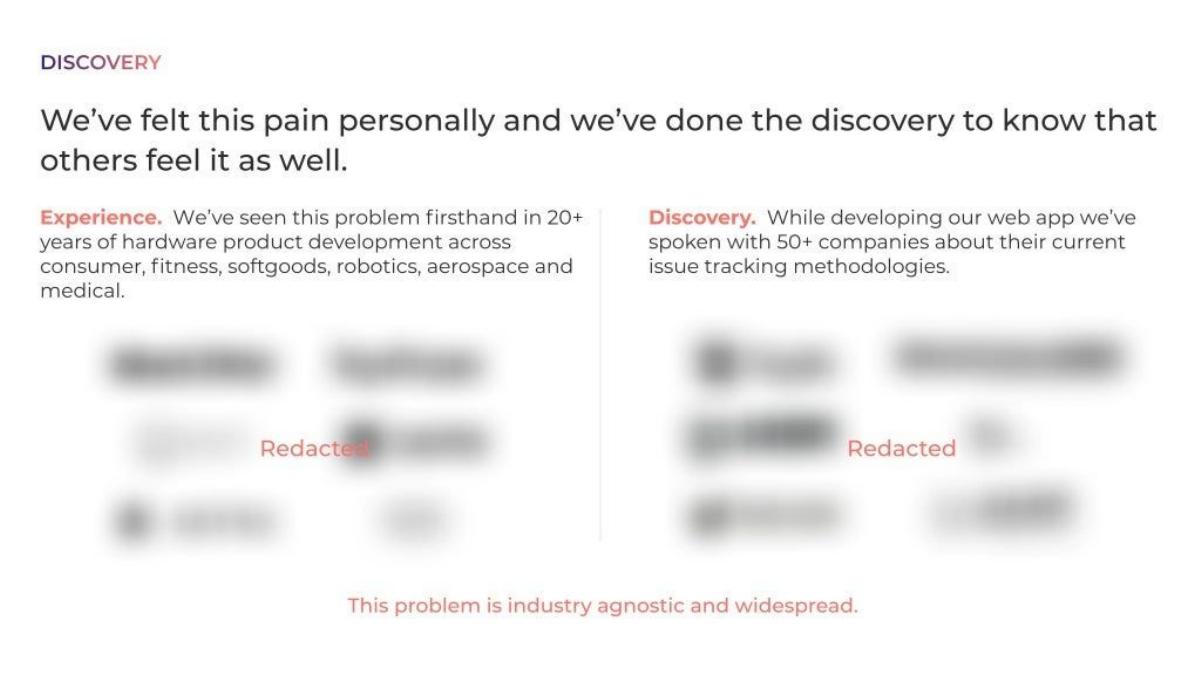
- The founders claim 20+ years of hardware development experience and discovery calls with 50+ companies on slide 3.
- The platform is designed for three distinct user types: CAD Integrated Engineers, Desktop Management, and Mobile Technicians (slide 4).
- Five Flute positions itself in the 'CAD Native' and 'Connected to engineering data' quadrant of the competitive landscape on slide 6.
- The total global opportunity is valued at $12B, with a specific $1.95B beachhead market targeting 3.25M active SolidWorks users (slide 7).
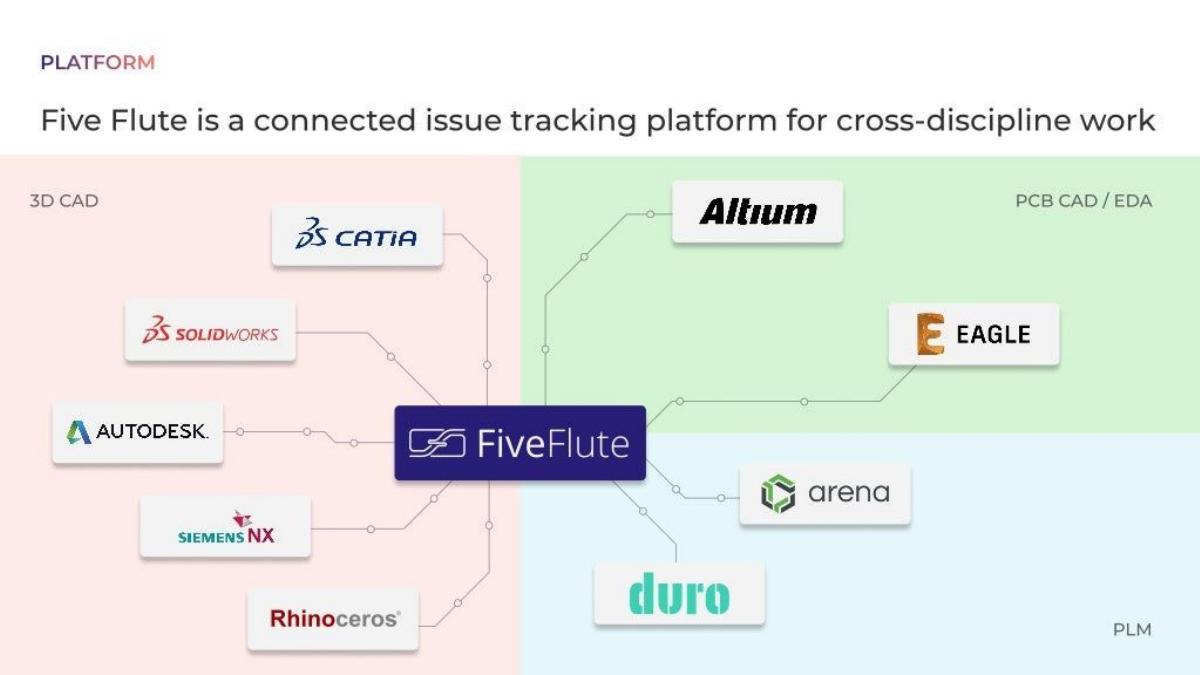
- The roadmap on slide 8 shows a progression from core tracking (2021) to SolidWorks integration (1Q2022), with future plans for Altium and Eagle integrations.
- The deck emphasizes a 'Product Led' growth strategy where team communication serves as a conversion engine for new account holders (slide 5).
Five Flute: Vertical SaaS for the Hardware World
Five Flute’s pitch deck is a masterclass in vertical SaaS positioning. Rather than trying to be a general project management tool, they have identified a specific, high-friction point in a high-value industry: hardware engineering. The deck focuses on the 'CAD-native' advantage, arguing that engineers shouldn't have to leave their design environment to manage issues.
Slide 1: The Cover and Value Proposition
The deck opens with a clear, concise tagline: "Issue Tracking SaaS for Physical Product Developers." It immediately follows this with a one-sentence explanation of the 'how': bringing collaboration directly into 3D design tools. This is a strong start because it avoids buzzwords and identifies both the user (engineers/designers) and the environment (3D design tools) within seconds.
Slide 2: Product Development Overview
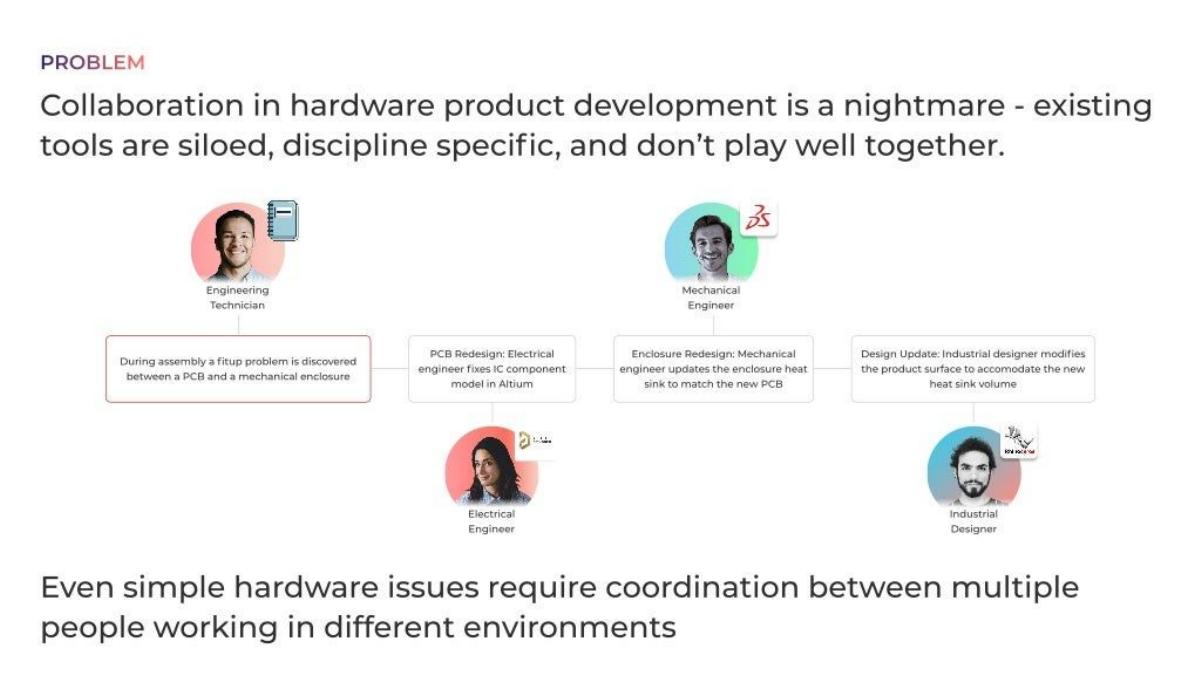
This slide serves as the 'Problem' slide, but it does so by illustrating complexity rather than just complaining about it. It breaks down the iterative process into stages: Benchtop Prototype (1-4 months), Works-Like, Looks-Like, Made-Like (3-12 months), and eventually Mass Production. Crucially, it lists the tools used at each stage, such as SolidWorks, Fusion 360, Altium, and Vault. By showing that these tools are used for years across a product's life, Five Flute establishes the massive surface area for potential errors and the need for a persistent tracking layer.
Slide 3: Discovery and Founder-Market Fit
Five Flute uses this slide to establish credibility. They cite "20+ years of hardware product development" across diverse sectors like robotics, aerospace, and medical. They also quantify their market research, stating they have "spoken with 50+ companies" about their methodologies. While the specific company logos are redacted in this version, the intent is clear: the founders are insiders solving a problem they have lived.
Slide 4: The Platform Interface
This slide provides a three-view look at the product: CAD Integrated (for engineers), Desktop Webview (for management), and Mobile (for technicians). This is a vital distinction. It shows the investors that the product isn't just a plugin; it's a cross-platform ecosystem that connects the person designing the part to the person manufacturing it on the shop floor.
Slide 5: Why We Win
The 'Why We Win' slide focuses on four pillars: Customer Experience, Simpler Adoption, Product Led growth, and Stickiness. The most compelling argument here is Simpler Adoption. By appearing inside CAD, they claim, "to them we're not a new tool, but rather a new set of capabilities." This addresses the common investor fear of 'tool fatigue' in enterprise software.
Slide 6: Competitive Landscape
The competitive matrix on slide 6 is aggressive. It places Five Flute in the top-right quadrant (CAD Native / Connected to engineering data). It labels the 'Web Only' and 'Siloed' competitors (likely tools like Jira or Trello, though redacted) as "structurally unable to address this niche." This is a bold claim that rests on the technical difficulty of building deep integrations into proprietary CAD software.
Slide 7: Market Opportunity
Five Flute provides a bottom-up market sizing. They identify 19.3M Global CAD Users as the total addressable market. However, they narrow their focus to a $1.95B beachhead market consisting of 3.25M Active SolidWorks Users. This specificity is excellent for a pre-seed deck; it shows the founders know exactly who their first 1,000 customers are and how much they are worth.
Slide 8: The Roadmap
The roadmap shows a logical progression of integrations. Having launched the core platform in 2021 and SolidWorks in 1Q2022, they signal future moves into Electrical CAD (Altium, Eagle) and PLM (Duro, Arena). This slide is meant to prove that Five Flute can grow from a simple plugin into the central nervous system of a hardware company.
Slide 9: Contact
The final slide is a standard contact page. In a full deck, this would usually follow an 'Ask' slide, which is missing from this selection.
What Works in the Five Flute Deck
Vertical Focus: The deck never tries to be everything to everyone. It stays laser-focused on the hardware engineer's workflow. · Workflow Integration: The emphasis on 'living where the work is done' is a powerful counter-argument to the difficulty of selling new SaaS tools. · Market Sizing: Using 'Active SolidWorks Users' as a beachhead is much more believable than a generic '1% of a $50B market' slide.
What is Missing
The Ask: The provided slides do not state how much capital is being raised or what the specific milestones for that capital are, though the source listing mentions a $1.2M round. · Business Model: There is no mention of pricing tiers, per-seat costs, or enterprise contract structures. · Traction Data: While they mention 50+ discovery calls, the deck lacks data on current paying customers, churn, or user engagement metrics.
Lessons for Founders
1. Define your 'Beachhead' by Tool, not just Industry. Five Flute didn't just say 'Hardware Companies'; they said 'SolidWorks Users.' If your product integrates with a specific platform (like Shopify, Salesforce, or AutoCAD), use that platform's user base to define your initial market.
2. Map the Lifecycle. Slide 2 is effective because it shows that the problem persists for years. If your product solves a problem in a complex process, draw that process out to show how many opportunities there are for your solution to add value.
3. Address the 'New Tool' Friction. Every VP of Engineering is tired of buying new tools that their team won't use. Five Flute’s argument that they are 'a new set of capabilities' within an existing tool is a brilliant way to bypass this objection.
Final Analysis
Five Flute’s deck succeeds because it feels like it was written by engineers for engineers. It respects the complexity of the hardware development cycle and offers a solution that fits into existing habits rather than trying to break them. For a $1.2M pre-seed round, this level of industry insight and technical focus is often exactly what specialized venture firms are looking for.
Frequently asked questions
- What specific problem does Five Flute solve?
- Five Flute addresses the fragmentation in hardware engineering workflows. According to slide 2, product development involves multiple disciplines and tools that are often siloed. By bringing issue tracking directly into 3D design tools (CAD), Five Flute prevents engineers from having to switch between generic task managers and their technical design environment, which improves visual context and communication efficiency as noted on slide 5.
- Who is the primary target audience for this software?
- The market opportunity slide (slide 7) identifies a broad audience of everyone involved in physical product development, including mechanical and electrical engineers, industrial designers, and technical program managers. However, their immediate 'beachhead' focus is the 3.25 million active users of SolidWorks, a leading 3D CAD software.
- How does Five Flute differentiate itself from competitors like Jira or Asana?
- Slide 6 uses a 2x2 matrix to show that generic competitors are 'Web Only' and 'Siloed.' Five Flute claims these tools are too generic for hardware development and force teams to change their workflows. Five Flute differentiates by being 'CAD Native' and 'Connected to engineering data' like parts, assemblies, and drawings, which generic tools cannot easily access.
- What is the company's long-term defensibility strategy?
- According to slide 5, Five Flute's defensibility is built on 'Stickiness' through integration across the entire product development toolchain. By moving from Mechanical CAD to ECAD (Electrical CAD) and eventually PLM (Product Lifecycle Management) systems, the software becomes a central, indispensable node for all engineering communication and data history.
- What is missing from this version of the pitch deck?
- This teardown is based on 9 of the 17 slides. Notable omissions in the provided set include a dedicated Team slide (though slide 3 mentions founder experience), a Business Model/Pricing slide, specific Traction metrics (revenue or user growth numbers), and a clear 'The Ask' slide detailing how the $1.2M will be spent.