FitMove is a fitness coaching startup led by founder Olivier Lemée, aiming to solve the high dropout rate in fitness clubs. The deck identifies a significant market opportunity, citing that 83% of gym members quit within six weeks, creating a 'quickly addressable' market of 24.8 million people. However, the presentation suffers from a critical lack of product detail; across the six slides provided, there is no visual representation of the app or service. Instead, the deck leans heavily on aggressive five-year financial projections, forecasting a jump from $450,941 in Year 1 revenue to $11.5 m…
Key takeaways
- The deck identifies a specific pain point: 83% of fitness club members drop out after just 6 weeks (Slide 2).
- The total economic cost of overweight and obesity in the US and Canada is stated as $300 billion per year (Slide 2).
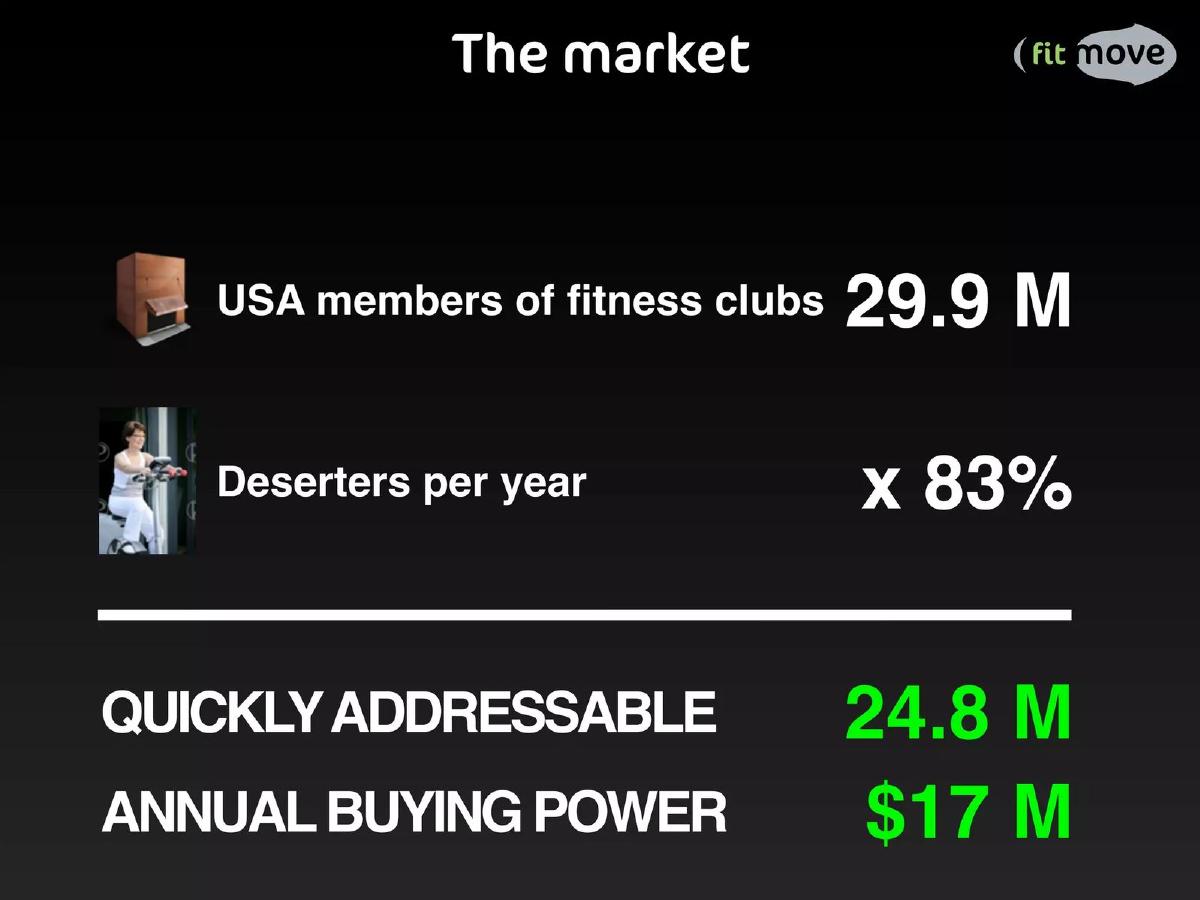
- Market sizing is calculated by applying the 83% dropout rate to 29.9 million US gym members to reach a target of 24.8 million people (Slide 3).
- Financial projections forecast a transition to profitability in Year 4 with a $1.6 million profit (Slide 4).
- Revenue is projected to grow from $450,941 in Year 1 to $11.5 million in Year 5 (Slide 4).
- The team slide relies heavily on future hires, including a Marketing VP, 4 developers, and additional coaches marked as 'TBH' (Slide 5).
- The startup is seeking a 'Tour 1' investment of $500,000 to move past the bootstrap phase (Slide 6).
- A second 'Tour 2' of $1.3 million is planned to cover Years 1 through 3 (Slide 6).
FitMove Pitch Deck Analysis
The FitMove pitch deck is a document focused on the logistics of scaling a fitness coaching business. It follows a traditional narrative arc: identifying a massive failure in the current fitness industry, quantifying the market of 'deserters,' and projecting a path to profitability. However, the deck is notable for what it lacks—specifically, a clear demonstration of the product itself. In an industry as visual and user-experience-driven as fitness, the absence of an interface or a clear value proposition for the 'coaching' mechanism is a significant hurdle for potential investors.
Slide 1: Title Slide
The opening slide introduces the brand 'FitMove' with a logo featuring a stylized footprint. The tagline is 'Personal fitness coaching anytime, anywhere.' The slide identifies Olivier Lemée as the founder. The design is minimalist, using a black background with white and lime green text, a color scheme maintained throughout the deck. While it establishes the sector (fitness coaching) and the promise (accessibility), it provides no hint as to whether this is a human-led service, an AI platform, or a hardware-software hybrid.
Slide 2: The Problem
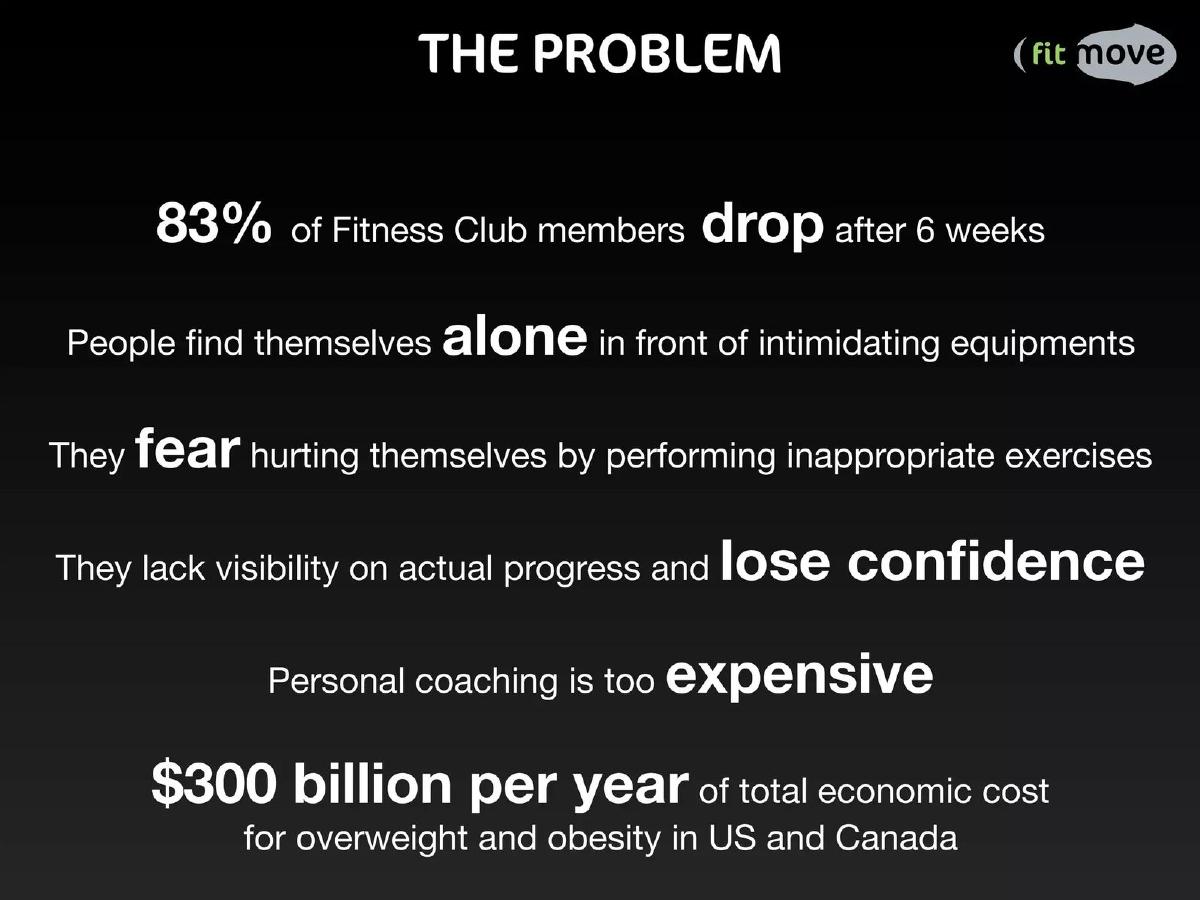
This slide attempts to build a sense of urgency by highlighting the failures of traditional fitness clubs. It lists several psychological and financial barriers: "83% of Fitness Club members drop after 6 weeks," people feel "alone in front of intimidating equipments," and they "fear hurting themselves." It also notes that "Personal coaching is too expensive." The slide concludes with a macro-economic figure: "$300 billion per year of total economic cost for overweight and obesity in US and Canada." This slide successfully identifies a high-churn market, but it conflates two different problems: the inefficiency of gyms and the total cost of obesity, without explaining how FitMove bridges that gap.
Slide 3: The Market
FitMove quantifies its opportunity by filtering the US gym-going population. It starts with "USA members of fitness clubs 29.9 M" and multiplies this by the "83%" dropout rate mentioned previously. This results in a "QUICKLY ADDRESSABLE" market of "24.8 M" people. The slide also lists an "ANNUAL BUYING POWER" of "$17 M." This figure is confusing; if the addressable market is 24.8 million people, a $17 million buying power implies each customer is only worth approximately $0.68 per year. This may be a typographical error or a reference to a very specific subset of spending that is not defined on the slide.
Slide 4: OUR RUN: some key figures
This is a comprehensive financial projection table covering a 'Bootstrap' phase followed by five years of operations. The growth targets are aggressive:
Customers: Growing from 0 in the bootstrap phase to 2,464 in Year 1, and reaching 106,966 by Year 5. · Workouts: Scaling from 23,040 in Year 1 to 868,808 in Year 5. · Revenue: Starting at $450,941 in Year 1 and climbing to $11,500,000 in Year 5. · Profit: The company projects losses for the first three years (ranging from -$450,110 to -$400,000) before turning a profit of $1.6M in Year 4 and $9.7M in Year 5.
The precision of the numbers (e.g., $450,941) suggests a detailed underlying model, but the leap from Year 3 to Year 5 represents a nearly 10x increase in revenue, which would require significant evidence of a scalable customer acquisition engine not present in these slides.
Slide 5: Our Team
The team slide is divided into four quadrants: Advisors, Management, Engineering, and Coaches. The Management Team consists of the Founder/CEO and an Operations Manager, with a "Marketing VP TBH" (To Be Hired) noted. The Engineering Team features two "Java architects" and two icons labeled "Nemesis" and "Scripto," along with a requirement for "4 developers TBH." The Coaches network is represented by a "France leader" and a "San Diego leader." The heavy reliance on 'TBH' roles indicates that the current team is a skeleton crew, and the success of the venture is contingent on future hiring.
Slide 6: Financing
The final slide in this set outlines the funding requirements and milestones. "Tour 1" is a request for "$500,000" to fund the transition from bootstrapping to Year 1. The uses for these funds include 'minimum infrastructure,' '4 junior developers,' and 'social network advertising.' "Tour 2" seeks "$1.3M" to cover Years 1 through 3, with the goal of becoming "PROFITABLE" by the end of Year 3. The roadmap includes 'Accessories integration' and a 'Bigger coaches network' by Year 4. This slide provides a clear capital path but highlights that the company is currently at a very early, pre-infrastructure stage.
What Works in This Deck
The deck is strongest when it identifies the 'Deserter' market. By focusing on the 83% of people who fail at the gym, FitMove is targeting a specific, recurring pain point rather than just 'people who want to get fit.' The financial table (Slide 4) is also well-structured, providing investors with a clear view of the founder's expectations for unit economics and growth trajectories, even if those projections are highly optimistic. The geographic split of the coaching network (France and San Diego) suggests an early attempt at international thinking, which could be an advantage in the digital coaching space.
What is Missing
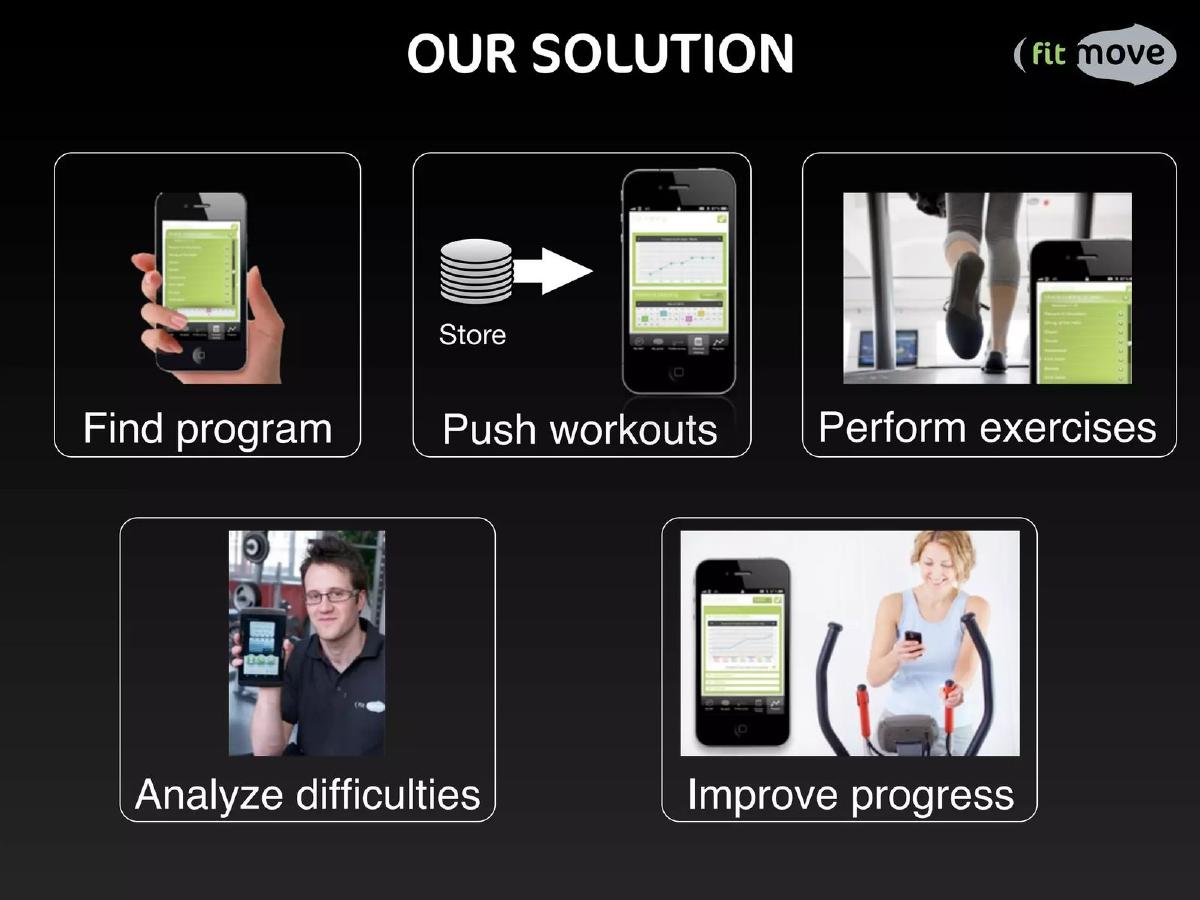
The most glaring omission is the Product Slide . Across these six slides, there is not a single image of the FitMove app, a description of the user journey, or an explanation of how the 'coaching' actually works. Is it live video? Asynchronous messaging? Automated plans? Without this, the financial projections feel untethered from reality. Additionally, there is no Competition Slide . The fitness tech space is crowded with giants like Peloton, Nike Training Club, and MyFitnessPal, as well as boutique coaching apps. FitMove does not explain how it will win against these established players. Finally, the Unit Economics are missing; while total revenue is projected, the cost to acquire a customer (CAC) and the lifetime value (LTV) are not discussed, which is critical for a service projecting 100,000+ users.
What a Founder Should Copy
Founders should emulate the clarity of the Problem Slide (Slide 2). It uses simple, punchy sentences to describe emotional states ('fear,' 'alone,' 'lose confidence') that resonate with a broad audience. The Financing Roadmap (Slide 6) is also a good model; it clearly links specific dollar amounts to specific operational milestones and hiring goals. This helps investors understand exactly what their 'Tour 1' money is buying. Lastly, the use of a consistent, high-contrast color palette makes the deck easy to read, ensuring that the data points—even the confusing ones—are the center of attention.
Frequently asked questions
- What is the core product FitMove is offering?
- Based on the six slides provided, the specific nature of the product is unclear. The title slide mentions 'Personal fitness coaching anytime, anywhere,' and the team slide mentions 'Java architects' and 'developers,' implying a mobile or web application. However, there are no screenshots, feature lists, or user flow diagrams to explain how the coaching is delivered or how it differs from existing fitness apps.
- How does the company justify its market size?
- FitMove uses a top-down approach. They start with 29.9 million US fitness club members and apply their 83% dropout statistic to define a 'Quickly Addressable' market of 24.8 million people. Curiously, they list the 'Annual Buying Power' of this massive group as only $17 million, which would equate to less than $1 per person per year, suggesting a potential typo or a very specific niche calculation not explained in the text.
- What are the primary financial goals of the startup?
- The startup aims to reach $11.5 million in annual revenue by Year 5. They project initial losses during the first three years, ranging from -$450,110 to -$384,932, before hitting profitability in Year 4. The goal is to scale from 2,464 customers in Year 1 to over 106,000 customers by Year 5, supported by a total of $1.8 million in raised capital across two rounds.
- Who are the key people involved in FitMove?
- The company is led by founder and CEO Olivier Lemée. The management team includes an Operations Manager and a vacant Marketing VP slot. The technical side is led by two Java architects, supported by two named entities, 'Nemesis' and 'Scripto.' The coaching network is divided geographically, with designated leaders for France and San Diego, though the deck notes that more coaches are 'To Be Hired.'
- What is the intended use of the $500,000 'Tour 1' funds?
- The initial $500,000 investment is earmarked for moving out of the 'Bootstrap' phase. Specific allocations include building 'minimum infrastructure,' hiring four junior developers, launching social network advertising, and formalizing the 'Company create' process. This suggests the funding is intended to take the company from a concept or MVP stage to a functional commercial entity.