WannaBiz, an angel seed fund, utilizes a 25-slide presentation (9 available for review) to bridge the gap between founders and investors. The deck is less a traditional startup pitch and more an educational framework, citing a 'traditional startup - investor meeting' as a point of friction (Slide 2). It provides a structured 9-point content list for pitch decks, emphasizing that founders should keep presentations to 10-12 slides and 10-15 minutes (Slide 4). Data-heavy slides reveal a community of 35 participants and a total investment of over $7,000,000 across 87 projects over two years, with…
Key takeaways
- The deck recommends a strict 10-12 slide limit for founder pitches to maintain engagement (Slide 4).
- WannaBiz reports a total investment volume exceeding $7,000,000 across 87 projects over a two-year period (Slide 7).
- The average investment check for the fund is precisely $48,100 (Slide 7).
- The fund's deal flow includes over 380 projects reviewed and more than 100 pitches conducted (Slide 7).
- 82.4% of the community members are willing to invest their knowledge and time through mentorship and hackathons (Slide 8).
- The Ukrainian investment climate is categorized as 30.7% 'unfavorable' and 30.7% 'positive dynamics after a period of calm' (Slide 8).
- Investors cite 'few projects' (32%) and 'low return on investment' (31%) as primary reasons to stop investing (Slide 8).
- The deck emphasizes a 'From founders to founders' philosophy, positioning the fund as an operator-led entity (Slide 1).
Introduction and Philosophy
Slide 1: Title and Positioning
The presentation opens with the WannaBiz logo and the subtitle 'WannaBiz angel seed fund.' The central hero image is a screenshot of a website featuring the tagline 'From founders to founders.' This immediately establishes the fund's identity as an operator-led investment vehicle. There are two clear call-to-action buttons visible in the background image: 'FOR STARTUPS' and 'FOR INVESTORS,' indicating a dual-sided audience for their communications.
Slide 2: The Problem in Communication
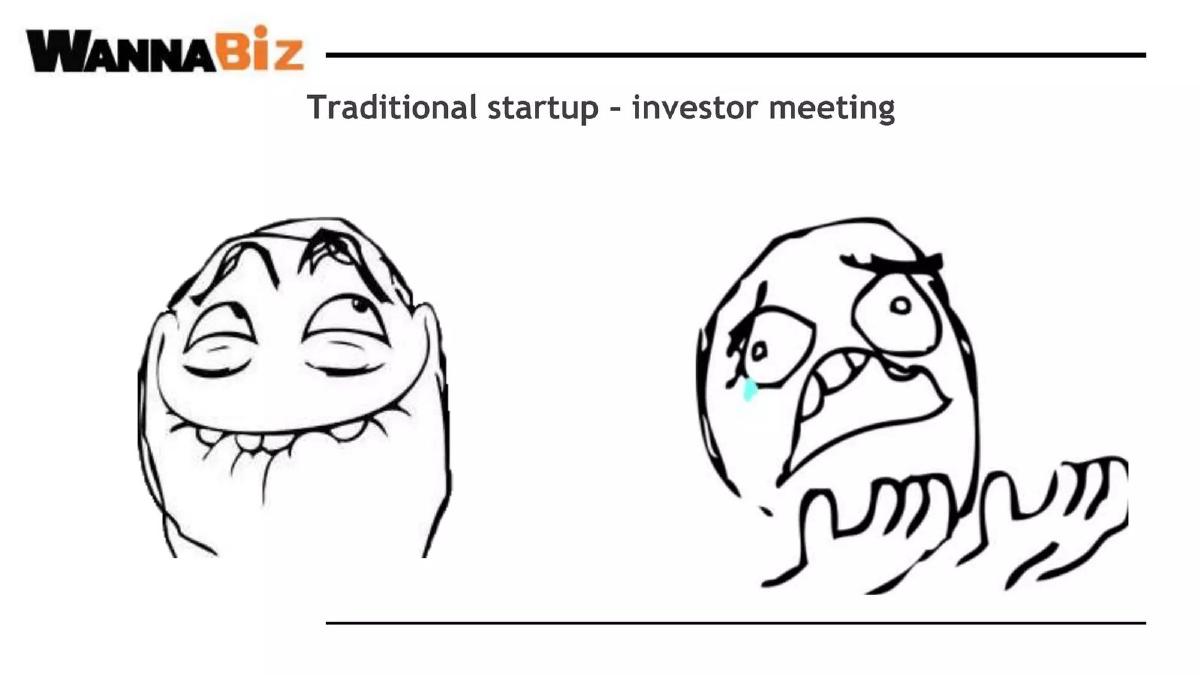
Slide 2, titled 'Traditional startup - investor meeting,' uses two popular internet memes (rage comics) to illustrate the emotional disconnect between founders and investors. The left image shows a smug, satisfied face, while the right shows a frustrated, crying face. This slide serves as a psychological hook, acknowledging the inherent difficulty and frequent failure of initial meetings in the venture capital space.
Slide 3: The Call for Restraint
Slide 3 contains only the text 'But know where to stop' in orange font. This acts as a transition slide, likely leading into the advice on deck brevity and focus. It reinforces the theme that more information is not necessarily better in early-stage fundraising communications.
The Founder's Guide
Slide 4: The Pitch Deck Blueprint
This slide, titled 'Your pitch deck,' is one of the most content-dense in the presentation. It provides a table of contents for a standard pitch deck in Russian, listing nine essential elements: Problem/Opportunity, Solution, 'Magic' (Key feature), Business Model, Marketing Plan, Market and Competition, Team, Financial Forecast/Metrics, and Current Progress/Plan. To the right, a 'Recommendations' box advises founders to keep the deck to 10-12 slides, the presentation to 10-15 minutes, use good English, minimize text, and project 'emotions, confidence, and passion.' Logos for WannaBiz, Verta Media, and Intersog appear at the bottom.
Slide 5: Media and Hype
Titled 'Mass media power,' this slide features a still from the film 'The Wolf of Wall Street' showing Leonardo DiCaprio's character with arms outstretched before a crowd. A footnote credits 'Adrian Pica presentation!' This slide likely discusses the role of public relations and media presence in building startup momentum, though the specific advice is left to the speaker's notes.
Slide 6: The Local Investor Advantage
Titled 'Why local investors?', the slide uses an image from the Pixar short film 'For the Birds,' showing a large bird landing among many smaller birds on a wire. This visual metaphor likely addresses the dynamics of lead investors versus followers, or the specific benefits of having a local 'big bird' investor who understands the regional market nuances better than distant firms.
Fund Performance and Ecosystem Data
Slide 7: Performance Metrics
This slide provides a detailed breakdown of the fund's activity. Under 'COMMUNITY,' it lists 35 participants with a 50:50 split between companies and private investors. The 'INVESTMENTS' section highlights that over 2 years, the fund invested in 87 projects with a total sum exceeding $7,000,000. A red box highlights the 'Average check: $48,100.' The 'DEAL FLOW' section claims over 380 projects reviewed, 20 meetings with selected projects at 'Coffee Diligence' sessions, and over 100 pitches. The bottom of the slide contrasts the benefits for entrepreneurs (access to investors, fast closing, mentoring) versus investors (more projects, joint review, risk reduction through syndication).
Slide 8: The Ukrainian Investment Climate
This slide offers a data-driven look at the local market. A bar chart titled 'Investment Climate in Ukraine' shows a split market: 30.7% unfavorable, 23.1% stagnating but shifting, 7.7% undeveloped, 7.8% favorable, and 30.7% positive dynamics. A separate section titled 'Why an angel might stop investing' lists 'Few projects' (32%), 'Low return' (31%), and 'Change of priority' (31%). Finally, a sidebar notes that 82.4% of community members are ready to invest time in mentorship, hackathons, and legislative initiatives.
Slide 9: Contact Information
The final slide is a 'Thank you!' page featuring a photograph of Alexandra Balkova and her email address (a.balkova@wannabiz.com.ua). This provides a clear point of contact for follow-up, maintaining the professional yet personal tone established by the 'founders to founders' mantra.
What Works and What is Missing
What Works
The deck is highly effective at establishing credibility through specific, hard numbers. Citing a total investment of $7,000,000 and an average check of $48,100 (Slide 7) removes ambiguity about the fund's stage and capacity. The inclusion of ecosystem data (Slide 8) positions the fund as a thought leader and an expert in the Ukrainian market, which is a strong value proposition for both limited partners and international co-investors. The 'meta' approach of teaching founders how to pitch (Slide 4) builds immediate rapport and top-of-funnel interest from startups.
What is Missing
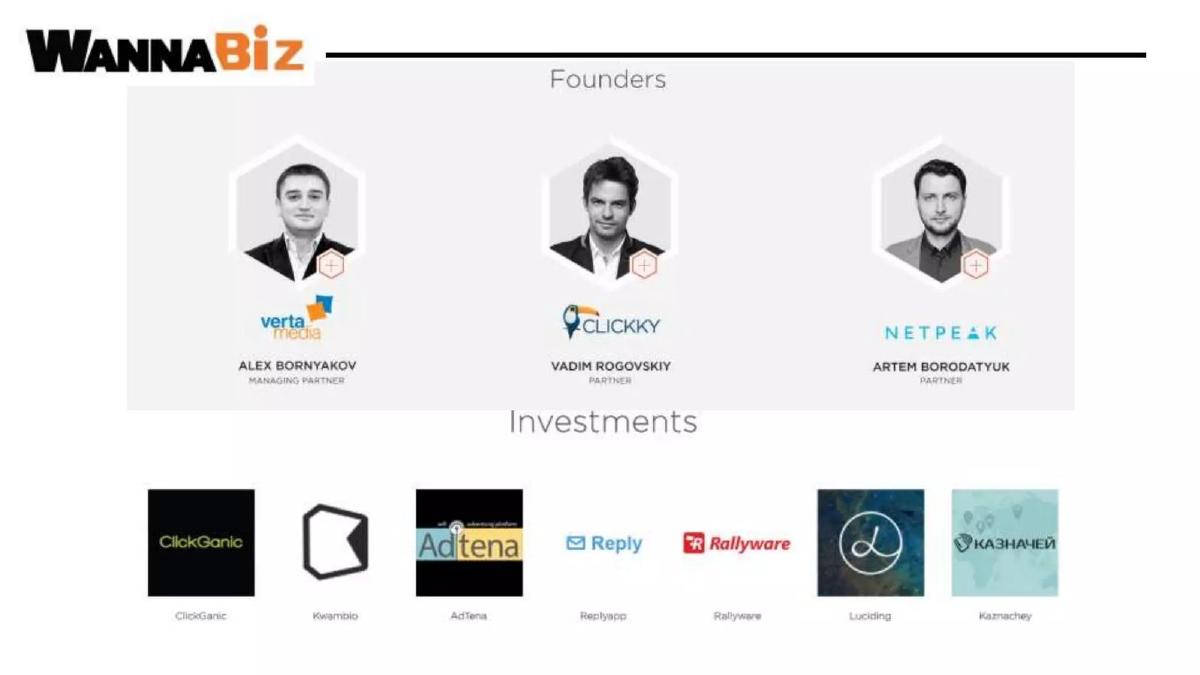
The deck lacks a clear 'Portfolio' slide that names specific successful companies. While it mentions 87 projects, it does not highlight any 'winners' or case studies to prove the efficacy of their selection process. There is also no mention of the fund's specific exit track record or the names of the 35 community members. Furthermore, the unit economics of the fund itself—such as management fees or carry structure—are omitted, which would be necessary for a pure 'For Investors' pitch.
What a Founder Should Copy
Founders should emulate the clarity of Slide 7. Using icons and clear bullet points to summarize 'Deal Flow,' 'Investments,' and 'Community' is an excellent way to show traction. The 9-point checklist on Slide 4 is also a gold standard for any seed-stage deck. Finally, the use of a professional, high-quality headshot on the contact slide (Slide 9) helps humanize the entity, which is crucial in early-stage investing where the 'team' is often the most important asset.
Frequently asked questions
- What is the primary purpose of this deck?
- Based on the title 'First communications with investor' and the content of Slide 4, this deck serves as a guide for founders on how to structure their own pitches while simultaneously presenting the credentials of the WannaBiz fund. It acts as a bridge, explaining what investors look for while showcasing the fund's own activity and success metrics in the Ukrainian market.
- What specific metrics does WannaBiz share about its performance?
- Slide 7 provides comprehensive data: 87 projects invested in over two years, a total investment sum surpassing $7,000,000, and an average check size of $48,100. It also notes a deal flow of 380+ projects and 100+ pitches, indicating a high level of selectivity and active engagement within their target ecosystem.
- How does the deck describe the Ukrainian investment climate?
- Slide 8 uses a segmented bar chart to show a fragmented market: 30.7% is unfavorable, 23.1% is stagnating but with positive shifts, 7.7% is undeveloped, 7.8% is favorable, and 30.7% shows positive dynamics. This suggests a market in recovery or transition, requiring the 'collective wisdom' the fund claims to offer.
- What does WannaBiz suggest should be in a standard pitch deck?
- Slide 4 outlines a 9-point checklist: 1. Problem/Opportunity, 2. Solution, 3. 'Magic' (Key feature), 4. Business Model, 5. Marketing Plan, 6. Market and Competition, 7. Team, 8. Financial Forecast/Metrics, and 9. Current Progress/Post-investment Plan. They explicitly advise using 'less text' and showing 'emotions, confidence, and passion.'
- Who are the key people or entities mentioned in the deck?
- The deck identifies Alexandra Balkova (a.balkova@wannabiz.com.ua) as a primary contact on Slide 9. It also references 'Adrian Pica presentation' on Slide 5 and displays logos for Verta Media and Intersog on Slide 4, suggesting partnerships or portfolio companies associated with the fund's leadership.