Paleo’s Series A deck is a concise, science-forward presentation that successfully raised $12.8M in 2024. The deck avoids the common pitfall of over-explaining market size, instead focusing on the technical 'why' behind consumer dissatisfaction with current meat alternatives. By highlighting specific taste and aroma compounds—such as 2-ethyl-6-methyl-pyrazine and pyrrole—Paleo positions its heme proteins as the missing link for the alt-protein industry. The deck is notably light on business metrics, omitting a formal 'Ask' slide, financial projections, or a roadmap. However, for a biotech fir…
Key takeaways
- The deck uses a 10-slide structure that prioritizes scientific proof points over traditional business metrics.
- Slide 2 clearly defines the company's role as a B2B functional ingredient provider using precision fermentation.
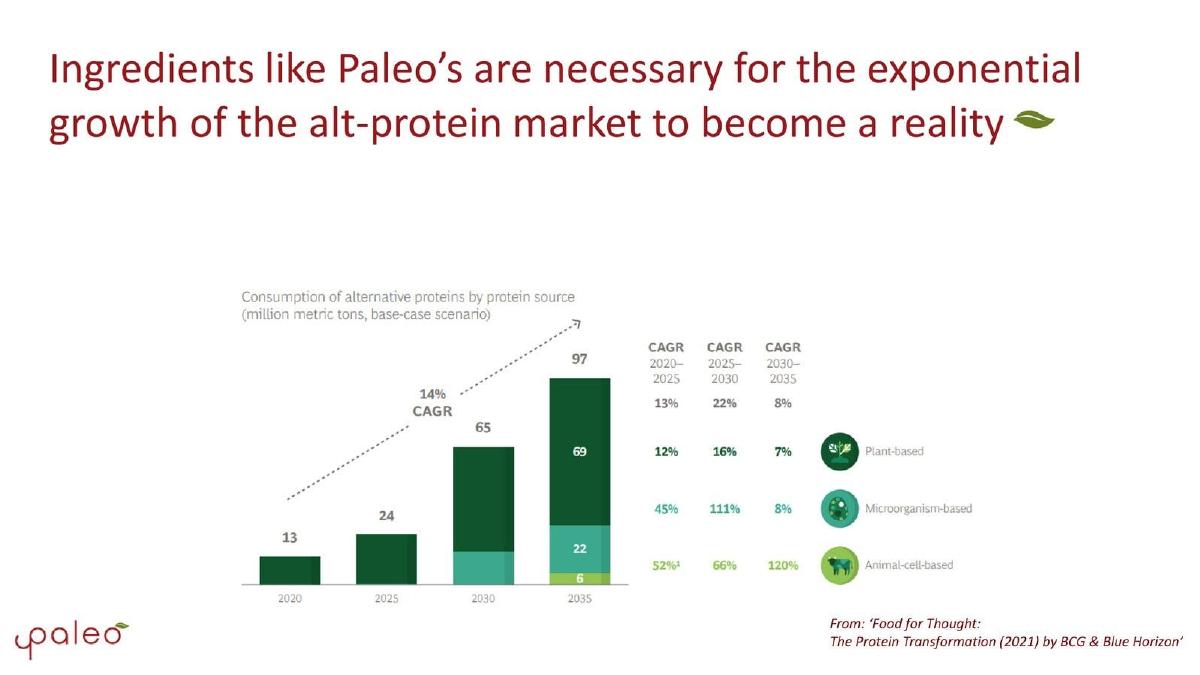
- Market demand is framed through a BCG & Blue Horizon study on Slide 6, projecting 97 million metric tons of alt-protein consumption by 2035.
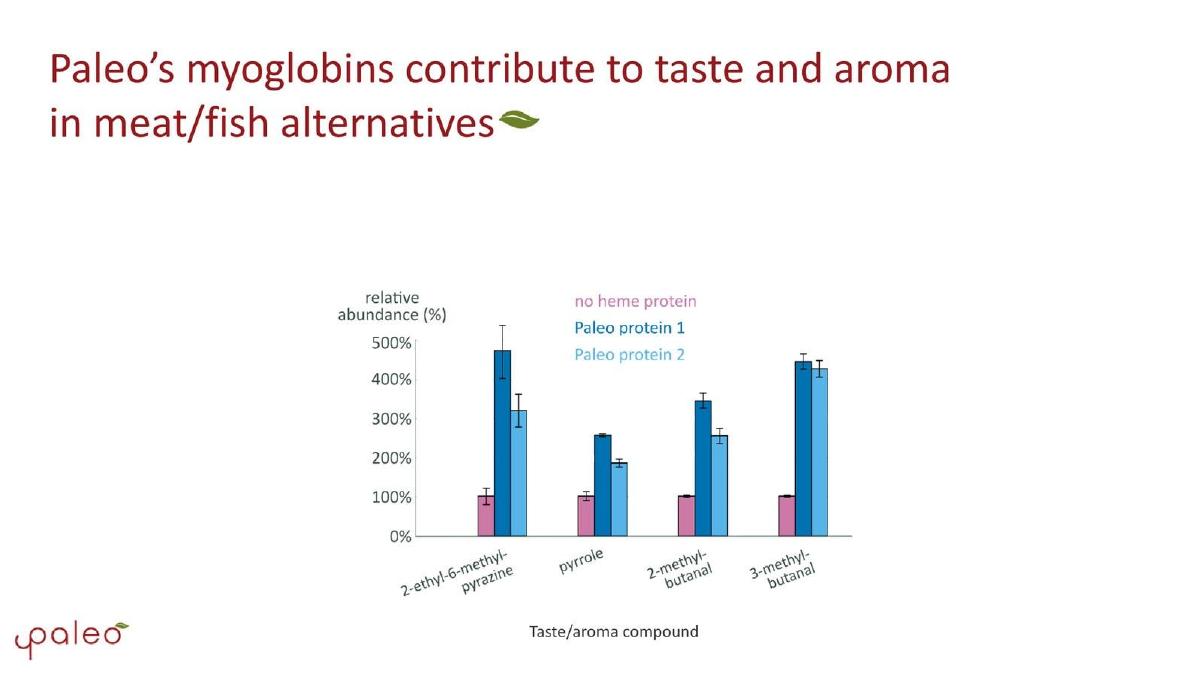
- Technical differentiation is proven on Slide 7, showing Paleo proteins have significantly higher relative abundance of key aroma compounds compared to no-heme alternatives.
- Nutritional parity is addressed on Slide 8, claiming iron bioavailability (80%+) comparable to a standard beef burger.
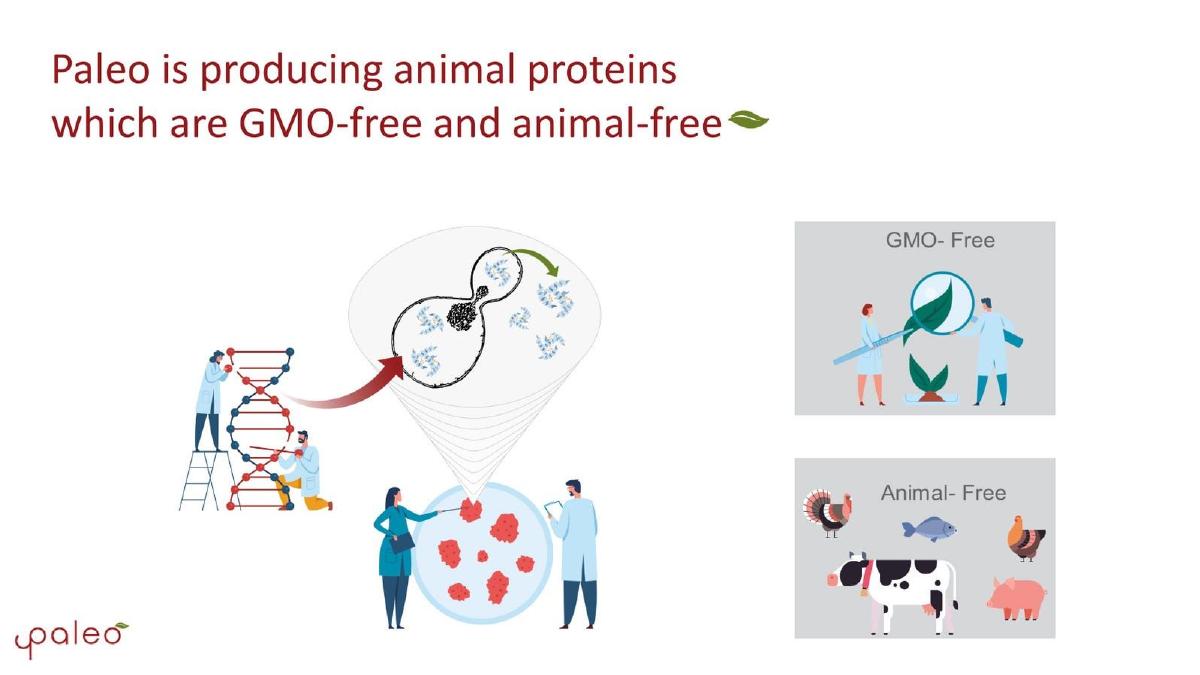
- The deck emphasizes a 'GMO-free and animal-free' process on Slide 5, a critical regulatory and consumer marketing distinction.
- Business Insider reports the company raised $12.8M in 2024 following this Series A presentation.
- The team slide (Slide 9) identifies co-founders Andy de Jong and Hermes Sanctorum but lacks specific professional biographies.
The Science of Taste: A Teardown of Paleo’s Series A Deck
Paleo, a European biotech firm, successfully secured $12.8M in Series A funding in 2024. Their pitch deck is a lean, 10-slide presentation that leans heavily into the technical requirements of the alternative protein market. Rather than selling a lifestyle brand, Paleo sells a molecular solution to a flavor problem. This teardown examines how they used scientific data to justify a significant capital injection in a tightening venture market.
Slide 1: Title Slide
The deck opens with a minimalist title slide featuring the Paleo logo—a stylized 'p' that incorporates a leaf motif. The background image shows industrial laboratory equipment, immediately signaling that this is a deep-tech or biotech play rather than a consumer packaged goods (CPG) company. There is no tagline or mission statement on this slide; it simply identifies the round as 'Series A.'
Slide 2: What We Do
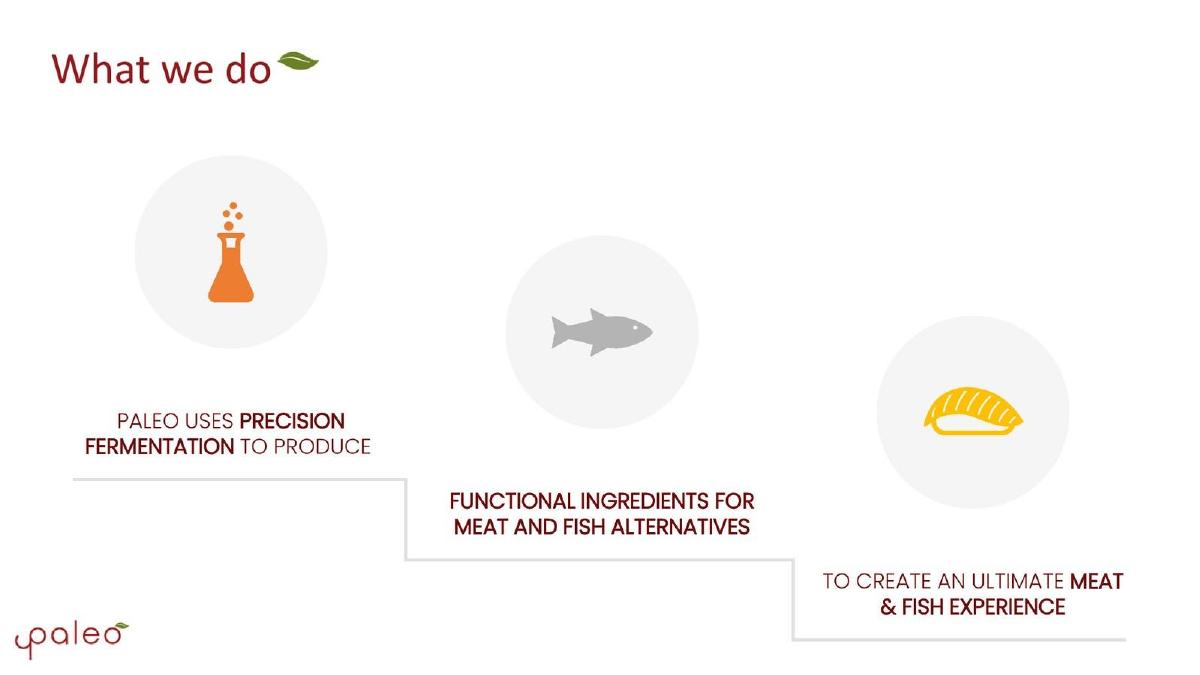
Slide 2 uses a simple three-step staircase graphic to explain the business model. It states that Paleo uses 'precision fermentation to produce functional ingredients for meat and fish alternatives to create an ultimate meat & fish experience.' This is a critical positioning slide. It tells the investor that Paleo is a B2B ingredient supplier, not a brand trying to fight for shelf space in grocery stores. By focusing on the 'experience,' they identify their value proposition as sensory improvement.
Slide 3: The Problem Statement
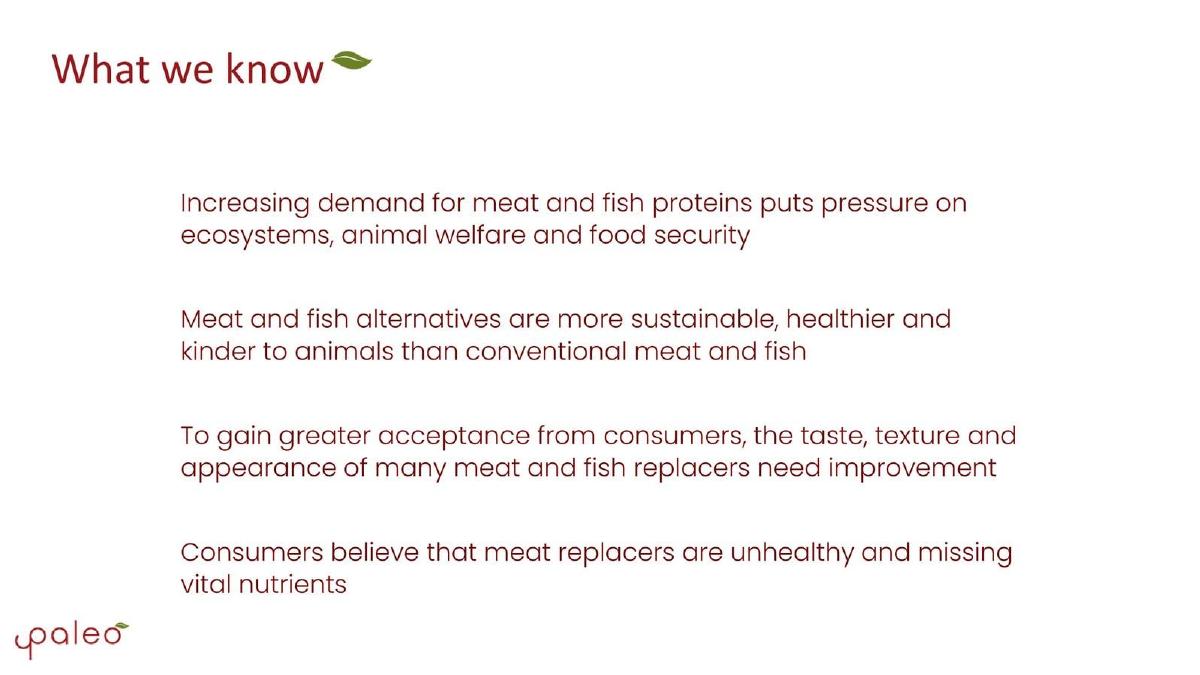
Titled 'What we know,' Slide 3 outlines the macro-trends driving the business. It lists four bullet points: the pressure on ecosystems from meat demand, the sustainability of alternatives, the need for taste/texture improvement to gain consumer acceptance, and the consumer perception that meat replacers are unhealthy. This slide sets up the 'why now' by acknowledging that while the market exists, it is currently failing to meet consumer expectations for taste and nutrition.
Slide 4: The Technology Process
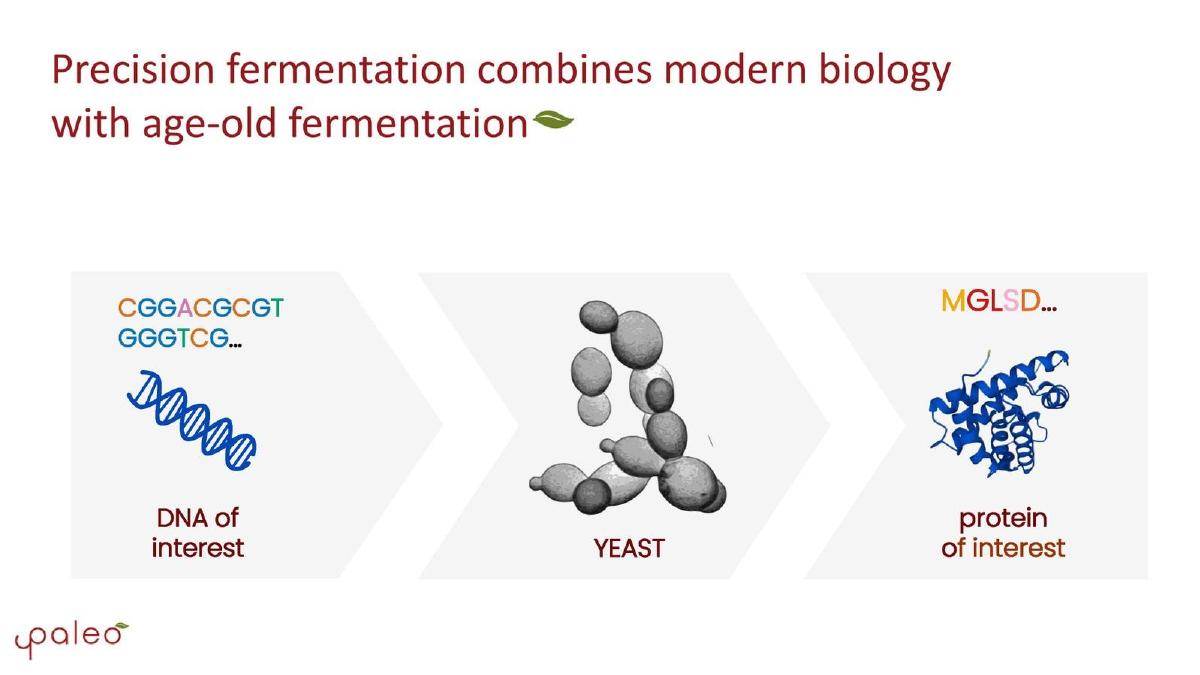
Slide 4 provides a high-level overview of precision fermentation. It visualizes the flow from 'DNA of interest' to 'Yeast' to 'protein of interest.' The slide uses the phrase 'combines modern biology with age-old fermentation,' which is a common framing used to make biotech sound less intimidating and more natural to investors and regulators.
Slide 5: Regulatory and Consumer Positioning
This slide addresses two of the biggest hurdles in the alt-protein space: GMO status and animal involvement. Paleo explicitly states their proteins are 'GMO-free and animal-free.' The slide includes icons of a cow, pig, chicken, fish, and turkey, suggesting their technology is platform-agnostic and can replicate proteins across various species. The 'GMO-free' claim is particularly relevant for the European market, where regulatory hurdles for genetically modified organisms are significantly higher than in the US.
Slide 6: Market Opportunity
Slide 6 uses data from a 2021 BCG & Blue Horizon report to project market growth. The chart shows alternative protein consumption growing from 13 million metric tons in 2020 to 97 million metric tons by 2035. The headline asserts that Paleo’s ingredients are 'necessary' for this growth to become a reality. By citing a reputable third-party source, Paleo avoids the 'founder optimism' trap and grounds their valuation in industry-standard projections.
Slide 7: Sensory Validation Data
This is the 'meat' of the deck. Slide 7 provides a bar chart showing the relative abundance of taste and aroma compounds. It compares 'no heme protein' against 'Paleo protein 1' and 'Paleo protein 2.' The data shows a massive increase (up to 500%) in compounds like 2-ethyl-6-methyl-pyrazine and pyrrole when Paleo’s proteins are added. For a technical investor, this is the proof that the product actually does what the 'What We Do' slide promised.
Slide 8: Nutritional Parity
Slide 8 focuses on iron bioavailability, a common criticism of plant-based diets. The chart compares bovine heme protein, Paleo proteins, and a standard beef burger in both raw and baked states. The data indicates that Paleo’s proteins offer 80%+ iron bioavailability, matching or slightly exceeding the performance of a traditional beef burger. This slide directly refutes the 'unhealthy' perception mentioned back on Slide 3.
Slide 9: The Team
The team slide features a group photo in a lab setting. It identifies co-founders Andy de Jong and Hermes Sanctorum. While the photo reinforces the scientific nature of the company, the slide is surprisingly light on detail. There are no logos of previous employers, no mention of PhDs or specific academic credentials, and no advisory board listed. In a Series A deck, investors usually expect more granular detail on why this specific team is uniquely qualified to solve this problem.
Slide 10: Contact and Closing
The final slide provides contact information and a website URL. It features a graphic of a '100% Paleo Meat' package, which serves as a visual reminder of the end-use case for their ingredients. Like the rest of the deck, it is clean and professional, though it lacks a final 'call to action' or a summary of the investment opportunity.
What Works in This Deck
Scientific Specificity: Paleo does not just say their food 'tastes better.' They use Slide 7 to name the specific chemical compounds responsible for that taste. This level of detail is highly persuasive for Series A investors who are conducting deep technical due diligence. It moves the conversation from subjective opinion to objective data.
Strategic Omission of the 'Total Addressable Market' (TAM) Slide: Many founders waste time calculating a multi-trillion dollar TAM that investors already know exists. Paleo instead uses Slide 6 to show the growth rate and the necessity of their specific sub-sector (microorganism-based proteins). This is a more sophisticated way to frame market opportunity.
Clear B2B Positioning: By explicitly stating they produce 'functional ingredients,' Paleo avoids being compared to consumer brands like Beyond Meat or Impossible Foods, which have faced significant market volatility. They are positioning themselves as the 'Intel Inside' of the alt-protein world.
What Is Missing from This Deck
The Ask and Use of Funds: The most glaring omission is the lack of a slide detailing how much money they are raising and what they plan to do with it. A standard Series A deck should outline milestones—such as 'achieving price parity,' 'scaling to 10,000L bioreactors,' or 'securing EFSA approval.' Without this, the deck feels more like a capability statement than a fundraising tool.
Competitive Landscape: The deck assumes a vacuum. There are several other companies (such as Motif FoodWorks or Impossible Foods) working on heme proteins. Paleo does not explain how their precision fermentation process or their specific yeast strains differ from these incumbents, other than the 'GMO-free' claim.
Business Traction: There is no mention of existing partnerships, LOIs (Letters of Intent) from food manufacturers, or pilot programs. For a $12.8M round, investors typically want to see that the technology has moved out of the lab and into the hands of potential customers.
What Founders Should Copy
The 'Data-First' Approach: If you are in biotech or deep-tech, your 'Problem' slide should be followed immediately by 'Proof' slides. Paleo’s use of Slides 7 and 8 to show sensory and nutritional data is a perfect example of how to build credibility quickly.
Visual Consistency: The deck uses a consistent color palette (maroon, green, and grey) and clean, professional iconography. This makes the complex scientific information easier to digest and gives the company a 'polished' feel that matches its Series A stage.
Focusing on the 'Enabler' Narrative: Instead of claiming they will take over the meat industry, Paleo positions itself as the missing piece that will allow the entire industry to grow. This 'tide that lifts all boats' narrative is often very attractive to venture capitalists who have broad portfolios in a specific sector.
Final Thoughts
Paleo’s deck is a high-signal, low-noise presentation. It succeeds because it identifies a specific technical bottleneck in a massive market and provides data-backed evidence that they have the solution. While it lacks the traditional 'business' slides one might expect, the strength of the scientific validation clearly resonated with investors, resulting in a successful $12.8M raise. For founders in highly technical fields, this deck serves as a reminder that at the Series A stage, your data is often your most important pitch.
Frequently asked questions
- What is the primary technology Paleo is pitching?
- Paleo pitches precision fermentation, a process that combines modern biology with age-old fermentation techniques. As shown on Slide 4, they insert a 'DNA of interest' into yeast to produce a specific 'protein of interest.' This allows them to create animal-identical heme proteins without using actual animals, which they claim improves the taste and aroma of plant-based foods.
- How does Paleo differentiate itself from other alt-protein companies?
- Paleo focuses on the 'functional ingredient' niche rather than creating a finished consumer product. Their differentiation lies in scientific specificity; Slide 7 shows their proteins increase specific aroma compounds like pyrazine and butanal by 300-500% compared to products without heme. They also emphasize being GMO-free (Slide 5), which is a major hurdle for competitors in the European market.
- What market data does the deck provide?
- The deck relies on third-party validation from BCG and Blue Horizon (Slide 6). It forecasts the alternative protein market will reach 97 million metric tons by 2035, with a 14% CAGR. The slide breaks down growth across plant-based, microorganism-based, and animal-cell-based proteins, positioning Paleo as a necessary enabler for this 'exponential growth' to occur.
- Is there a clear financial 'Ask' in the deck?
- No. The 10-slide deck provided does not include a slide detailing the amount of capital sought, the valuation, or the specific milestones the funding will achieve. While Business Insider reports a $12.8M raise, the deck itself functions more as a technical and strategic overview rather than a transactional document.
- Who are the founders of Paleo?
- According to Slide 9, the company was co-founded by Andy de Jong and Hermes Sanctorum. The slide features a photograph of the founders alongside the 'Paleo Scientific team' in a laboratory setting. However, the deck does not list their previous experience, education, or specific roles within the company, which is an unusual omission for a Series A deck.