Paladin’s pitch deck is a mission-driven presentation that leverages the growing corporate emphasis on Social Responsibility (CSR) to sell a pro bono management platform. The deck identifies a significant 'Justice Gap'—where 80% of those needing free legal help in America are underserved—and proposes a B2B solution for enterprises to source and track impact. With a strong team featuring backgrounds from Skadden Arps, the UN, and Hillary for America, the company demonstrates early traction, growing from 50 to 1,500 users in just three months during their beta phase. While the deck is light on…
Key takeaways
- The deck identifies a massive service gap, stating that 80% of Americans needing free legal help do not receive it (Slide 3).
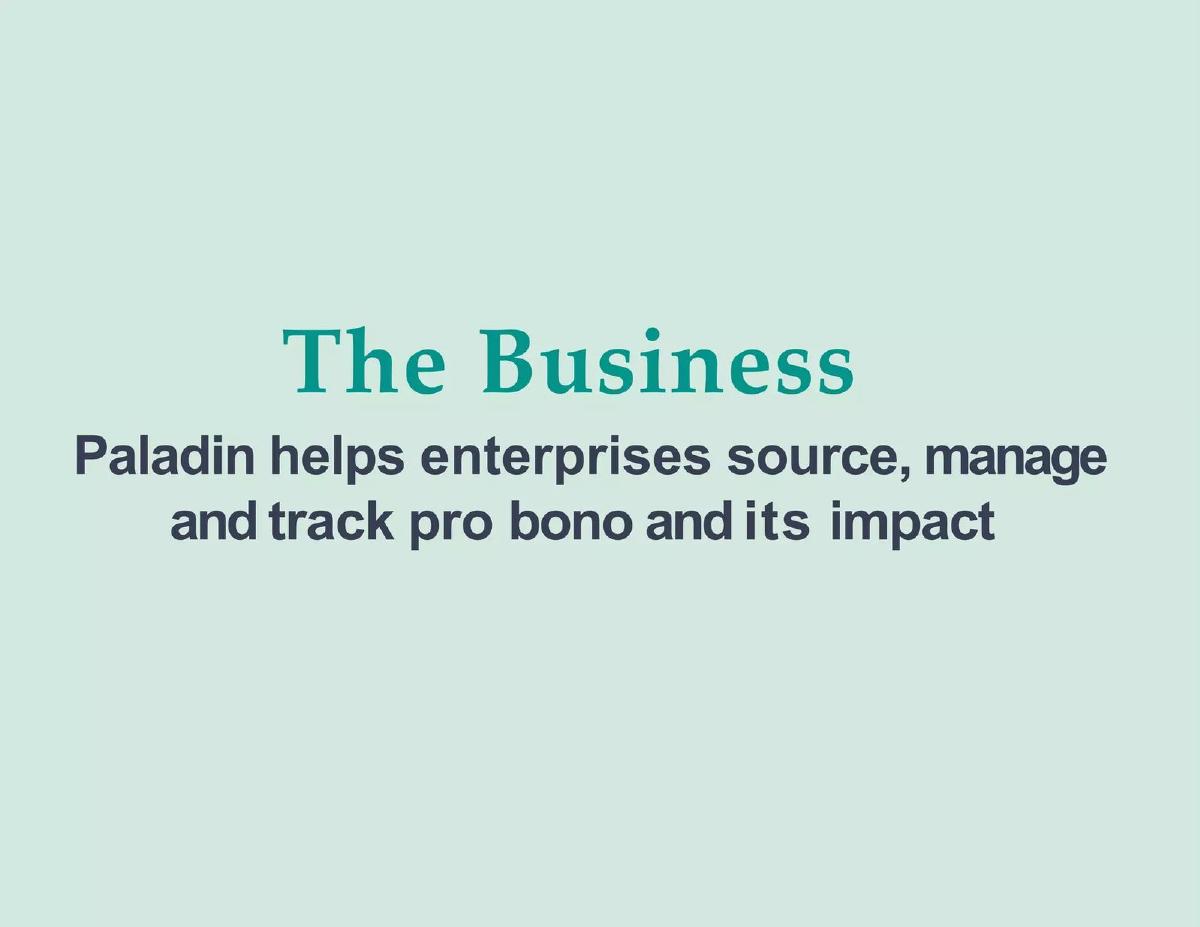
- Paladin defines its core business as helping enterprises source, manage, and track the impact of pro bono work (Slide 5).
- The market opportunity is framed by a $25 billion annual corporate spend on CSR initiatives (Slide 7).
- A historical chart shows a significant upward trend in the number of companies reporting CSR programs from 2000 to 2013 (Slide 7).
- The team slide highlights deep domain expertise, including a CEO with experience at Skadden Arps and the United Nations (Slide 9).
- Technical leadership includes a CTO who served as a Senior Engineer for Hillary Clinton and a Senior Developer for Charity: Water (Slide 9).
- Paladin demonstrates rapid early adoption, growing from 50 to 1,500 users between October 2016 and January 2017 (Slide 11).
- The deck concludes with qualitative beta success stories, including criminal record expungement for 30 clients (Slide 13).
Paladin Pitch Deck Analysis: Bridging the Justice Gap
Paladin’s pitch deck is a masterclass in mission-driven storytelling backed by professional pedigree. The company positions itself not just as a legal tech tool, but as an essential infrastructure for the $25 billion Corporate Social Responsibility (CSR) market. By focusing on the administrative friction of pro bono work, Paladin identifies a niche that serves both a social good and a corporate need. The deck is structured to move from a massive social problem to a scalable business solution, ending with proof of concept through rapid user growth.
Slide 1: Title Slide
The opening slide is minimalist, featuring the company name 'Paladin' and the tagline 'Powering pro bono.' The background image of people working in a collaborative setting reinforces the idea of professional services. It sets a serious, professional tone suitable for the legal and corporate enterprise sectors.
Slide 3: The Problem - The Justice Gap
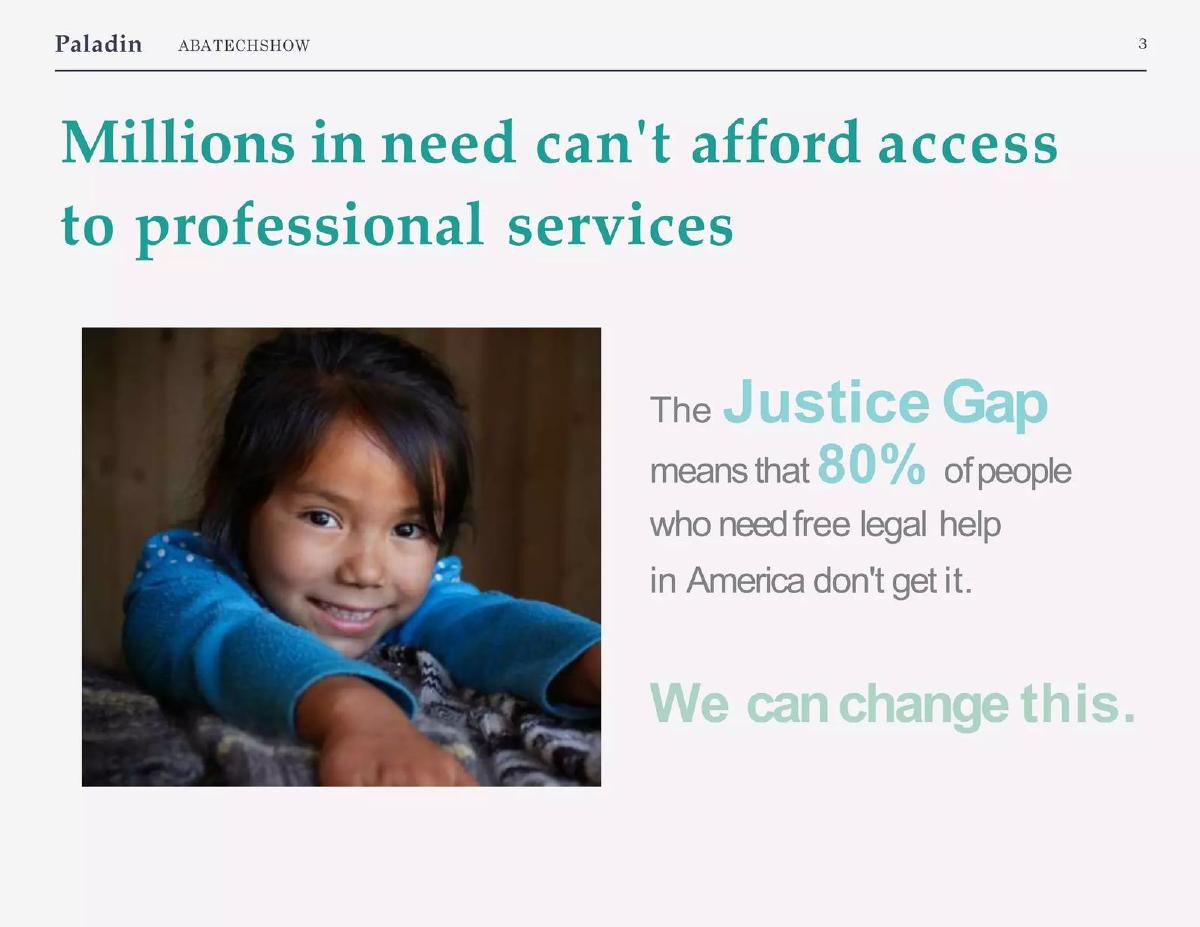
Paladin immediately establishes the stakes. They define the 'Justice Gap' with a striking statistic: 80% of people who need free legal help in America don't get it. By using a photo of a child and the phrase 'Millions in need,' they appeal to the investor's sense of social responsibility before transitioning to the business opportunity. This slide identifies the 'why' behind the company's existence.
Slide 5: The Business Model
This slide provides a concise definition of the product. Paladin is described as a platform that helps 'enterprises source, manage and track pro bono and its impact.' This is a critical pivot from the social problem to the B2B solution. It clarifies that the customer is the enterprise, and the value proposition is the simplification of a complex, often manual, administrative process.
Slide 7: Market Opportunity and CSR Trends
To prove that pro bono management is a viable business, Paladin looks at the broader CSR landscape. They cite that companies spend over $25 billion on CSR. The slide includes a line graph showing a steady increase in companies reporting CSR programs from the year 2000 to 2013. Furthermore, they add a demographic driver: 71% of millennials require strong CSR from their employers. This suggests that Paladin is not just a 'nice to have' but a tool for talent acquisition and retention in a competitive labor market.
Slide 9: Team Expertise
The team slide is one of the strongest in the deck, showcasing significant institutional credibility. CEO Felicity Conrad brings legal experience from Skadden Arps and the UN. CTO Matt Tucker provides technical weight with his background at Charity: Water and as a Senior Engineer for the Hillary Clinton campaign. The inclusion of a 'Head of Nonprofits' and a 'Head of Legal Partnerships' shows a balanced approach to the two sides of their marketplace. The presence of Carter Cleveland (Founder/CEO of Artsy) as Founding Chairman adds further entrepreneurial validation.
Slide 11: Traction and User Growth
Paladin demonstrates early product-market fit with a traction chart. The slide title, 'From 50 to 1500 users in 3 months,' is a clear, impressive headline. The graph shows the growth from October 18, 2016, to January 17, 2017. While the deck does not specify if these are paying users or individual lawyers within an enterprise, the velocity of the growth curve is a strong indicator of demand for the platform during its beta phase.
Slide 13: Impact and Success Stories
The final slide in this set focuses on qualitative results. Instead of hard numbers, it offers testimonials from the beta period. These include helping domestic violence victims, expunging criminal records for 30 clients to facilitate employment, and shaping transgender policy. This slide serves to humanize the data presented earlier and reminds investors of the tangible real-world impact the platform facilitates.
What Works in the Paladin Deck
Strong Founder-Market Fit: The team slide (Slide 9) is exceptionally well-constructed. By highlighting logos like Skadden, the UN, and Princeton, the founders signal that they understand the high-stakes, conservative world of enterprise legal departments while possessing the technical chops to build a modern SaaS product.
Clear Market Tailwind: Slide 7 does an excellent job of connecting Paladin to a larger economic trend. By framing pro bono work as a subset of the $25B CSR market, they expand their perceived Total Addressable Market (TAM) beyond just 'legal aid software.'
Urgency through Traction: The 30x growth in users over three months (Slide 11) creates a sense of momentum. It suggests that the 'Justice Gap' they identified is a problem that people are actively looking to solve with technology.
What is Missing from the Paladin Deck
Revenue Model: While Slide 5 mentions helping 'enterprises,' the deck (in the provided slides) does not explain how Paladin makes money. Is it a per-seat SaaS model, a flat enterprise fee, or a percentage of CSR spend? Investors need to see the mechanics of monetization.
Competitive Landscape: There is no mention of how legal departments currently manage pro bono (e.g., spreadsheets, legacy software) or who the direct competitors are. A 'competitor matrix' would help define Paladin’s unique advantages.
The 'Ask': The provided slides do not include a funding goal or a breakdown of how the capital will be used. Without a clear 'Ask,' the deck functions more as a company overview than a fundraising tool.
Unit Economics: While user growth is shown, there is no data on Customer Acquisition Cost (CAC) or Lifetime Value (LTV). For a B2B enterprise play, understanding the cost to close a large law firm or corporation is vital.
Lessons for Founders
Lead with the 'Why': Paladin starts with a compelling social problem (Slide 3) that is easy to understand and hard to ignore. This creates an emotional hook before diving into the business mechanics. · Use Logos for Credibility: If your team has worked at prestigious institutions, use their logos. Slide 9 uses visual shorthand to tell a story of competence and network reach that text alone cannot convey. · Quantify the Trend: Don't just say your market is growing; show the historical data. Slide 7 uses a 13-year trend line to prove that CSR is a permanent shift in corporate behavior, not a fad. · Show, Don't Just Tell, Impact: The success stories on Slide 13 provide 'social proof.' For platforms that facilitate services, showing the end-result of those services (e.g., expunged records) validates that the platform actually works.
Frequently asked questions
- What is the primary problem Paladin aims to solve?
- Paladin addresses the 'Justice Gap,' which they define on Slide 3 as the fact that 80% of people in America who need free legal help are unable to access it. They position this as a systemic failure in the delivery of professional services that their platform aims to fix by streamlining the pro bono process for large organizations.
- Who is the target customer for Paladin's platform?
- Based on Slide 5, the target customers are 'enterprises.' The deck suggests that these large organizations have a need to source, manage, and track the impact of their pro bono programs, likely to satisfy internal CSR goals and the demands of a workforce that increasingly values social impact.
- How does Paladin justify the market size for a pro bono tool?
- Paladin points to the broader Corporate Social Responsibility (CSR) market rather than just legal tech. Slide 7 notes that companies spend over $25 billion on CSR annually and that 71% of millennials require strong CSR from their employers, suggesting that tools to manage these programs are becoming essential for talent retention and brand management.
- What does the team's background suggest about their ability to execute?
- The team possesses a high degree of 'founder-market fit.' CEO Felicity Conrad is a former Skadden Arps lawyer, and CTO Matt Tucker has experience in high-stakes environments like the Hillary Clinton campaign and Charity: Water. This combination of legal industry knowledge and scaled technical experience is a strong signal for investors (Slide 9).
- What metrics does Paladin use to show traction?
- Paladin uses user growth as its primary traction metric. Slide 11 shows a growth curve starting at 50 users in mid-October 2016 and reaching approximately 1,500 users by mid-January 2017. This represents a 30x increase in user base over a three-month beta period.