Pajebal is a North Carolina-registered nonprofit aiming to revolutionize online microfinance by transitioning 'traditional donors' into 'social investors.' The deck critiques existing platforms like Kiva for their lack of transparency and financial accountability. Instead, Pajebal proposes a three-pronged solution: a video-based pitch system, a game-like equities market for small businesses, and a direct one-to-one B2B relationship model where U.S. companies provide both capital and consultative mentorship to entrepreneurs in the developing world. While the deck is conceptually strong regardi…
Key takeaways
- The company identifies a lack of financial accountability and communicative dynamism in current microfinance platforms (Slide 3).
- Idea #1 proposes a video-based pitch system to allow lenders to screen entrepreneurs directly (Slide 4).
- Idea #2 suggests a simulated 'stock market' where participants trade non-legal shares of small businesses using a points system (Slide 5).
- The core 'Deep Dive' (Idea #3) focuses on a one-lender-to-one-borrower B2B relationship between U.S. corporations and developing world entrepreneurs (Slide 6).
- Pajebal intends to facilitate communication through Skype-based video meetings and bilingual employees (Slide 8).
- The organization is a registered North Carolina nonprofit with an existing office in Quetzaltenango, Guatemala (Slide 9).
- The deck omits a traditional management team slide, financial projections, and a specific capital raise amount (Slides 1-10).
- The platform aims to move beyond 'micro' financing to support small-to-medium businesses to encourage specialization of labor (Slide 7).
Executive Summary: The Shift from Charity to Investment
The Pajebal pitch deck, authored by Rob Krieger and Jessie Margolis, presents a conceptual framework for evolving the microfinance industry. Rather than focusing on the volume of small loans, Pajebal advocates for a high-touch, B2B model that emphasizes transparency, financial literacy, and long-term mentorship. The deck is structured as a response to the perceived shortcomings of market leaders like Kiva and MicroPlace, proposing a more rigorous 'social investor' mindset over the 'traditional donor' approach.
Slide 1: Title and Vision
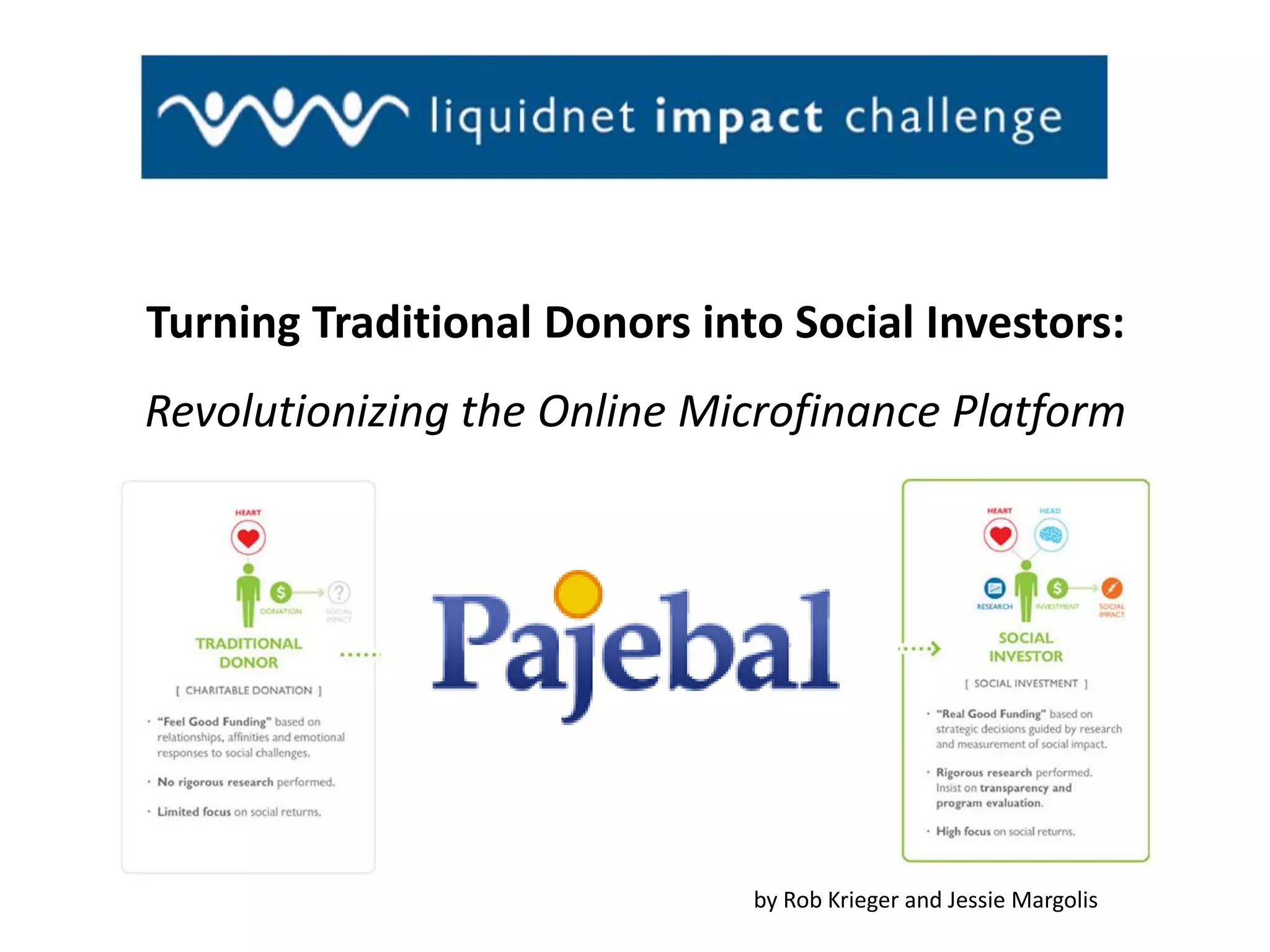
The cover slide introduces the core thesis: 'Turning Traditional Donors into Social Investors.' It sets the stage for a 'revolution' in online microfinance. The visual comparison between a 'Traditional Donor' (driven by heart/emotion, no research, limited focus on returns) and a 'Social Investor' (driven by heart and head, rigorous research, high focus on social returns) serves as the foundation for the entire presentation.
Slide 2: The Current Landscape
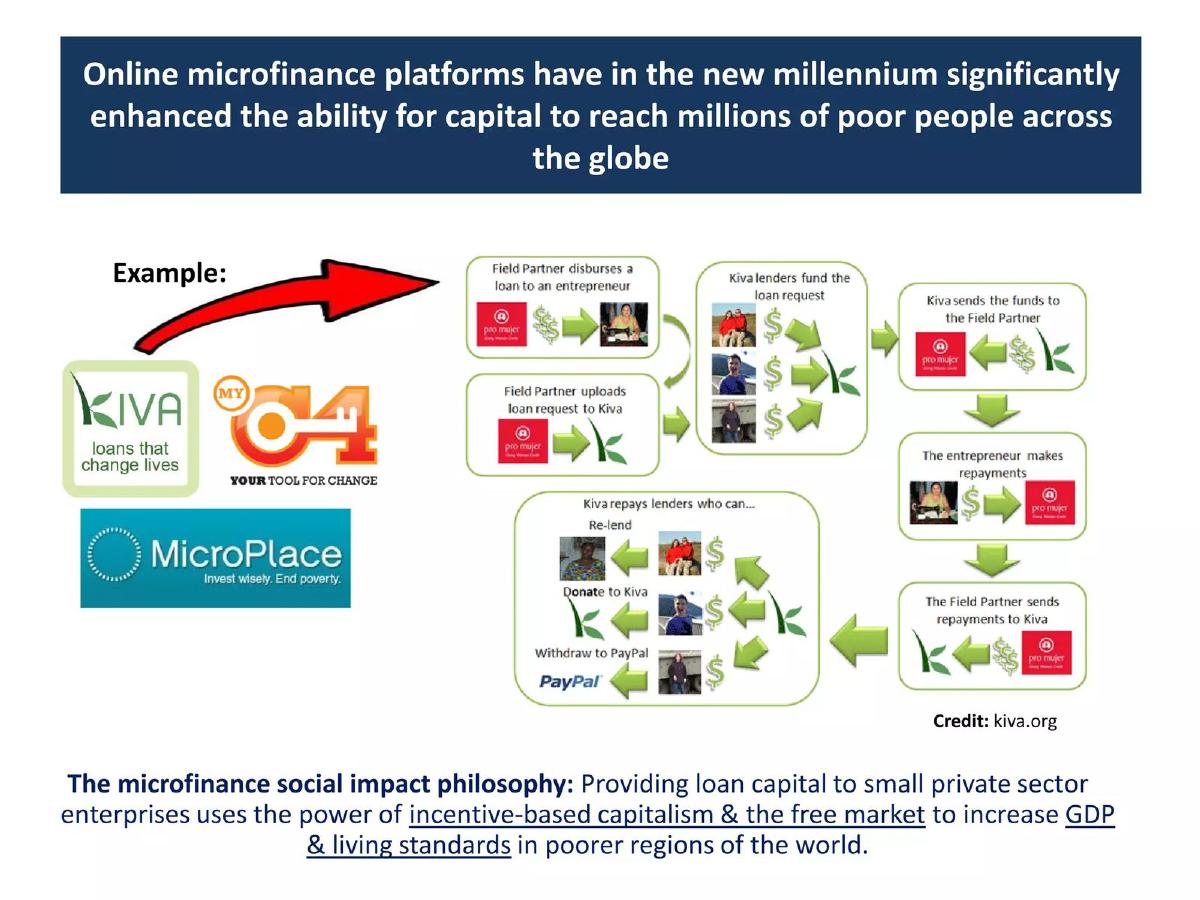
Slide 2 acknowledges the success of existing platforms in reaching millions of poor people. It uses a Kiva-style flowchart to illustrate how capital currently moves from lenders to field partners and eventually to entrepreneurs. This slide establishes that the founders understand the existing mechanics of the industry before they begin their critique.
Slide 3: Identifying the Gaps
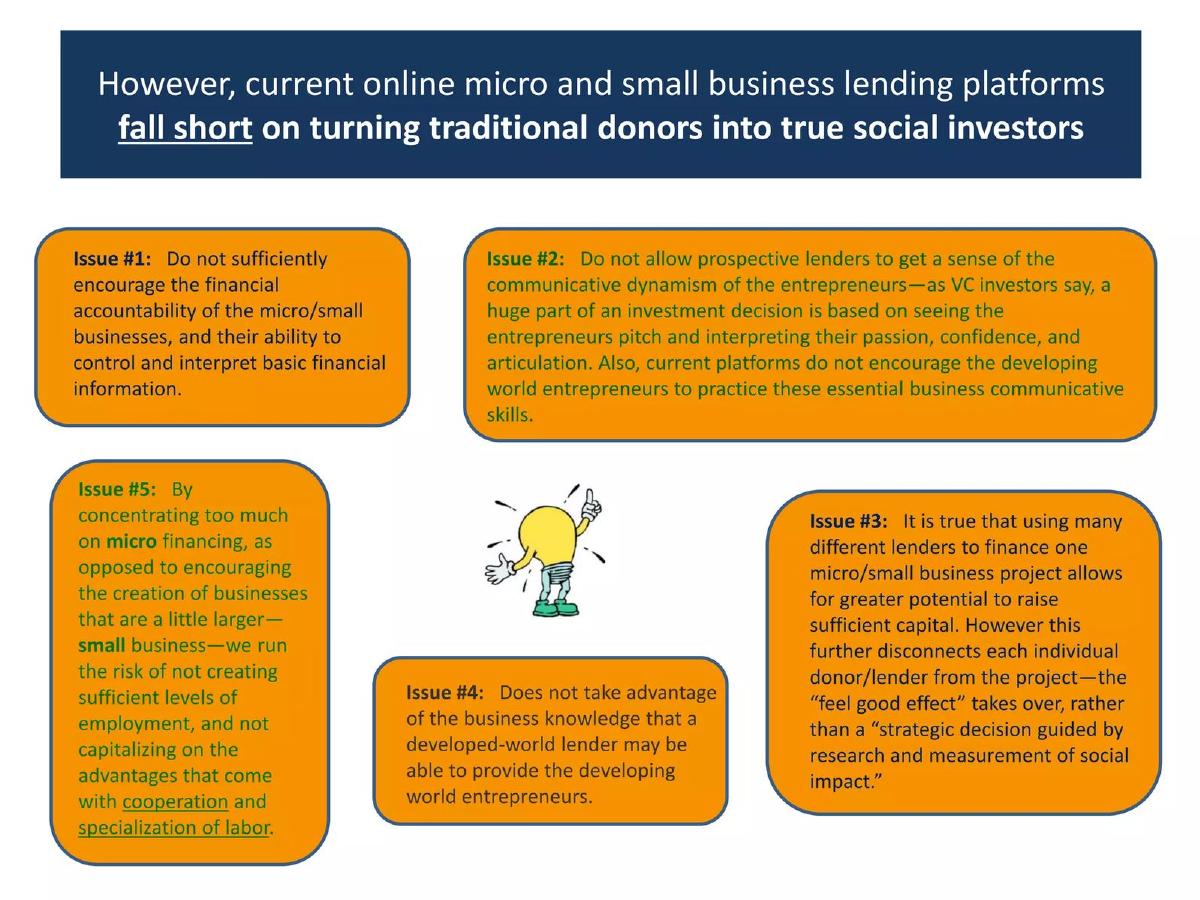
This slide outlines five specific 'Issues' with current lending platforms. The most notable critiques include the lack of financial accountability for small businesses (Issue #1), the inability for lenders to see the 'passion' or 'communicative dynamism' of entrepreneurs (Issue #2), and the disconnect caused by having many scattered lenders for a single project (Issue #3). Issue #5 is particularly strategic, suggesting that the industry focuses too much on 'micro' finance at the expense of slightly larger small businesses that could create more significant employment.
Slide 4: Idea #1 - The Video Pitch
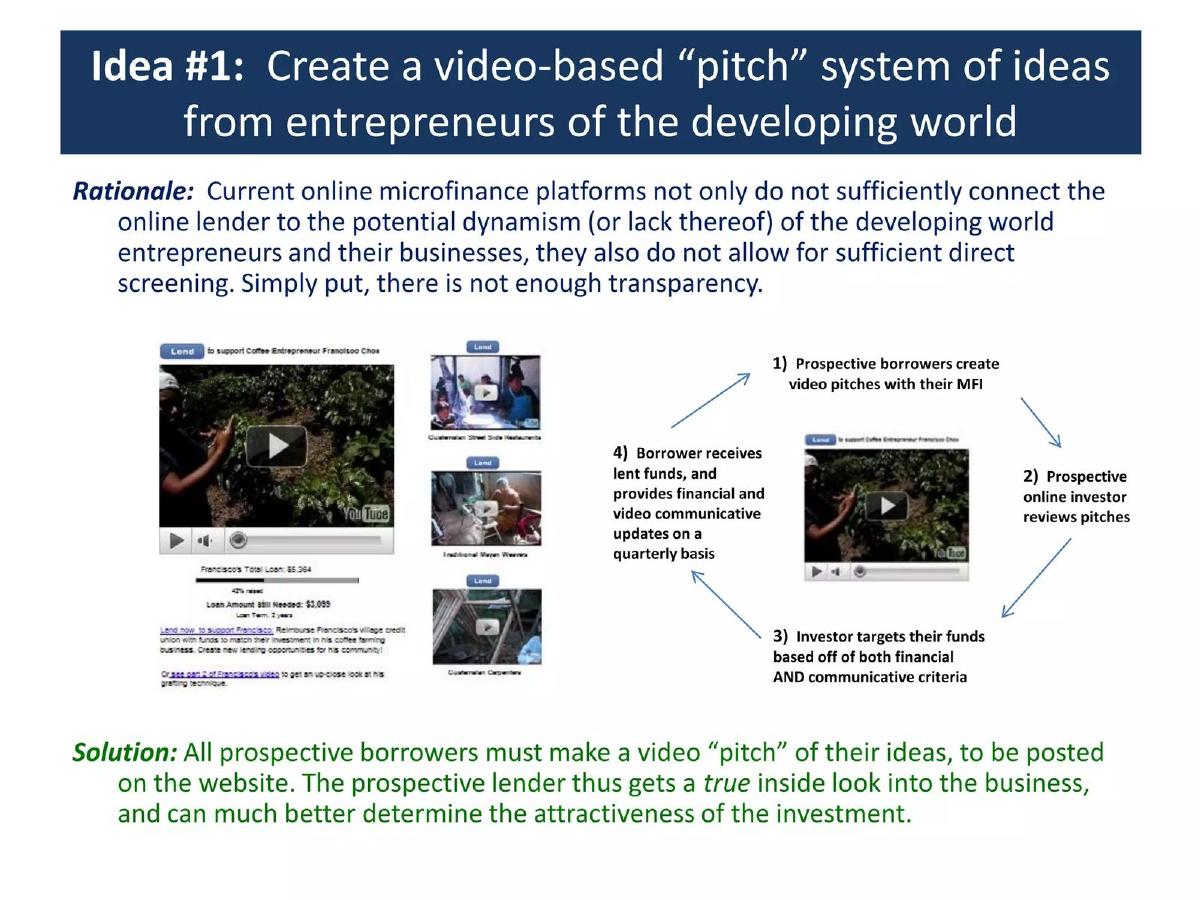
To solve the transparency issue, Pajebal proposes a video-based 'pitch' system. The rationale is that online lenders currently lack a 'true inside look' into the businesses they fund. The proposed four-step cycle involves borrowers creating video pitches with their Microfinance Institution (MFI), investors reviewing these pitches, and borrowers providing quarterly video updates. This is a direct attempt to bring venture capital-style due diligence to the microfinance space.
Slide 5: Idea #2 - The Simulated Equities Market
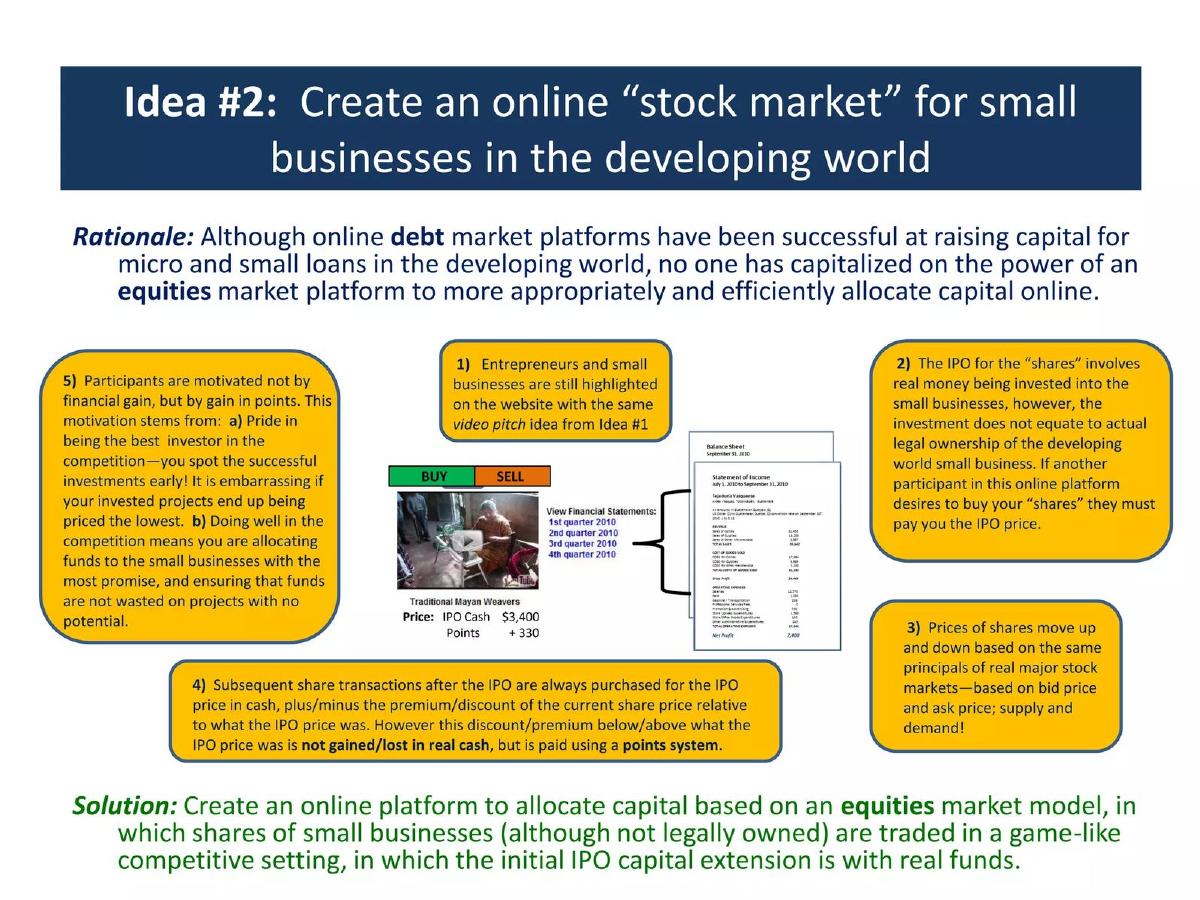
Slide 5 introduces a more experimental concept: an online 'stock market' for small businesses. The deck clarifies that these 'shares' do not equate to legal ownership. Instead, it is a game-like competitive setting where participants trade shares for 'points' after an initial real-money IPO. The goal is to use the mechanics of a stock market (bid/ask prices, supply and demand) to efficiently allocate capital to the most promising entrepreneurs based on pride and competition rather than just charity.
Slide 6: Idea #3 - The B2B Deep Dive
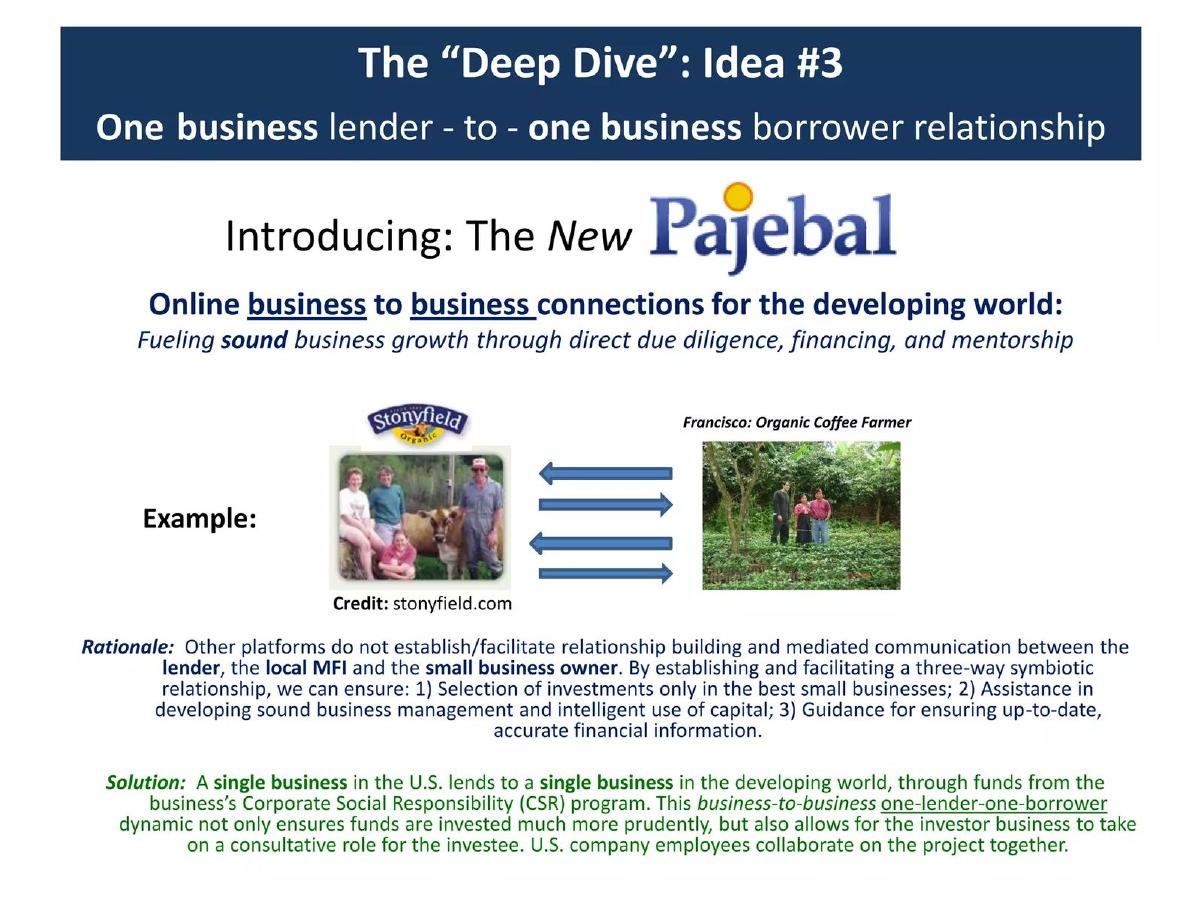
This is the core of the 'New Pajebal' model. It proposes a one-lender-to-one-borrower relationship. Using Stonyfield Farm and a Guatemalan organic coffee farmer as an example, the slide explains how a U.S. business can use its CSR program to provide direct financing and mentorship. The rationale is that a single, larger loan (a few thousand dollars) is more impactful than many tiny loans and encourages the lender to take a consultative role.
Slide 7: Maximizing the Value Proposition
Slide 7 maps the solutions back to the five issues identified on Slide 3. It emphasizes that by moving beyond the 'micro' phase to small-to-medium businesses, the platform can encourage the specialization of labor and regional economic development. It also highlights the use of Skype and online portals to facilitate the consultative role of the U.S. business lender.
Slide 8: Process Comparison
This slide provides a side-by-side comparison of how 'John Doe' uses traditional platforms versus how a corporation like 'Stonyfield Farm' would use Pajebal. The key differentiator is the depth of engagement: Stonyfield analyzes the project using video and financial data, transfers a larger sum that results in a lower interest rate for the borrower, and maintains a direct connection through a bilingual Pajebal employee or volunteer.
Slide 9: Implementation and Status
The implementation slide details a 6-step process for building the lender-borrower relationship, ranging from profile exchange to quarterly feedback and goal evaluation. Crucially, this slide reveals the company's legal status: a registered North Carolina nonprofit with an office in Guatemala. It also defines the geographic roadmap, starting in western Guatemala with plans to scale across Latin America.
Slide 10: The Origin of the Name
The final slide explains the name 'Pajebal,' which means 'at the end of the line' in Kiche Maya. It serves as a mission statement, asserting that the people at the end of the line have been there too long and deserve business growth solutions rooted in sound management and intelligent capital use.
What Works in This Deck
Clear Problem/Solution Mapping: The deck does an excellent job of identifying specific pain points in the microfinance industry (Slide 3) and systematically addressing them with proposed features (Slide 7). This logical flow makes the 'why' behind the product very clear.
Psychological Differentiation: The distinction between a 'donor' and an 'investor' (Slide 1) is a powerful framing device. It appeals to a more sophisticated class of philanthropic partners who want to see their expertise, not just their money, put to work.
Operational Specificity: Unlike many conceptual decks, Pajebal explains exactly how the communication will happen—mentioning Skype, bilingual employees, and specific feedback loops (Slide 9). This makes the proposal feel grounded in reality.
What Is Missing from This Deck
A Management Team Slide: The deck mentions Rob Krieger and Jessie Margolis on the title slide, but there are no bios, photos, or descriptions of their expertise. In a nonprofit or social impact venture, the credibility of the founders is paramount.
Financial Projections and Sustainability: While the deck explains how capital reaches the borrower, it does not explain how Pajebal itself survives. There is no mention of transaction fees, membership dues for corporations, or a long-term fundraising plan beyond 'funds won in this competition.'
Traction Metrics: Slide 9 mentions an office in Guatemala and that the village of Pajebal 'inspired our work,' but it does not state how many loans have been facilitated to date or what the repayment rates are for their specific pilot projects.
A Specific 'Ask': The deck concludes without a clear request for a specific dollar amount. While it mentions the 'Liquidnet Impact Challenge,' a standard pitch deck should clearly state: 'We are seeking $X to achieve Y milestones.'
Founder Takeaways
Use Comparison to Establish Context: Pajebal uses Kiva as a benchmark (Slide 2). For founders entering a crowded space, showing a flowchart of the 'status quo' before showing your 'new way' is an effective way to educate the investor on the market gap.
Focus on the 'Head' and the 'Heart': Social impact decks often lean too heavily on emotion. Pajebal’s insistence on 'rigorous research' and 'financial accountability' (Slide 8) makes the project feel more like a business and less like a handout, which is attractive to modern philanthropists.
Define Your Niche: By explicitly stating they want to move 'beyond the micro phase' (Slide 7), Pajebal carves out a specific segment of the market (Small-to-Medium Enterprises) that distinguishes them from the thousands of other micro-loan providers.
Frequently asked questions
- What is the primary problem Pajebal aims to solve?
- Pajebal argues that current microfinance platforms rely on 'feel good' emotional responses rather than strategic social investment. They claim existing systems fail to encourage financial accountability in borrowers and do not allow lenders to assess the 'communicative dynamism' or passion of the entrepreneurs they are funding.
- How does the proposed 'stock market' for small businesses work?
- According to slide 5, the platform would create an online equities model where 'shares' are traded in a game-like setting. While the initial IPO involves real funds, subsequent trades are made using a points system. These shares do not represent legal ownership but are intended to motivate investors through competition and pride in spotting successful projects.
- What is the role of U.S. corporations in the Pajebal model?
- Pajebal proposes that U.S. businesses use their Corporate Social Responsibility (CSR) funds to lend to a single business in the developing world. Beyond capital, the U.S. company takes on a consultative role, with employees providing mentorship and due diligence via Skype and online portals to ensure sound business growth.
- Is Pajebal a for-profit startup or a nonprofit?
- Slide 9 explicitly states that Pajebal, Inc. is a registered North Carolina nonprofit corporation. The deck was created for the 'Liquidnet Impact Challenge,' and it mentions that any funds won in the competition would be donated to the organization to help scale its operations from Guatemala to the rest of Latin America.
- What geographic regions does Pajebal target?
- The deck focuses heavily on Guatemala, specifically mentioning an office in Quetzaltenango and a village named Pajebal. The implementation plan suggests starting in western Guatemala before scaling out to other areas of Latin America, as noted on slide 9.