Pacifica Labs (now Sanvello) raised $53,800 in 2015 using a minimalist 9-slide deck that prioritized user growth and market need over traditional business metrics. The deck reports reaching 375,000 users within nine months of launch, supported by $8,000 in Monthly Recurring Revenue (MRR). By framing the problem as a massive gap in professional mental health care—where only 1 in 3 of the 40 million U.S. adults with anxiety receive help—Pacifica positioned itself as a 'self-service' solution. While the deck lacks a formal 'Ask' slide, detailed unit economics, or a competitive landscape analysis…
Key takeaways
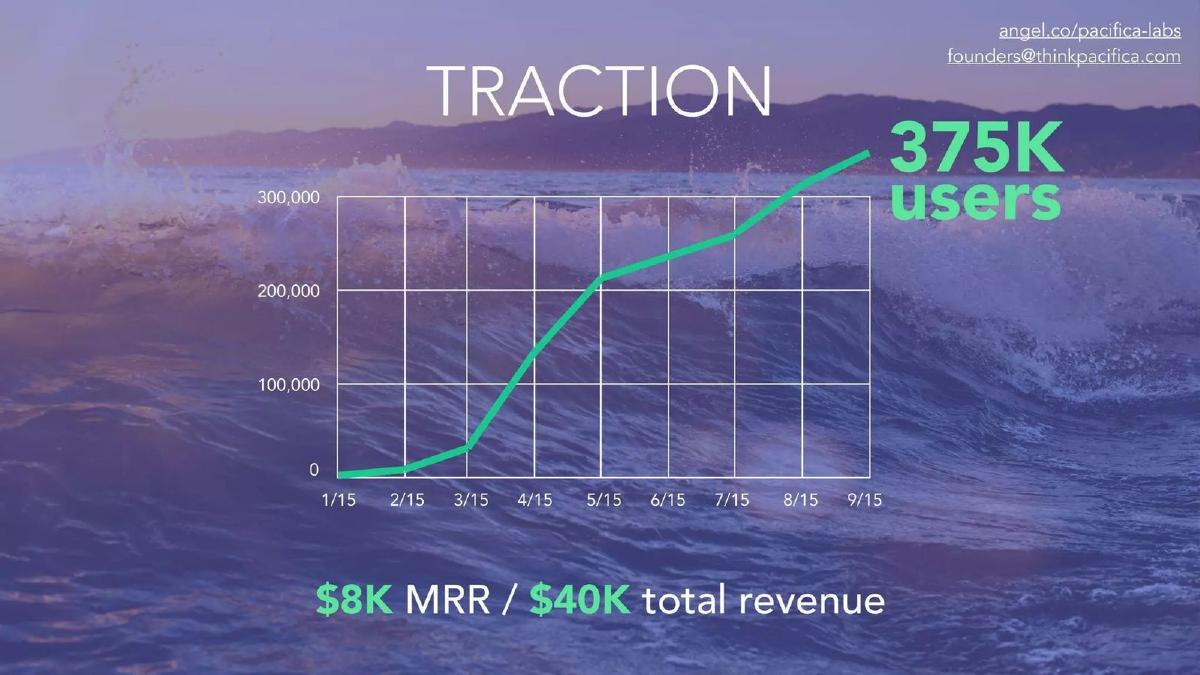
- The company achieved a user base of 375,000 within nine months, growing from near zero in January 2015 to the peak in September 2015 (Slide 2).
- Revenue at the time of the deck was $8,000 MRR with $40,000 in total revenue generated to date (Slide 2).
- The market opportunity is defined by 40 million adults in the U.S. suffering from anxiety disorders (Slide 3).
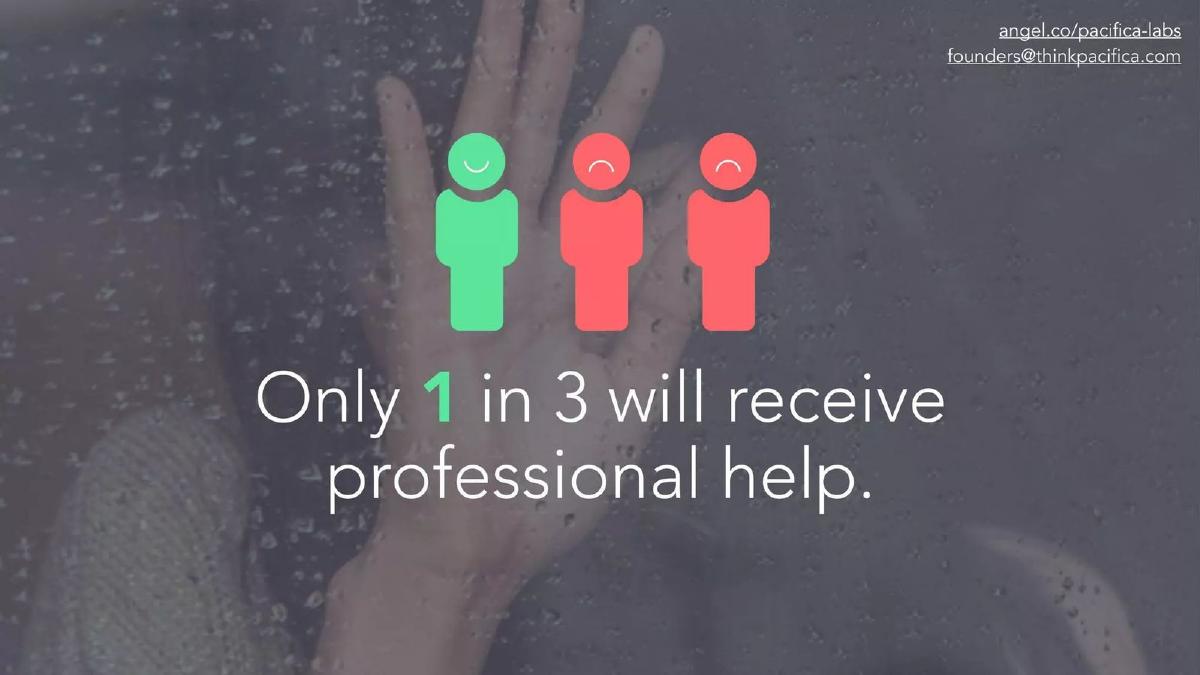
- A significant care gap is highlighted: only 1 in 3 individuals with anxiety receive professional help (Slide 4).
- The product is positioned for the 'Self-Service Generation,' implying a shift in how mental health care is consumed (Slide 5).
- The core team consists of two co-founders with previous experience at StudyBlue (Slide 8).
- Clinical credibility is established through two advisors with Ph.D. and Psy.D. credentials from VA Palo Alto and CBT specialties (Slide 8).
- The deck concludes with validation through upcoming clinical trials at the University of Minnesota and UCSF (Slide 9).
The 9-Slide Minimalist Approach to Digital Health
Pacifica Labs, which later rebranded to Sanvello and was acquired by UnitedHealth Group’s Optum, provides a look back at how early-stage digital health companies pitched in 2015. The deck is remarkably brief, containing only nine slides. It relies on a high-contrast, image-heavy aesthetic that mirrors the 'calm' branding of the app itself. Rather than overwhelming investors with data, the founders chose to highlight a single, powerful growth curve and the massive underserved market for anxiety treatment.
The Hook and Immediate Traction
Slide 1: Title Slide The deck opens with the Pacifica logo and the tagline 'Live Happier Today.' The contact information points to an AngelList profile and a company email address. The background image of a person holding a sparkler sets a lifestyle-oriented, emotional tone rather than a clinical one.
Slide 2: Traction Unusually, Pacifica leads with traction immediately after the title slide. This is a strategic move often used when the growth numbers are the most compelling part of the story. The slide shows a line graph tracking user growth from January 2015 to September 2015. The company reached 375,000 users in this nine-month window. Below the graph, they disclose '$8K MRR / $40K total revenue.' This transparency shows that while the user base is large, monetization was still in its infancy at the time of the pitch.
Defining the Care Gap
Slide 3: The Market Size The deck shifts to the problem statement. Slide 3 is a simple text overlay on a rainy window: '40M adults in the U.S. have an anxiety disorder.' By using a large, bold font for '40M,' the founders establish the scale of the TAM (Total Addressable Market) without needing complex spreadsheets.
Slide 4: The Opportunity This slide identifies the specific inefficiency in the current healthcare market. It states, 'Only 1 in 3 will receive professional help.' The visual uses three icons, with two in red and one in green, to emphasize the 'missing' care. This frames Pacifica not just as a 'wellness app,' but as a necessary bridge for the 66% of sufferers who are currently unserved by the traditional medical system.
Product Identity and Social Features
Slide 5: The Self-Service Generation This slide serves as a transition into the solution. It uses the phrase 'The Self-Service Generation' to suggest a cultural shift. It implies that modern consumers prefer autonomous, digital tools over traditional, high-friction clinical appointments. This aligns the company with broader consumer trends seen in other industries like fintech or food delivery.
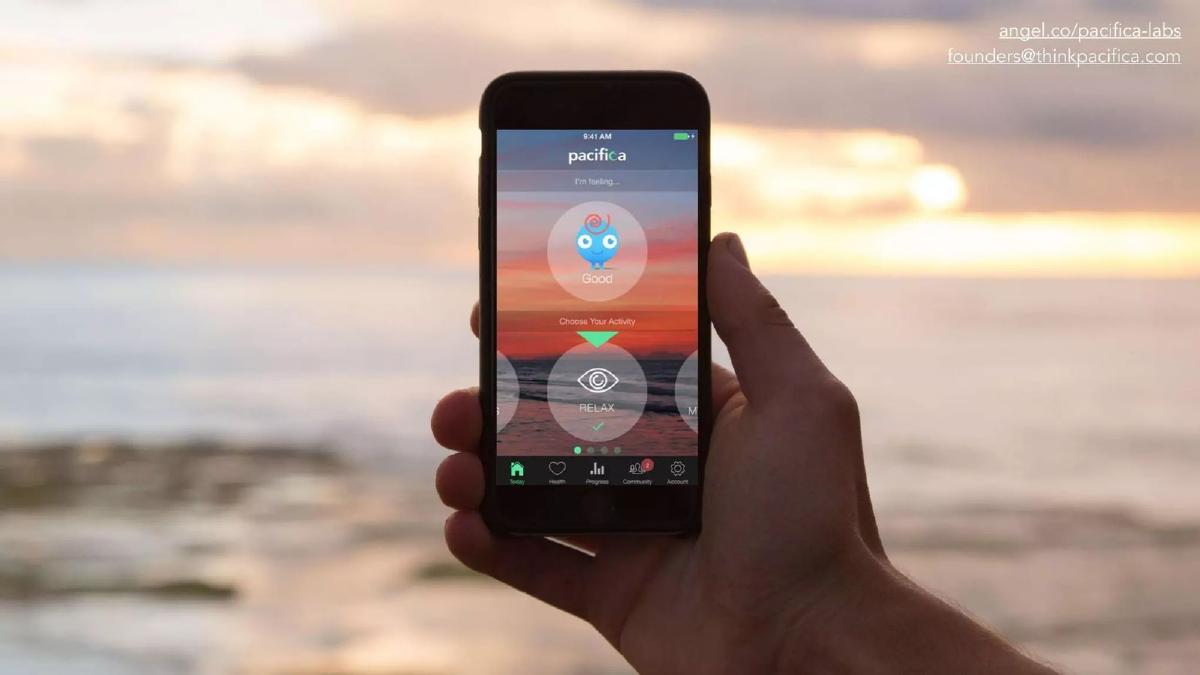
Slide 6: Product Interface A single smartphone mockup shows the app's UI. The screen displays a mood tracker ('I'm feeling... Good') and activity choices like 'Relax.' The design is clean and centered on a sunset background, reinforcing the brand's focus on tranquility. However, the slide lacks a feature list or a deep dive into the CBT (Cognitive Behavioral Therapy) methodology mentioned in the company's self-description.
Slide 7: Peer Support This slide features a photo of a group of people around a bonfire with the text 'PEER SUPPORT.' This indicates that the app includes a community or social component, which is a key driver for retention in mental health apps. It suggests that the platform is more than just a library of exercises; it is a social ecosystem.
Team and Clinical Validation
Slide 8: Team and Advisors The team slide is split between the two co-founders and two clinical advisors. Dale Beermann (CEO) and Chris Goettel (Designer) both highlight their history at StudyBlue, signaling a pre-existing working relationship and experience scaling a startup. The inclusion of Christine Moberg, Ph.D., and Ross Nelson, Psy.D., is critical for a health tech company. Their affiliations with the VA Palo Alto System and expertise in CBT provide the scientific 'permission to play' in a regulated space.
Slide 9: Upcoming Clinical Trials The final slide functions as the 'Validation' or 'Proof' slide. It displays the logos of the University of Minnesota and UCSF under the heading 'UPCOMING CLINICAL TRIALS.' For a seed-stage company, having two major research institutions willing to test the product is a significant de-risking factor for investors. It moves the product from 'lifestyle app' to 'evidence-based digital therapeutic.'
What Works in This Deck
Speed to Value: By putting the traction slide (Slide 2) at the very beginning, the founders immediately answer the question of product-market fit. Investors don't have to wait until the end of the deck to find out if anyone actually uses the app.
Emotional Resonance: The photography and color palette are consistent. The deck 'feels' like the product. This is often overlooked in technical pitches, but for a consumer-facing mental health app, the ability to design a soothing experience is a core competency.
Clinical Credibility: The combination of the advisor slide and the clinical trials slide (Slides 8 and 9) provides a necessary counterweight to the 'Self-Service' branding. It tells investors that while the app is easy to use, it is built on a foundation of legitimate science.
What Is Missing
The Business Model: While the deck mentions $8,000 MRR, it never explains how that revenue is generated. Is it a subscription? A one-time purchase? A B2B play for employers? This is a significant omission for any investor looking to understand the path to a $100M+ valuation.
The Ask: There is no slide stating how much money the company is raising or what they plan to do with the capital. While this information is sometimes kept for the verbal pitch, including a 'Use of Funds' slide is standard practice to show the founders have a plan for the next 18 months.
Competitive Landscape: In 2015, the mental health app space was already becoming crowded with players like Headspace and Calm. This deck does not address how Pacifica differs from meditation apps or other CBT-based tools.
What a Founder Should Copy
The Problem Framing: Slide 4 is a masterclass in identifying a market gap. Instead of just saying 'mental health is a big problem,' they quantify the specific percentage of people who are not getting help. This creates a clear 'Why Now' and 'Why Us' narrative.
Minimalist Design: Founders often clutter slides with too much text. Pacifica uses high-quality imagery and minimal text to ensure the investor stays focused on the key takeaway of each slide. Each slide has exactly one job.
Leveraging Advisors: If you are in a specialized field like healthcare, don't just list your advisors; list their specific credentials and how they contribute to the product (e.g., 'Content Consultant' or 'CBT Specialist'). This builds trust in the product's efficacy.
Final Thoughts
The Pacifica Labs deck is a 'traction-first' presentation. It assumes that if you show a vertical growth curve in a massive, underserved market, the technical details of the business model can be handled in the follow-up meeting. While risky, this approach worked to secure their initial funding and eventually led to a successful exit in the digital health space.
Frequently asked questions
- How much did Pacifica Labs raise with this deck?
- According to the catalogue listing, Pacifica Labs raised $53,800 in 2015 during its Seed stage. This is a relatively small amount for a seed round, suggesting this deck might have been used for an angel bridge or a specific accelerator application rather than a large institutional round.
- What is the primary growth metric shown in the deck?
- The primary metric is user acquisition. Slide 2 shows a steep growth curve starting in January 2015 and reaching 375,000 users by September 2015. This emphasizes the viral or organic demand for the product in the mental health sector.
- Who are the founders and what is their background?
- The founders are Dale Beermann (CEO) and Chris Goettel (Designer). Both are listed on Slide 8 as having previously worked at StudyBlue, where Beermann was a multi-time founder and CTO, and Goettel was the lead designer.
- Does the deck explain how the app works?
- Only superficially. Slide 6 shows a single mobile interface with buttons for 'Relax' and 'Mood' tracking, while Slide 7 mentions 'Peer Support.' The catalogue description clarifies it is based on Cognitive Behavioral Therapy (CBT), but the slides themselves focus more on the 'feeling' of the brand.
- What is missing from this pitch deck?
- The deck is missing several standard components: a business model (how they make money beyond the mentioned MRR), a competitive analysis, a clear 'Ask' (how much they are raising), and a roadmap for future features.