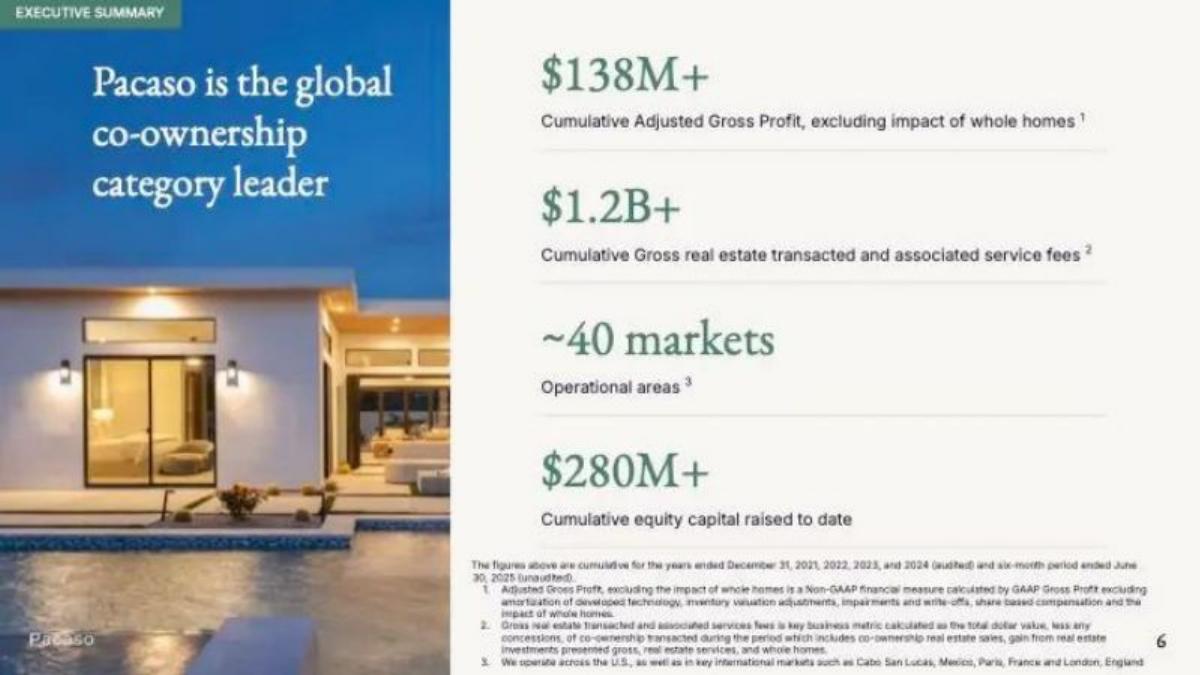
Pacaso’s Series D pitch deck presents a mature marketplace model aiming to disrupt the luxury real estate sector through co-ownership. The narrative centers on solving the 'vacation home conundrum'—specifically the 89% vacancy rate of typical second homes. With a leadership team boasting pedigrees from Zillow and Hotwire, the company highlights a massive $1.3T US serviceable market where they currently hold less than 1% penetration. The deck signals a strategic pivot from broad brand marketing to high-precision, AI-modeled customer acquisition. While the presentation excels at showcasing luxu…
Key takeaways
- Typical vacation homes sit vacant for 89% of the year, creating a waste of personal capital that Pacaso aims to solve (Slide 4).
- The leadership team includes co-founders from Zillow and executives with backgrounds at Google, Uber, and RE/MAX (Slide 3).
- Pacaso identifies a $1.3T US serviceable market based on transactions greater than $500k per home sold (Slide 9).
- The company reports less than 1% market penetration today based on total assets on the platform as of year-end 2023 (Slide 9).
- Growth strategy is shifting from national brand marketing to targeted acquisition using AI to identify high-net-worth households (Slide 15).
- International expansion is a core growth pillar, specifically targeting markets like Paris, Cabo, and London (Slide 17).
- The company is developing custom financing products, including a partnership with MoXi for Mexican property purchases (Slide 19).
- AI implementation is focused on an in-app concierge, remote home inspection tools, and tailored buyer experiences (Slide 22).
Introduction and Team
Slide 1: Title Slide
The deck opens with a high-resolution image of a luxury kitchen and living space, immediately establishing the aspirational nature of the brand. The title is 'Pacaso Investment Offering & Growth Plan,' with a specific round closing date of September 18, 2025. This sets a clear timeline for potential investors.
Slide 3: The Leadership Team
Pacaso leans heavily on its executive pedigree. The slide features eight key leaders, most notably Co-Founder & CEO Austin Allison and Co-Founder & Chair Spencer Rascoff. The bottom of the slide displays a 'who's who' of tech and real estate logos, including Zillow, Hotwire, Google, Uber, and RE/MAX . The text highlights a 'diverse set of backgrounds across real estate, technology and hospitality,' positioning the team as the primary drivers of the 'digital transformation of real estate.'
The Problem and Market Opportunity
Slide 5: Visual Portfolio
This slide is a collage of luxury properties in high-demand locations such as Jackson Hole, Los Cabo, Palm Springs, London, Lake Tahoe, and Cape Cod . It serves as a proof of concept for the types of assets currently under management or targeted by the platform.
Slide 4: Executive Summary - The Vacation Home Conundrum
Pacaso defines the problem through three specific lenses: underutilization, mental load, and unpredictable rental experiences. They cite an EBP Report stating that typical vacation homes sit vacant for 89% of the year . They also note that 40% of Americans aspire to own a second home in the next year, but are deterred by the complexities of luxury property ownership.
Slide 9: Unlocking Massive TAM
The market opportunity is quantified with large-scale figures. Pacaso identifies ~24M US households with annual incomes of $150K+ . They value the US serviceable market at $1.3T , based on transactions greater than $500K per home sold. Crucially, they state that Pacaso currently has less than 1% penetration of this market based on total assets on the platform at year-end 2023. They also mention a $500B expansion opportunity into Europe.
The Growth Plan
Slide 11 & 13: Growth Strategy Overview
Following a transition slide, Slide 13 outlines four 'Growth Focus Areas': Best-in-Class Consultative Selling, Strategic International Expansion, Expand Value through Global Swap Platform, and Leverage AI to Scale Faster and Improve CX . This provides a roadmap for how the Series D capital will be deployed.
Slide 15: Targeted Customer Acquisition
This slide represents a strategic shift in the company's maturity. Pacaso is moving away from 'national brand marketing' toward 'targeted customer acquisition.' They plan to use data science and AI modeling to identify high-net-worth households. A dot-grid graphic illustrates the focus on the intersection of 'Likelihood to Respond' and 'Likelihood to Convert,' suggesting a move toward higher marketing efficiency and lower CAC (Customer Acquisition Cost).
Slide 17: International Expansion
The deck emphasizes global ambitions with imagery of Paris, Cabo, and London . The text notes that managing international real estate independently is 'near impossible' and that Pacaso simplifies the buying, financing, and owning process abroad through local expertise.
Slide 19: Financing Products
To lower the barrier to entry, Pacaso is developing 'Co-ownership financing products.' This includes flexible financing programs to increase the owner base and a partnership with MoXi to offer financing for homes in Mexico. This slide suggests that Pacaso is becoming not just a marketplace, but a fintech provider for the co-ownership category.
Slide 22: AI and Technology
The company highlights its 'technology-first' approach. The slide shows a mobile app interface featuring an 'AI-powered in-app concierge' . They also mention remote home inspection tools and a scalable property management platform designed to support both owners and the internal operations team.
Conclusion
Slide 24: Investment Summary
The final content slide summarizes the bull case: Pacaso is the 'category leader and creator' with 'strong repeat and referral sales.' It reiterates the massive U.S. TAM, the AI-empowered platform, and 'diversified initial and ongoing monetization opportunities.' It concludes with a claim of 'strong business momentum,' though specific revenue growth percentages are not provided on this slide.
What Pacaso’s Deck Does Well
Strong Team Credibility: By highlighting the Zillow and Hotwire connection, Pacaso immediately overcomes the 'trust' hurdle inherent in high-ticket real estate marketplaces. Investors are buying into a team that has successfully scaled real estate platforms before.
Clear Problem Identification: The '89% vacancy' statistic is a powerful anchor. It turns a luxury purchase into a logical 'efficiency' play, which is a compelling narrative for both users and investors.
Strategic Pivot: The move from brand-building to AI-driven targeted acquisition (Slide 15) shows a company moving from the 'awareness' phase to the 'efficiency' phase of its lifecycle. This is exactly what Series D investors look for—optimization of the growth engine.
What is Missing from the Pacaso Deck
Specific Financial Performance: While the deck mentions 'strong business momentum' and 'diversified monetization,' it lacks a slide dedicated to historical revenue, GMV (Gross Merchandise Volume), or EBITDA margins. For a Series D round, the absence of a detailed financial 'hockey stick' or path to profitability is notable.
Unit Economics: There is no breakdown of the take rate, management fees, or the cost of acquiring a customer (CAC) versus the lifetime value (LTV) of an owner. In a marketplace model, these are the most critical metrics for assessing long-term viability.
Competitive Landscape: The deck claims Pacaso is the 'category creator,' but it does not acknowledge or differentiate itself from emerging competitors in the fractional ownership space or traditional timeshare models. A competitive matrix would have strengthened the 'category leader' claim.
What Founders Should Copy
The 'Serviceable Market' Visualization: Slide 9 is an excellent example of how to present TAM. By breaking it down into specific household income brackets and transaction sizes, the $1.3T figure feels grounded in reality rather than being a 'top-down' guess.
The 'Growth Focus Areas' Framework: Slide 13 uses a clean, four-pillar structure that is easy for an investor to remember. It links high-level strategy (International Expansion) with specific technological advantages (AI Concierge).
High-Quality Visuals: Real estate is a visual business. Pacaso uses full-bleed, professional photography that reinforces the 'luxury' brand at every turn. Founders in B2C or lifestyle sectors should ensure their deck's aesthetic matches their product's price point.
Frequently asked questions
- What is the primary problem Pacaso is solving?
- According to slide 4, Pacaso addresses the 'vacation home conundrum.' This includes the fact that typical vacation homes are vacant 89% of the year, the heavy mental load of maintaining a home from afar, and the unpredictable nature of renting vacation properties. They position co-ownership as the solution to these inefficiencies in personal capital and community impact.
- How does Pacaso define its Total Addressable Market (TAM)?
- On slide 9, Pacaso defines its US serviceable market at $1.3 trillion. This is based on approximately 24 million US households with an annual income of $150k+ and the fact that 80% of Americans aspire to own a second home. They also note a $500 billion expansion opportunity into the European vacation home market.
- What is Pacaso's new marketing strategy?
- Slide 15 outlines a shift from broad national brand marketing to 'targeted customer acquisition.' This strategy relies on a data science foundation using AI modeling to identify high-net-worth households with a high propensity to convert. They aim to prioritize markets with the most efficient growth potential rather than maintaining a general national presence.
- Who are the key members of the Pacaso leadership team?
- As shown on slide 3, the team is led by Co-Founder & CEO Austin Allison and Co-Founder & Chair Spencer Rascoff (formerly of Zillow). Other executives bring experience from major firms including Google, Uber, Concur, and RE/MAX. The deck emphasizes that the founding members are established industry thought leaders in real estate and technology.
- How is Pacaso using AI in its operations?
- Slide 22 details three AI-focused initiatives: an AI-powered in-app concierge and remote home inspection tools, tailored buyer experiences, and a scalable property management platform. The goal is to use technology to scale faster and improve the customer experience (CX) for owners buying, staying, and selling within their global portfolio.