Everyrealm (formerly Republic Realm) raised $66.3 million in 2021 with a deck that leans almost entirely on vision and social proof rather than traditional financial metrics. The 11-slide presentation positions the company as a 'full-stack metaverse & NFT innovation platform' (Slide 1). It highlights a massive portfolio of 3,000+ NFTs and investments across 25 platforms (Slide 4), backed by a 'who's who' list of Silicon Valley VCs and celebrities including Andreessen Horowitz and Paris Hilton (Slide 5). While the deck lacks a business model, financial projections, or a specific 'ask,' it effe…
Key takeaways
- The deck positions the metaverse as the 'greatest wealth-creation opportunity of our lifetime' on Slide 2.
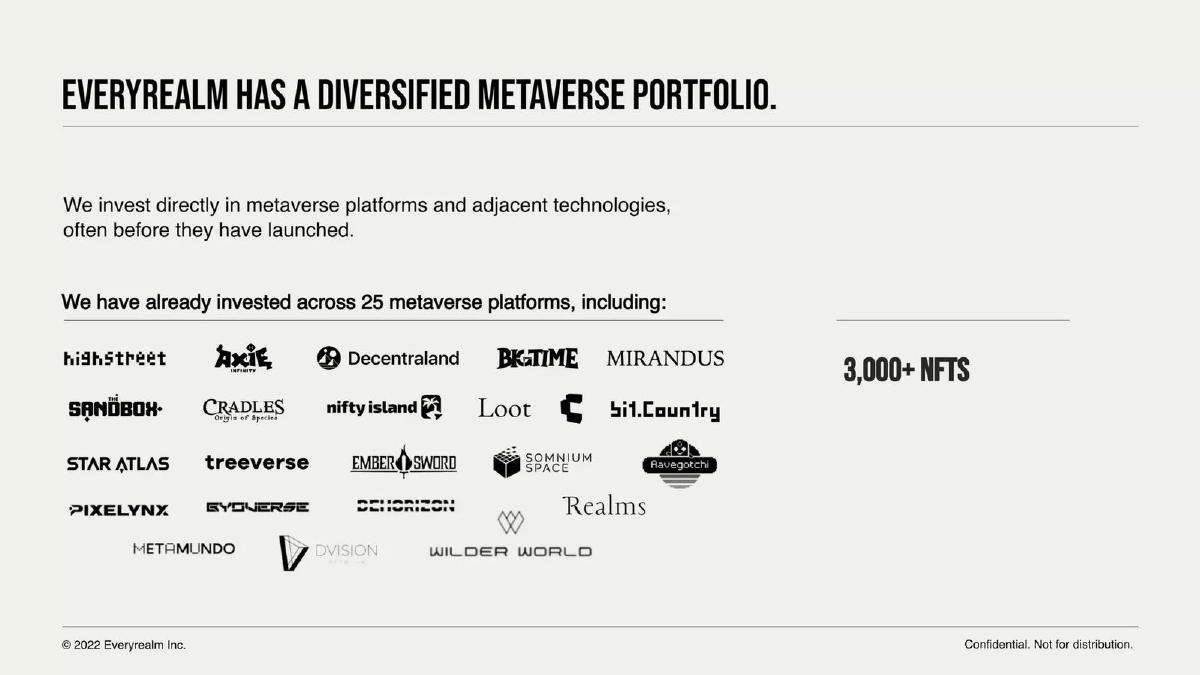
- Everyrealm claims a portfolio of over 3,000 NFTs and investments in 25 metaverse platforms as of Slide 4.
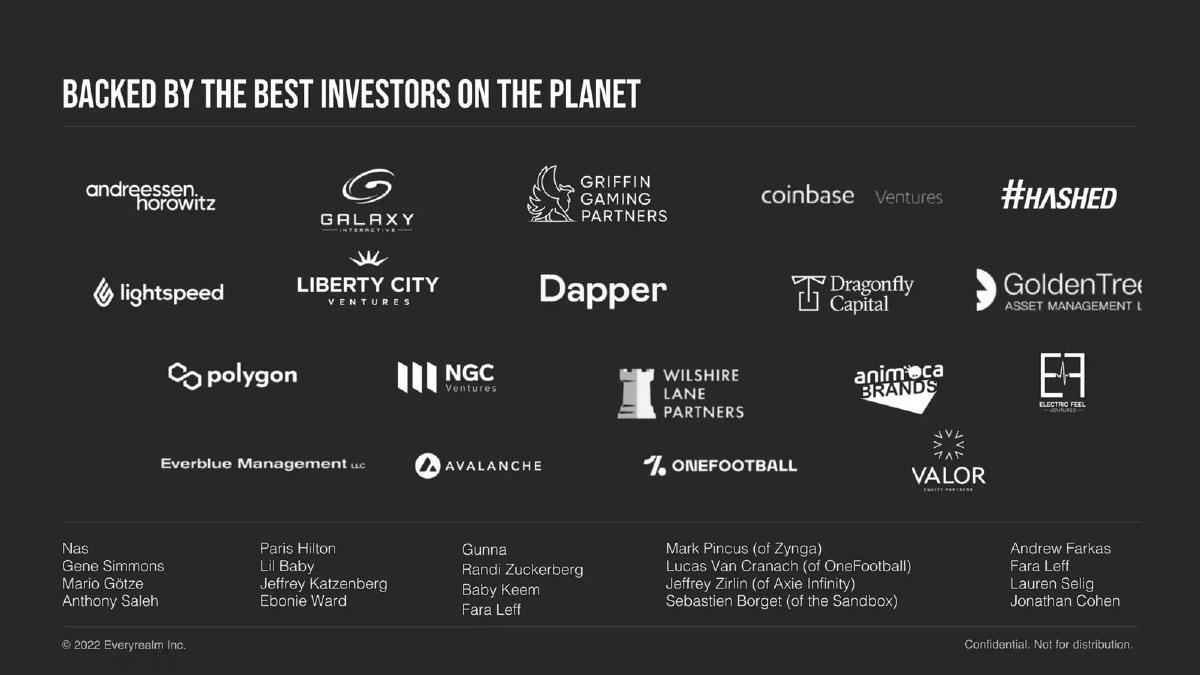
- Slide 5 showcases an extensive list of top-tier institutional investors including a16z, Lightspeed, and Coinbase Ventures.
- The company utilizes celebrity social proof, listing names like Nas, Gunna, and Gene Simmons as backers on Slide 5.
- Three specific real estate case studies (Slides 8, 9, and 10) demonstrate tangible development work in Decentraland and The Sandbox.
- The Metajuku Shopping District case study on Slide 8 highlights high-profile tenants like JPMorgan Chase.
- The deck completely omits a team slide, financial projections, revenue models, and a specific funding ask.
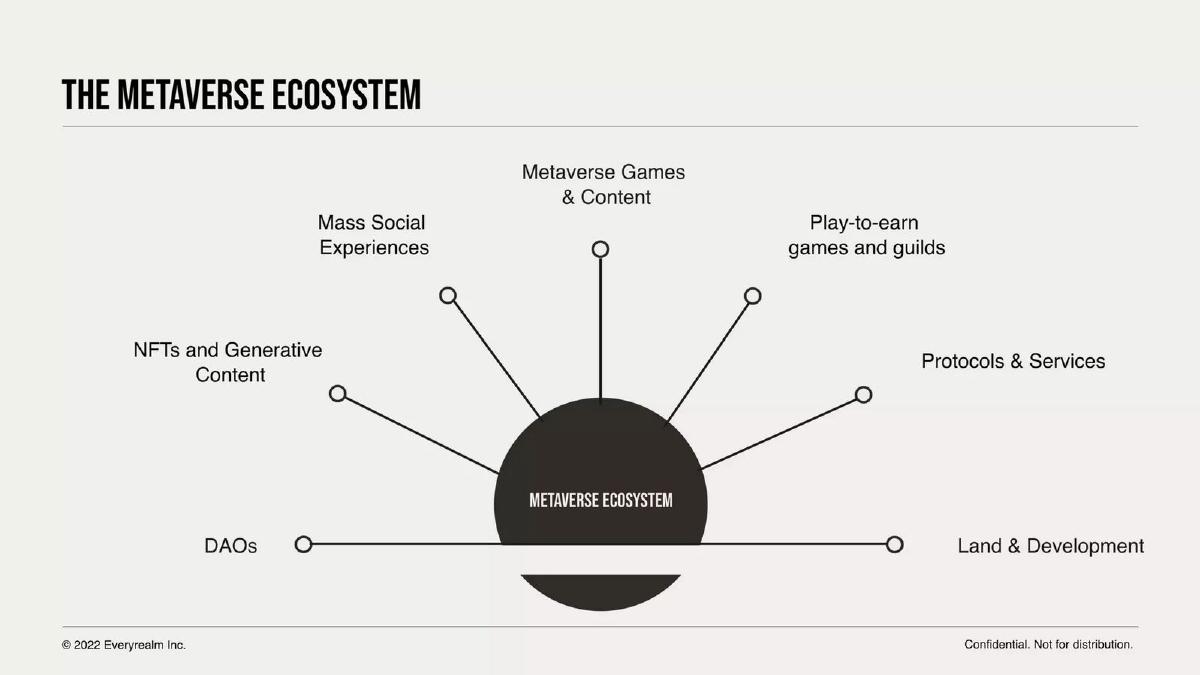
- Slide 6 provides a conceptual map of the 'Metaverse Ecosystem' covering DAOs, gaming, and land development.
The $66 Million Metaverse Portfolio
Everyrealm’s 2021 pitch deck is a masterclass in narrative-driven fundraising. At a time when the 'metaverse' was the most sought-after buzzword in venture capital, this 11-slide presentation focused on two things: scale and social proof. By positioning themselves as the primary gateway to virtual real estate, Everyrealm managed to secure $66.3 million without including a single chart of revenue growth or a detailed breakdown of their unit economics. This teardown examines how they leveraged early-mover advantage and an elite investor roster to win.
The Vision and Validation (Slides 1-3)
Slide 1: Title The deck opens with a minimalist black slide. The company defines itself as a "full-stack metaverse & NFT innovation platform." This phrasing is intentional; 'full-stack' implies they handle everything from investment to development and infrastructure, positioning them as a comprehensive solution rather than a niche player.
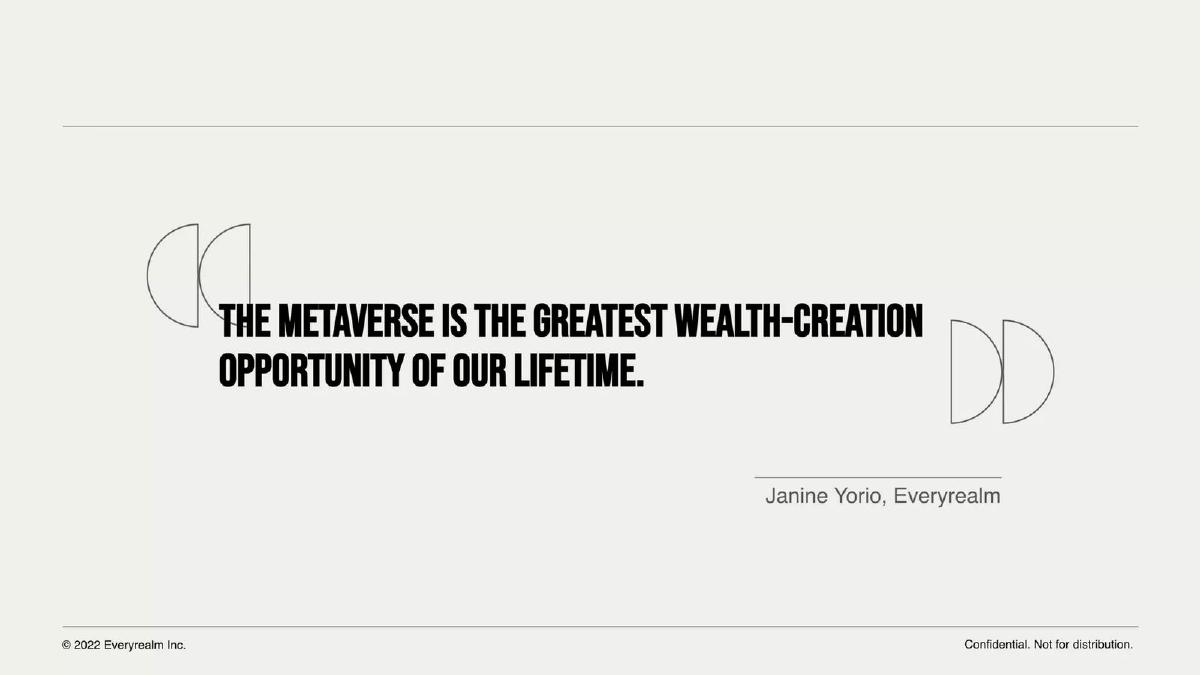
Slide 2: The Vision Slide 2 features a quote from Janine Yorio: "The metaverse is the greatest wealth-creation opportunity of our lifetime." This is a bold, macro-thesis statement. It sets the stakes for the investor—suggesting that not participating in this round is a missed generational opportunity. It focuses on the 'Why Now' without needing to explain the technology in depth.
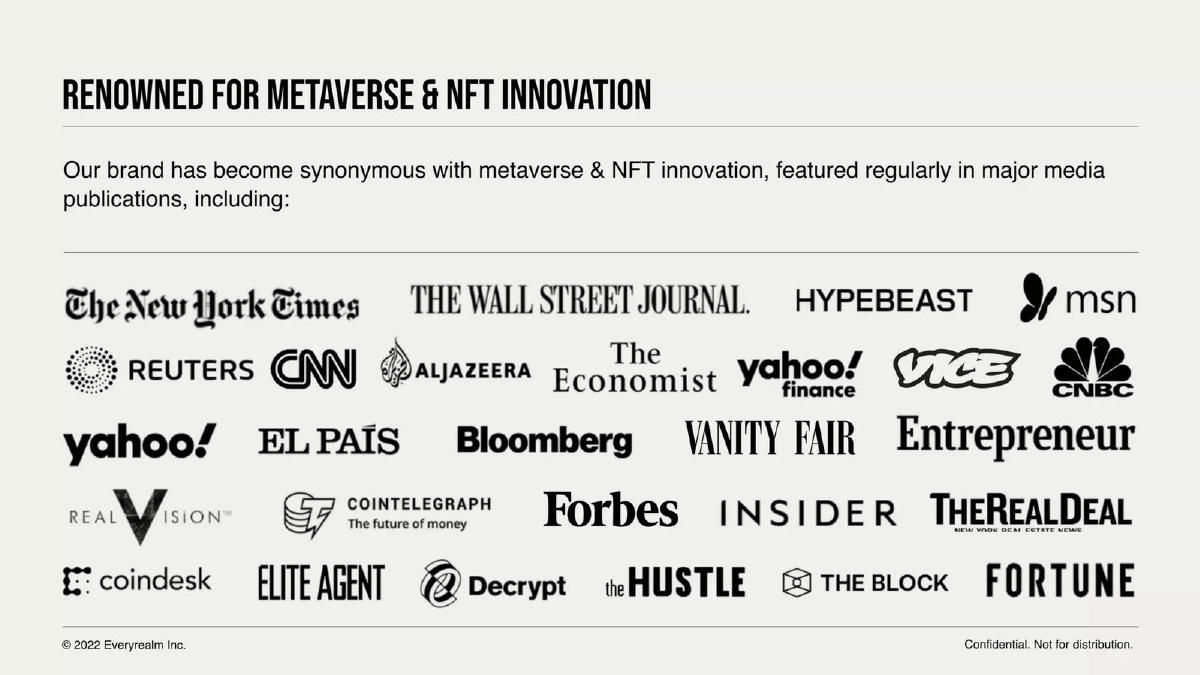
Slide 3: Media Proof Before explaining what they do, Everyrealm establishes credibility. Slide 3, titled "Renowned for Metaverse & NFT Innovation," displays 24 logos of major media publications. The list includes The New York Times, The Wall Street Journal, Bloomberg, and Forbes. The text claims their brand has become "synonymous" with the sector. For an investor, this slide mitigates the perceived risk of an emerging industry by showing that the mainstream financial press is already paying attention.
Portfolio and Pedigree (Slides 4-5)
Slide 4: The Portfolio This is the 'traction' slide, though it focuses on assets rather than revenue. Everyrealm states they have "already invested across 25 metaverse platforms" and own "3,000+ NFTs." The slide features logos of major crypto projects like The Sandbox, Axie Infinity, and Decentraland. By showing a diversified portfolio, they present themselves as a 'Metaverse Index,' offering investors broad exposure to the space through a single vehicle.
Slide 5: The Cap Table Slide 5 is perhaps the most influential slide in the deck. Titled "Backed by the Best Investors on the Planet," it is a dense grid of high-status logos and names. Top-tier VCs like Andreessen Horowitz (a16z), Lightspeed, and Coinbase Ventures are featured prominently. Below the logos, a list of individual investors includes celebrities like Nas, Paris Hilton, and Gene Simmons , alongside tech founders like Mark Pincus (Zynga) . This slide effectively ends the 'due diligence' phase for many investors; if a16z and the founders of the platforms themselves (like Sebastien Borget of The Sandbox) are in, the social proof is absolute.
The Ecosystem and Execution (Slides 6-7)
Slide 6: The Ecosystem Map This slide provides a conceptual framework for the metaverse. It breaks the market into six segments: NFTs and Generative Content, Mass Social Experiences, Metaverse Games & Content, Play-to-earn games and guilds, Protocols & Services, and Land & Development. This slide serves to educate the investor while positioning Everyrealm at the center of these converging trends.
Slide 7: Development Overview Everyrealm shifts from 'investor' to 'developer.' Slide 7 shows four visual examples of their work: the RTFKT metaverse mall and Metajuku in Decentraland, the Everyrealm Academy in Somnium Space, and Fantasy Islands in The Sandbox. These visuals are critical because they prove the company isn't just 'flipping' digital land—they are building utility and 'experiences' that could eventually generate rent or commerce.
Case Studies: Tangible Virtual Real Estate (Slides 8-10)
Slide 8: Metajuku Shopping District This case study focuses on a specific development in Decentraland (Coordinates: 94, 21). The slide notes that "Tenants include wearable developer DressX and JPMorgan Chase." The mention of JPMorgan Chase is a massive validation point, showing that traditional 'Fortune 500' companies are using Everyrealm's developments to enter the metaverse. The project "Launched June 2021" and received coverage from Coindesk and WWD.
Slide 9: Realm Retreat This slide highlights a "social and gathering space" featuring an NFT art gallery, plunge pool, and conference center. It notes a "Soft launch July 2021." This slide emphasizes the social utility of their real estate, moving beyond retail into lifestyle and corporate events.
Slide 10: Fantasy Islands Private Islands NFTs The final case study describes a "master-planned single-family private island community" launched in August 2021. This project represents the 'luxury residential' side of their development business. By showing retail (Metajuku), social (Realm Retreat), and residential (Fantasy Islands) projects, Everyrealm demonstrates a complete real estate development strategy mirrored after the physical world.
Closing (Slide 11)
Slide 11: Contact The deck ends simply with the company logo and a link to their website. There is no specific call to action or 'ask' slide included in this version of the deck.
What Works in This Deck
Extreme Social Proof: Slide 5 is the 'heavy lifter.' In a speculative market, investors look for signals from other smart money. By aggregating a16z, Lightspeed, and industry insiders, Everyrealm makes it very difficult for a VC to say no based on credibility concerns.
Visual Execution: The use of high-quality renders and screenshots from their actual developments (Slides 8-10) is essential. It moves the conversation from abstract 'metaverse' concepts to tangible assets that an investor can visualize (and even visit).
The 'Index' Strategy: By highlighting investments in 25 different platforms (Slide 4), Everyrealm positions itself as a safer bet than any single metaverse platform. They are the 'landlords' of the entire ecosystem, which is a powerful defensive narrative.
What Is Missing
The Team Slide: Surprisingly, there is no slide dedicated to the founders' backgrounds. While Janine Yorio is quoted on Slide 2, the deck doesn't detail the team's specific expertise in real estate, finance, or game development. In a $66M round, the 'Who' is usually as important as the 'What.'
Business Model and Unit Economics: The deck never explains how Everyrealm actually makes money. Do they take management fees? Do they sell NFTs? Do they collect rent from tenants like JPMorgan? The lack of a revenue model suggests this deck was used to sell a vision of asset appreciation rather than a cash-flow business.
The Ask: There is no mention of how much money is being raised or what the milestones for the next 18-24 months are. This information may have been delivered in a separate document or during the live pitch, but its absence here makes the deck feel more like a marketing brochure than a formal funding request.
What a Founder Should Copy
The 'Case Study' Format: If you are building in a new or complex industry, use slides 8-10 as a template. Don't just say you 'develop experiences'—show the coordinates, name the tenants, and cite the launch date. Specificity builds trust.
Logo Hierarchy: Everyrealm does an excellent job of organizing logos. Slide 3 (Media) and Slide 5 (Investors) are clean and categorized. Founders should notice how they grouped 'Institutional' vs. 'Individual' investors to maximize the impact of the names.
Macro-Thesis First: Slide 2 is a perfect example of how to frame a market opportunity. Instead of getting bogged down in technical definitions of the metaverse, they frame it as a "wealth-creation opportunity." Start with the 'Why' to get the investor's heart rate up before you dive into the 'How.'
Final Thoughts
Everyrealm’s deck is a product of its time—a high-momentum, high-signal presentation for a booming sector. It succeeds not through rigorous financial analysis, but by creating an aura of inevitability. By the time an investor reaches Slide 11, they have seen the media's approval, the industry's top VCs, and tangible proof of development. For a founder in a hot market, this 'show, don't tell' approach to social proof is often the fastest path to a term sheet.
Frequently asked questions
- How much did Everyrealm raise with this deck?
- According to the catalogue facts, Everyrealm raised $66,300,000 in 2021. This was a significant round for the 'Other' stage, reflecting the intense investor interest in metaverse and NFT infrastructure during that period. The deck's focus on top-tier VCs like Andreessen Horowitz suggests this was a highly competitive round led by institutional giants.
- What is Everyrealm's primary business model based on the slides?
- The slides describe Everyrealm as a 'full-stack metaverse & NFT innovation platform.' Based on Slides 4 and 7-10, their model involves investing in virtual land, developing that land into 'experiences' (like malls, villas, and galleries), and managing a portfolio of over 3,000 NFTs. They act as both a venture fund and a digital real estate developer.
- Who are the notable investors mentioned in the deck?
- Slide 5 lists a massive array of backers. Institutional investors include a16z, Galaxy Interactive, Lightspeed, and Animoca Brands. Celebrity investors include Paris Hilton, Nas, Gene Simmons, and Lil Baby. It also lists industry figures like Mark Pincus (Zynga) and Sebastien Borget (The Sandbox), indicating deep ties within the gaming and crypto sectors.
- What specific metaverse platforms does Everyrealm operate in?
- Slide 4 lists 25 platforms, including well-known names like The Sandbox, Decentraland, Axie Infinity, and Star Atlas. The case studies on Slides 8 through 10 specifically highlight developments within Decentraland (Metajuku), Somnium Space (Everyrealm Academy), and The Sandbox (Fantasy Islands).
- What is missing from this pitch deck?
- This deck is notably missing several standard components: a dedicated Team slide (though some names appear in the investor list), a Problem/Solution framework, a Business Model/Revenue slide, Financial Projections, and a specific 'Ask' slide detailing how the $66.3M would be spent. It functions more as a portfolio showcase than a traditional business plan.