Evertune's 17-slide deck successfully articulates a shift in consumer behavior: the migration from Google search to AI-powered chat interfaces like ChatGPT and Perplexity. By positioning themselves at the intersection of SEO ($68B), Brand Monitoring ($45B), and Search Advertising ($306B), the company makes a compelling case for a new category of marketing analytics. The deck uses specific luxury SUV case studies to demonstrate how LLMs currently rank brands and, crucially, identifies why certain content is excluded from AI training sets due to crawler blocks. While the deck is light on team c…
Key takeaways
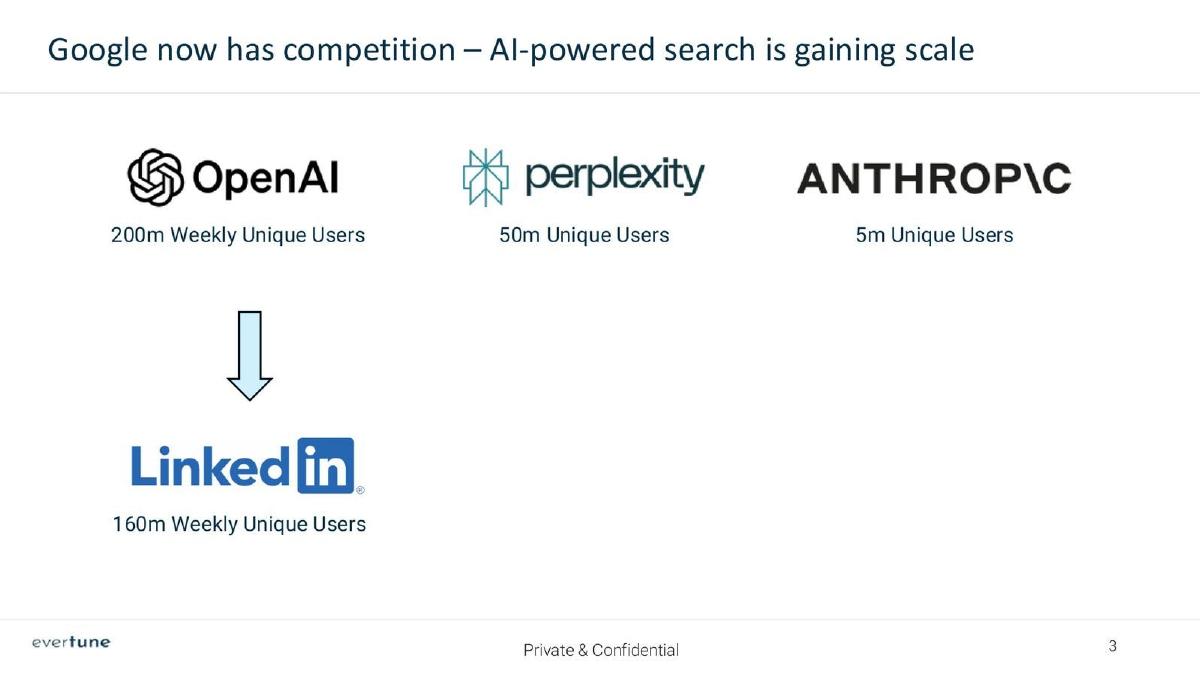
- The deck identifies a massive shift in search scale, noting OpenAI has 200m weekly unique users compared to LinkedIn's 160m (Slide 3).
- Evertune defines its value proposition through three pillars: understanding LLM output, identifying training content gaps, and providing action steps for brand education (Slide 7).
- The platform provides a proprietary 'AI Brand Index' that benchmarks brands across different models like GPT-4.0, Gemini, and Llama 3 (Slide 7).
- A luxury SUV case study demonstrates radar charts measuring 'Top of Mind,' 'Perception,' and 'Media' across different LLMs (Slide 9).
- The deck highlights a technical friction point: brands and publishers blocking AI crawlers, which prevents models from learning about their products (Slide 11).
- Competitor benchmarking data shows specific 'Content Block Rates,' such as Porsche having a 39% block rate for OpenAI crawlers (Slide 13).
- Evertune targets three massive legacy markets: SEO ($68B), Brand Monitoring ($45B), and Search Advertising ($306B) (Slide 15).
- The deck omits a dedicated team slide, financial ask, and roadmap, focusing instead on the market shift and product utility.
The Shift from SEO to LLMO
Evertune’s pitch deck is a masterclass in 'Why Now' positioning. In the 2024 venture landscape, simply being an 'AI company' is no longer enough. Evertune succeeds by identifying a specific, high-stakes problem created by the AI boom: the loss of brand control in the age of the chatbot. As search moves from a list of links to a single generative answer, brands are flying blind. This deck outlines the tools required to navigate that transition.
Slide 1-2: Title and Branding
The deck opens with a minimalist aesthetic. The dark navy background and clean white typography signal a professional, enterprise-grade tool. There is no tagline on the cover, simply 'Introduction to Evertune' and the date 'August 2024.' This simplicity suggests a deck intended for a sophisticated audience already familiar with the broader AI discourse.
Slide 3: The Scale of AI Search
Slide 3 establishes the market urgency. It compares the weekly unique users of major AI platforms to established social networks. Specifically, it notes that OpenAI has reached 200 million weekly unique users, Perplexity has 50 million, and Anthropic has 5 million. By placing an arrow pointing from OpenAI to LinkedIn (160 million weekly unique users), the deck visually argues that AI search has already surpassed major established platforms in terms of active engagement. This sets the stage for why marketers can no longer ignore these channels.
Slide 5: Ubiquity of AI Interfaces
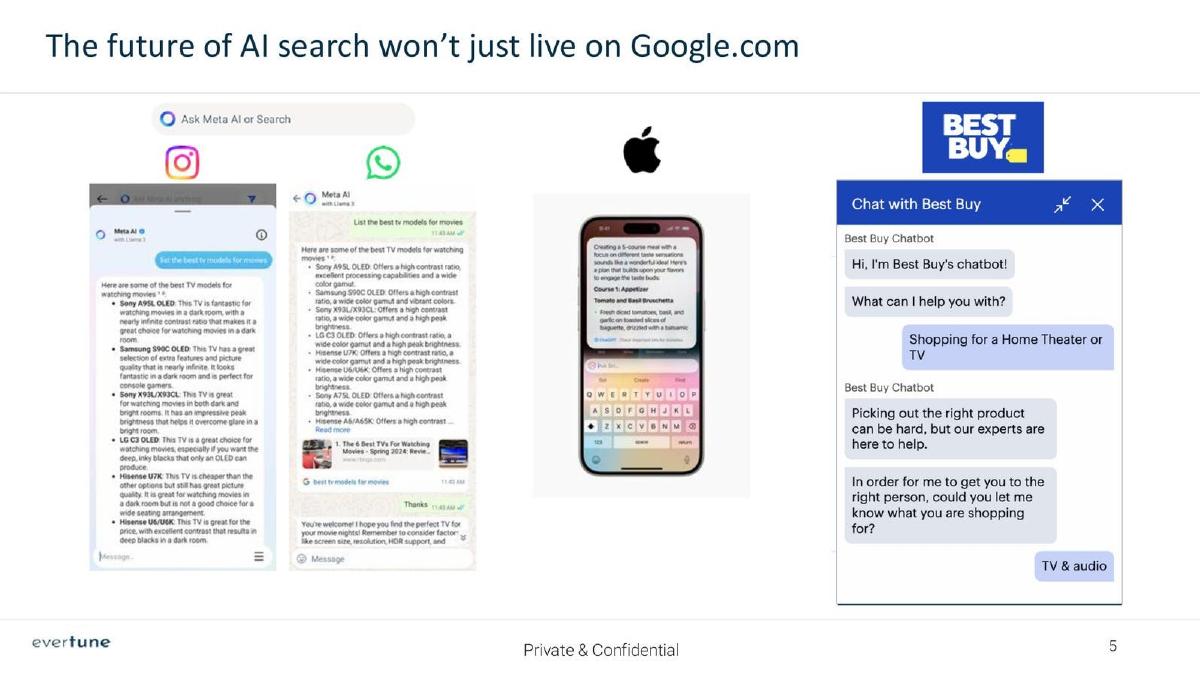
This slide illustrates that AI search is not confined to a single website. It shows screenshots of Meta AI integrated into Instagram and WhatsApp, Apple’s integration, and a Best Buy chatbot. The headline, 'The future of AI search won’t just live on Google.com,' reinforces the idea that the 'search' entry point is fragmenting across the entire digital ecosystem. For a brand, this means their reputation is being mediated by LLMs in every corner of the web.
Slide 7: The Evertune Value Proposition
Slide 7 introduces the product as a platform built to help marketers navigate this era. It breaks the offering into three distinct functions: 1) Understanding what LLMs tell consumers, 2) Gaining insights into what content is (or isn't) educating the models, and 3) Providing action steps to better educate those models. The slide includes a UI mockup of the 'AI Brand Index,' showing a bar chart comparing brands like Lexus, BMW, and Mercedes across different LLMs (ChatGPT, Gemini, Llama). This slide is critical because it moves the deck from 'theoretical problem' to 'tangible solution.'
Slide 9: Deep Dive into Brand Perception
Using a 'Client Example' of Luxury SUVs, Slide 9 demonstrates the depth of Evertune’s analytics. It uses radar charts to visualize brand performance across five axes: Top of Mind, Perception, Media, Price, and Product. By overlaying data from GPT-4o, Gemini-Pro, and Llama-3.1, the slide shows that a brand might have high 'Top of Mind' awareness in one model but poor 'Price' perception in another. This level of granularity is exactly what a CMO would need to justify a budget shift toward AI optimization.
Slide 11: The Technical Gap - AI Crawlers
Slide 11 identifies the 'how' behind the problem. It explains that Gen AI models learn by ingesting content, but many publishers and brands are inadvertently blocking AI crawlers. It features a screenshot of a Reddit thread ('The good, the bad, the ugly - Cayenne ownership') as an example of what AI is reading. The takeaway is that if a brand’s official site is blocked but Reddit is open, the LLM’s 'opinion' of the brand will be shaped entirely by third-party forum sentiment rather than official specifications.
Slide 13: Competitor Benchmarking and Block Rates
This is perhaps the most data-rich slide in the deck. It provides a side-by-side comparison of 'Crawlable Pages Found' and 'Content Block Rates' for Mercedes, BMW, and Porsche across four different crawlers (OpenAI, Google, Meta, CommonCrawl). The data is startling: Porsche has a 39% block rate for OpenAI, while Mercedes is only at 22%. This slide proves that Evertune isn't just scraping chat prompts; they are auditing the technical infrastructure of the AI-web relationship. It provides a clear 'Aha!' moment for investors: brands are invisible to AI because of their own technical settings.
Slide 15: Market Size and Intersection
Slide 15 uses a Venn diagram to position Evertune at the center of three massive, existing markets: SEO ($68 billion), Brand Monitoring ($45 billion), and Search Advertising ($306 billion). By citing specific industry reports in the footer, the company anchors its potential in reality. The implication is that Evertune is the 'Next Gen' version of these combined categories, which represent over $400 billion in annual spend.
Slide 17: Conclusion
The deck ends on a simple 'Thank You' slide. There is no contact information or 'Ask' visible in this specific slide set, though the publisher reports a $4M Seed round was successfully closed in 2024.
What Works in the Evertune Deck
The 'Why Now' is Undeniable: By showing that OpenAI's user base has eclipsed LinkedIn's, the founders create an immediate sense of FOMO for marketers and urgency for investors.
Specific Vertical Use Cases: Instead of speaking in generalities, the deck uses the Luxury SUV market (Porsche, BMW, Mercedes) to show exactly how the data looks. This makes the product feel 'ready to sell' rather than a research project.
Technical Insight: The focus on 'Content Block Rates' (Slide 13) is a brilliant move. It moves the conversation from 'AI is magic' to 'AI is a crawler-based system that we can audit and optimize.' This gives the brand an 'edge' that feels defensible.
What is Missing from the Evertune Deck
Team Credentials: In a Seed round, the team is often more important than the product. This deck (or at least the 9 slides provided) lacks a team slide. In the highly technical world of LLM analytics, knowing if the founders come from Google Search, OpenAI, or a top-tier ad agency is vital.
Business Model: There is no mention of how Evertune makes money. Is it a SaaS subscription for brands? An API for agencies? A per-report fee? Without this, it’s hard to evaluate the scalability of the $400B market claim.
The 'Ask': A fundraising deck should ideally state how much is being raised and what the milestones are for that capital. While we know from external reports they raised $4M, the slide itself is silent on the terms or the roadmap.
Founder's Playbook: What to Copy
Use Comparative Scale: If you are building in a new category, don't just say the market is big. Compare your new category's growth to a known entity (like the OpenAI vs. LinkedIn comparison on Slide 3). It provides instant context.
Visualize the 'Black Box': Evertune took the abstract concept of 'what an AI thinks' and turned it into a radar chart (Slide 9). If your product deals with complex data, find a familiar visualization (like a radar or bar chart) to make it digestible.
Identify the Friction: The best B2B decks identify a specific technical friction point that the customer didn't know they had. For Evertune, it was the 'Content Block Rate.' Find the 'clogged pipe' in your industry and show the data that proves it exists.
Frequently asked questions
- What is the core problem Evertune is solving?
- Evertune addresses the 'black box' nature of Large Language Models (LLMs) for marketers. As consumers move from Google to AI chatbots, brands lose visibility into how they are being recommended. Evertune provides the analytics to see what LLMs say about a brand and identifies the specific content or technical blocks preventing AI models from accurately learning about a brand's products.
- How does Evertune measure brand performance in AI?
- The company uses an 'AI Brand Index' and radar charts to score brands on metrics like 'Top of Mind,' 'Perception,' 'Price,' and 'Product.' These scores are segmented by specific models, such as GPT-4, Gemini-Pro, and Llama-3.1, allowing brands to see where they are winning or losing in the AI-driven recommendation engine.
- What is the significance of the 'Content Block Rates' mentioned in the deck?
- This is a critical technical insight. Many websites use robots.txt or other methods to block AI crawlers. Evertune shows that if a brand like Porsche blocks 39% of OpenAI's crawlers, the resulting AI answers about Porsche will be incomplete or outdated. Evertune identifies these gaps so brands can strategically 'unblock' or feed data to the models.
- Which markets does Evertune intend to disrupt?
- Evertune positions itself as the evolution of three major categories: Search Engine Optimization (SEO), Brand Monitoring, and Search Advertising. By citing the total addressable market of these three sectors as over $400 billion, they suggest that 'LLM Optimization' will eventually capture a significant portion of traditional marketing budgets.
- What is missing from this pitch deck?
- The provided slides are heavily focused on the 'Why Now' and 'Product' sections. It lacks a team slide (crucial for a Seed round), a clear 'Ask' slide detailing how the $4M will be spent, a business model/pricing slide, and a forward-looking roadmap. These may have been in the 8 slides not included in the visual set but are notable omissions here.