The everbill pitch deck from 2012 is a concise 8-slide presentation that leans heavily on existing traction to justify a $500,000 seed round. Positioned as 'SAP for Startups and SMBs,' the company avoids wordy explanations in favor of bold numbers: 650 paying users, $120,000 in annual revenue, and $300 million billed through the platform since inception. The deck's primary strength is its clear evidence of product-market fit, demonstrated by a 34% trial-to-paid conversion rate that significantly outpaces the cited 12% industry average. However, the deck is notably thin on market sizing, compe…
Key takeaways
- The company positions itself as a simplified ERP solution with the tagline 'SAP for Startups and SMBs' on slide 1.
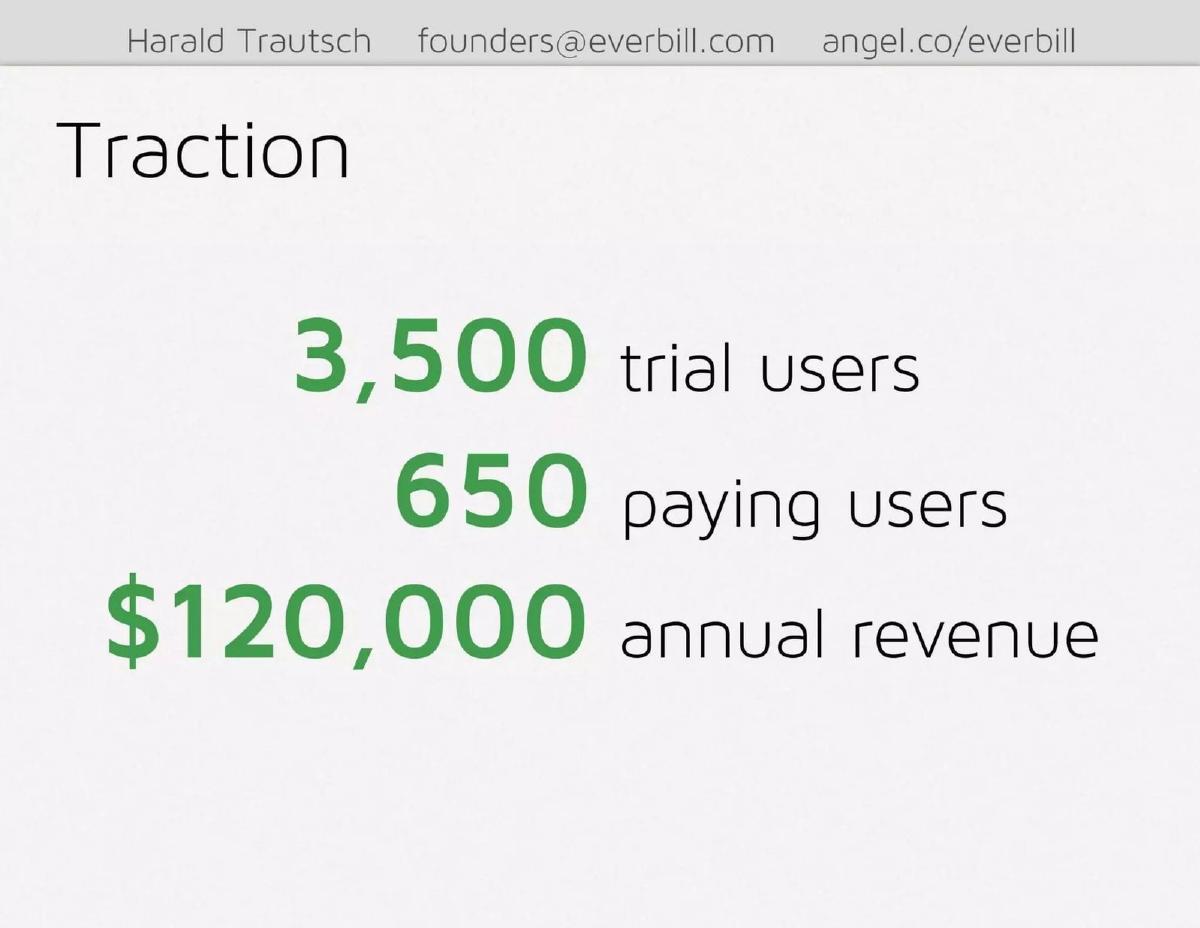
- everbill reported $120,000 in annual revenue from 650 paying users at the time of the pitch (slide 4).
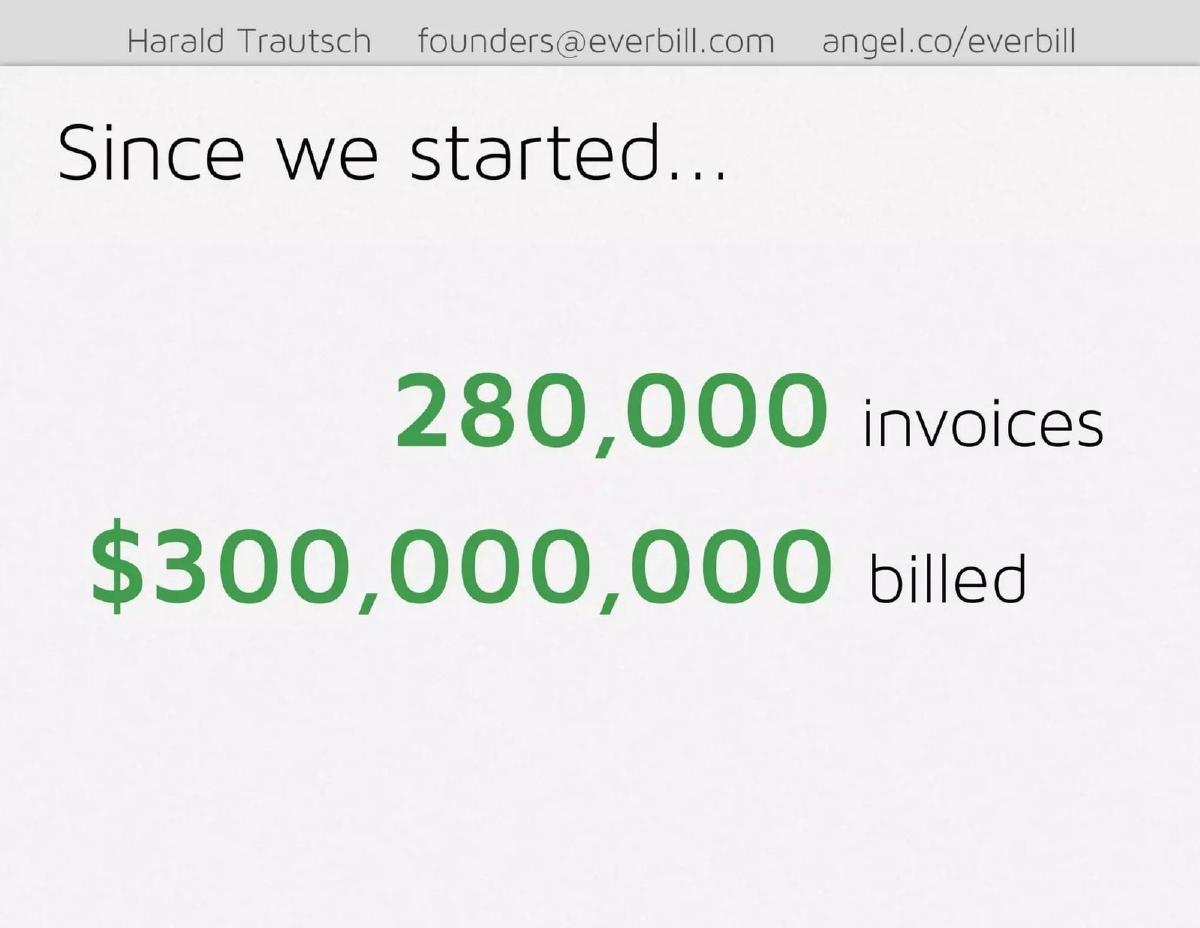
- The platform demonstrated significant usage volume, with 280,000 invoices and $300,000,000 billed since its start (slide 6).
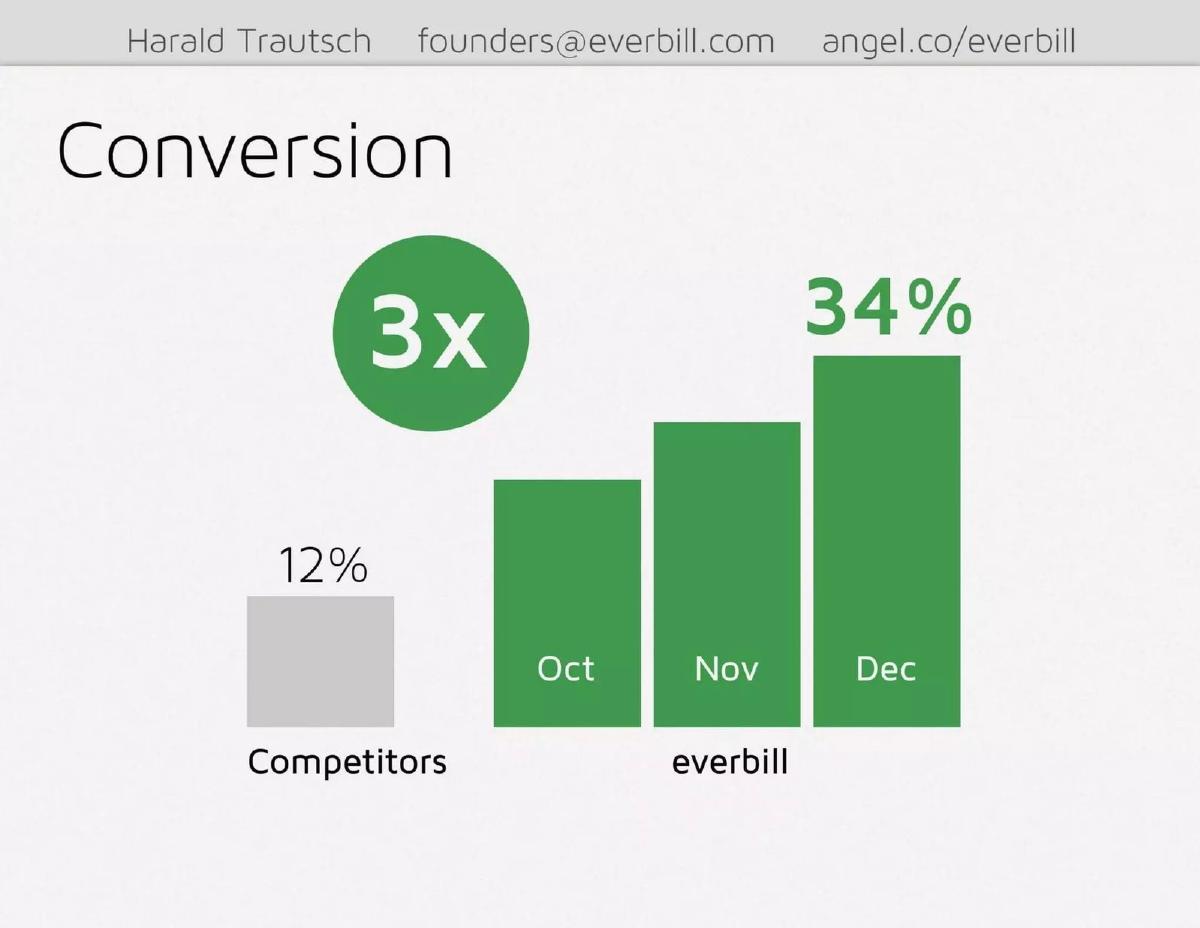
- Conversion rates were a core highlight, showing a climb to 34% in December, compared to a 12% competitor benchmark (slide 5).
- The growth strategy relies heavily on a reseller model, specifically highlighting T-Mobile as a key partner (slide 7).
- The deck seeks a $500,000 investment for SaaS, enterprise software, and B2B partnerships (slide 8).
- The team slide identifies four key roles (CEO, COO, CTO, CMO) but provides no professional history or prior successes (slide 8).
- There is a total absence of a market size (TAM/SAM/SOM) slide or a detailed competitor comparison beyond a single conversion metric.
The everbill Teardown: Minimalism in Seed Fundraising
The everbill pitch deck, dating from 2012, is a brief 8-slide document that prioritizes traction over narrative. In an era where pitch decks often stretched to 20 or 30 slides, everbill opted for a high-impact, low-word-count approach. The company, which describes itself as a SaaS application for SMEs to manage invoices and inventory, uses this deck to prove that they have already found a segment of the market willing to pay for their solution.
The Hook and the Team
Slide 1: Title Slide The deck opens with a clear, albeit ambitious, analogy: "SAP for Startups and SMBs." This immediately tells the investor that everbill is an ERP (Enterprise Resource Planning) play for the smaller end of the market. The contact information for Harald Trautsch is prominently displayed at the top, along with an AngelList link, which was a standard practice for startups in the early 2010s.
Slide 2: The Relationship Slide 2 is an unconventional choice. It features a vintage photograph of two young men, presumably founders, leaning against a chain-link fence. There is no text on this slide. In the context of a pitch, this is intended to signal a long-term partnership and "founder fit," suggesting that the team has known each other for years and can withstand the pressures of building a company. However, without context, it risks appearing unprofessional to more traditional investors.
Product and Traction
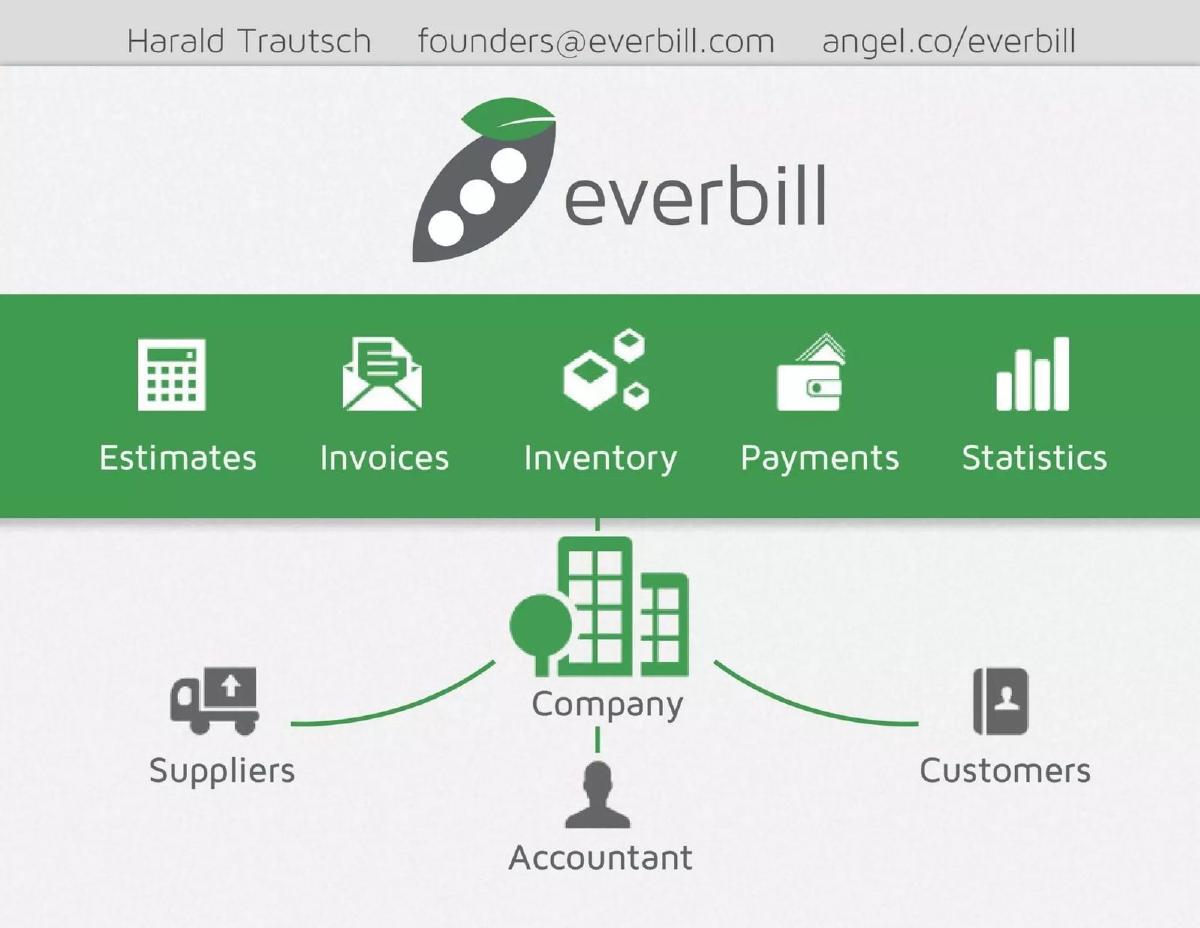
Slide 3: The Ecosystem This slide serves as the product overview. It uses icons to represent the five core modules of the software: Estimates, Invoices, Inventory, Payments, and Statistics. Below this, a diagram shows the "Company" at the center, connected to Suppliers, Customers, and an Accountant. This effectively communicates that everbill is not just a tool for the business owner, but a hub for the business's entire financial ecosystem.
Slide 4: Traction This is the most important slide in the deck. It lists three key figures in large, green font: 3,500 trial users, 650 paying users, and $120,000 annual revenue. For a seed-stage company in 2012, $120k in ARR (Annual Recurring Revenue) was a strong signal of product-market fit. It moves the conversation from "will people buy this?" to "how fast can we scale this?"
Performance and Scale
Slide 5: Conversion everbill doubles down on its metrics here. The slide shows a bar chart of conversion rates growing from October to December, peaking at 34%. It compares this to a "Competitors" benchmark of 12%. A 34% trial-to-paid conversion rate is exceptionally high for SaaS, suggesting either a very high-intent user base or a product that solves a very painful problem immediately upon sign-up.
Slide 6: Historical Volume To prove the robustness of the platform, slide 6 highlights the cumulative volume: 280,000 invoices and $300,000,000 billed. This demonstrates that the software is capable of handling significant financial throughput and is being used for more than just occasional testing by its 650 paying users.
Growth Strategy and The Ask
Slide 7: Growth Strategy The strategy is summarized in one word: "Resellers." The T-Mobile logo is the centerpiece of this slide. This indicates a pivot or a focus on channel sales rather than direct customer acquisition. By partnering with a massive telco like T-Mobile, everbill gains access to hundreds of thousands of small business customers without the high CAC (Customer Acquisition Cost) of digital marketing.
Slide 8: Team and Investment The final slide introduces the four-man leadership team: Harald (CEO), Michael (COO), Robert (CTO), and Gerald (CMO). Below the headshots is the funding ask: $500,000. A progress bar indicates that a portion of this round has already been committed. The slide concludes with the intended use of funds: SaaS, enterprise software, and B2B partnerships with banks and telcos. This aligns perfectly with the reseller strategy mentioned on the previous slide.
What Works in the everbill Deck
1. Extreme Clarity on Metrics: The deck does not hide behind vague percentages. By listing $120,000 in revenue and 650 paying users, the founders provide concrete data that investors can model. The conversion rate comparison (34% vs 12%) is a powerful way to demonstrate competitive advantage without needing a complex feature-comparison matrix.
2. The 'Reseller' Focus: For an SMB-focused SaaS, the biggest hurdle is often the cost of acquisition. By highlighting a partnership with T-Mobile, everbill addresses the scalability concern head-on. It shows they have a distribution hack that allows them to punch above their weight class.
3. Visual Simplicity: The deck uses a consistent color palette (green and grey) and very little text. This ensures that the investor's attention is focused on the numbers and the logos, rather than getting lost in paragraphs of technical jargon.
What is Missing from the everbill Deck
1. Market Size (TAM): There is no mention of how large the total addressable market is. While "SMBs" is a massive category, investors generally want to see a slide that quantifies the specific segment everbill is targeting and how much of that market they can realistically capture.
2. Competitive Landscape: While slide 5 mentions "Competitors" in the context of conversion rates, it doesn't name them or explain how everbill differs from established players like QuickBooks, FreshBooks, or Xero, all of which were active in 2012.
3. Team Pedigree: The team slide is remarkably thin. It doesn't list where the founders worked previously, what they studied, or if they have had any prior exits. In seed investing, the team is often as important as the traction, and this deck misses an opportunity to build founder authority.
4. Unit Economics: While we see revenue and conversion, we don't see Churn, LTV (Lifetime Value), or CAC. A 34% conversion rate is great, but if those users churn after two months, the business model is unsustainable. These metrics would have added significant weight to the traction slide.
What a Founder Should Copy
1. The 'Traction First' Approach: If you have revenue, lead with it. everbill puts its best foot forward by making its $120k revenue and high conversion rates the center of the presentation. This builds immediate credibility.
2. The Power of Analogy: "SAP for Startups" is a strong, punchy way to describe a complex product. It tells the investor exactly what the product does (ERP/Management) and who it is for (SMBs) in four words.
3. Channel Strategy: If your growth depends on a specific partnership, highlight it. The T-Mobile logo on slide 7 is a massive trust signal. It tells investors that a multi-billion dollar corporation has already vetted the technology and found it valuable enough to offer to their own customers.
Final Thoughts
The everbill deck is a product of its time—a lean, AngelList-era presentation that relies on the strength of its early numbers. While it lacks the polish and deep strategic analysis of modern Series A decks, its focus on paying users and strategic partnerships provides a clear blueprint for how seed-stage startups can communicate value quickly. The fact that they raised $50,000 against a $500,000 ask (according to catalogue data) suggests that while the traction was impressive, the lack of market depth or team history may have made the larger round more difficult to close.
Frequently asked questions
- What is everbill's core value proposition?
- everbill positions itself as 'SAP for Startups and SMBs,' providing a cloud-based SaaS suite that handles estimates, invoices, inventory, payments, and statistics. According to the catalogue listing, it aims to eliminate the need for local software installation and maintenance, allowing small businesses to manage documents and exchange them with suppliers and customers via any connected device.
- How does everbill plan to acquire customers?
- The deck outlines a 'Reseller' growth strategy on slide 7. Rather than focusing on direct-to-consumer marketing, everbill highlights partnerships with large entities, specifically featuring the T-Mobile logo. Slide 8 further clarifies that the investment will be used to fuel B2B partnerships with banks and telecommunications companies, leveraging their existing SME customer bases.
- What are the key financial metrics mentioned in the deck?
- On slide 4, everbill reports 3,500 trial users, 650 paying users, and $120,000 in annual revenue. Slide 6 adds historical context, stating that since the company's inception, users have generated 280,000 invoices totaling $300,000,000 in billed volume. These figures suggest a healthy level of activity per user for a seed-stage startup in 2012.
- Who are the founders of everbill?
- The team consists of Harald (CEO), Michael (COO), Robert (CTO), and Gerald (CMO), as shown on slide 8. A nostalgic photo on slide 2 suggests a long-standing relationship between at least two of the founders. However, the deck does not list their surnames (except for Harald Trautsch in the header) or their previous professional experience, which is a significant omission.
- What is the 'Ask' in this pitch deck?
- Slide 8 features a large '$500,000' figure with a progress bar that appears to be approximately 40% full. The funds are intended for SaaS development, enterprise software, and expanding B2B partnerships with banks and telcos. While the deck sought $500,000, the catalogue listing indicates the company raised $50,000 in 2012.