Eventya’s 2016 pitch deck outlines a platform for creating localized mobile and web apps, branded as a 'Digital Neighbourhood.' The company targets the European market, specifically the Netherlands, Romania, France, and Belgium, with a dual revenue model consisting of €300/year premium subscriptions for local businesses and €3,000/year for nationwide advertisers. The deck is notable for its extreme financial transparency, admitting that the team was only working at 30% capacity due to 'internal funding limitations' while generating €2,500 in monthly income. While the deck provides a clear roa…
Key takeaways
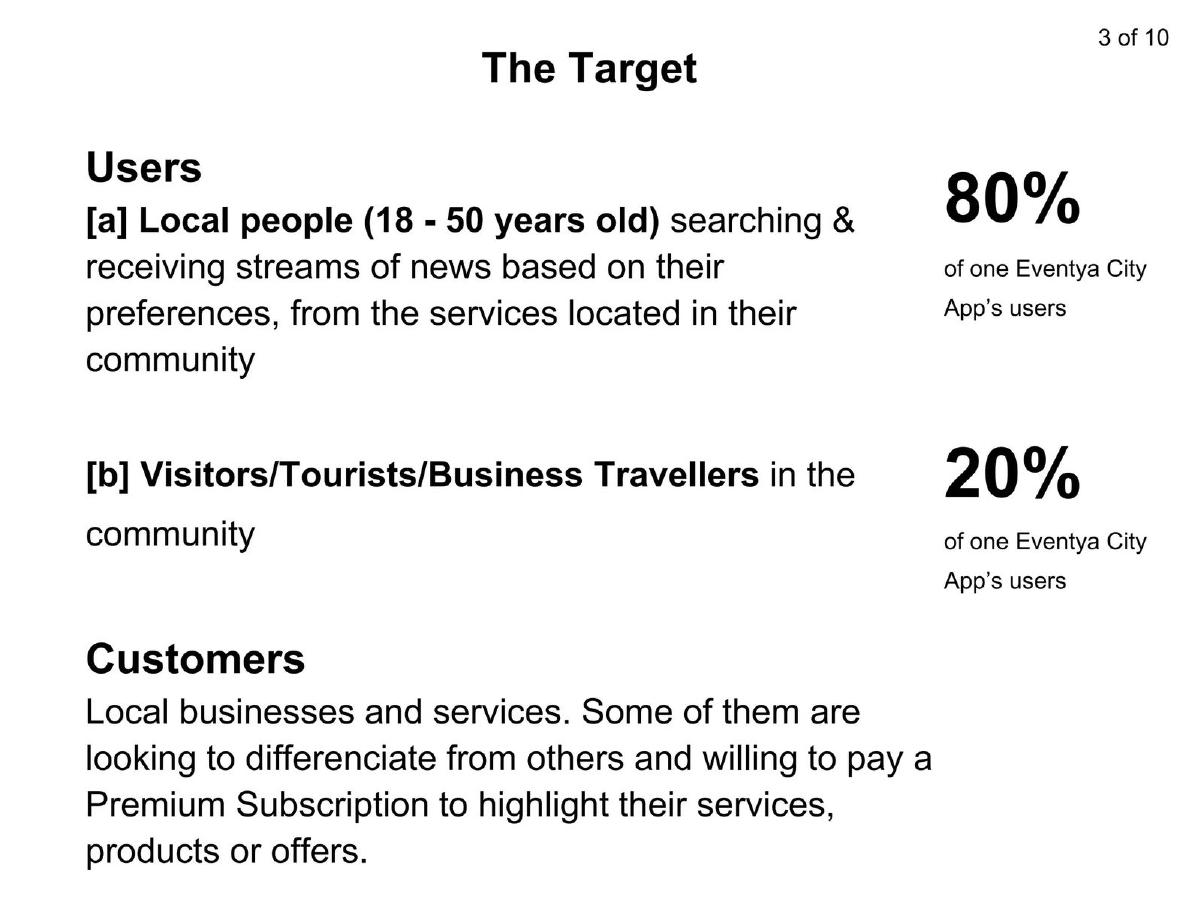
- The platform is positioned as a localized information system maintained by local people to serve needs within a 20 km radius (Slide 1, 2).
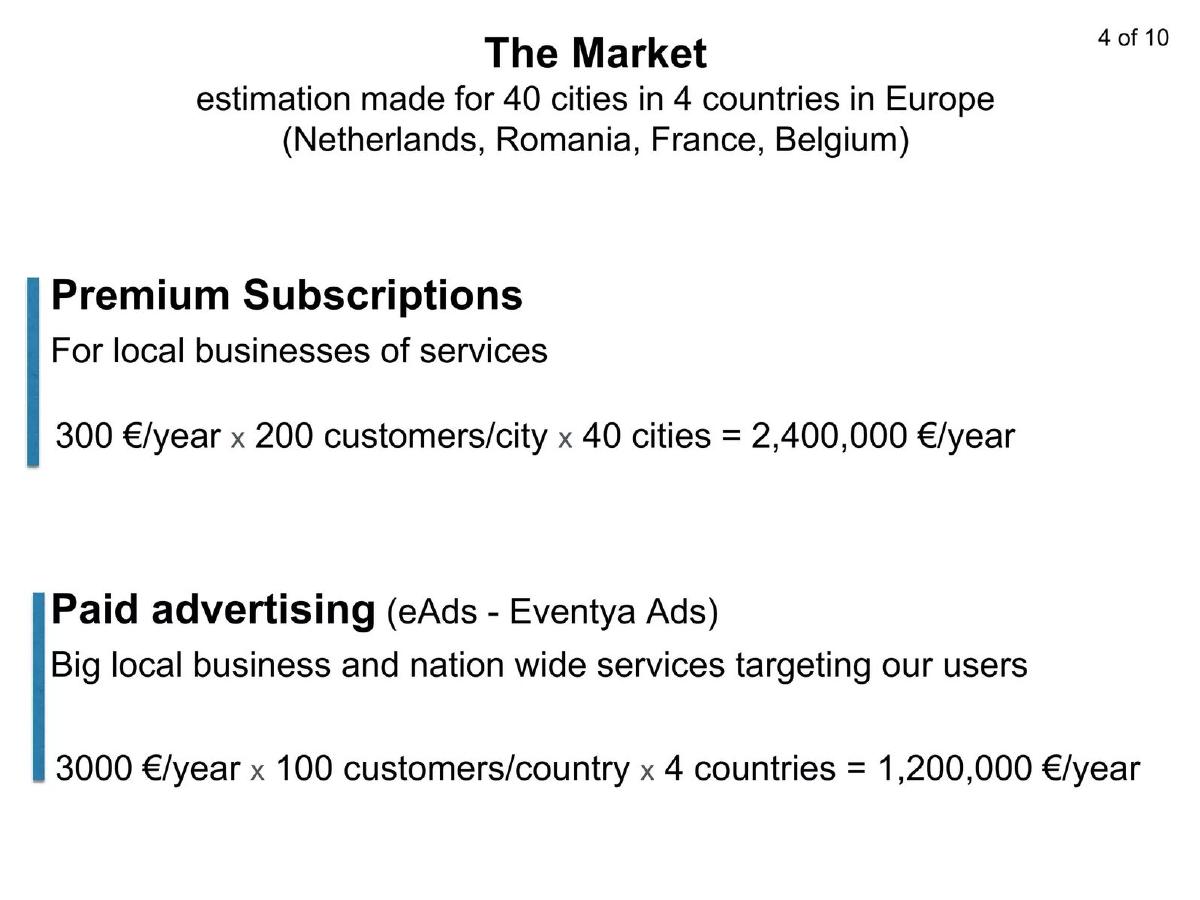
- Eventya targets a market of 40 cities across four European countries: Netherlands, Romania, France, and Belgium (Slide 4).
- Revenue projections are based on two tiers: €300/year for local service businesses and €3,000/year for nationwide advertisers (Slide 4).
- Current monthly income is stated at €2,500, with current expenses at €10,000 per month (Slide 6).
- The founders admit to working at only 30% capacity due to funding constraints, projecting expenses to rise to €25,000-€30,000 at full capacity (Slide 6).
- The team is large for an early-stage startup, consisting of 15 people including 7 developers and 3 marketing/PR staff (Slide 8).
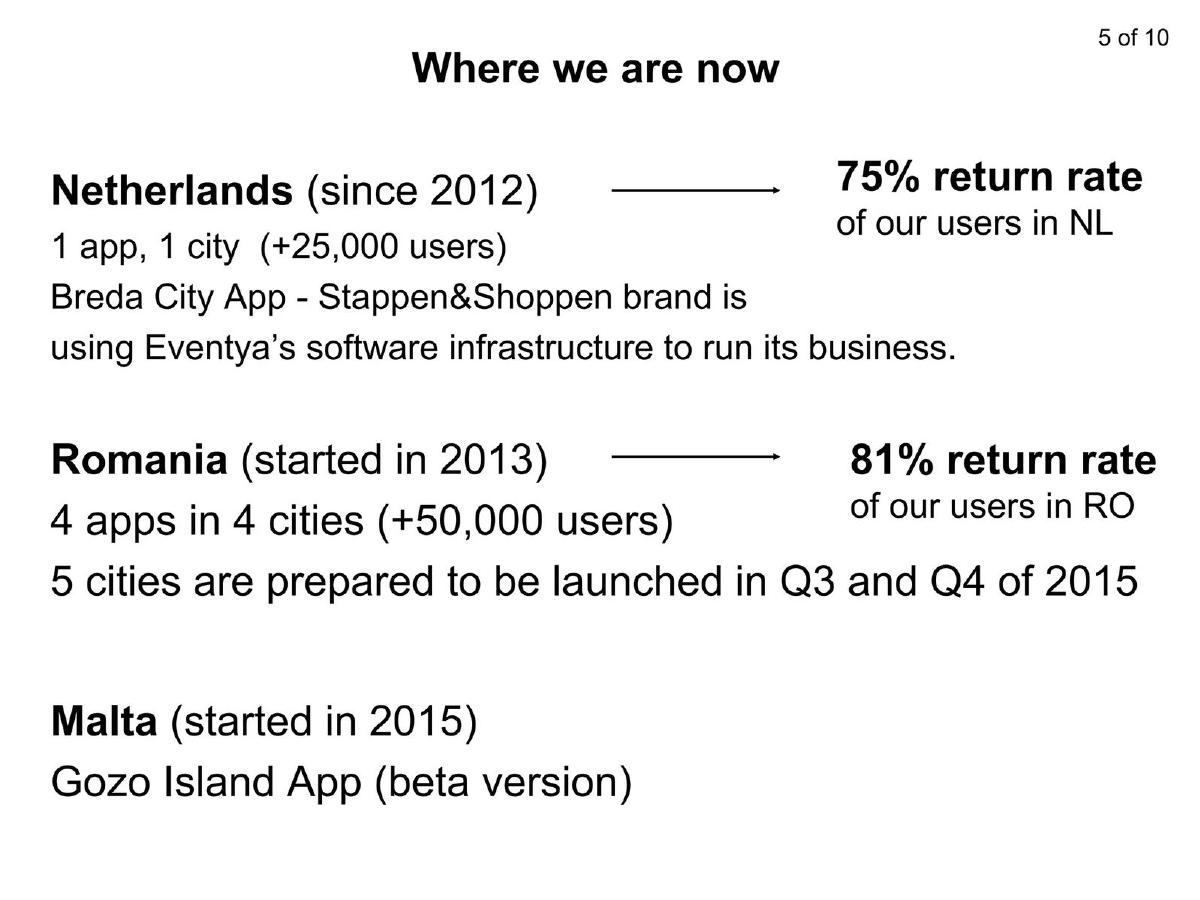
- The product is already live in multiple cities including Sibiu, Cluj-Napoca, Timișoara, Breda, and Gozo (Slide 10).
- The deck lacks a specific investment ask, valuation, or use-of-funds breakdown.
Introduction: The Hyper-Local Information Gap
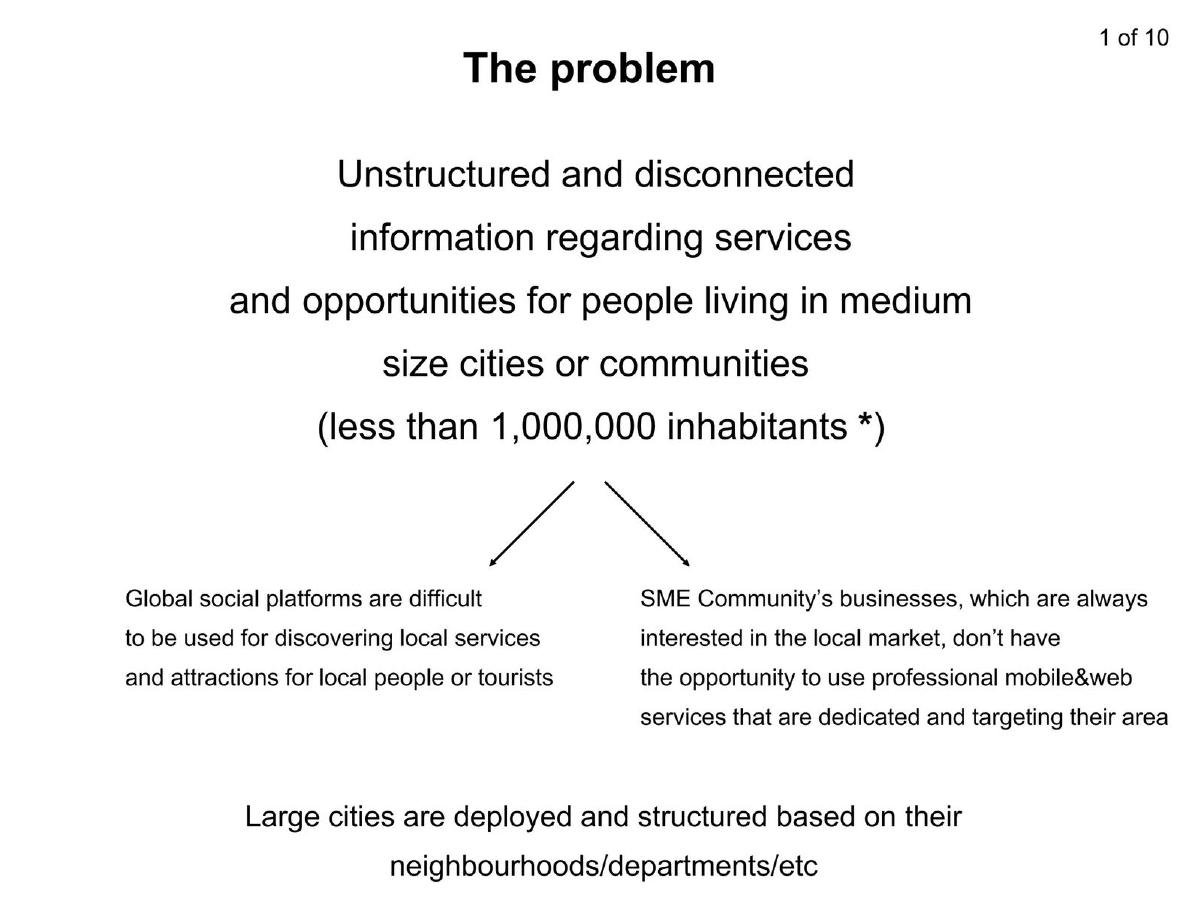
Eventya’s pitch deck, dated March 2016, addresses a specific niche in the mobile app market: the 'Digital Neighbourhood.' The premise is built on the statistic that the vast majority of consumer activity happens within a 20-kilometer radius. While global platforms like Facebook or Yelp cover these areas, Eventya proposes a white-label or template-based 'Information System' that allows local communities to own their digital presence. This teardown examines how they plan to scale this localized model across Europe.
Slide 1: The Hook
The deck opens with a strong, data-driven hook: "90% of the events, places & services you access are less than 20 km away." This immediately establishes the relevance of local search and discovery. The branding identifies the company as a "Digital Neighbourhood," which suggests a focus on community rather than just a directory. The logo is simple, featuring a stylized human figure, reinforcing the social aspect of the platform.
Slide 2: The Solution
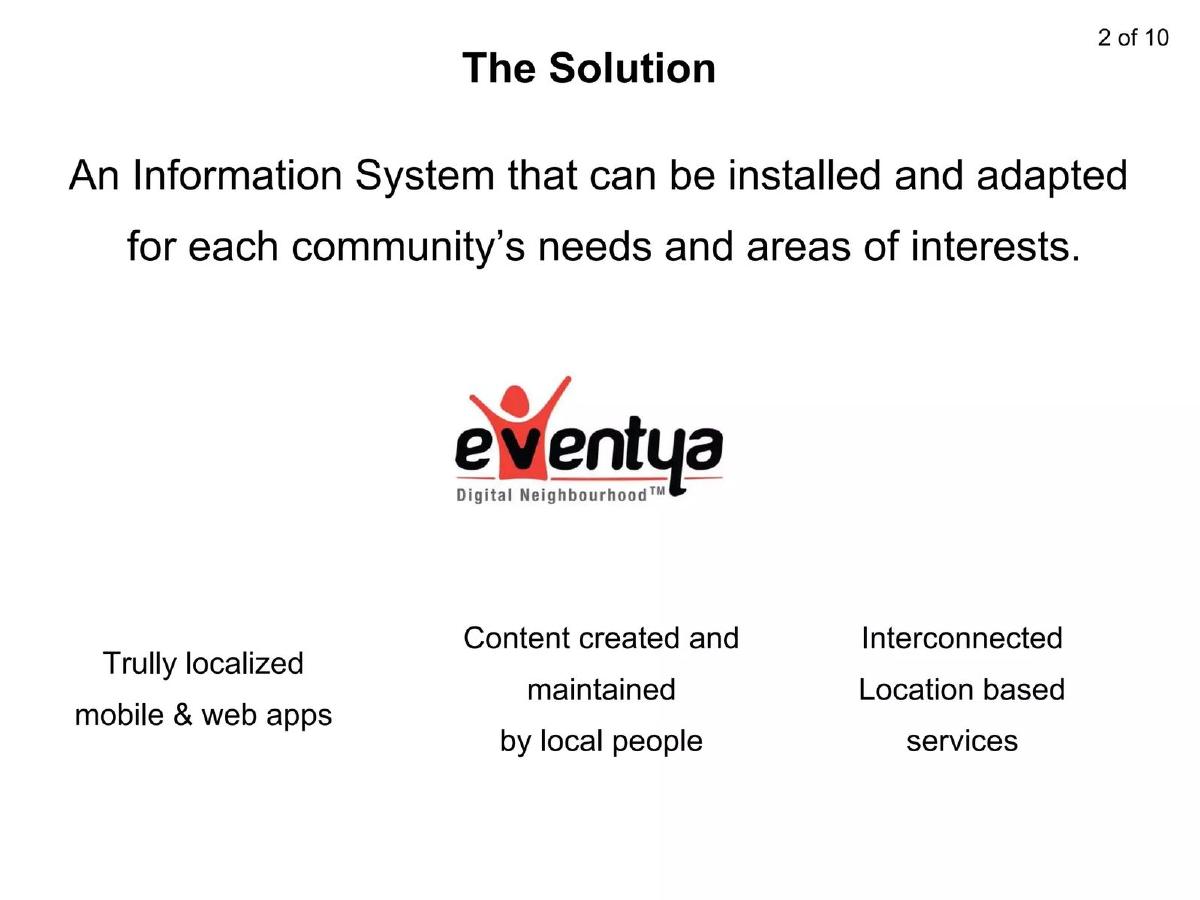
Slide 2 defines the product as an "Information System that can be installed and adapted for each community’s needs and areas of interests." The slide breaks the solution into three pillars:
Trully localized mobile & web apps: Emphasizing a multi-platform approach. · Content created and maintained by local people: A crowdsourced or community-managed content model, which reduces overhead for the parent company. · Interconnected Location based services: Suggesting that while the apps are local, they share a common technological backbone.
Slide 4: The Market and Revenue Model
This slide is a hybrid of market sizing and a business model. It focuses on a specific expansion plan: 40 cities in 4 countries (Netherlands, Romania, France, Belgium). The revenue math is presented clearly:
Premium Subscriptions: 300 €/year x 200 customers/city x 40 cities = 2,400,000 €/year. · Paid Advertising (eAds): 3000 €/year x 100 customers/country x 4 countries = 1,200,000 €/year.
The total projected revenue is €3.6 million. While the math is simple, the slide lacks the 'Bottom-Up' validation—there is no data provided to prove that 200 businesses per city are willing to pay €300 annually.
Slide 6: Financials and Transparency
This is perhaps the most honest slide in the deck. It lists an Average Monthly Income of 2,500 € and Average Monthly Expenses of 10,000 € . The founders explicitly state that the team is currently at 30% capacity due to "internal funding limitation." They project that moving to 100% capacity (15 people) would increase expenses to €25,000 - €30,000 per month. This level of transparency is rare; it tells the investor exactly why the money is needed (to unlock the full potential of the existing team) but also highlights a significant monthly burn relative to revenue.
Slide 8: The Team
The team slide shows a surprisingly large organization for a company making €2,500 a month. It lists 15 people: 3 founders, 7 developers, 3 Marketing/PR staff, 1 Datacenter manager, and 1 Business Advisor. Ionuț Munteanu is listed as a serial entrepreneur and software engineer. The presence of two existing investors (Popa Daniel and Julien Suquet) suggests that the company has already successfully raised some capital or has significant backing from the founders' previous ventures.
Slide 10: Traction and Proof of Concept
The final slide in this selection serves as the traction slide. It invites the reader to "Try our end-user apps" and lists five specific locations where the apps are live: Sibiu, Cluj-Napoca, and Timișoara in Romania; Breda in the Netherlands; and Gozo in Malta. By providing direct links to the App Store and Google Play, Eventya proves that the product is not 'vaporware' but a fully functional, deployed system. This mitigates the technical risk for a potential investor.
What Works in This Deck
1. Radical Financial Honesty: Most founders try to hide their limitations. Eventya’s admission that they are only at 30% capacity because they can't afford to pay their full team is a bold move. It frames the investment as a way to 'turn the lights on' for a team that is already built and ready to work.
2. Clear Geographic Focus: Instead of claiming they will conquer the world, they focus on 40 cities in 4 specific European countries. This makes the market entry strategy feel attainable and calculated.
3. Multi-Platform Readiness: By showing both iOS and Android availability across multiple regions, they demonstrate that their 'Information System' is scalable and capable of handling different languages and localizations.
What is Missing
1. The Ask: The most significant omission in these slides is a clear 'Ask.' How much money are they looking for? What is the valuation? Without this, the deck is a presentation of status rather than a fundraising tool.
2. Unit Economics: While they show the price of a subscription (€300), they don't show the cost to acquire a customer (CAC). In a hyper-local model, sales costs are often high because they require local boots on the ground. The deck doesn't explain how they will acquire 200 customers per city profitably.
3. Competitive Analysis: There is no mention of competitors. In 2016, Foursquare, Yelp, and even Facebook Local were significant threats. Eventya needs to explain why a local business would pay them €300 instead of spending that money on Facebook Ads.
4. User Metrics: While they show the apps exist, they don't show how many people are using them. Downloads, Daily Active Users (DAU), and retention rates are missing, which are critical for any B2C or 'Digital Neighbourhood' platform.
Founder's Playbook: What to Copy
Use the 'Radius' Hook: Slide 1 is a masterclass in setting the stage. If your business is local, start with a statistic that proves why 'local' matters. It grounds the problem in physical reality.
The 'Capacity' Argument: If you have a large team that is currently part-time or underpaid, using the '30% capacity' argument is a clever way to show latent value. It tells investors that their money isn't just going to 'hiring' (which is risky) but to 'activating' (which is lower risk).
Direct Links to Product: Always include App Store/Play Store badges if your product is live. It is the fastest way to build credibility and allows the investor to do immediate due diligence on the user experience.
Final Thoughts
Eventya’s deck is a product-heavy, transparent look at a startup that has built a significant team and a working product but is struggling with the 'valley of death' between launch and scale. The transparency regarding their 30% capacity is a double-edged sword: it shows a ready-to-go workforce, but it also signals a high burn rate if they cannot quickly achieve the sales targets outlined in Slide 4. To be successful, the missing slides would need to address the cost of sales and the specific user engagement metrics that prove the 'Digital Neighbourhood' is a place people actually want to visit.
Frequently asked questions
- What is the primary value proposition of Eventya?
- Eventya positions itself as a 'Digital Neighbourhood' platform. According to Slide 1, 90% of the events and services people access are within 20 km. The platform provides an information system that can be adapted for specific community needs, featuring localized mobile and web apps with content maintained by local residents.
- How does Eventya plan to generate revenue?
- The business model relies on two streams detailed on Slide 4. First, premium subscriptions for local businesses at €300 per year. Second, paid advertising (eAds) for large local or nationwide businesses at €3,000 per year. They estimate a potential of €3.6 million in annual revenue across 40 targeted cities.
- What is the current financial status of the company according to the deck?
- As of the deck's publication, Eventya was generating €2,500 in monthly income against €10,000 in monthly expenses. Slide 6 reveals the team was only operating at 30% capacity due to 'internal funding limitations,' suggesting the startup was in a 'lean' or survival mode while seeking investment to scale.
- Who is behind Eventya?
- The leadership includes CEO Ionuț Munteanu (a serial entrepreneur and software engineer), Architect Andrei Luca, and Project Manager Oana Munteanu. The team is supported by 15 total staff members and has existing investors from Romania and France, along with a US-based business advisor (Slide 8).
- Is the product functional or just a concept?
- The product is functional and deployed. Slide 10 lists active end-user apps available on the App Store and Google Play for cities in Romania (Sibiu, Cluj-Napoca, Timișoara), the Netherlands (Breda), and Malta (Gozo).