eToro’s investor presentation is a masterclass in late-stage scaling and public market readiness. Spanning 62 slides, the deck details the company's evolution from a niche trading tool to a 'Next Generation Social Investment Platform.' The data reveals an aggressive growth trajectory, with registered users jumping from 12.3 million in 2019 to 18.7 million by January 2021. A significant portion of the deck is dedicated to the FinTech Acquisition Corp. V partnership, showcasing the SPAC sponsor's track record with companies like Payoneer and CardConnect. Beyond historical metrics, eToro outline…
Key takeaways
- Registered users grew from 174k in 2008 to 18.7 million by January 2021, showing a massive acceleration in the final 24 months (Slide 15).
- The presentation introduces eToro Money, a debit card product designed to enable instant deposits/withdrawals and eliminate withdrawal fees (Slide 29).
- FinTech Acquisition Corp. V, the SPAC partner, highlights a track record of upsized PIPEs for companies like Payoneer ($300M) and Metromile ($170M) (Slide 08).
- Average monthly churn has stabilized at 1.5% from 2018 through 2020, with a projected 1.5% through 2025 (Slide 43).
- The 2017 crypto rally caused a significant spike in accumulated average revenue, creating an outlier year compared to the 2018-2020 cohorts (Slide 43).
- The deck includes an extensive 'Risk Factors' section, with Slide 50 detailing operational risks and Slide 57 focusing on digital asset vulnerabilities.
- eToro positions itself as a community-driven platform where users 'connect and learn from each other' via free virtual accounts (Slide 15).
- The company projects a long-term ARPU model of $1,138 by month 35 for its funded account cohorts (Slide 43).
Introduction: The Social Trading Giant Goes Public
The eToro investor presentation is a comprehensive 62-slide document designed for a public market debut via a Special Purpose Acquisition Company (SPAC). The deck transitions from a high-level vision of social investing to granular cohort data and exhaustive risk disclosures. It serves as a bridge between eToro’s origins as a retail trading platform and its future as a diversified fintech ecosystem.
Slide 1: Vision and Branding
The title slide establishes the core identity: "Next Generation Social Investment Platform." The use of the signature lime green branding is consistent throughout the deck. By leading with "Social Investment," eToro differentiates itself from traditional discount brokers like Charles Schwab or ETRADE, signaling that its value lies in the network effect of its user base rather than just execution speed or low fees.
Slide 08: The SPAC Partner – FinTech Acquisition Corp. V
This slide focuses on the credibility of the merger partner. It lists four key pillars: Strong strategic partner, Leader in the SPAC market, Experienced leadership team, and an Impressive track record. The bottom of the slide provides concrete proof points of the sponsor's past successes, including a +90% return for CardConnect and a +65% return for Intermex. It also notes upsized PIPEs (Private Investment in Public Equity) for Paya ($250M), Perella Weinberg Partners ($125M), Metromile ($170M), and Payoneer ($300M). This is a standard but vital inclusion in SPAC decks to reassure investors that the deal is backed by seasoned operators.
Slide 15: Exponential User Growth
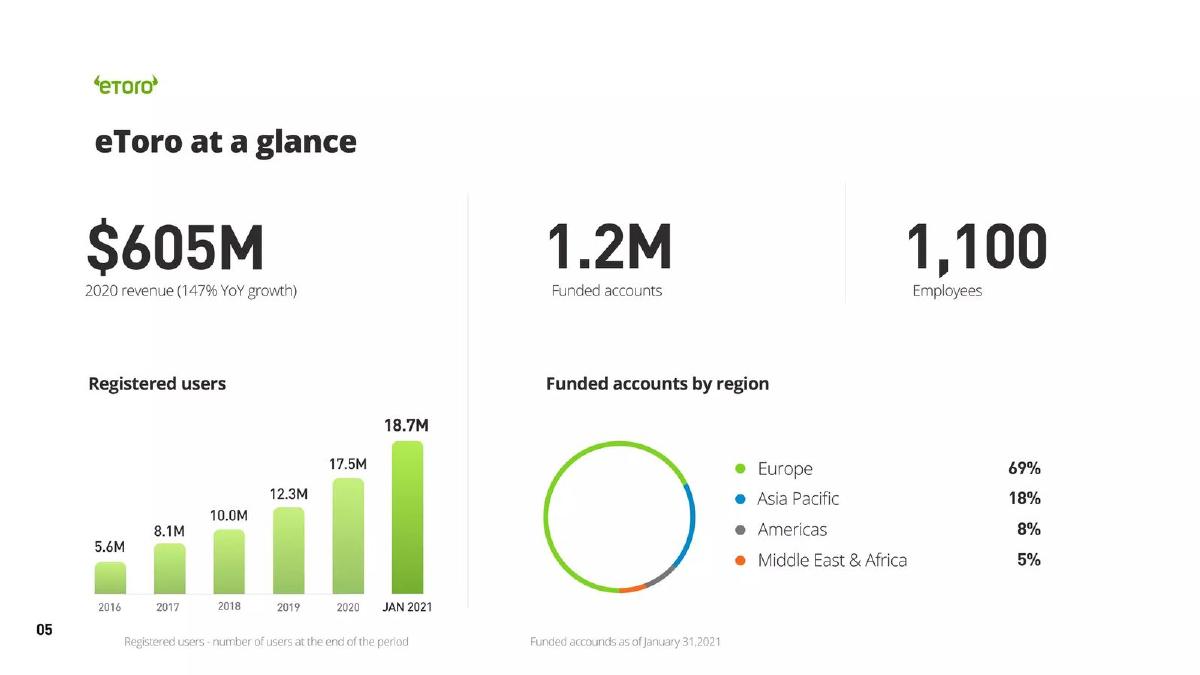
This is the "hockey stick" slide every investor looks for. It tracks registered users from 2008 to January 2021. The growth is steady but modest for the first decade, reaching 5.6M in 2016. However, the acceleration from 2019 (12.3M) to 2020 (17.5M) and then to 18.7M by January 2021 demonstrates a massive influx of retail interest. The slide also mentions that users have access to a "free virtual account," which serves as a top-of-funnel lead magnet to build user confidence before they commit real capital.
Slide 29: Product Expansion – eToro Money
The "Product Overview" section introduces eToro Money . The slide states that in 2021, the company plans to introduce a debit card to create a "holistic customer experience." Key features highlighted include instant deposit/withdrawal, competitive currency conversion rates, and no withdrawal fees. The visual shows a sleek black Visa debit card and a mobile interface with a balance of $36,524.82. This move is clearly aimed at increasing user retention and capturing a larger share of the user’s financial life beyond just active trading.
Slide 43: Unit Economics and Cohort Stability
This is perhaps the most data-dense slide in the deck. It tracks Accumulated average revenue over time by cohort year (2017-2020). While the 2017 line is a clear outlier due to the "2017 crypto rally," the 2018, 2019, and 2020 lines show a consistent, upward trajectory. The table in the top right shows that Average monthly churn dropped from 2.8% in 2017 to a stable 1.5% in 2018, 2019, and 2020. The company models this 1.5% churn rate to continue through 2025, projecting a month-35 ARPU of $1,138 . This stability is meant to counter the narrative that retail trading platforms are purely cyclical and prone to massive user flight during market downturns.
Slides 50 & 57: The Reality of Risk
As a document intended for public markets, the deck includes a massive "Risk Factors" section. Slide 50 outlines operational risks, noting that results "fluctuate due to market volatility" and that "historical growth rates may not be indicative of our future growth." It specifically mentions the impact of the COVID-19 outbreak on 2020 results. Slide 57 dives into the technical risks of digital assets, including "loss or destruction of a private key," "blockchain forks," and the potential for "smart contract-based digital assets" to fail. The inclusion of 12 full slides of risks is a regulatory necessity but also provides a sobering look at the complexities of running a global, multi-asset trading platform.
What eToro Does Well
The deck excels at balancing high-level vision with deep-dive metrics. By showing the 2017 crypto spike as an outlier on Slide 43, eToro actually gains credibility; they aren't trying to hide the volatility of their past, but rather show how the underlying business has stabilized since then. The clear distinction between "Registered Users" and the path to "Real Capital" (Slide 15) shows a sophisticated understanding of their user acquisition funnel. Furthermore, the transition from a trading app to a "holistic" financial service (Slide 29) provides a clear narrative for future growth that doesn't rely solely on adding more traders.
What is Missing from the Deck
While the deck is 62 slides long, the nine slides provided omit several key areas. There is no specific Team Slide in this selection, which is unusual for a growth-stage company, though the SPAC sponsor's team is mentioned. There is also a lack of Competitor Comparison . While eToro calls itself "Next Generation," it doesn't explicitly show how its fees or social features stack up against Robinhood, Coinbase, or Plus500. Finally, the Unit Economics are shown as revenue per cohort, but the deck (in this selection) does not explicitly state the Customer Acquisition Cost (CAC) , making it difficult to calculate the true LTV/CAC ratio.
What Founders Should Copy
Cohort Analysis: If you have a subscription or recurring revenue model, use a chart like Slide 43. Showing that different yearly cohorts behave similarly proves that your growth is a result of a repeatable process, not just a lucky market moment. · Product Roadmap as Strategy: Don't just list features; show how a new product (like eToro Money on Slide 29) solves a specific business problem (like withdrawal friction) and expands your TAM. · Transparency on Outliers: If your revenue had a massive spike due to a one-time event (like a crypto bull market or a pandemic), label it. Investors will find it anyway; labeling it yourself allows you to control the narrative. · Visual Consistency: The deck uses a limited color palette and clean, professional typography. For a 62-slide deck, this consistency is vital to prevent "investor fatigue."
Frequently asked questions
- What is the primary value proposition eToro presents to investors?
- eToro positions itself as the 'Next Generation Social Investment Platform.' Unlike traditional brokerages, it emphasizes the community aspect, where 18.7 million users (as of Jan 2021) can connect, learn, and copy trades. The deck argues that this social layer drives higher engagement and lower churn compared to legacy platforms.
- How does eToro plan to expand its product ecosystem?
- Slide 29 introduces 'eToro Money,' a strategic move to become a holistic financial hub. By launching a Visa debit card, eToro aims to capture more 'share of wallet' through instant deposits, competitive currency conversion, and the removal of withdrawal fees, effectively moving from a trading app to a primary spending account.
- What do the cohort metrics reveal about eToro's revenue stability?
- Slide 43 shows that while the 2017 crypto rally was a massive revenue outlier, the subsequent cohorts (2018-2020) have shown remarkably consistent growth in accumulated average revenue. Churn has also remained steady at 1.5% for three consecutive years, suggesting a predictable and scalable business model.
- Who is the SPAC sponsor and what is their history?
- The partner is FinTech Acquisition Corp. V. Slide 08 highlights their deep expertise in the sector, citing successful outcomes like a +90% return for CardConnect and significant upsized PIPEs for other fintech leaders. This slide is intended to build institutional trust in the merger's leadership.
- What are the biggest risks identified in the presentation?
- The deck is unusually thorough regarding risks. Key concerns include market volatility affecting trading activity (Slide 50), the difficulty of managing rapid growth, and specific digital asset risks like private key loss, blockchain forks, and smart contract failures (Slide 57).