Estasharah is a telehealth platform designed to connect patients with doctors via a mobile interface, specifically utilizing Facebook Messenger as a primary entry point. The deck, dating from late 2018, leans heavily on product screenshots to demonstrate the user journey, from initial medical history intake to payment and doctor response. While the deck provides a clear view of the 'Medicobot' interface and a dual-revenue stream consisting of high-margin commissions (40-60%) and advertising, it lacks critical investor data. There is no mention of market size, current traction, financial proje…
Key takeaways
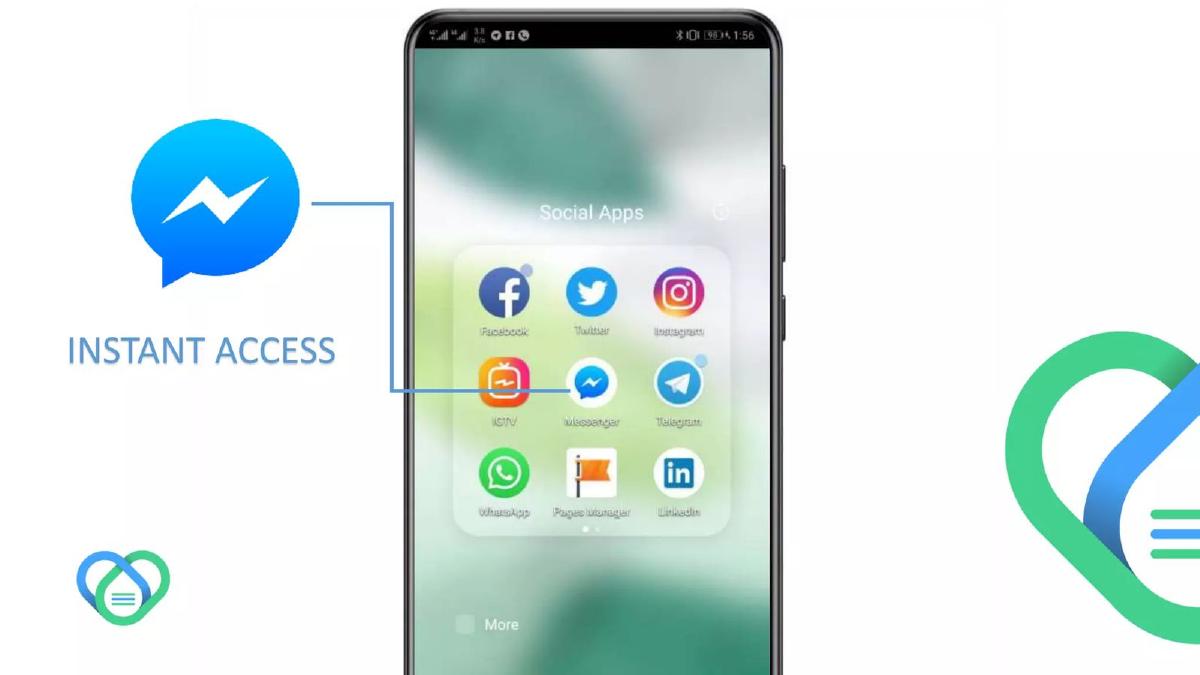
- The platform utilizes Facebook Messenger for 'Instant Access,' suggesting a low-friction user acquisition strategy (Slide 2).
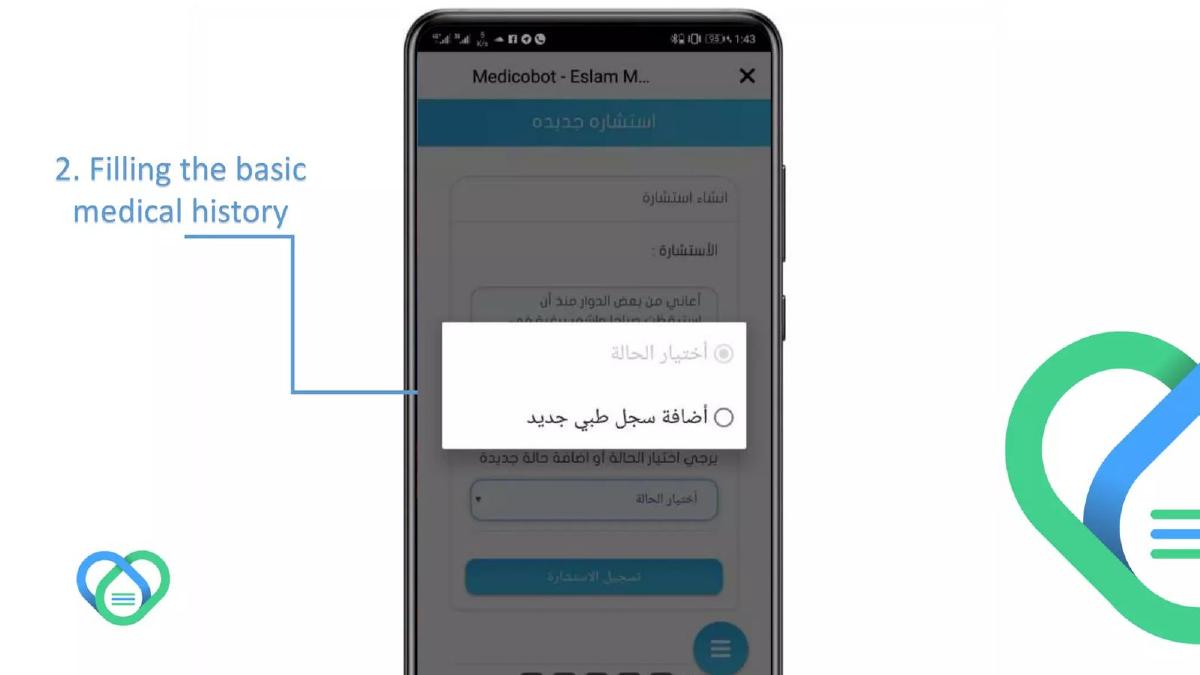
- The user onboarding process includes a detailed digital medical history form to customize consultations (Slide 3).
- Consultation pricing is tiered, with a standard option at L.E 25 and a 'Plus' option at L.E 39 (Slide 4).
- The doctor-facing interface allows for structured responses, including fields for medication, dosage, and required scans or tests (Slide 5).
- Estasharah identifies Altibbi and Vezeeta (indicated by the Cura logo) as primary competitors in the regional market (Slide 6).
- The business model relies on a significant commission rate of 40% to 60% on consultations (Slide 7).
- A secondary revenue stream is planned through 'Online Marketing for Doctors' via ads on the Medicobot platform (Slide 7).
- The team is fully staffed across technical roles, including Back-End, Front-End, and Android developers, alongside a Social Media Specialist (Slide 8).
Estasharah Pitch Deck Analysis
The Estasharah pitch deck from November 2018 serves primarily as a product walkthrough for a telehealth solution focused on the Egyptian market. While the visual identity is consistent, the deck functions more as a functional specification or a sales presentation than a traditional venture capital pitch. It lacks the macro-economic data and traction metrics usually required to secure institutional funding, focusing instead on the mechanics of the 'Medicobot' interface.
Slide 1: Title Slide
The title slide features the Estasharah logo, which incorporates a heart shape and a chat bubble icon, signaling the intersection of healthcare and communication. The Arabic tagline 'دكتورك بين يديك' translates to 'Your doctor in your hands,' reinforcing the mobile-first nature of the service. The design is clean, using a palette of blue and green, which are standard colors for the healthcare technology sector.
Slide 2: Instant Access
This slide highlights the entry point for users. Rather than requiring a standalone app download immediately, Estasharah points to Facebook Messenger as a primary channel for 'Instant Access.' This is a strategic choice for the 2018 Egyptian market, where Facebook usage was high, and reducing friction for first-time users is critical for adoption. The slide uses a smartphone mockup to show the Messenger icon within a 'Social Apps' folder.
Slide 3: Medical History Intake
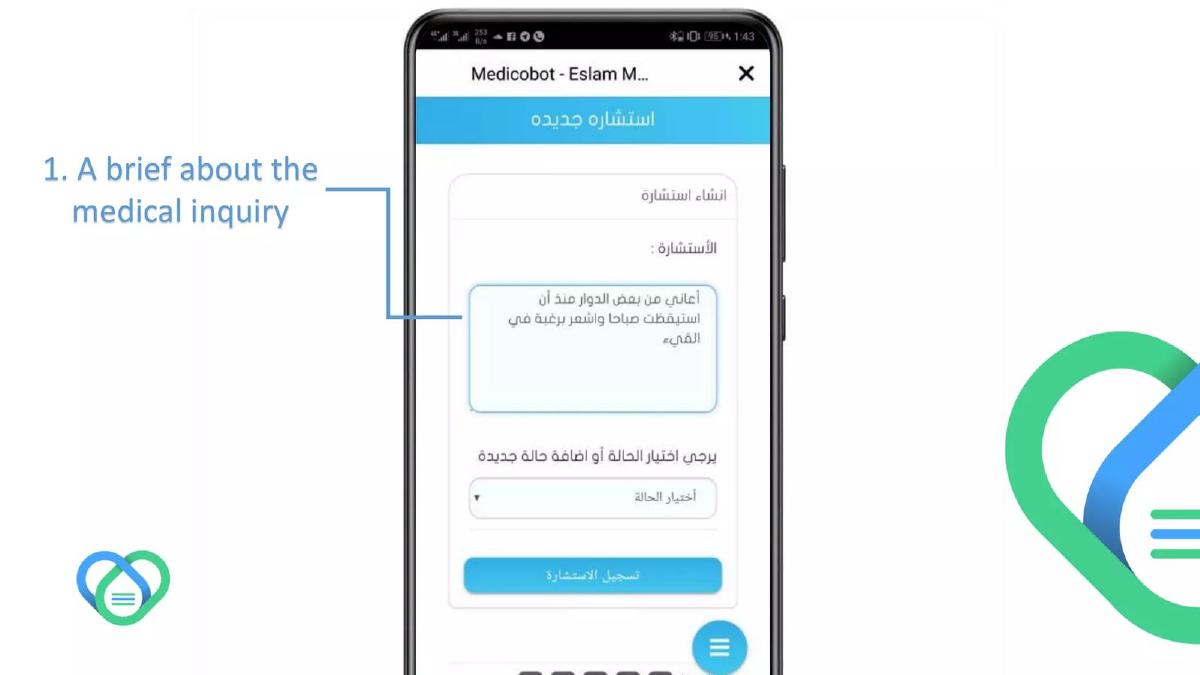
Slide 3 demonstrates the second step of the user journey: 'Filling the basic medical history.' The screenshot shows an Arabic form within the 'Medicobot' interface. Fields appear to include location (Egypt, Giza, Dokki), date of birth, and gender. This step is vital for telehealth platforms to ensure that the consulting physician has context before the interaction begins, potentially improving the quality of the advice given.
Slide 4: Monetization and Tiers
This slide, titled '5. Paying for the consultation,' reveals the pricing strategy. Two tiers are shown: a standard consultation for L.E 25 (approximately $1.40 USD in 2018) and a 'Plus' consultation for L.E 39 (approximately $2.20 USD). The 'Plus' option promises a faster and more detailed response. The presence of a '35% discount' badge on the Plus tier suggests an active promotional strategy to upsell users to the higher-margin service.
Slide 5: The Doctor's Response
Slide 5 shows the interface from the physician's perspective or the resulting output for the patient. Titled '3. Answering Patient,' the screen includes a text area for the doctor's advice and structured fields for 'Medication Name,' 'Dosage,' 'Scan Name,' and 'Test Name.' This structured data approach is superior to simple text chat, as it allows for better record-keeping and potential integration with pharmacies or diagnostic labs in the future.
Slide 6: Competitive Positioning
The company uses a four-circle Venn-style diagram to position itself. The core attributes claimed are High Responsive, Remoteness Accessibility, All Medical Specializations, and Customized to Medical History. To the right, the logos of Altibbi and Cura are displayed. While it identifies these competitors, the slide fails to explain why Estasharah is better than these well-funded incumbents, other than the four general adjectives provided.
Slide 7: Business Model
The business model is presented through two overlapping circles. The primary revenue driver is 'Commissions' at a rate of 40% - 60% on consultations. This is an exceptionally high commission rate for a marketplace, which usually ranges between 15% and 30%. The second revenue stream is 'Ads,' specifically 'Online Marketing for Doctors on Medicobot.' This suggests a B2B play where doctors pay for lead generation or featured placement within the bot.
Slide 8: Team Composition
The final slide in this selection introduces the team. It is a large team for an early-stage startup, featuring eight individuals. The leadership includes Eslam M. Youssef (CEO), Ahmed Said (CMO), and Ahmed Ibrahim (CTO). The technical side is well-represented with a Back-End Developer, Front-End Developer, and Android Developer. The inclusion of a Social Media Specialist and a Product Manager suggests the company was focused on both product iteration and user acquisition via social channels.
What Estasharah Does Well
The deck excels at explaining the product flow. By using actual screenshots of the 'Medicobot,' the founders remove any ambiguity about how the service works. The integration with Facebook Messenger is a smart 'Trojan Horse' strategy for market entry in regions with high social media penetration but lower app-store engagement. Furthermore, the business model slide is refreshingly direct about their take rate, even if that rate is aggressively high.
What is Missing from the Deck
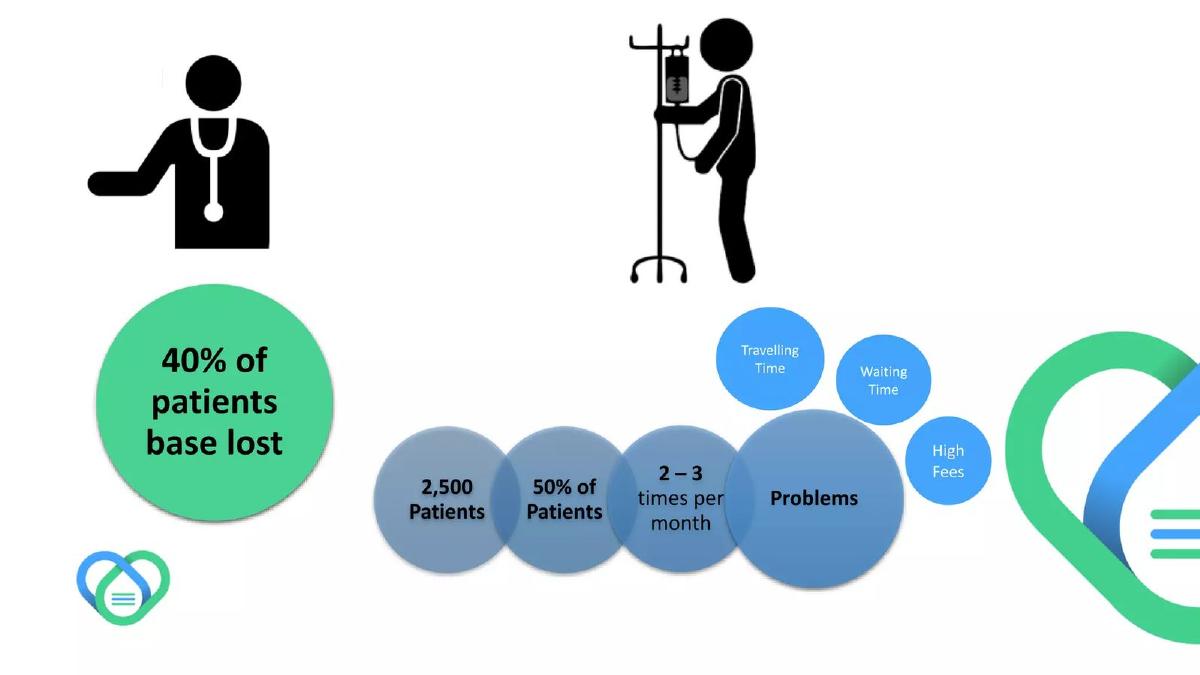
As a fundraising tool, this deck is incomplete. The most glaring omission is the lack of a 'Problem' slide; we are shown a solution without being told the scale of the inefficiency it solves. There is no data on the Egyptian healthcare market, the number of doctors available, or the target demographic's spending habits. Most importantly, there is no traction slide. Investors need to know how many consultations have been completed, the customer acquisition cost (CAC), and the lifetime value (LTV) of a user. Finally, the absence of a 'Funding Ask' means the deck fails to communicate what the founders actually want from the reader.
Founder Takeaways
Show, Don't Just Tell: Using screenshots to walk through a user journey is highly effective for technical products. It proves the product exists and is functional. · Address the Incumbents: Simply listing competitors isn't enough. Founders should use a comparison table to show specific feature advantages or price-point superiorities. · Be Realistic with Commissions: A 60% commission is difficult to sustain as you scale, as it incentivizes service providers (doctors) to move off-platform. Founders should justify such high rates with high-value services. · Include the 'Why Now': A pitch deck needs to explain why this is the right moment for this specific solution. Estasharah missed an opportunity to discuss the digital transformation of the MENA region. · Don't Forget the Ask: Every pitch deck must end with a clear request for capital, including the amount, the instrument (SAFE, Equity), and the milestones that capital will achieve.
Frequently asked questions
- What is the primary value proposition of Estasharah?
- Based on Slide 6, the company focuses on four pillars: High Responsiveness, Remoteness Accessibility, All Medical Specializations, and consultations that are Customized to Medical History. By integrating with social platforms like Messenger, they aim to provide immediate medical advice without the need for physical travel, leveraging a bot-assisted intake process to ensure doctors have relevant data before responding.
- How does the company generate revenue?
- According to Slide 7, the revenue model is two-fold. The primary source is a commission on consultations, which ranges from 40% to 60% of the fee paid by the patient. The secondary source is advertising, specifically described as 'Online Marketing for Doctors on Medicobot,' allowing practitioners to pay for visibility within the platform's ecosystem.
- What is the user experience for a patient?
- The deck outlines a five-step process: entering via a social app (Slide 2), filling out a medical history (Slide 3), selecting a consultation package (Slide 4), paying the fee, and receiving an answer from a doctor (Slide 5). The interface shown is in Arabic, indicating a primary focus on the Middle East and North Africa (MENA) market, specifically Egypt, given the L.E (Egyptian Pound) currency.
- Who are the key competitors mentioned in the deck?
- Slide 6 explicitly shows the logos for Altibbi and Cura. These are established players in the MENA telehealth space. Estasharah attempts to differentiate itself through its high responsiveness and the depth of medical history customization, though the deck does not provide a feature-by-feature comparison matrix to prove these advantages.
- What critical information is missing from this pitch deck?
- The deck is missing several fundamental investment slides. There is no 'Ask' slide detailing how much capital is being raised or how it will be used. Furthermore, it lacks a 'Problem' slide to quantify the pain point, a 'Market Size' (TAM/SAM/SOM) slide, 'Traction' metrics (user growth, revenue to date), and 'Financial Projections' for future years.