The ERPNext Demo Day deck from June 2012 is not a traditional venture capital pitch deck, but rather a progress report for a 'Demo Day' audience. Spanning just 8 slides, it bypasses standard investor tropes like market sizing or competitive moats to focus on the 'how' of the business. The presentation details a significant architectural shift from 'wnframework' to 'wnlib,' the adoption of Jinja2 for templating, and the recruitment of the company's first dedicated sales and marketing hire. It serves as a historical artifact of a technical founder transitioning from pure development to organiza…
Key takeaways
- The deck focuses on a technical migration from 'wnframework' to 'wnlib,' citing 'hand-written modules' and 'awkward MVC architecture' as primary motivations (Slide 2).
- A dual-release strategy was employed to manage the framework transition, allowing parts of the system to remain in the old model while others moved to the new one (Slide 3).
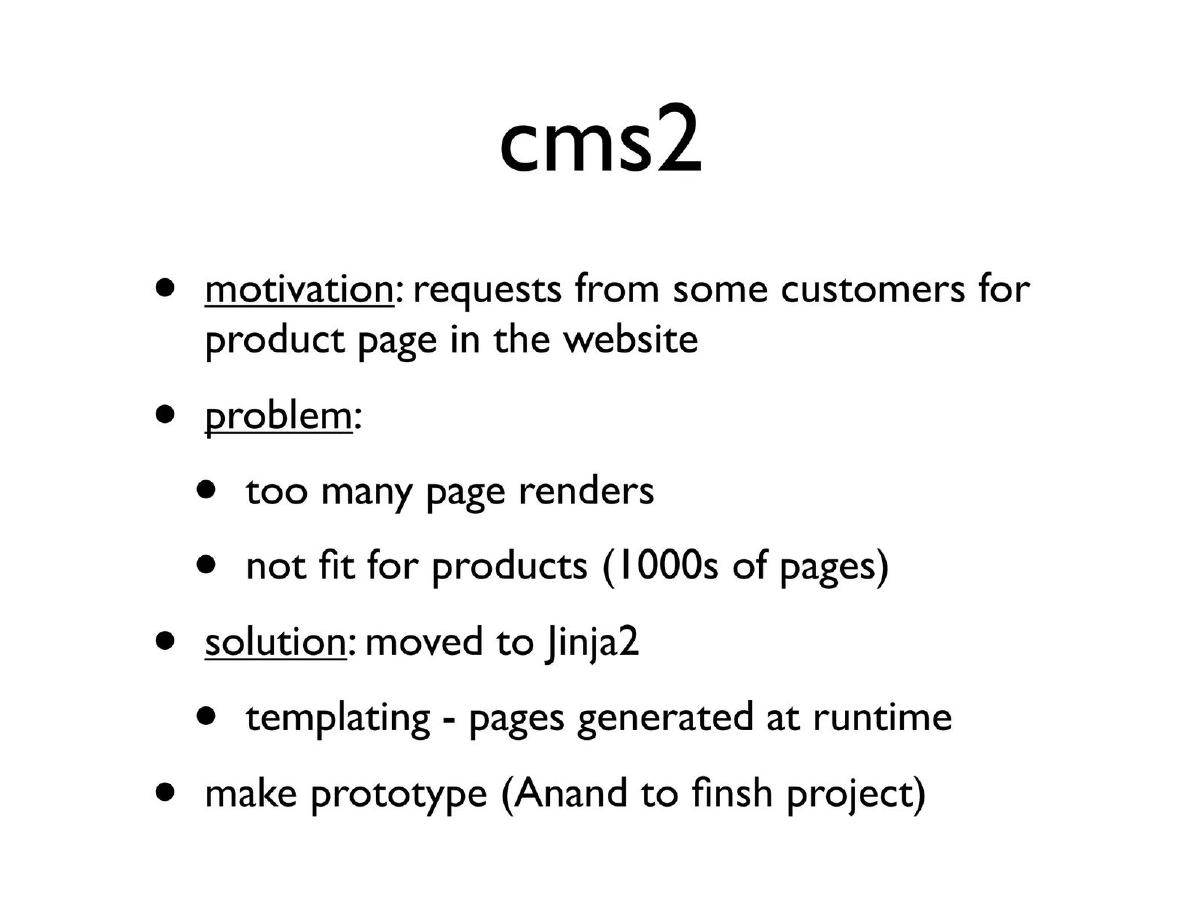
- Customer demand for product pages drove a CMS overhaul, moving to Jinja2 to handle thousands of pages and runtime generation (Slide 4).
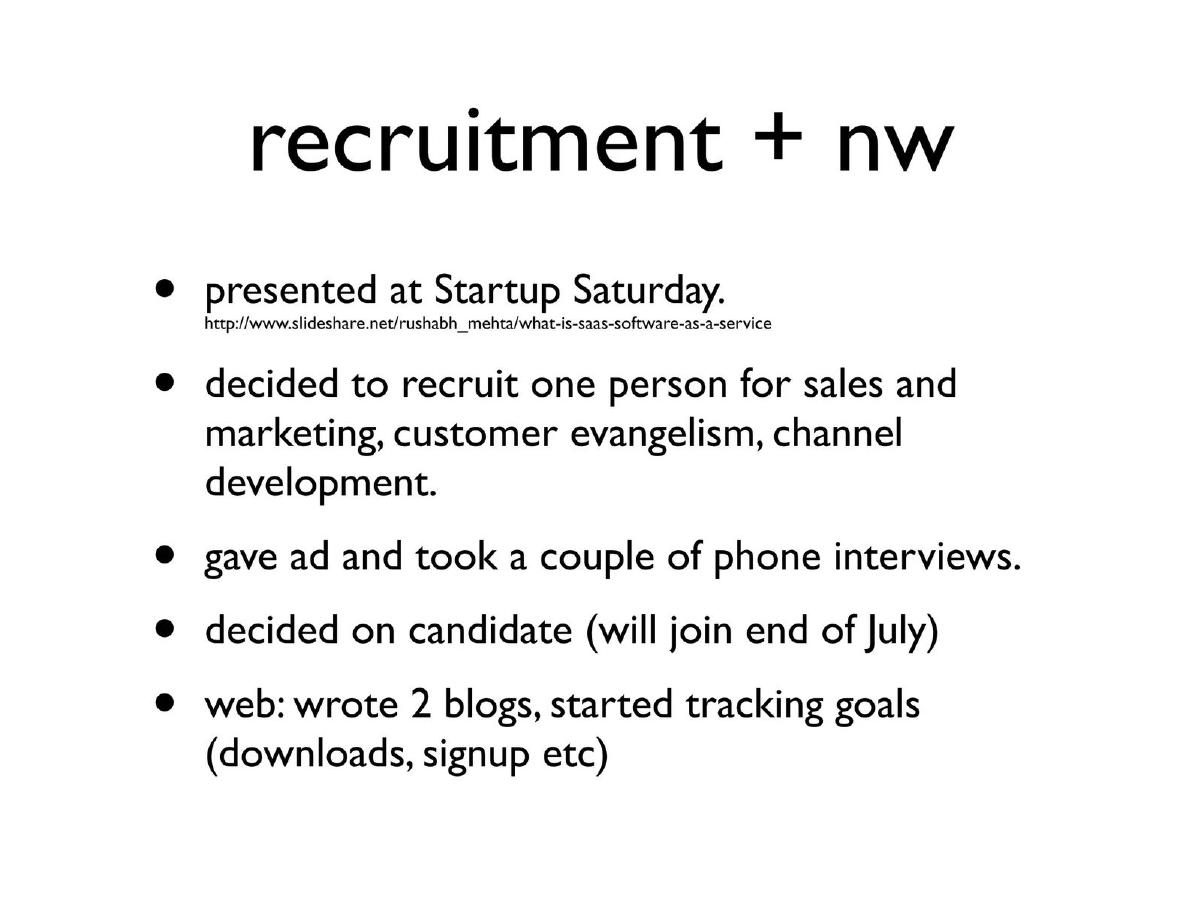
- The company initiated its first non-technical hire for sales, marketing, and customer evangelism, with the candidate set to join in July 2012 (Slide 5).
- Early marketing efforts were minimal, consisting of two blog posts and the start of tracking downloads and signups (Slide 5).
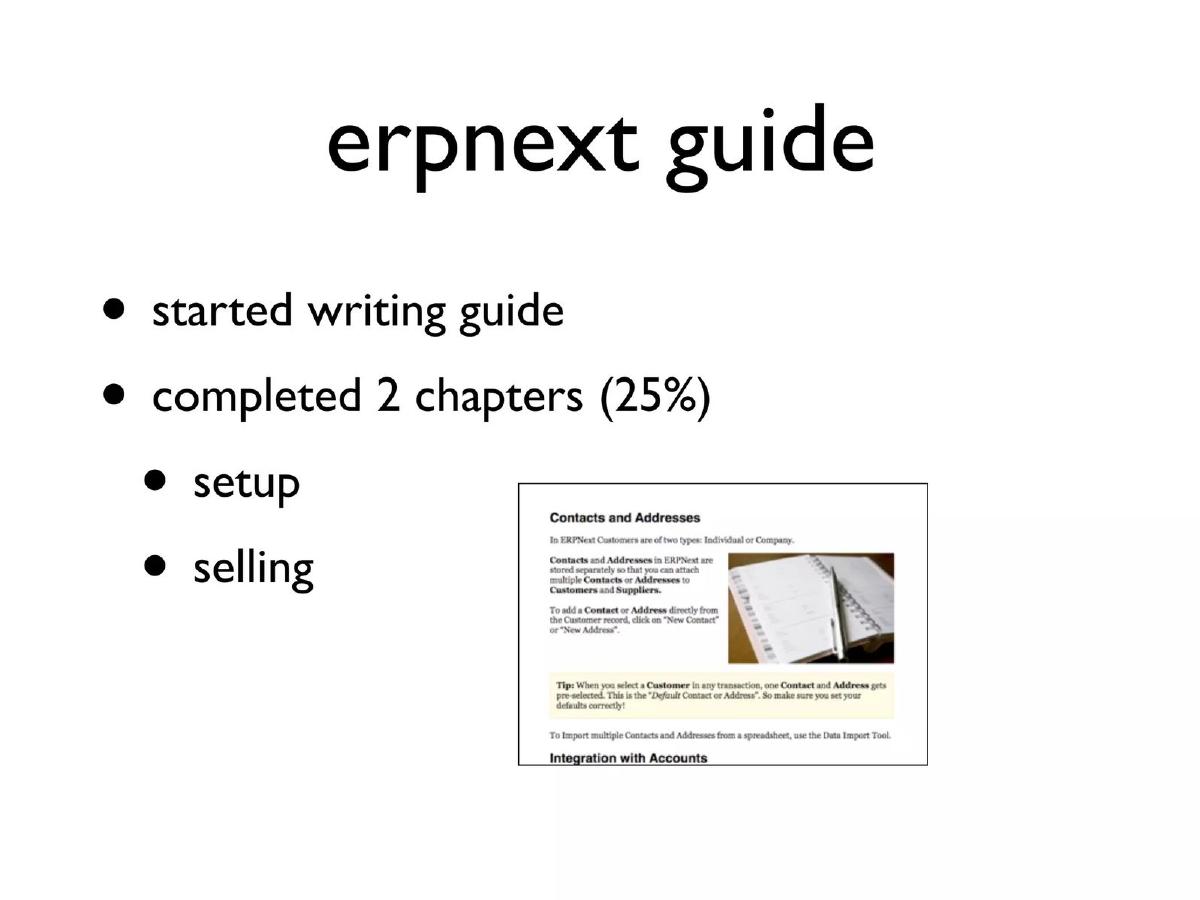
- Documentation was a priority, with 25% of an 'erpnext guide' completed, covering setup and selling (Slide 6).
- The deck lacks all standard financial metrics, including revenue, burn rate, valuation, and a specific funding ask.
- There is no mention of market size, competition, or the long-term business model, focusing entirely on immediate technical and operational tasks (Slide 7).
Introduction: The Raw Reality of Early-Stage Development
The ERPNext Demo Day deck from June 2012 is a minimalist, 8-slide presentation that offers a window into the technical evolution of an open-source project. Unlike modern pitch decks that are often over-designed and heavy on market hyperbole, this deck is strictly functional. It was presented by Rushabh Mehta and focuses on the granular details of software architecture, documentation, and the first steps toward building a commercial team.
Slide 1: Title Slide
The title slide is as sparse as possible. It contains the text "demo day" , the date "27th June" , and the name "Rushabh Mehta" . There is no company logo, no tagline, and no visual branding. This sets the tone for a presentation that is intended for an audience already familiar with the project, likely a developer community or a small group of early supporters.
Slide 2: Framework n+1 - Motivation and Solution
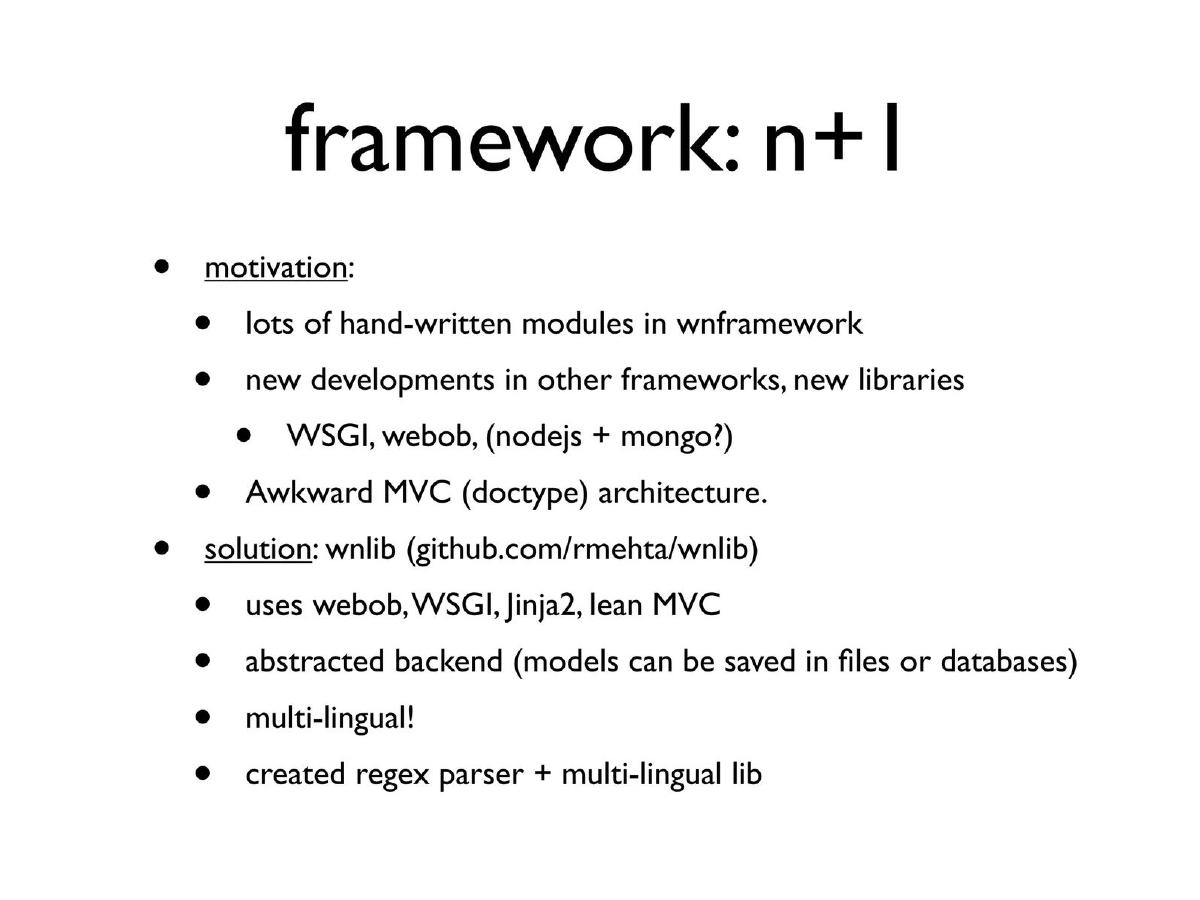
This slide dives immediately into technical debt. The heading "framework: n+1" refers to the next iteration of the software's core. Under "motivation," Mehta lists the reliance on "lots of hand-written modules in wnframework" and an "Awkward MVC (doctype) architecture." The slide also mentions the need to adopt new developments like "WSGI, webob, (nodejs + mongo?)" .
The "solution" is identified as "wnlib," with a direct link to a GitHub repository. The new framework is described as using "webob, WSGI, Jinja2, lean MVC" and featuring an "abstracted backend" where models can be saved in files or databases. It also highlights a "multi-lingual" capability and a "created regex parser." This is a developer-to-developer slide, focusing on the efficiency and modernization of the codebase.
Slide 3: Framework n+1 - Implementation Strategy
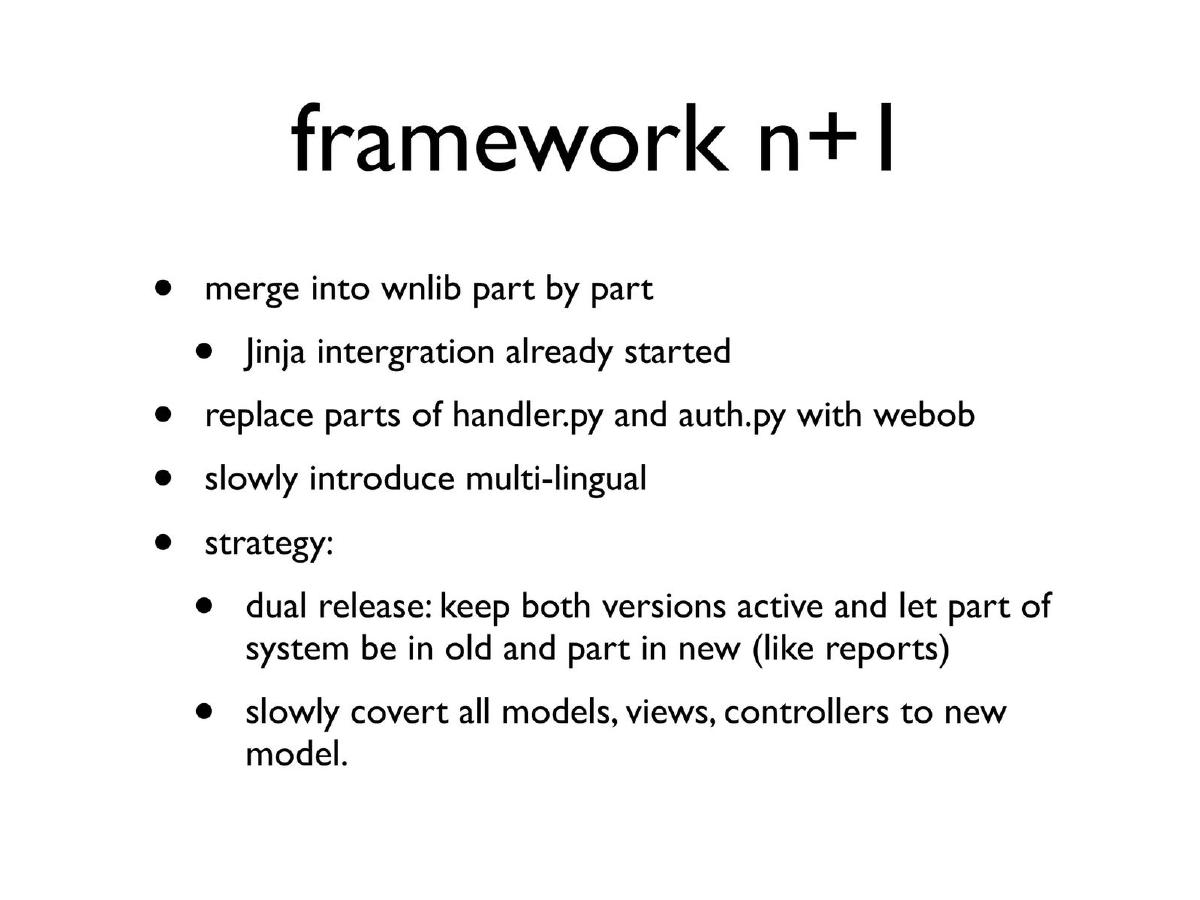
Continuing the technical theme, Slide 3 outlines the migration plan. The strategy is to "merge into wnlib part by part." Specific tasks include starting "Jinja intergration" (note the typo in the slide) and replacing parts of "handler.py and auth.py with webob."
The most important business takeaway here is the "strategy" of a "dual release." Mehta notes the plan to "keep both versions active and let part of system be in old and part in new (like reports)." This indicates a pragmatic approach to development, ensuring that existing users are not disrupted while the underlying architecture is overhauled.
Slide 4: CMS2 - Addressing Customer Needs
Slide 4 shifts from internal architecture to customer-facing features. The "cms2" heading refers to the second version of their Content Management System. The "motivation" cited is "requests from some customers for product page in the website."
The "problem" with the old system was "too many page renders" and it being "not fit for products (1000s of pages)." The "solution" was a move to "Jinja2" for runtime page generation. The slide concludes with a note to "make prototype (Anand to finsh project)," showing the collaborative nature of the small team at the time.
Slide 5: Recruitment and Networking
This slide marks the transition from code to company building. Mehta notes that the project was "presented at Startup Saturday" and includes a link to a previous SlideShare presentation. The key organizational update is the decision to "recruit one person for sales and marketing, customer evangelism, channel development."
The slide tracks the progress of this hire: "gave ad and took a couple of phone interviews" and "decided on candidate (will join end of July)." On the marketing front, the efforts were modest: "wrote 2 blogs, started tracking goals (downloads, signup etc)." This is the first mention of any metrics in the deck, though no actual numbers are provided.
Slide 6: ERPNext Guide
Documentation is a critical but often overlooked part of software scaling. Slide 6 focuses on the "erpnext guide." Mehta states he has "started writing guide" and "completed 2 chapters (25%)" covering "setup" and "selling." A screenshot of the guide is included, showing a clean, text-heavy layout. For an ERP system, which is notoriously complex to implement, this guide represents a significant step toward reducing user friction.
Slide 7: Next Month
The penultimate slide looks forward to the immediate future. The goals are tactical: "complete guide ()" , "complete some usability tasks," and "work a bit on the new framework ideas." The four asterisks next to the guide suggest it is the highest priority. There are no long-term strategic goals or financial targets mentioned here, reinforcing that this was a month-to-month progress report.
Slide 8: Thanks!
The deck concludes with a simple "thanks!" on a white background. There is no contact information, no call to action, and no summary of why an investor should care. It is a quiet end to a very technical presentation.
What Works in This Deck
Honesty regarding technical debt: The founder is very clear about the limitations of the current framework and why a change is necessary. This builds credibility with a technical audience. · Direct link to customer feedback: The CMS overhaul is directly attributed to customer requests, showing that the development roadmap is not purely theoretical but driven by market demand. · Pragmatic migration strategy: The "dual release" strategy shows a mature understanding of software deployment, prioritizing system stability over a "move fast and break things" approach. · Focus on documentation: Recognizing that a guide is 25% complete shows a commitment to user success, which is vital for the adoption of open-source enterprise software.
What Is Missing from This Deck
Market Analysis: There is no mention of the size of the ERP market or the specific niche ERPNext aims to fill. · Competitive Landscape: The deck does not mention competitors like SAP, Oracle, or Odoo (then OpenERP), nor does it explain ERPNext's unique value proposition. · Business Model: It is unclear how the company makes money. While it is open-source, there is no mention of hosting fees, support contracts, or premium features. · Financial Metrics: There are no figures for revenue, user growth, churn, or burn rate. Even the mention of "tracking goals" omits the actual data. · Team Slide: While "Anand" is mentioned in passing, there is no slide dedicated to the founding team's background or expertise. · The Ask: There is no request for funding, partnerships, or specific help, which is the primary purpose of most pitch decks.
What a Founder Should Copy
The 'Motivation/Problem/Solution' structure: Even in a technical update, this framework (used on Slides 2 and 4) is the most effective way to communicate why resources are being spent on specific tasks. · Transparency in Recruitment: Sharing the status of key hires (Slide 5) shows that the company is growing its capabilities beyond just the founders. · Quantifying Progress: Stating that a guide is "25% complete" (Slide 6) is much more effective than simply saying "working on documentation." · Focusing on Usability: The mention of "usability tasks" in the forward-looking slide (Slide 7) shows an awareness that technical excellence is useless if the software is too difficult to use.
Conclusion
The ERPNext Demo Day deck is a relic of a different era of startup culture—one focused more on the craft of building software than the theater of fundraising. While it fails as a venture capital pitch deck by modern standards, it succeeds as a transparent, no-nonsense progress report. It highlights the reality that in the early days, the most important "metrics" are often just getting the code right, listening to the first few customers, and hiring the first person who isn't a developer.
Frequently asked questions
- Is this a standard fundraising deck?
- No. This is a 'Demo Day' progress report. It lacks the essential components of a seed or Series A pitch deck, such as a market slide, business model, financial projections, or a specific investment ask. It is designed to update a community or a small group of stakeholders on technical and operational progress rather than to solicit capital from institutional investors.
- What was the primary technical challenge mentioned?
- The primary challenge was technical debt within the original 'wnframework.' The founder noted that the architecture was 'awkward' and relied on too many hand-written modules. The solution was a migration to 'wnlib,' which integrated modern libraries like Webob, WSGI, and Jinja2 to create a leaner MVC (Model-View-Controller) structure.
- How did ERPNext handle customer feedback in 2012?
- Feedback was directly tied to product development. Slide 4 notes that customers requested product pages for their websites, which the existing CMS could not handle due to page render limits. This feedback led to a complete rebuild of the CMS using Jinja2 to support thousands of runtime-generated pages.
- What was the company's approach to growth at this stage?
- Growth was in its infancy. The deck mentions the recruitment of a single person to handle sales, marketing, and customer evangelism. Marketing activities were limited to writing two blog posts and beginning to track basic metrics like downloads and signups, indicating a transition from a developer-only project to a commercial entity.
- What is missing from this deck that a modern founder should include?
- Almost everything required for a professional raise is missing. A modern founder needs to include a clear problem statement, a defined target market (TAM/SAM/SOM), a competitive analysis, a clear monetization strategy, and a team slide highlighting relevant experience. This deck is purely a tactical update.