EquityZen's 9-slide deck is an exceptionally lean presentation that focuses on the friction within secondary markets for private company shares. By positioning itself as the 'E-Trade for the Private Market,' the company highlights a solution that keeps cap tables unchanged and honors transfer restrictions—key pain points for late-stage startups. The deck leans heavily on social proof, showcasing logos of prominent companies like Palantir and Dropbox, and emphasizes a founding team with deep roots in securities law, tech, and finance. While it lacks traditional metrics, financial projections,…
Key takeaways
- The deck positions EquityZen as a 'Marketplace for Investments in Proven Startups' on slide 1.
- Social proof is established early by displaying logos of high-growth companies like Pinterest, Dropbox, and Palantir on slide 2.
- The problem statement identifies existing secondary markets as 'broken,' specifically naming competitors SharesPost, SecondMarket, and NYPPEX on slide 3.
- EquityZen differentiates itself by ensuring the 'Cap Table Unchanged' and 'Shareholder Count Intact' on slide 4.
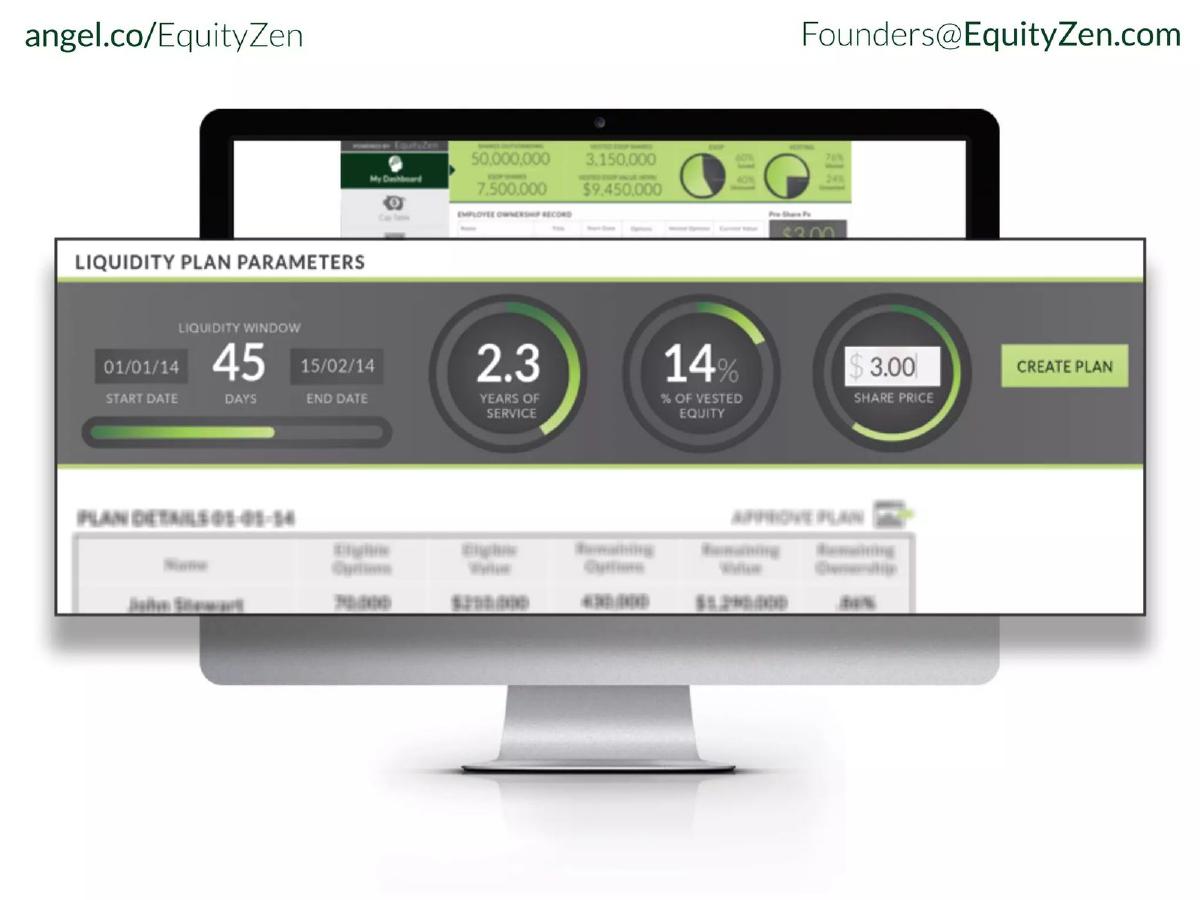
- The product UI slide shows a 'Liquidity Plan' interface with parameters for share price and years of service on slide 5.
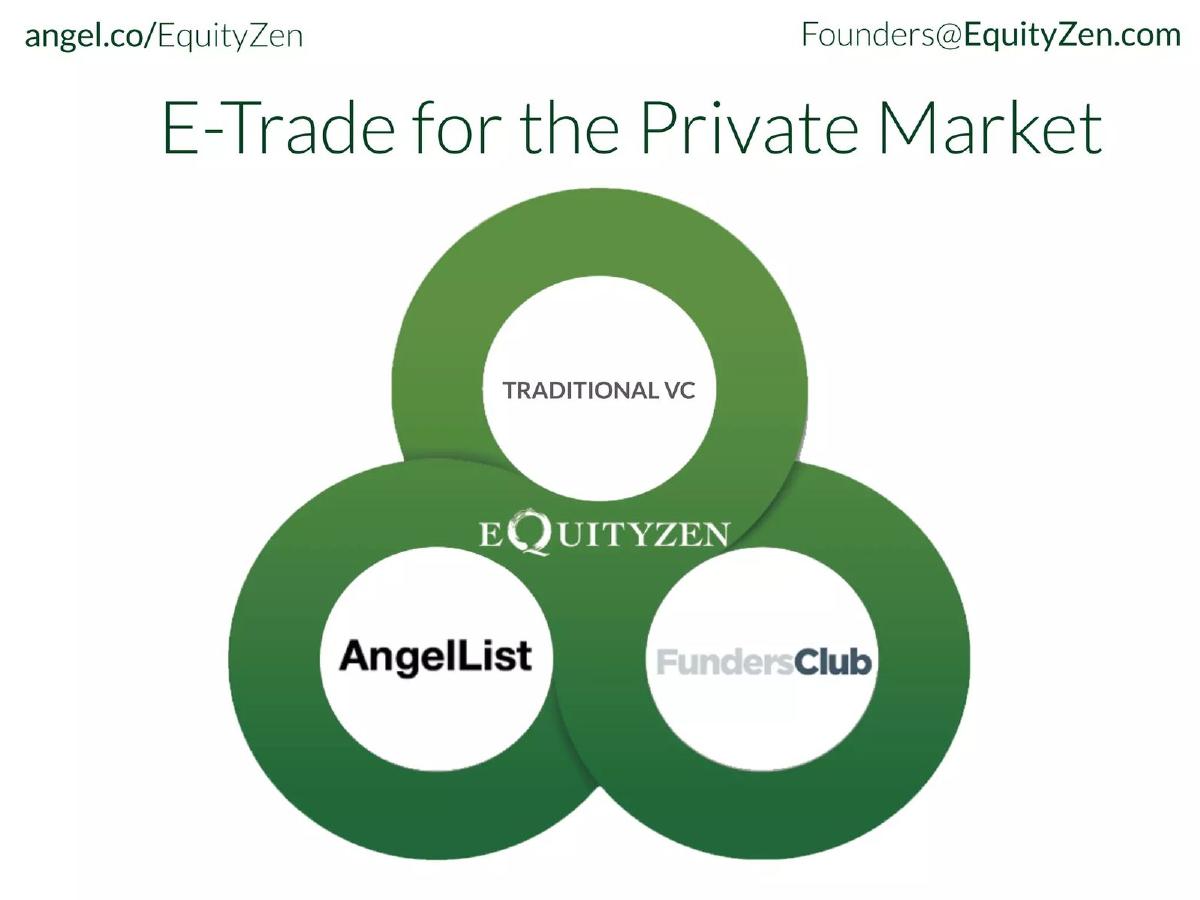
- Market positioning is visualized as an overlap between Traditional VC, AngelList, and FundersClub on slide 6.
- The team slide highlights specialized expertise in Securities Law, Tech, and Finance from institutions like Barclays and Wharton on slide 7.
- A visual metaphor on slide 8 uses 'Monopoly money' and a hundred-dollar bill to represent the conversion of illiquid equity into cash.
EquityZen Pitch Deck Analysis
EquityZen’s pitch deck is a study in minimalism. At only nine slides, it avoids the data-heavy density common in fintech decks, opting instead for high-level positioning and visual metaphors. The deck is designed to sell a concept: that the secondary market for private shares is inefficient and that EquityZen has the legal and technical architecture to fix it without upsetting the target companies.
Slide 1: Title Slide
The cover slide establishes the brand immediately. The tagline, "Marketplace for Investments in Proven Startups," is a critical piece of positioning. By using the word "Proven," EquityZen distances itself from seed-stage crowdfunding platforms. It signals that this is a venue for late-stage, lower-risk (relatively speaking) private equity. The inclusion of an AngelList URL and a founder email address suggests this deck was used during an early-stage fundraising round where the founders were directly accessible.
Slide 2: The Social Proof Slide
Without using a single word of prose, slide 2 establishes the company's sandbox. By displaying logos for TaskRabbit, Dropbox, Hotel Tonight, Pinterest, Flurry, Palantir, One Kings Lane, and ZocDoc , EquityZen tells the investor exactly which cap tables they are targeting. These were the "unicorns" of the era. This slide functions as a proxy for market size and demand; if these companies have employees, those employees likely want liquidity.
Slide 3: The Problem Statement
Slide 3 is aggressive. It features a black-and-white image of a smashed ATM screen next to the text "SECONDARY MARKETS ARE BROKEN." Below the text, it lists three major incumbents: SharesPost, secondmarket, and NYPPEX . This is a classic 'David vs. Goliath' slide. It doesn't explain why they are broken—that is left for the presenter to narrate—but it clearly identifies the competition and asserts that their existing solutions are failing the market.
Slide 4: The Value Proposition
This slide explains why EquityZen is "Different." It addresses the primary concerns of a startup CFO or General Counsel: "Cap Table Unchanged," "Shareholder Count Intact," and "Transfer Restrictions Honored." In the secondary market, companies often block trades because they don't want the administrative burden of managing thousands of small shareholders. EquityZen’s promise to keep the cap table clean is their primary product advantage for the supply side of their marketplace.
Slide 5: The Product Interface
Slide 5 provides a glimpse of the platform. The screenshot shows a "Liquidity Plan Parameters" dashboard. Key metrics visible include a "Liquidity Window" of 45 days , "2.3 Years of Service," and a "Share Price" of $3.00 . This slide proves the product isn't just a concept; there is a functional interface for managing these complex transactions. It suggests a level of automation in a process that was historically manual and handled by expensive law firms.
Slide 6: Market Positioning
The deck uses a Venn diagram on slide 6 to define its niche. It positions EquityZen at the center of Traditional VC, AngelList, and FundersClub . The headline "E-Trade for the Private Market" is a powerful hook. It suggests that EquityZen is bringing the ease of public market trading to the private sector. This slide helps investors categorize the business model: it’s a high-volume, platform-based brokerage rather than a boutique investment bank.
Slide 7: The Team
The team slide is exceptionally strong for an early-stage company. It breaks the three founders into functional silos: Securities Law (Shri Bhashyam), Tech (Atish Davda), and Finance (Phil Haslett) . The logos for Shearman & Sterling, AQR, Barclays, and Wharton provide the necessary institutional credibility. In fintech, the pedigree of the team is often as important as the product, as investors need to know the founders can navigate complex regulatory environments.
Slide 8: The Visual Metaphor
Slide 8 is the most abstract. It shows Monopoly money being converted through the EquityZen logo into a real $100 bill . This is a visceral representation of the company's core function: turning illiquid, "paper" wealth into spendable cash. It simplifies a complex financial transaction into a universal desire for liquidity.
Slide 9: Closing Slide
The deck ends as it began, with the logo, tagline, and contact information. There is no "Ask" slide, no mention of how much money is being raised, and no valuation. This suggests the deck may have been used as a teaser or as part of a rolling close on a platform like AngelList where the terms were hosted elsewhere.
What EquityZen Does Well
EquityZen excels at distilling a complex legal and financial process into simple concepts . By focusing on the "Cap Table Unchanged" aspect, they speak directly to the biggest hurdle in their industry. The use of high-profile logos (Pinterest, Palantir) does the heavy lifting of explaining their target market without requiring a slide full of text. The team slide is also a highlight, clearly showing that they have the three specific types of expertise required to build a secondary marketplace.
What is Missing from the Deck
The most glaring omission is traction and metrics . There is no mention of how many trades have been completed, the total volume of shares on the platform, or user growth. Furthermore, there is no business model slide ; while an investor can guess they take a commission, the specific unit economics are absent. Finally, the lack of a "The Ask" slide means the deck doesn't tell the investor what the company needs to reach the next milestone. It feels more like a sales presentation for partners than a comprehensive fundraising deck.
What Other Founders Should Copy
Founders in complex industries should copy EquityZen’s use of clear positioning statements . "E-Trade for the Private Market" is a perfect example of a "high-concept pitch" that immediately gives an investor a mental model for the business. Additionally, the way they categorized their team by functional expertise (Law, Tech, Finance) rather than just listing titles is a great way to show that all critical bases are covered. Finally, the minimalist design ensures that the investor stays focused on the founder's narrative rather than getting lost in a sea of bullet points.
Frequently asked questions
- What is the primary problem EquityZen is solving according to the deck?
- According to slide 3, EquityZen identifies that 'Secondary Markets Are Broken.' The deck implies that existing platforms like SharesPost and SecondMarket create friction for companies. EquityZen’s solution, as detailed on slide 4, focuses on providing liquidity while keeping the company's cap table unchanged and honoring transfer restrictions, which are common hurdles in private share transactions.
- How does EquityZen position itself against competitors?
- EquityZen uses slide 6 to position itself as the 'E-Trade for the Private Market.' It uses a Venn diagram-style graphic to show it occupies a space between Traditional VC, AngelList, and FundersClub. By doing so, it suggests it offers the accessibility of a retail trading platform but for the exclusive, high-stakes environment of private startup equity.
- What kind of companies is EquityZen targeting for its marketplace?
- Slide 2 features the logos of TaskRabbit, Dropbox, Hotel Tonight, Pinterest, Flurry, Palantir, One Kings Lane, and ZocDoc. This indicates a focus on 'Proven Startups'—typically late-stage, venture-backed companies with high valuations where employees and early investors have significant paper wealth but no immediate path to liquidity.
- What are the core technical advantages mentioned in the deck?
- The deck emphasizes the administrative and legal ease of their process. Slide 4 lists three core pillars: 'Cap Table Unchanged,' 'Shareholder Count Intact,' and 'Transfer Restrictions Honored.' This suggests their platform uses a structure (likely Special Purpose Vehicles) that allows investors to gain exposure to shares without the startup having to add hundreds of individual names to their official cap table.
- Who are the founders and what is their background?
- Slide 7 introduces three founders: Shri Bhashyam (Securities Law), Atish Davda (Tech), and Phil Haslett (Finance). Their backgrounds include prestigious institutions and firms such as Shearman & Sterling, Penn, AQR Capital Management, Wharton, Pomelo Capital, Barclays, and Tufts. This 'three-legged stool' of expertise covers the essential pillars required to run a regulated financial marketplace.