Equals, a B2B SaaS platform for spreadsheet-based dashboards, raised a $5.5M seed round in 2022 using a deck that prioritizes narrative over data. The presentation contains only 10 slides, omitting common sections like market size (TAM), business model details, and current traction metrics. Instead, the deck leans heavily on the 'founder-market fit' of Bobby Pinero and Ben McRedmond, both former Intercom executives who scaled that company from $1M to over $180M in ARR. The deck identifies two specific pain points—lack of live data and poor team workflows—and proposes a vertically integrated s…
Key takeaways
- The deck identifies exactly two problems with spreadsheets: they are not connected to live data and lack team workflows (Slide 1).
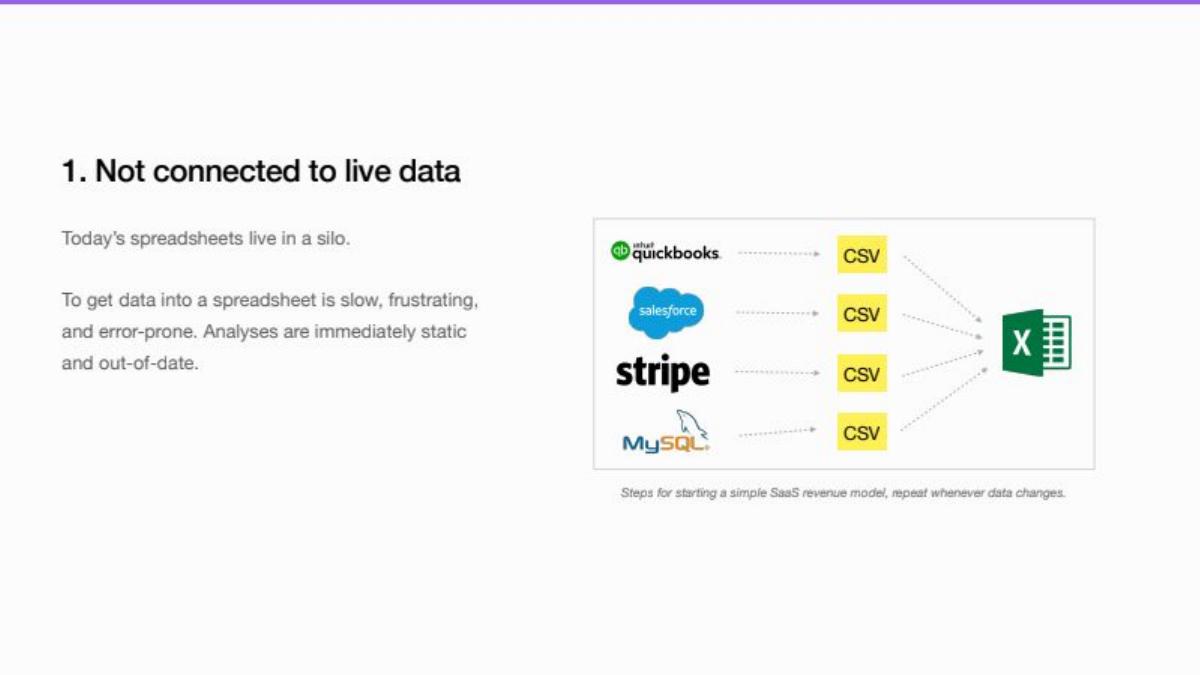
- A visual diagram on Slide 2 illustrates the current 'siloed' manual process of exporting CSVs from QuickBooks, Salesforce, Stripe, and MySQL into Excel.
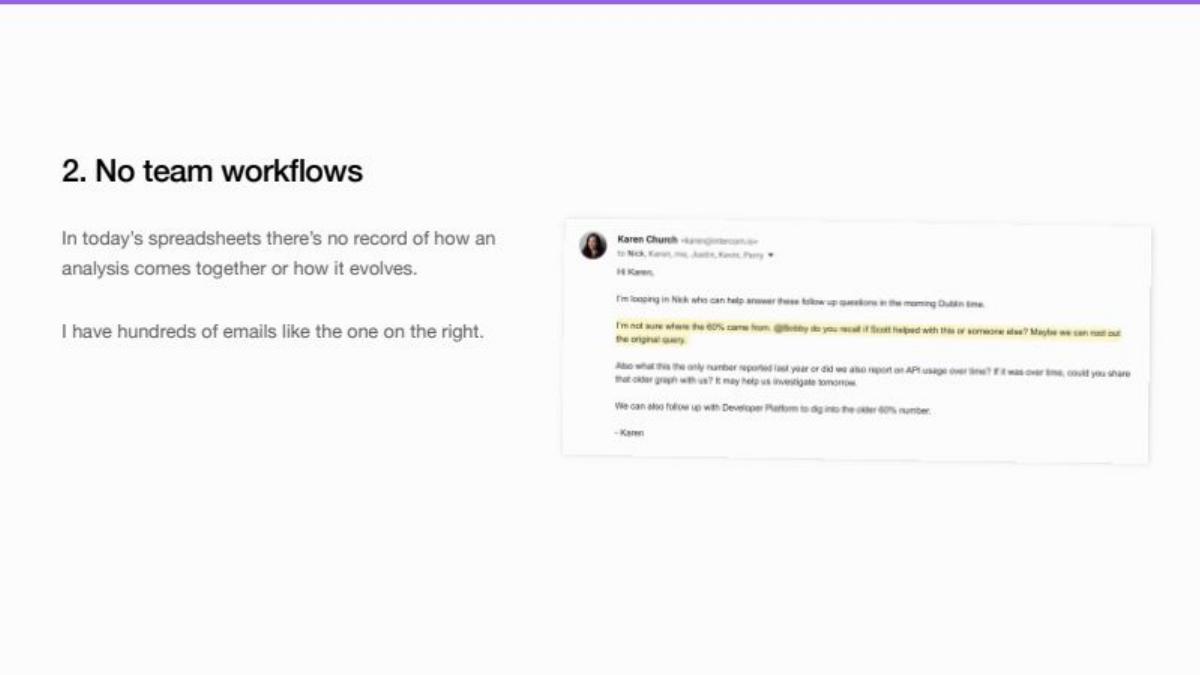
- Slide 3 uses a real-world email artifact to demonstrate the friction in existing data workflows, highlighting the lack of record-keeping in analysis.
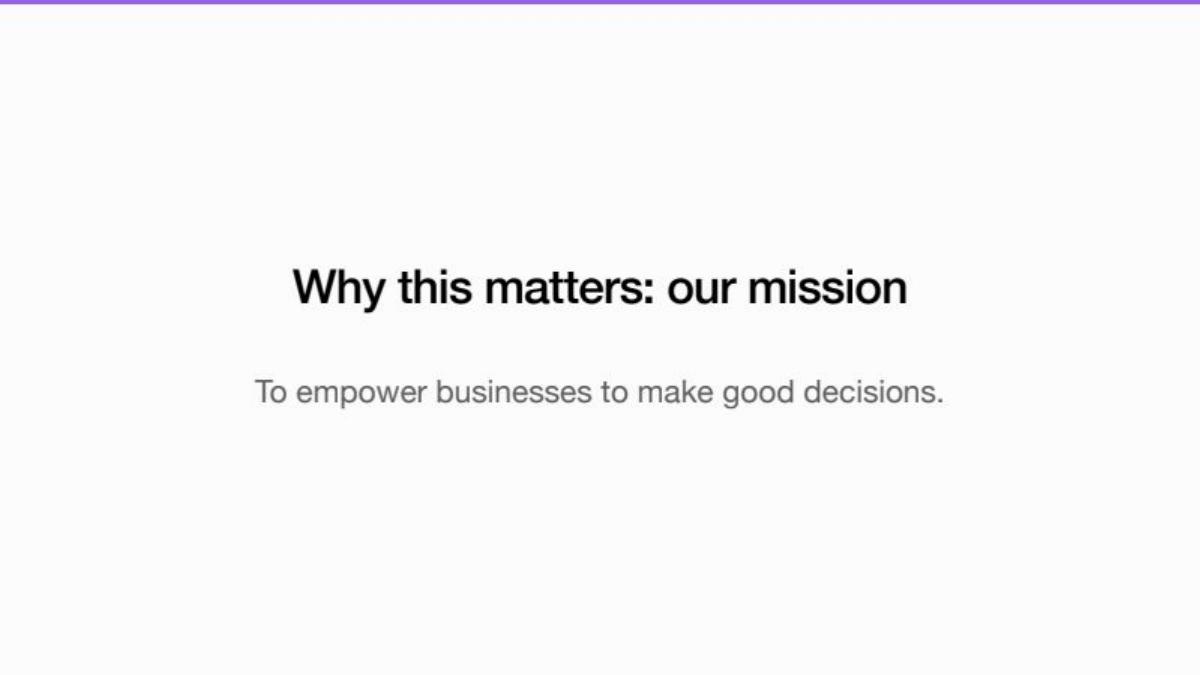
- The company defines its mission on Slide 4 as empowering businesses to make good decisions.
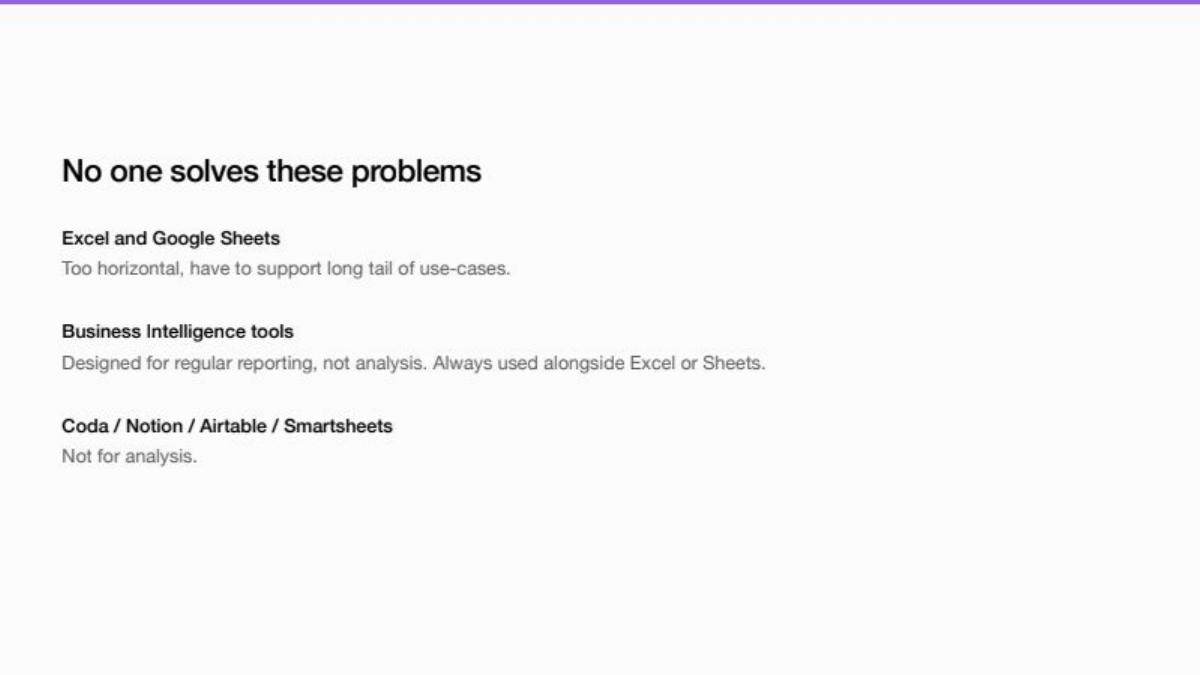
- Competitive analysis on Slide 5 dismisses Excel, BI tools, and Notion/Airtable as either too horizontal or not designed for deep analysis.
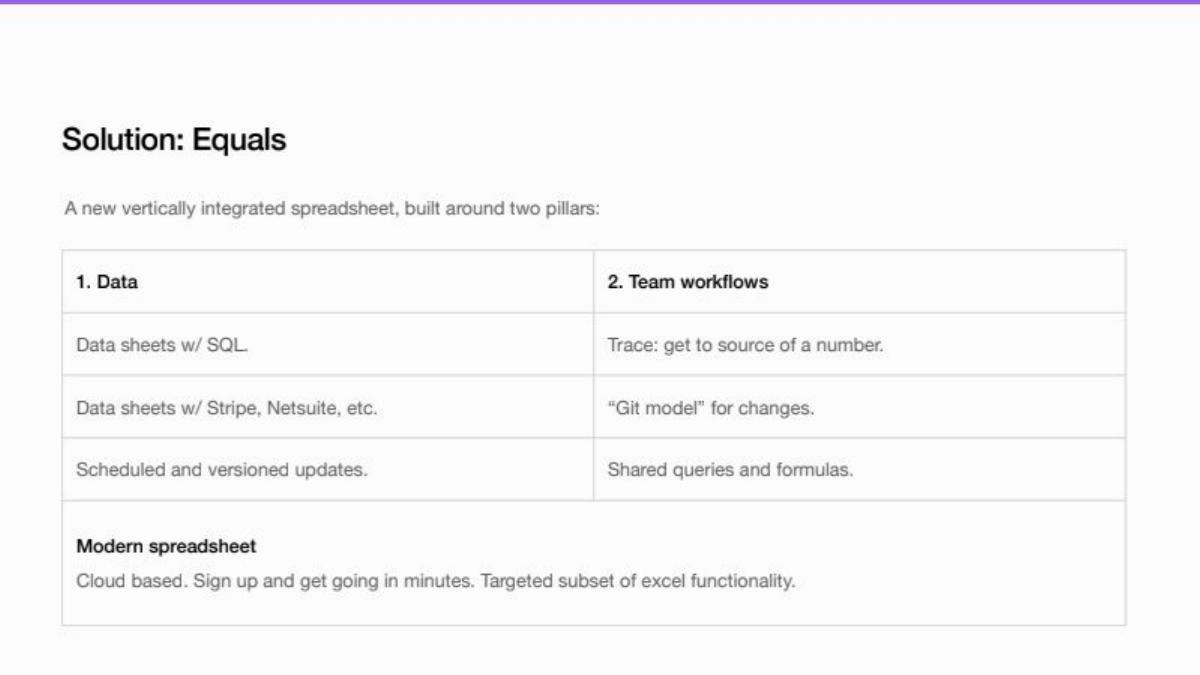
- The solution is presented as a 'vertically integrated spreadsheet' built on two pillars: Data (SQL/API connections) and Team Workflows (Git-style versioning) (Slide 6).
- Slide 8 highlights significant founder pedigree, noting the CEO scaled Intercom from $1M to $180M+ ARR.
- The funding ask on Slide 9 was for 'around $4M' to fund an initial team for 24 months and build V1, though the round eventually closed at $5.5M.
The Power of Minimalism in Seed Fundraising
The Equals pitch deck is a striking example of how high-pedigree founders can raise significant capital by focusing on a singular, well-defined problem. At only 10 slides, it ignores many of the 'standard' pitch deck requirements—there are no financial projections, no market sizing charts, and no detailed roadmap. Instead, it relies on a clean narrative that moves from a universal pain point to a specific solution, backed by a team that has already proven they can scale a SaaS giant.
Slides 1-3: Defining the Friction
Slide 1 sets the stage immediately by narrowing the focus to 'Two problems with spreadsheets.' By stating that spreadsheets are 'Not connected to live data' and have 'No team workflows,' the founders create a specific frame for the entire pitch. They aren't trying to replace everything Excel does; they are fixing two specific, high-value failures.
Slide 2 provides a visual representation of the 'Not connected to live data' problem. It shows a manual workflow where data from QuickBooks, Salesforce, Stripe, and MySQL is exported to CSV files and then imported into Excel. The caption notes this is 'slow, frustrating, and error-prone,' and must be repeated 'whenever data changes.' This is a highly relatable visual for any finance or operations professional.
Slide 3 addresses the lack of team workflows using a 'social proof' artifact: a screenshot of a confusing email thread. The email, from Karen Church at Intercom, asks questions like 'I’m not sure where the 60% came from' and 'do you recall if Scott helped with this?' This slide effectively proves that even at a sophisticated company like Intercom, data analysis is currently a mess of untracked changes and lost context. It moves the problem from the theoretical to the actual.
Slides 4-5: Mission and Competitive Landscape
Slide 4 is a simple transition slide stating the mission: 'To empower businesses to make good decisions.' While broad, it serves to elevate the product from a 'tool' to a 'strategic necessity.'
Slide 5 handles the competition with a 'No one solves these problems' header. It categorizes existing tools into three buckets: Excel/Google Sheets (too horizontal), BI tools (designed for reporting, not analysis), and Coda/Notion/Airtable (not for analysis). This is a bold positioning strategy. By claiming that BI tools are only for 'regular reporting,' Equals carves out a niche for 'ad-hoc analysis' that is currently underserved. It positions Equals as the only tool that combines the flexibility of a spreadsheet with the power of a live data warehouse.
Slides 6-7: The Solution and Product Vision
Slide 6 introduces the solution: Equals. It is described as a 'new vertically integrated spreadsheet.' The founders break the solution down into the two pillars identified on Slide 1. For data, they promise SQL integration and direct connections to Stripe and Netsuite. For workflows, they introduce the 'Git model' for changes and shared queries. This slide is the technical heart of the deck, promising a 'Modern spreadsheet' that is cloud-based and targeted at a subset of Excel functionality.
Slide 7 is a variation of Slide 6, titled 'V1: Equals.' It uses a faded-out design to emphasize that the initial focus (V1) will be on the 'Data' pillar and 'Modern spreadsheet' basics, while the full 'Team workflows' will follow. This manages investor expectations regarding the product roadmap, showing a clear path from a Minimum Viable Product to a full platform.
Slide 8: The 'Why Us' Factor
Slide 8 is arguably the most important slide in the deck. It details the backgrounds of Bobby Pinero (CEO) and Ben McRedmond (CPO). Pinero’s bio highlights that he scaled Intercom from $1M to $180M+ ARR and led almost every operational department, including FP&A and Data Engineering. McRedmond was the first employee at Intercom and scaled the growth team to 30+ people. For a seed investor, this slide provides the 'de-risking' necessary to ignore the lack of other data in the deck. These founders have seen the 'end state' of a successful startup and are building the tool they wish they had during that journey.
Slide 9: The Plan and the Ask
Slide 9 outlines the 'Plan.' The founders state they are raising 'a seed round of around $4M.' The goals are specific: fund an initial team for 24 months and build V1 to demonstrate product-market fit with a 'small number of paying users.' This is a classic seed-stage milestone plan. It acknowledges that they are pre-PMF but have a clear 2-year runway to find it. Interestingly, the catalogue facts indicate they actually raised $5.5M, suggesting the round was oversubscribed based on the strength of the team and vision.
What Works in the Equals Pitch Deck
Extreme Clarity: The deck never uses jargon where a simple sentence will do. The 'Two problems' approach on Slide 1 makes the narrative easy to follow. · Relatable Pain Points: Using a real email (Slide 3) and a common manual workflow diagram (Slide 2) makes the problem feel urgent and real. · Founder-Market Fit: The team slide (Slide 8) perfectly aligns the founders' past experiences with the product they are building. They are the 'target users' for their own product. · Constraint: By admitting they are targeting a 'subset of excel functionality' (Slide 6), they avoid the trap of claiming they will replace a 40-year-old incumbent overnight.
What is Missing from the Equals Pitch Deck
Market Size (TAM): There is no mention of how many people use spreadsheets or the dollar value of the BI/Spreadsheet market. · Traction: The deck does not mention any beta users, waitlist numbers, or early feedback. It is a 'pure vision' play. · Business Model: While SaaS is implied, there is no discussion of pricing strategy or how they plan to acquire customers (Go-to-Market). · Financials: There are no projections or details on how the $4M will be allocated beyond 'initial team.'
Lessons for Founders
Sell the 'Why' before the 'How': Equals spends the first half of the deck explaining why current tools fail before showing a single product feature. · Leverage your history: If you have worked at a successful company, quantify your impact there (e.g., '$1M to $180M ARR') to build immediate credibility. · Don't overcomplicate the slides: Most slides in this deck have fewer than 50 words. This forces the investor to listen to the founder rather than reading a wall of text. · Identify the 'Pillars': Grouping your solution into 2-3 clear 'pillars' (Slide 6) makes a complex product much easier to remember and discuss.
Frequently asked questions
- How did Equals raise $5.5M with only 10 slides and no traction data?
- The raise was driven primarily by founder pedigree and a clear, relatable problem statement. Bobby Pinero and Ben McRedmond were early, high-level employees at Intercom, a highly successful SaaS company. Investors often bet on 'second-time' founders or early employees of unicorns who have seen the 'scale playbook' firsthand. The deck demonstrates they understand the specific pain points of data analysis at scale because they lived them at Intercom.
- Why is there no TAM (Total Addressable Market) slide in this deck?
- For a product targeting the spreadsheet market, the TAM is often considered 'obvious' by VCs. Since almost every business uses Excel or Google Sheets, the founders likely felt that proving the market size was less important than proving they could build a superior alternative. In high-conviction seed rounds, founders sometimes skip the TAM slide to focus on the uniqueness of their product vision.
- What does the 'Git model' for spreadsheets mean on Slide 6?
- This refers to version control. In software engineering, Git allows teams to track changes, see who made them, and revert to previous versions. By applying this to spreadsheets, Equals aims to solve the problem of 'broken' formulas and mysterious data changes that plague traditional Excel files, which lack a transparent audit trail of how an analysis evolved.
- Is the lack of a business model slide a red flag?
- In a seed round for a B2B SaaS company, the business model is generally assumed to be a per-user or per-workspace subscription. Because Equals was in the 'V1' building phase (as stated on Slide 9), the exact pricing tiers were likely less important to investors than the technical feasibility of the live data connections and the founders' ability to hire a team.
- How does Equals differentiate itself from tools like Airtable or Notion?
- Slide 5 explicitly addresses this. Equals argues that while Airtable and Notion are great for organization, they are 'not for analysis.' They position Equals as a tool that maintains the computational power of a spreadsheet (formulas, pivot tables) but adds the data connectivity and collaboration features that those 'no-code' databases lack.