Entrepreneur Resorts presents a specialized hospitality model targeting the 'entrepreneur' demographic through a combination of luxury resorts and urban beach clubs. The 2017 deck was designed to support a $3M IPO on the Seychelles Trop-X exchange, primarily to fund the acquisition of the Tau Game Lodge in South Africa. The company anchors its valuation on the success of its 17-room Vision Villa in Bali, which reportedly operates at 20%+ profitability. With a target of 5 resorts and 50 beach clubs by 2021, the deck leans heavily on the personal brand of founder Roger Hamilton and comparisons…
Key takeaways
- The company sought to raise $3M through an IPO on the Seychelles Trop-X main board (Slide 3).
- The primary use of funds was the purchase of the 30-room Tau Game Lodge in Madikwe Game Reserve, South Africa (Slide 3, 4).
- The business model relies on a 20%+ profitability rate established at their initial Bali location (Slide 2).
- The resort model projections show revenue growing from $3.1m in Year 1 to $4.3m in Year 4 (Slide 4).
- The company set an ambitious growth target of 5 resorts and 50 beach clubs with a $100m+ valuation by 2021 (Slide 3).
- The organizational structure involves a Seychelles Holding Company overseeing a Singapore Pte Ltd entity and various regional subsidiaries (Slide 5).
- The deck identifies Richard Branson’s Necker Island as a partner rather than a direct competitor (Slide 6).
- The leadership team features hospitality veterans from Aman, Kerzner International, and Carlson Rezidor Hotel Group (Slide 7).
Executive Summary: The Niche Hospitality IPO
Entrepreneur Resorts represents a specific era of 'lifestyle' investing, where the lines between community, co-working, and luxury travel blurred. This deck, used for their 2017 IPO on the Seychelles Trop-X exchange, is less a traditional venture capital pitch and more a public offering prospectus for retail and impact investors. The core value proposition is the 'entrepreneurial retreat'—a profitable niche within the broader hospitality market that claims higher margins than standard tourism by bundling education, networking, and accommodation.
Slide 1: Title and Vision
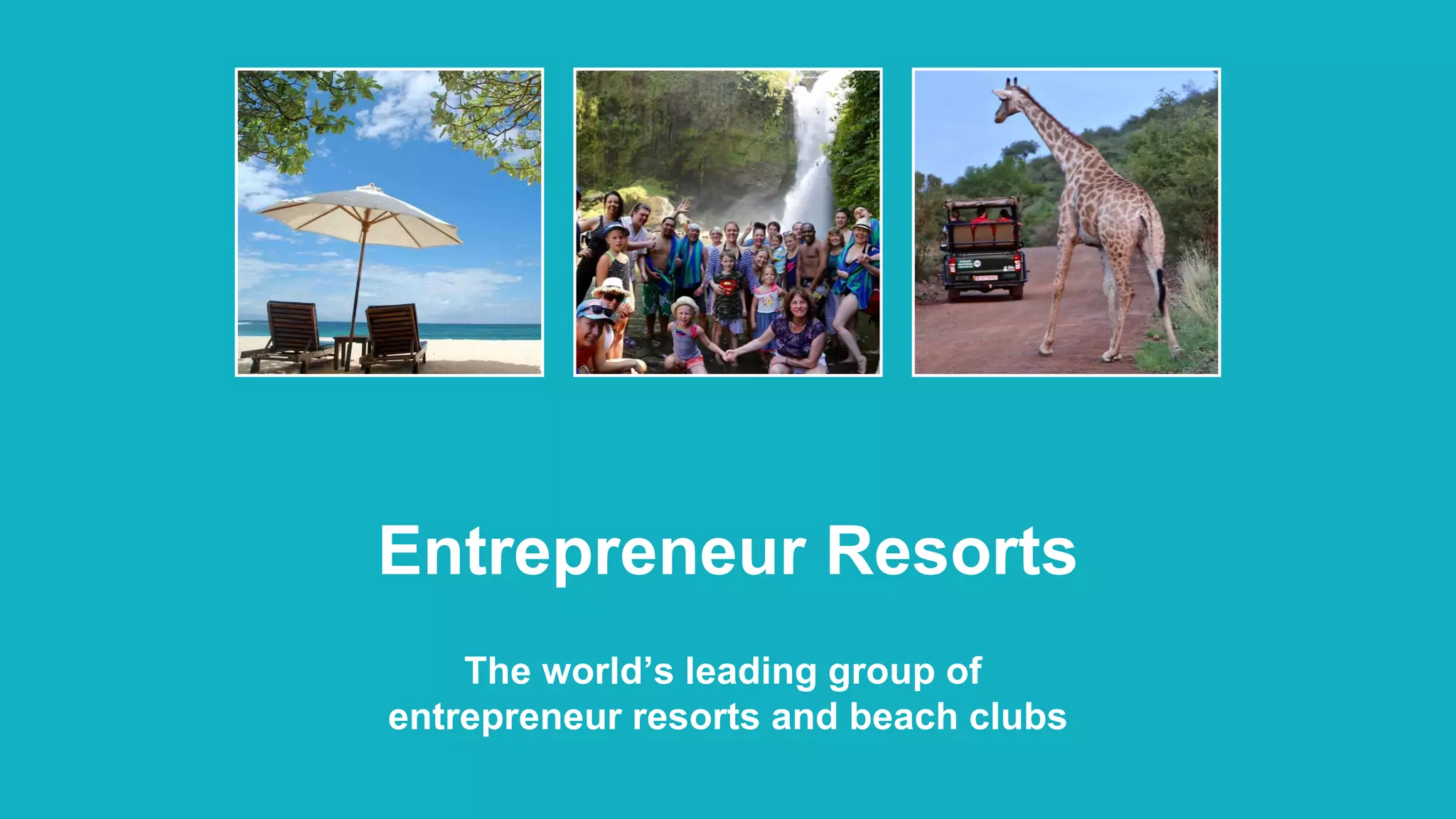
The cover slide establishes the brand identity through three distinct images: a tropical beach, a group of travelers at a waterfall, and a safari vehicle near a giraffe. The subtitle, "The world’s leading group of entrepreneur resorts and beach clubs," sets a high bar for a company that, at the time of the deck, was largely operating out of a single primary location in Bali. The aesthetic is clean, using a teal background that evokes tropical travel.
Slide 2: The Solution
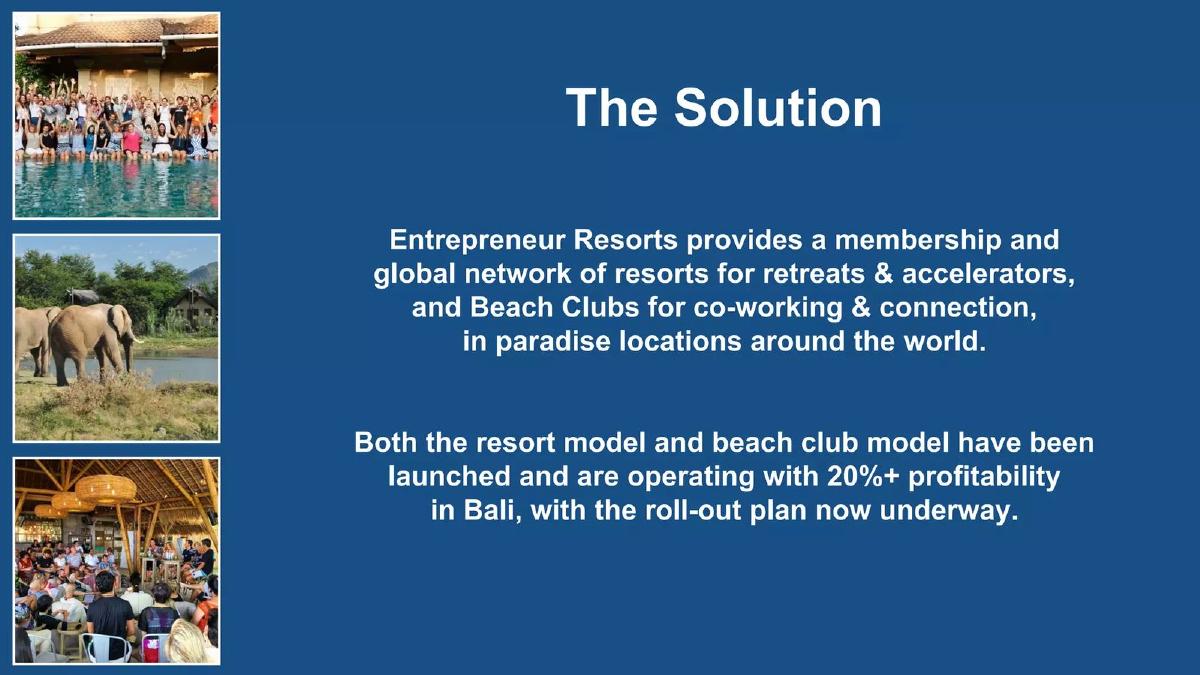
Slide 2 defines the product: a membership-based global network of resorts for retreats and accelerators, plus beach clubs for co-working. The most critical piece of data here is the claim that "Both the resort model and beach club model have been launched and are operating with 20%+ profitability in Bali." This establishes the 'proof of concept' necessary to justify an expansion-focused IPO. The slide notes that the roll-out plan is now underway, shifting the narrative from a single-site operation to a scalable brand.
Slide 3: Seychelles IPO and Targets
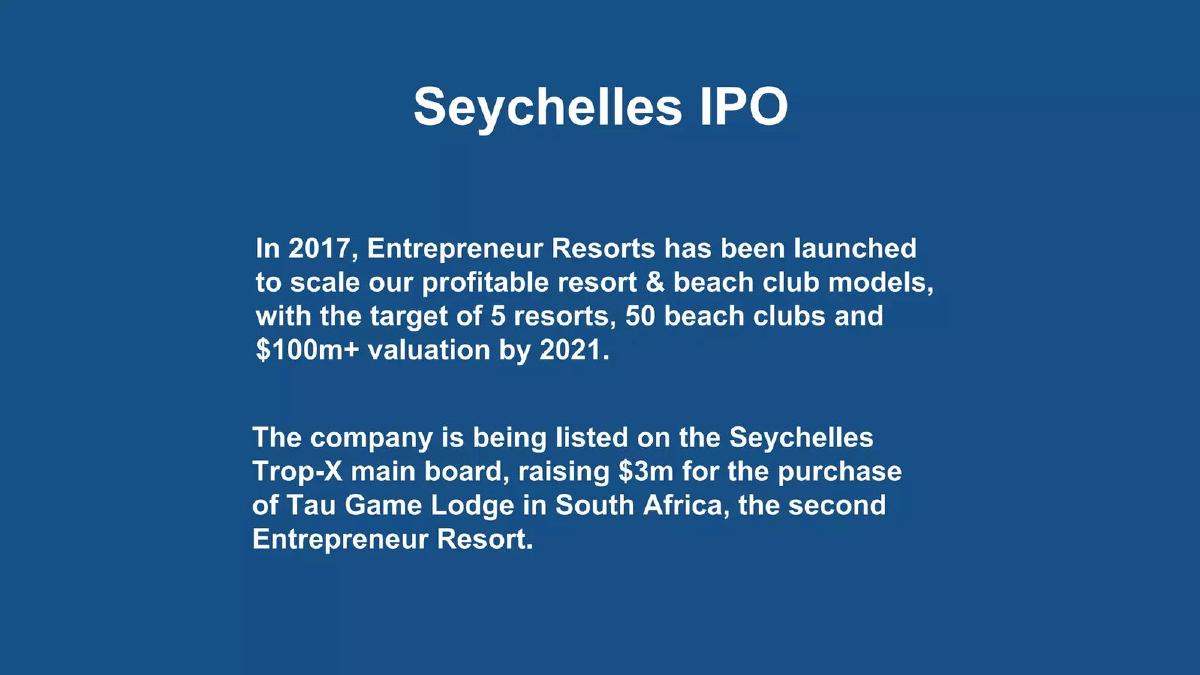
This slide provides the hard facts of the offering. The company is listing on the "Seychelles Trop-X main board, raising $3m for the purchase of Tau Game Lodge in South Africa." It also sets a four-year roadmap: "5 resorts, 50 beach clubs and $100m+ valuation by 2021." This is a classic 'use of proceeds' slide combined with a long-term vision, though it lacks the specific valuation at the time of the $3m raise.
Slide 4: The Resort Model Economics
Slide 4 is the most financially dense slide in the deck. It uses the 17-room Vision Villa in Bali as the benchmark. The table lists Year 1 Revenue at $3.1m and Year 4 Revenue at $4.3m . Operating income is projected to grow from $400k to $900k over the same period. Interestingly, the Set-up cost is cited as $300k , which seems low for a boutique resort unless it refers specifically to the branding and operational 'entrepreneurial' overlay rather than the physical real estate acquisition. The slide confirms an accepted offer for the 30-room Tau Game Lodge, signaling immediate growth.
Slide 5: The Business Model and Corporate Structure
This slide uses a flow chart to explain a complex international corporate structure. The Seychelles Listed Co acts as the Holding Company, owning a Singapore Pte Ltd Co which manages the "Global Beach Club Membership." Beneath this are regional subsidiaries: an Indonesian company for the Bali assets, a South African company for the Africa assets, and a Thai company for Phuket. The chart also forecasts "+3 Resorts" and "+48 Beach Clubs" by 2020, illustrating the scale of the ambition.
Slide 6: Competitive Landscape
The company takes a bold stance on competition, stating "There currently is no global equivalent to our Global Beach Club Membership." They categorize Richard Branson’s Necker Island as a "partner resort" rather than a competitor. They also reference WeWork, noting its "$16.9 billion" valuation at the time, and state they are "learning from their global membership model." By aligning themselves with Branson and WeWork, they attempt to borrow the prestige and market excitement of those brands.
Slide 7: The Team
The team slide focuses on two heavyweights in the hospitality industry. Lisa Bovio brings experience from Aman and Kerzner International, while Dennis Dubois brings a finance background from Carlson Rezidor and Hyatt. The slide claims the Board of Directors has "over 100 years of world class expertise." This is a strong slide that mitigates the risk of the founder's 'lifestyle' brand by showing institutional hospitality experience in the leadership ranks.
Slide 8: Impact Investor Group
This slide introduces a community element to the investment. Investors with "25,000 or more shares" are invited into an "Impact Investor Group." This is a clever marketing tactic for a public listing, turning shareholders into brand ambassadors and customers. It mentions an upcoming retreat at the Tau Game Lodge from "Jul 29th - Aug 3rd," creating a sense of urgency and tangible value for potential investors.
Slide 9: Next Steps and Call to Action
The final slide provides the logistical details for the IPO. The offer opens on May 19 and closes on Jul 19 . It directs users to the company website and Wealth Migrate, a real estate crowdfunding platform. The imagery of footprints in the sand reinforces the travel theme while providing a clear path to participation.
What Entrepreneur Resorts Does Well
The deck excels at anchoring a new concept in established success . By repeatedly citing the 20% profitability of the Bali location, they provide a safety net for the ambitious 50-club expansion plan. The inclusion of high-level hospitality executives (Slide 7) is also a masterstroke; it signals to investors that while the brand is 'entrepreneurial' and 'lifestyle,' the operations are handled by industry veterans who understand the complexities of global hotel management.
Furthermore, the clarity of the 'Use of Proceeds' is excellent. Many decks are vague about what the money will do, but Slide 3 explicitly names the asset being purchased (Tau Game Lodge). This makes the investment feel backed by physical real estate rather than just 'growth capital' for a digital platform.
What Is Missing from the Deck
The most glaring omission is detailed unit economics for the Beach Clubs . While the resort model is broken down on Slide 4, the plan to build 50 beach clubs is a massive undertaking with different margins, lease structures, and capital requirements. There is no data on how a beach club generates revenue—is it primarily through memberships, food and beverage, or event fees?
Additionally, the deck lacks a Market Size (TAM/SAM/SOM) analysis . While they mention WeWork, they don't quantify how many 'entrepreneurs' are actually traveling and seeking these specific types of retreats. Without this, the target of 50 beach clubs feels like an arbitrary round number rather than a data-driven goal. Finally, there is no Risk Disclosure regarding the Seychelles listing, which is a non-traditional exchange for most global investors and carries specific liquidity risks.
Founder's Playbook: What to Copy
Founders should emulate the visual storytelling used here. The deck doesn't just talk about resorts; it shows the lifestyle through high-quality imagery that aligns with the brand. The corporate structure chart (Slide 5) is also a great template for companies operating across multiple jurisdictions, as it clearly explains how a holding company interacts with regional operations.
Another takeaway is the investor perks strategy (Slide 8) . For companies building a community-centric product, offering tiered access or 'retreats' for larger investors can be a powerful way to close a round and build a loyal base of stakeholders who are also active users of the product.
Frequently asked questions
- What is the specific financial goal of this pitch deck?
- The deck was created to facilitate a $3M IPO on the Seychelles Trop-X main board. According to slide 3, the capital was specifically earmarked for the acquisition of the Tau Game Lodge in South Africa, which would serve as the company's second resort location.
- How does the company define its competitive advantage?
- Entrepreneur Resorts claims there is no global equivalent to their specific membership model. On slide 6, they position themselves alongside high-end niche offerings like Necker Island and mass-market co-working giants like WeWork, suggesting they occupy a unique middle ground focused on 'paradise locations' for business retreats.
- What are the projected economics for a single resort unit?
- Slide 4 outlines the 'Resort Model' based on a 17-room boutique setup. It project Year 1 revenue of $3.1m with $400k in operating income, scaling to $4.3m revenue and $900k operating income by Year 4. The setup cost for such a unit is listed at $300k.
- What is the corporate structure of Entrepreneur Resorts?
- As shown on slide 5, the company uses a tiered international structure. A Seychelles-listed Holding Company sits at the top, owning a Singapore Pte Ltd Co. This Singapore entity manages the global membership and mentors, while individual resorts and beach clubs are held under specific national companies in Indonesia, South Africa, and Thailand.
- Who are the key people leading the hospitality operations?
- The deck highlights two directors on slide 7: Lisa Bovio, formerly the CMO of luxury chain Aman and SVP at Kerzner International, and Dennis Dubois, a former Senior Director of Finance for Carlson Rezidor Hotel Group with 16 years of experience at Hyatt Hotels Corporation.