Enough’s 16-slide growth deck serves as a masterclass in industrial-scale biotech fundraising. By positioning themselves as a B2B infrastructure play rather than a consumer food brand, the company addresses the primary bottleneck in the alternative protein market: scalable, low-cost production. The deck highlights their 'ABUNDA' mycoprotein, claiming it to be the most scalable and sustainable protein source available. With a clear focus on their new production facility and a target of 60,000 tonnes per annum by 2027, Enough successfully moved the conversation from 'proof of concept' to 'indus…
Key takeaways
- The company positions itself as a B2B ingredient supplier rather than a consumer-facing brand, focusing on 'infrastructure and scale' (Slide 1).
- Enough claims to be the 'lowest cost producer of protein' by utilizing high-scale fermentation (Slide 3).
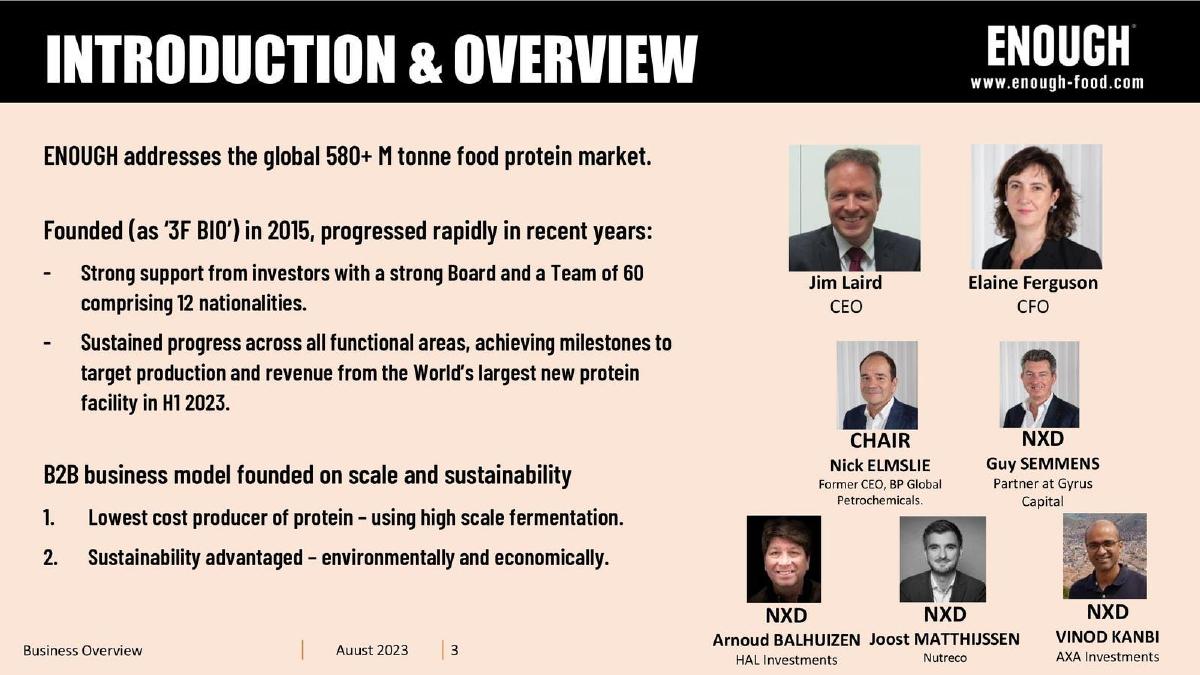
- The team slide emphasizes industrial and investment experience, featuring a former CEO of BP Global Petrochemicals as Chair (Slide 3).
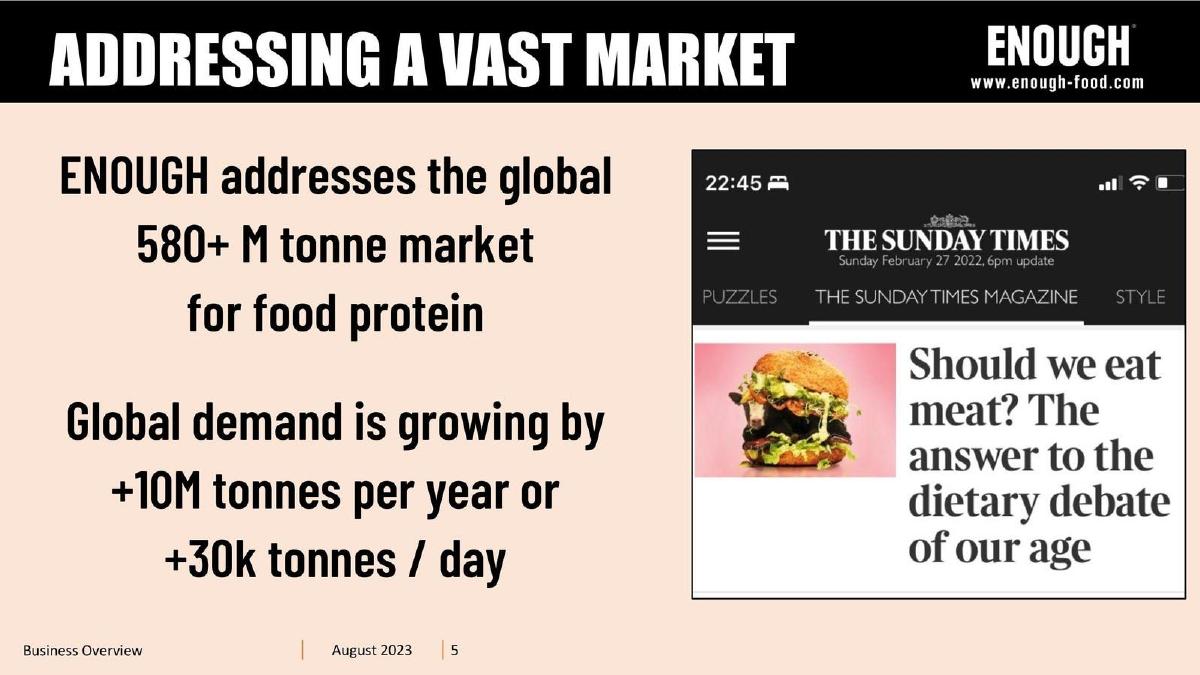
- Market demand is quantified using external validation, citing a global demand growth of +10M tonnes per year (Slide 5).
- The deck highlights a specific production milestone: achieving revenue from the 'World’s largest new protein facility' in H1 2023 (Slide 3).
- Product versatility is demonstrated through 'NO-Beef,' 'NO-Tuna,' and 'NO-Chicken' applications using their ABUNDA ingredient (Slide 9).
- Operational targets are aggressive, aiming for 60,000 tonnes per annum by 2027, which they equate to 30 cows of meat every hour (Slide 11).
- Sustainability metrics are granular, comparing ABUNDA's water and CO2 impact against beef, chicken, peas, and lentils (Slide 13).
Slide 1: Title and Vision
The deck opens with a clear, minimalist title slide. The company name, Enough, is centered above the tagline 'delicious. nutritious. sustainable.' The slide immediately establishes the core theme of the pitch: 'Infrastructure & Scale.' By including a high-quality image of a prepared meal that looks like chicken, Enough signals that their biotech solution results in a familiar, appetizing food product. The date, August 2023, indicates this deck was used shortly before their reported 2024 Series B close.
Slide 3: Introduction & Overview
Slide 3 serves as a combined executive summary and team slide. It establishes the company's history, noting it was founded as '3F BIO' in 2015. The slide highlights a significant milestone: achieving production and revenue from the 'World’s largest new protein facility' in H1 2023. This is a critical piece of de-risking for a Series B round, moving the narrative from theoretical capacity to active operations. The team section is notable for its focus on industrial expertise; the inclusion of a former BP Global Petrochemicals CEO as Chair suggests the company views its challenge as a chemical engineering and logistics problem rather than just a culinary one. The slide also explicitly defines their B2B business model, aiming to be the 'lowest cost producer of protein.'
Slide 5: Addressing a Vast Market
Enough uses Slide 5 to frame the 'Problem' through the lens of market volume. They cite a global food protein market of 580+ million tonnes. Rather than focusing on a niche vegan segment, they target the entire protein industry. The slide includes a screenshot from The Sunday Times to provide social proof and cultural context for the 'dietary debate of our age.' The key metric here is the growth rate: +10 million tonnes per year, or 30,000 tonnes per day, emphasizing that the market is expanding faster than current sustainable solutions can keep up.
Slide 7: Market Estimates and Regional Focus
Slide 7 provides a more granular look at market demand, specifically within Europe. Using data from UBS and Euromonitor, the company projects a $4 billion increase in demand for plant-based proteins by 2027. The chart shows Western Europe as a primary growth driver ($4.0bn), which aligns with the company's HQ in Glasgow and their reported European operations. By using 'bearish' market estimates to still show a 'vast unmet need,' Enough builds credibility with skeptical investors who may be wary of hype in the alt-protein sector.
Slide 9: Mycoprotein - A Sustainable Protein
This slide introduces the product: ABUNDA mycoprotein. It describes the ingredient as a 'wet protein' with a consistency similar to chicken mince. The slide is effective because it shows the product in three stages: the raw ingredient, the B2B packaging (14kg bags), and the end-use applications (NO-Beef, NO-Tuna, NO-Chicken). This visual progression reinforces their B2B route-to-market strategy. They also list key product attributes: high in protein and fiber, containing all essential amino acids, and having a 'clean taste.'
Slide 11: Operational Plan
Slide 11 is the 'Scale' slide. It makes a bold claim: 'The largest non-animal protein factory globally.' The target of 60,000 tonnes per annum by 2027 is the centerpiece of their growth narrative. To make this number relatable, they provide a 'meat equivalent' comparison: 30 cows per hour. This type of comparison is highly effective in pitch decks as it translates abstract industrial metrics into a vivid, understandable scale of impact.
Slide 13: Impact
The Impact slide provides the ESG (Environmental, Social, and Governance) data that many modern institutional investors require. Enough compares ABUNDA against beef, chicken, peas, and lentils. The data is impressive: 93% less water than beef and 92% less CO2. By including comparisons to other sustainable options like peas and lentils (where they still claim a 15-24% advantage in CO2), they position mycoprotein as the superior choice among all alternatives, not just compared to animal meat. They also mention 'Rural development' and 'Job creation >200,' appealing to the social impact side of the investment.
Slide 15: Future Funding Plans
The final content slide, Slide 15, is surprisingly vague regarding the 'Ask.' It features a photo of the large team in front of their industrial facility, which reinforces the 'Infrastructure' theme. However, the text only states that growth will come from a 'combination of financing options.' There is no specific dollar amount listed on the slide, nor a breakdown of how the funds will be allocated. This suggests that this version of the deck may have been a general 'Business Overview' used for initial discussions rather than a final term-sheet pitch, or that the specific round details were kept in a separate, confidential document.
What Enough Does Well
Enough excels at positioning itself as an industrial powerhouse rather than a food startup. In a market where many companies struggle with the high costs of 'lab-grown' or niche plant-based products, Enough focuses entirely on the economics of scale. By citing their goal to be the 'lowest cost producer' (Slide 3) and showing their massive physical infrastructure (Slide 15), they address the biggest concern in the biotech space: margins. Their use of external data from reputable sources like UBS (Slide 7) adds a layer of professional rigor that is often missing from early-stage decks. Furthermore, their B2B focus is a strategic masterstroke; it allows them to avoid the massive marketing spend required to build a consumer brand, instead piggybacking on the distribution networks of established food manufacturers.
What is Missing from the Enough Deck
The most glaring omission is a detailed financial slide. While they mention being the 'lowest cost producer,' they do not provide unit economics, COGS (Cost of Goods Sold), or projected margins. For a Series B 'Growth Round,' investors typically expect to see a clear path to profitability or at least a detailed breakdown of how the cost per kilogram scales as production volume increases. Additionally, there is no mention of existing B2B contracts or a sales pipeline. While they mention 'achieving revenue' on Slide 3, they don't name any partners or disclose the volume of current off-take agreements. Finally, the lack of a specific 'Ask' or 'Use of Funds' on Slide 15 makes the deck feel more like a corporate brochure than a targeted fundraising tool.
Founder Takeaways
1. Contextualize your metrics: Enough doesn't just say '60,000 tonnes'; they say '30 cows per hour.' If your product involves high-volume production, find a relatable comparison that sticks in the investor's mind. 2. Lead with your moat: For Enough, the moat isn't just a recipe; it's the 'World’s largest new protein facility.' If you have physical assets or proprietary infrastructure, make them the star of the show. 3. Use 'Bearish' data to your advantage: By showing that you can win even in a conservative market scenario, you build trust. Enough’s use of UBS estimates (Slide 7) shows they aren't just drinking their own Kool-Aid. 4. The Team is more than just founders: Enough highlighted their Board and NXD (Non-Executive Directors) prominently. For a capital-intensive business, showing that you have 'adults in the room' with deep industry experience (like the former BP CEO) is vital for securing large checks.
Frequently asked questions
- What is Enough's primary product?
- Enough produces 'ABUNDA' mycoprotein, a sustainable protein created through fungi fermentation. Unlike companies that make finished burgers for supermarkets, Enough operates as a B2B supplier, providing the raw 'wet protein' ingredient to food manufacturers in 14kg bags, as shown on Slide 9.
- How does Enough plan to compete on price?
- The company explicitly states on Slide 3 that their goal is to be the 'lowest cost producer of protein.' They intend to achieve this through 'high scale fermentation' and the operational efficiency of their new facility, which they claim is the largest of its kind globally.
- What are the environmental benefits of their mycoprotein?
- According to Slide 13, every kilogram of ABUNDA production uses 93% less water than beef and 64% less than chicken. It also emits 92% less CO2 than beef and is even more efficient than plant-based alternatives like peas and lentils.
- Who is leading the company?
- The leadership team, detailed on Slide 3, includes CEO Jim Laird and CFO Elaine Ferguson. Notably, the board includes heavyweights from the industrial and investment sectors, such as Nick Elmslie (former CEO of BP Global Petrochemicals) and representatives from AXA and Nutreco.
- What is the scale of their production ambitions?
- Enough is targeting a production capacity of 60,000 tonnes per annum by 2027. Slide 11 contextualizes this for investors by stating this output is equivalent to the meat produced by 30 cows every single hour.