How founders show grants and other non-dilutive funding on a pitch deck: awarded vs received vs expected, conditions, repayable money.
How to Show Grants and Non-Dilutive Funding on Your Pitch Deck
Twelve slides from real pitch decks that mention grants or other non-dilutive funding. For each, we record what the slide says was awarded, received or expected, what it leaves out, and how the non-dilutive money sits beside the equity the company raised or is asking for.
TL;DR
Non-dilutive funding is money that does not cost the company shares: grants, prizes, some government programmes and, depending on terms, revenue-based or other repayable financing. On a pitch deck it does two jobs. It lowers the equity a company needs for a plan, and a competitive grant can signal that an outside reviewer rated the work. A grant line earns trust when the slide names the funder, gives the amount, says whether the money is awarded, received or only applied for, states what it must be spent on, and keeps it separate from equity.
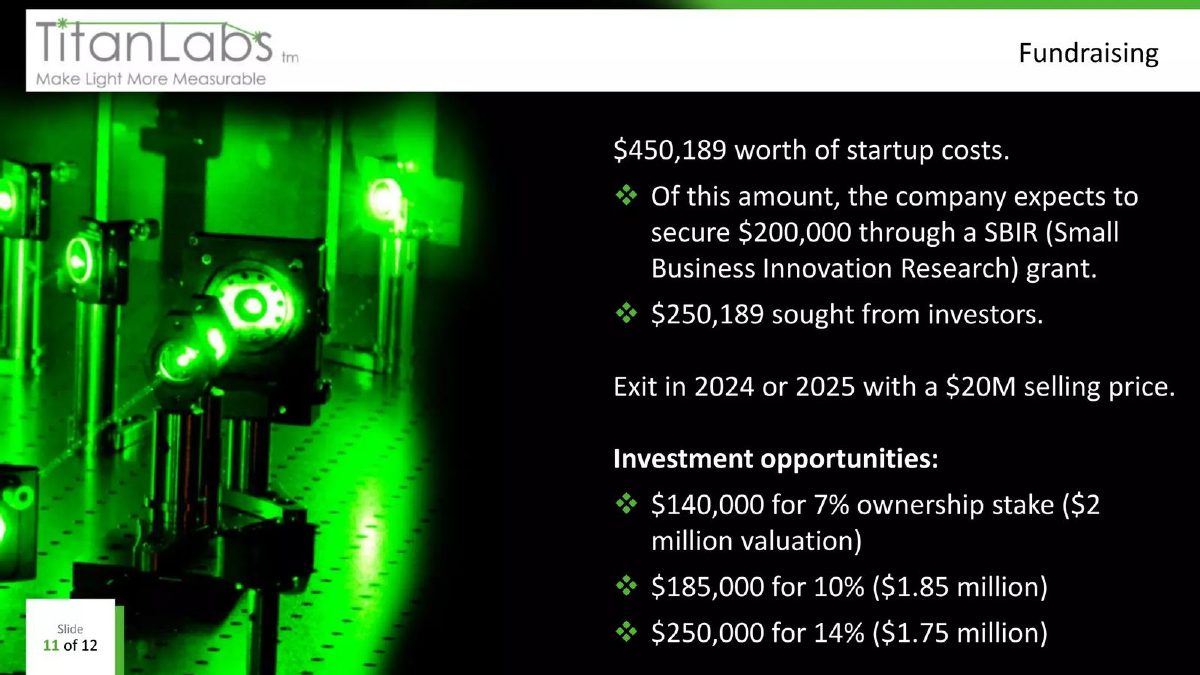
In this set, Transcode Therapeutics does this most plainly: a "Source of Capital" table lists angel seed ($2,240,000), an SBIR grant ($2,300,000) and IPO net proceeds ($25,400,000), and the three add to its $29,940,000 total (our calculation). TitanLabs shows the opposite risk: its $450,189 plan depends on $200,000 the company "expects to secure" through an SBIR grant, so 44% of the plan (our calculation) rests on an application. Arya calls $18M of "cohort financing" non-dilutive but does not say what it is or how it is repaid.
Grant and non-dilutive funding slides from real pitch decks
Each example shows the exact page from the original public deck above its analysis and links to the full teardown. Figures are the companies' own and have not been verified. Calculations are ours and are labelled. Page numbers are PDF page numbers; where the slide carries its own number, we note it.
Transcode Therapeutics ask slide — slide 3
RNA therapeutics company, listed on Nasdaq as RNAZ. "Corporate Capitalization" page of a post-IPO deck.
Transcode Therapeutics deck, slide 3. Exact stored slide matched to this analysis.
Our analysis: A sources table that places a grant beside equity and reconciles to its total.
Evidence and limitation: Our calculation: the three sources add exactly to $29,940,000; the SBIR grant is slightly larger than the angel seed and about 7.7% of the total.
What a founder can adapt: Name the awarding agency and the grant period, and say whether the grant has been fully drawn.
Supporting analysis
What the deck claims: "Source of Capital": Seed Capital (Angel investors) 2,240,000; SBIR Grant 2,300,000; IPO (net proceeds) 25,400,000; Total $29,940,000. A second table lists 12,904,574 common shares, options and warrants, total 15,009,746.
Presentation choice: The reader can see at once how much of the company's funding did not cost shares.
When it does not fit: Don't list a grant that has only been awarded, not paid, as if it were cash raised.
Optical measurement company (streak camera). "Fundraising" page, labelled "Slide 11 of 12".
TitanLabs deck, slide 12. Exact stored slide matched to this analysis.
Our analysis: A plan that depends on a grant not yet awarded, with no fallback shown.
Evidence and limitation: Our calculation: $200,000 plus $250,189 is $450,189; the grant is about 44% of the plan. $250,000 at 14% implies about $1.79M, not $1.75M, and is $189 short of the amount sought.
What a founder can adapt: Say whether the SBIR application is filed and when a decision is due, and show the plan if it is declined.
Supporting analysis
What the deck claims: "$450,189 worth of startup costs"; the company "expects to secure $200,000 through a SBIR (Small Business Innovation Research) grant"; "$250,189 sought from investors"; exit in 2024 or 2025 at $20M; options of $140,000 for 7% ($2 million valuation), $185,000 for 10% ($1.85 million), $250,000 for 14% ($1.75 million).
Presentation choice: The split between grant and equity is explicit and the arithmetic mostly holds, so the dependency is easy to see.
When it does not fit: Don't present an expected grant in the same sentence as costs you will certainly incur without flagging the risk.
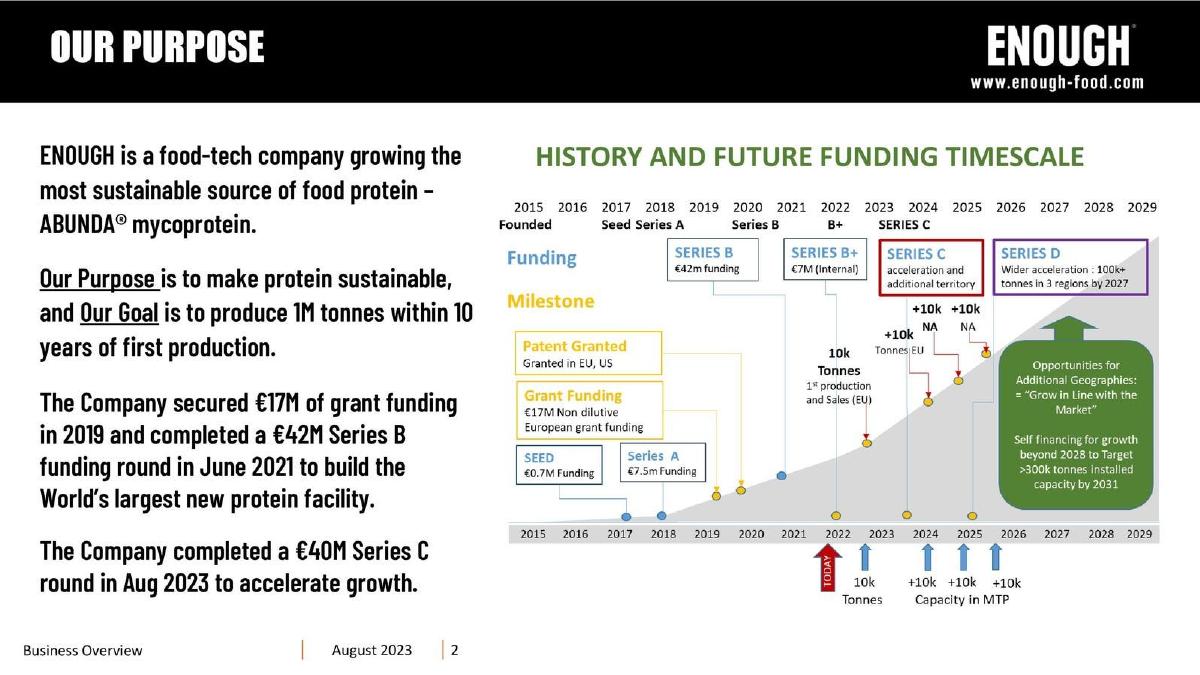
Mycoprotein food company. "Our Purpose" page with a "History and Future Funding Timescale" chart, dated August 2023.
Enough deck, slide 2. Exact stored slide matched to this analysis.
Our analysis: A large grant shown on the funding history beside equity rounds, with year and source type.
Evidence and limitation: Our calculation: the grant is about 40% of the Series B and more than twice the €8.2M of seed and Series A combined.
What a founder can adapt: Name the programme, say what the grant funded (for example the factory) and how much has been paid out.
Supporting analysis
What the deck claims: "The Company secured €17M of grant funding in 2019 and completed a €42M Series B funding round in June 2021"; "a €40M Series C round in Aug 2023". Timeline boxes: Seed €0.7M, Series A €7.5M, "Grant Funding: €17M Non dilutive European grant funding", Series B+ €7M (internal).
Presentation choice: The reader sees that a substantial part of early funding came without dilution.
When it does not fit: "Secured" can mean awarded or received; with staged grants, the difference can be years.
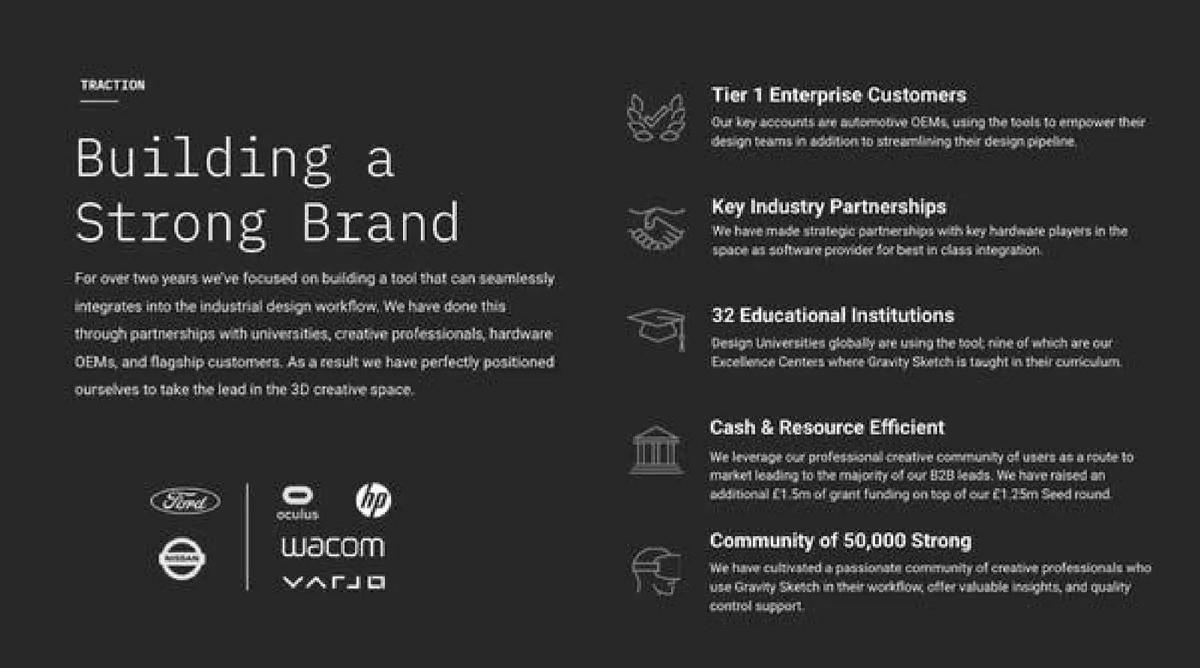
3D design software company. "Building a Strong Brand" traction page.
Gravity Sketch deck, slide 4. Exact stored slide matched to this analysis.
Our analysis: Grant funding used as a capital-efficiency point, stated beside the seed round.
Evidence and limitation: Our calculation: grants are 1.2 times the seed and about 55% of the £2.75M total.
What a founder can adapt: Say how many grants, from whom, and what they are restricted to.
Supporting analysis
What the deck claims: Under "Cash & Resource Efficient": "We have raised an additional £1.5m of grant funding on top of our £1.25m Seed round." Also 32 educational institutions and a community of 50,000.
Presentation choice: One sentence tells the reader the company has more than doubled its seed without dilution.
When it does not fit: "Raised" for grants can blur awarded and received; use the precise word.
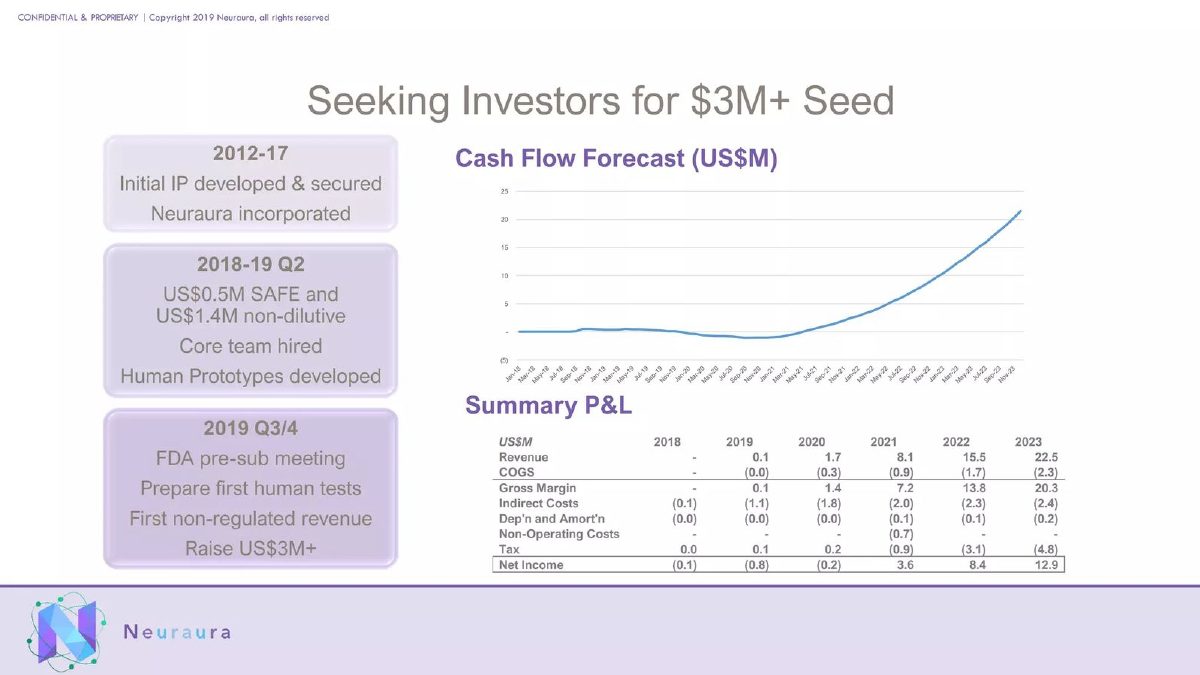
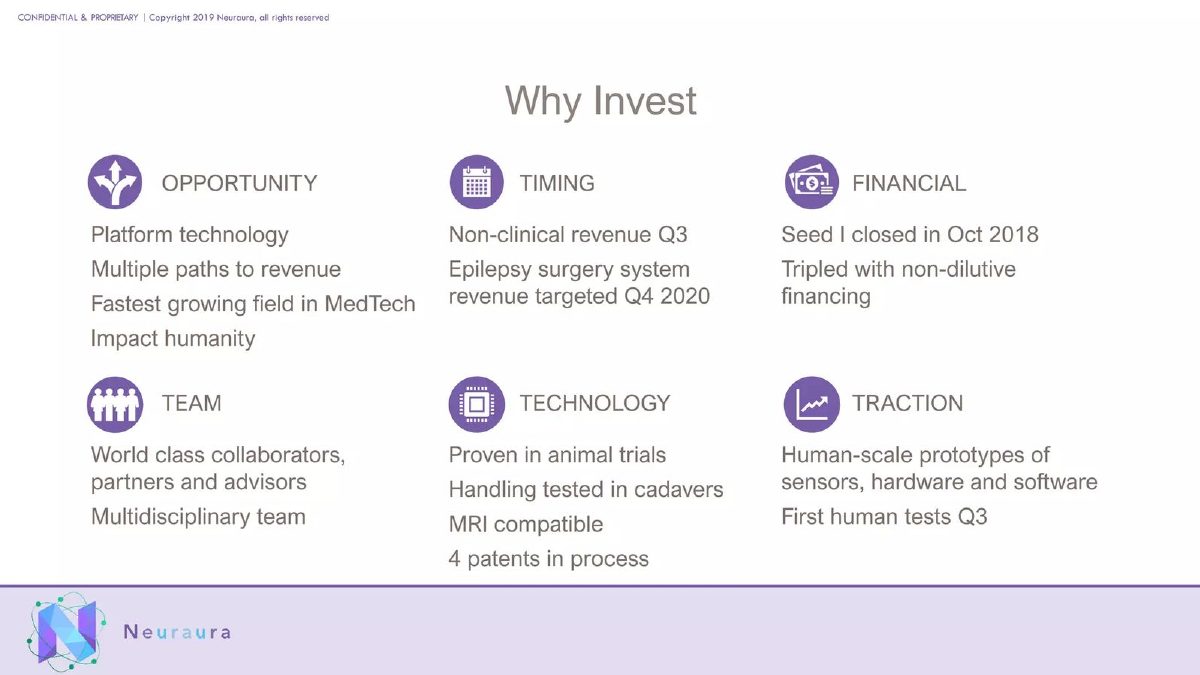
Medical device company (neural sensing). "Seeking Investors for $3M+ Seed" (page 10) and "Why Invest" (page 12), 2019.
Neuraura deck, slide 10. Exact stored slide matched to this analysis.Neuraura deck, slide 12. Exact stored slide matched to this analysis.
Our analysis: Non-dilutive money stated beside the equity it multiplied, but its type is undefined.
Evidence and limitation: Our calculation: $1.4M is 2.8 times the $0.5M SAFE; the combined $1.9M is 3.8 times it. Neither page says what the $1.4M is.
What a founder can adapt: Say whether the $1.4M is a grant, loan or tax credit, and use the exact multiple.
Supporting analysis
What the deck claims: Page 10: "2018-19 Q2: US$0.5M SAFE and US$1.4M non-dilutive"; a cash flow forecast and summary P&L to 2023. Page 12: "Seed I closed in Oct 2018"; "Tripled with non-dilutive financing".
Presentation choice: The two pages together show how far outside funding stretched a small SAFE.
When it does not fit: Don't round 2.8x to "tripled"; state the figures and let the reader see the ratio.
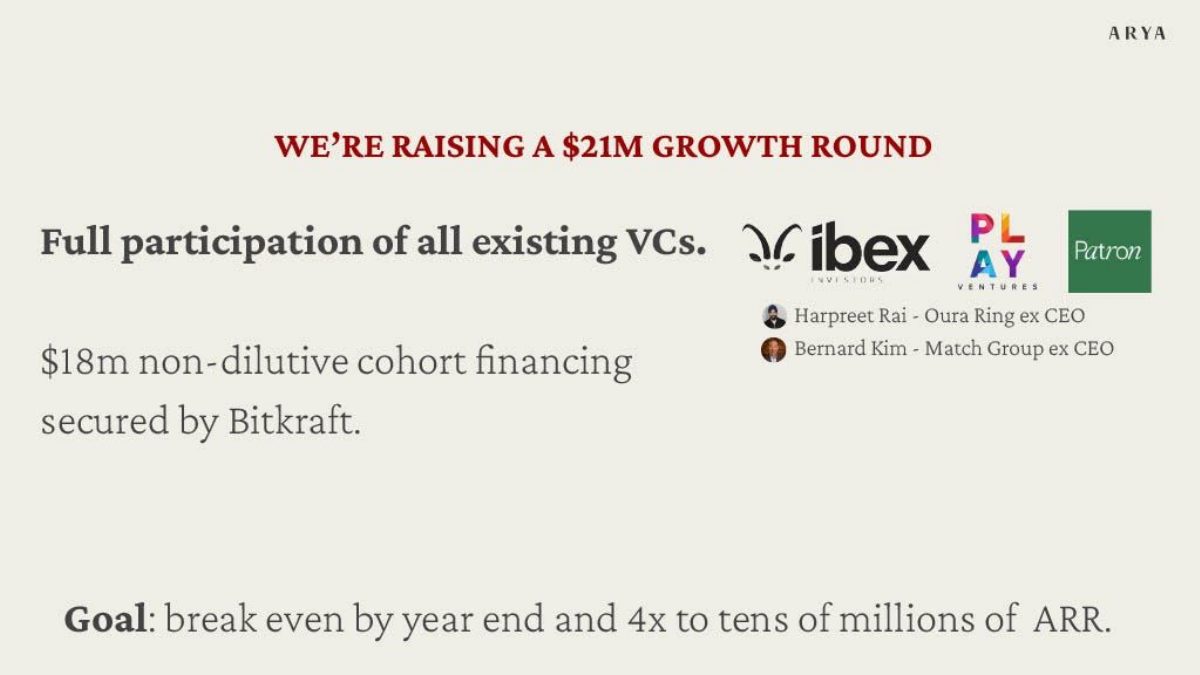
Games company. "We're Raising a $21M Growth Round" page.
Arya deck, slide 17. Exact stored slide matched to this analysis.
Our analysis: A large non-dilutive figure whose type and relation to the round are both unclear.
Evidence and limitation: The page does not define cohort financing or its repayment terms, or say whether the $18M is part of the $21M. Our calculation: if it is, the equity is $3M; if not, total new funding is $39M.
What a founder can adapt: Say what the financing is, how it is repaid, and give a sources table for the round.
Supporting analysis
What the deck claims: "Full participation of all existing VCs" (ibex, Play Ventures, Patron and two named angels); "$18m non-dilutive cohort financing secured by Bitkraft"; "Goal: break even by year end and 4x to tens of millions of ARR."
Presentation choice: It shows why "non-dilutive" needs a definition: financing repaid from revenue is closer to debt than to a grant.
When it does not fit: Don't let a reader add repayable financing to equity as if both were free capital.
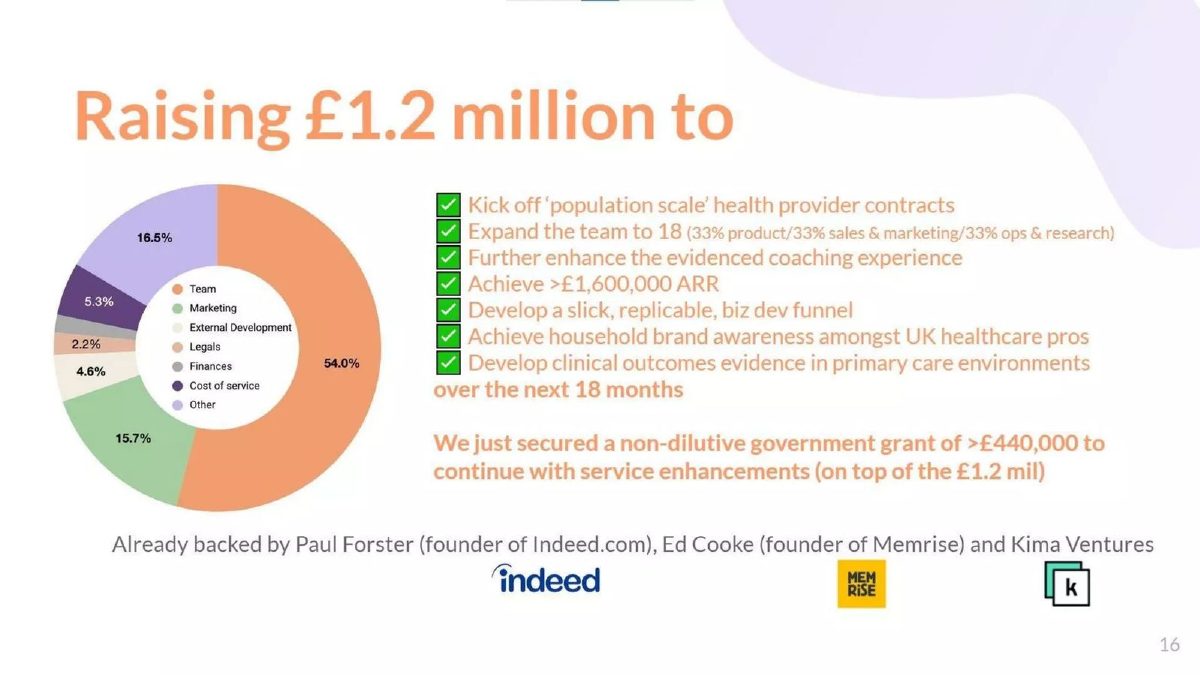
Digital health coaching company in the UK. "Raising £1.2 million to" ask page.
Holly Health deck, slide 16. Exact stored slide matched to this analysis.
Our analysis: A grant added to the ask but left out of the use of funds.
Evidence and limitation: Our calculation: the grant adds at least 37% to the funds available, for at least £1.64M in total; the labelled slices add to 98.3%.
What a founder can adapt: Allocate the grant in the chart or say whether the 18-month targets assume it; name the programme.
Supporting analysis
What the deck claims: 18-month targets including a team of 18 and ARR of more than £1,600,000; a pie chart of the £1.2M (Team 54.0%, Marketing 15.7%, Other 16.5%, Cost of service 5.3%, External Development 4.6%, Legals 2.2%, one unlabelled slice); "We just secured a non-dilutive government grant of" more than £440,000 "to continue with service enhancements (on top of the £1.2 mil)".
Presentation choice: The grant is dated, sized and marked as additional, which many slides omit.
When it does not fit: Label every slice of the pie, and don't leave the reader to guess which plan the grant pays for.
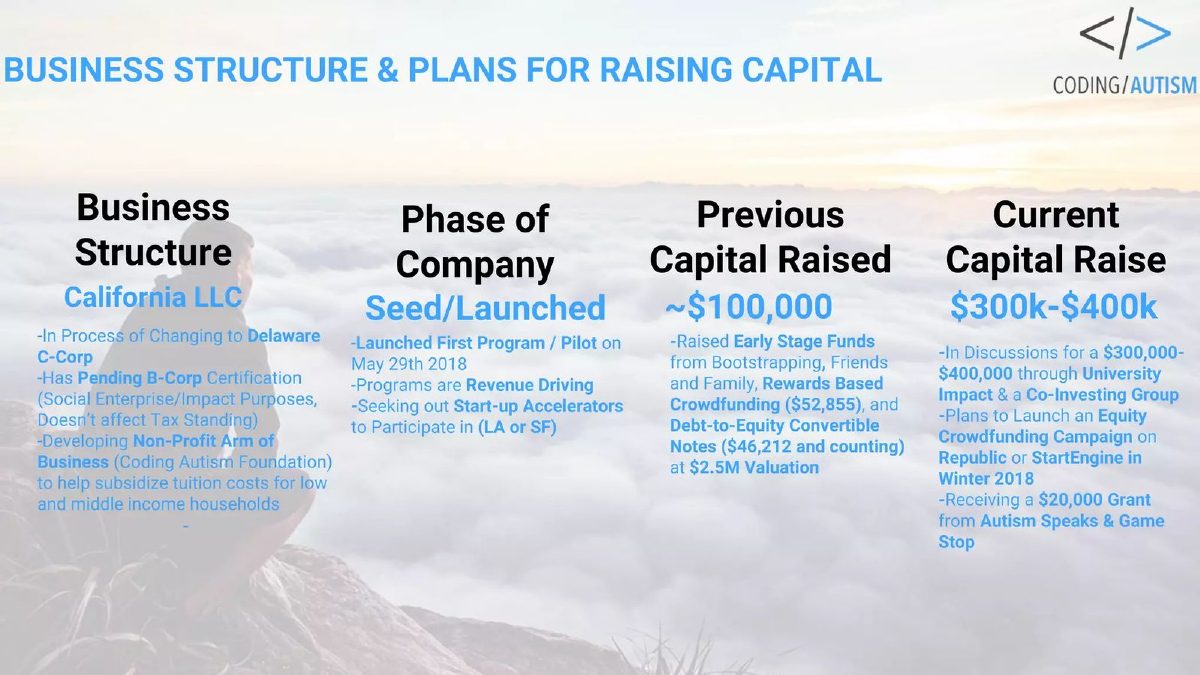
Coding education programme for autistic adults. "Business Structure & Plans for Raising Capital" page, 2018.
Coding Autism deck, slide 15. Exact stored slide matched to this analysis.
Our analysis: A small grant listed under the equity raise, with an ambiguous status and relation to the range.
Evidence and limitation: Our calculation: crowdfunding plus notes is $99,067; the grant is 5% to 7% of the current range.
What a founder can adapt: Say whether the grant is awarded or received and whether it counts toward the $300k-$400k.
Supporting analysis
What the deck claims: "Previous Capital Raised ~$100,000" from bootstrapping, friends and family, rewards crowdfunding ($52,855) and convertible notes ($46,212 and counting) at a $2.5M valuation; "Current Capital Raise $300k-$400k", including "Receiving a $20,000 Grant from Autism Speaks & Game Stop".
Presentation choice: Funders and amount are named, and the grant sits beside the company's full funding history.
When it does not fit: "Receiving" is ambiguous; say awarded, received or applied for.
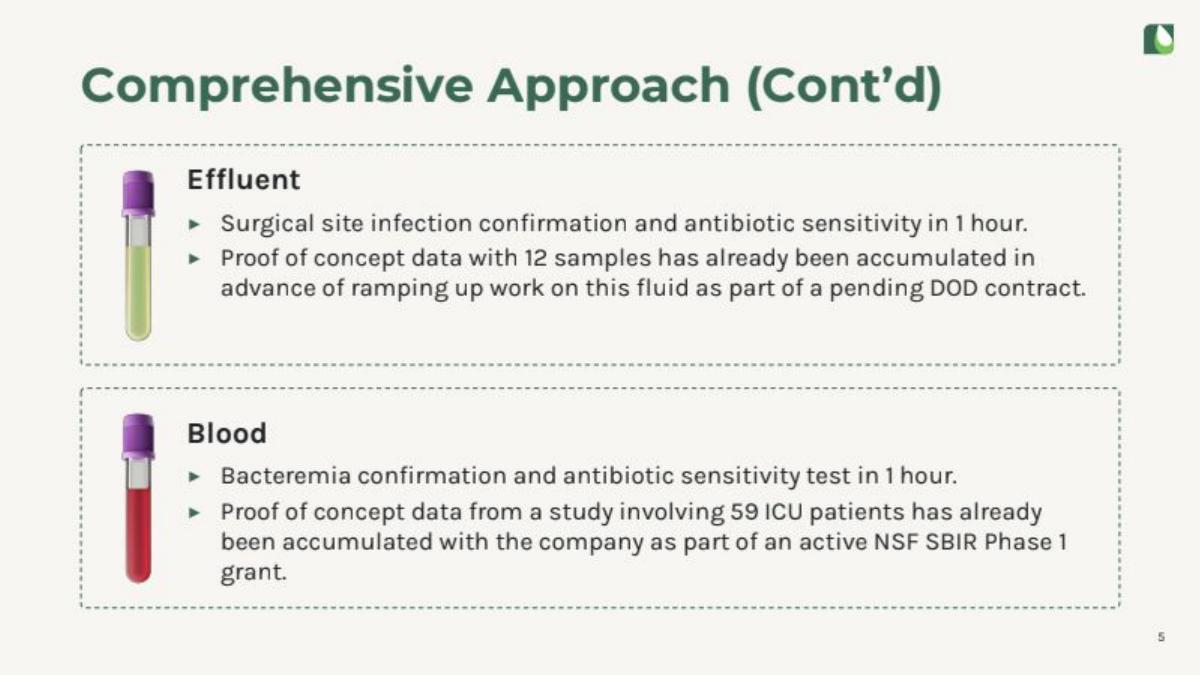
Astek Diagnostics deck, slide 5. Exact stored slide matched to this analysis.
Our analysis: A grant presented as the source of validation data rather than as funding.
Evidence and limitation: The grant is tied to a named output (a 59-patient study); no amount is given, and the DOD contract is pending.
What a founder can adapt: Add the grant amount and period, and the date the DOD decision is expected.
Supporting analysis
What the deck claims: Blood: "Proof of concept data from a study involving 59 ICU patients has already been accumulated with the company as part of an active NSF SBIR Phase 1 grant." Effluent: data "with 12 samples" gathered "as part of a pending DOD contract".
Presentation choice: Linking the award to what it produced is more persuasive than a funder logo.
When it does not fit: Don't place an active grant and a pending contract side by side without marking the difference as clearly as this slide does.
mRNA medicines company. Timeline page "Our mRNA Approach Allowed us to Move mRNA-1325 to First-in-Human in Less than 1 Year".
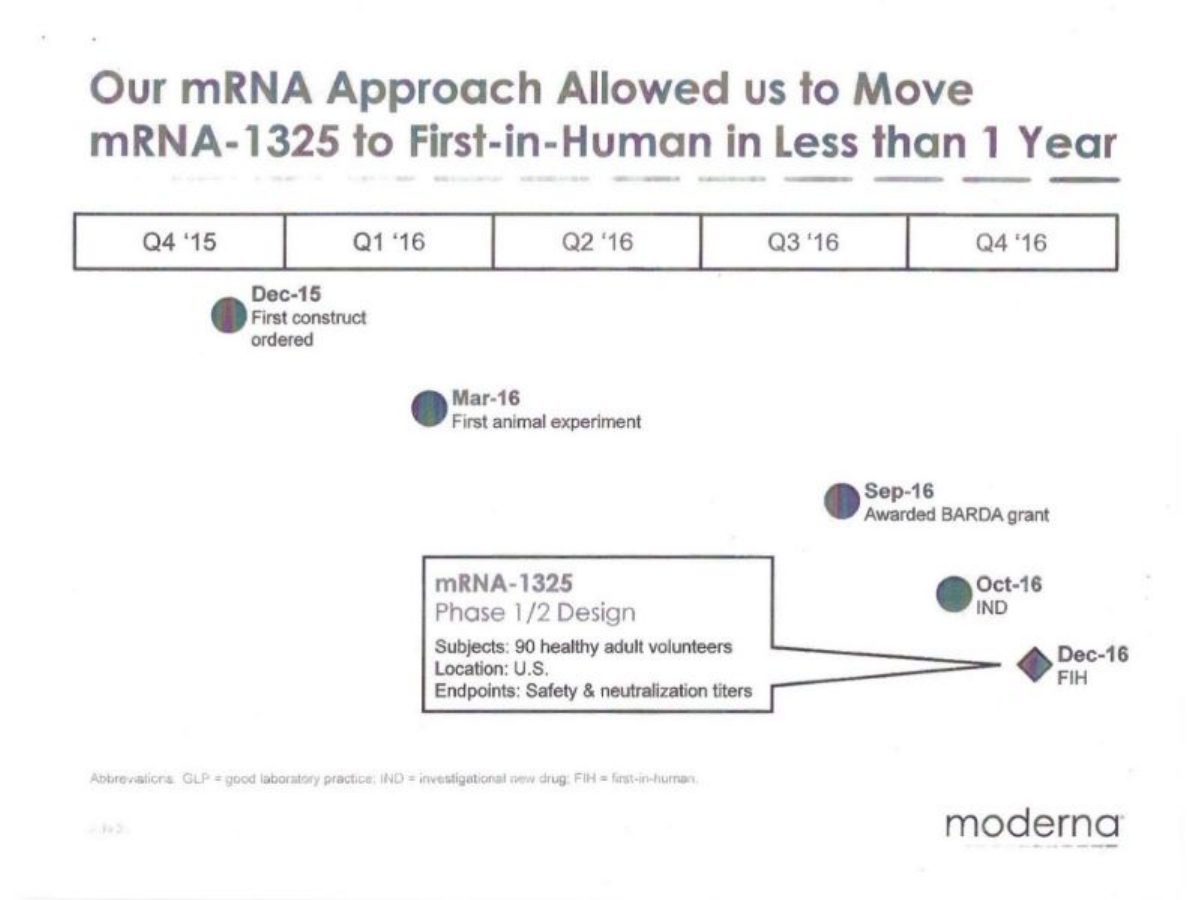
Moderna deck, slide 25. Exact stored slide matched to this analysis.
Our analysis: A government award used as a dated credential on a development timeline.
Evidence and limitation: The grant appears as a dated milestone; no amount or scope is given.
What a founder can adapt: Give the award amount and what it covers beside the milestone.
Supporting analysis
What the deck claims: "Dec-15 First construct ordered"; "Mar-16 First animal experiment"; "Sep-16 Awarded BARDA grant"; "Oct-16 IND"; "Dec-16 FIH"; Phase 1/2 design with 90 healthy adult volunteers in the U.S.
Presentation choice: Placing the award on the timeline shows when outside backing arrived relative to the science.
When it does not fit: A grant milestone with no figure can't be weighed as funding; don't imply it can.
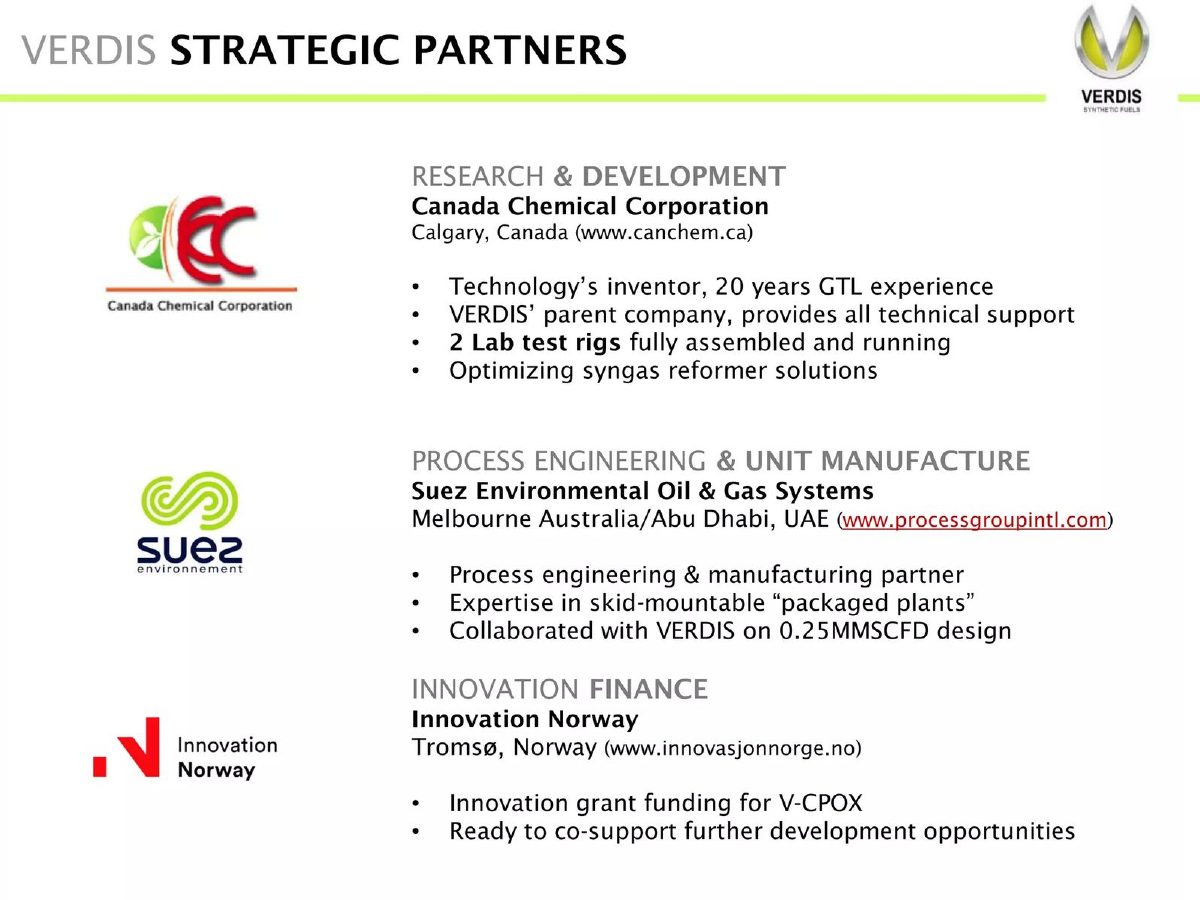
Verdis deck, slide 10. Exact stored slide matched to this analysis.
Our analysis: A grant funder shown as a partner, with future support implied.
Evidence and limitation: No amount or date is given; the second line is a statement about future support with no commitment shown.
What a founder can adapt: Give the grant amount and year, and drop or evidence the claim about future co-support.
Supporting analysis
What the deck claims: Under "Innovation Finance", Innovation Norway (Tromsø): "Innovation grant funding for V-CPOX"; "Ready to co-support further development opportunities". Other partners: Canada Chemical Corporation (parent, R&D) and Suez Environmental Oil & Gas Systems (engineering).
Presentation choice: Naming the agency and the funded project (V-CPOX) is better than a logo alone.
When it does not fit: Don't present a funder's general willingness as committed funding.
Tax and compliance software for small businesses. "Milestones/Accolades" page.
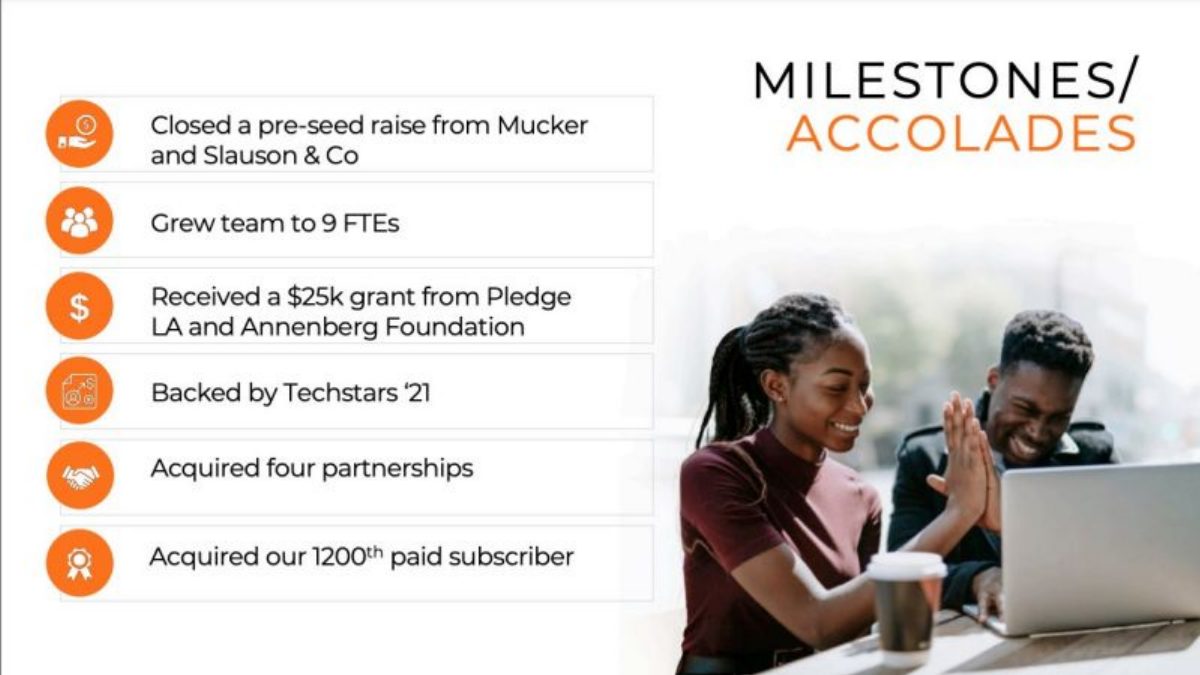
Complyant deck, slide 11. Exact stored slide matched to this analysis.
Our analysis: A received grant listed with full detail among milestones, next to an unsized equity round.
Evidence and limitation: The grant has amount, funders and status (received); the pre-seed round beside it has no amount.
What a founder can adapt: Give the pre-seed amount too, so the reader can see what share of funding the grant represents.
Supporting analysis
What the deck claims: "Closed a pre-seed raise from Mucker and Slauson & Co"; "Grew team to 9 FTEs"; "Received a $25k grant from Pledge LA and Annenberg Foundation"; "Backed by Techstars '21"; "Acquired four partnerships"; "Acquired our 1200th paid subscriber".
Presentation choice: "Received" plus named funders plus amount is the complete grant line.
When it does not fit: Don't size the smaller item and leave the larger one unsized.
Each cell reports only what the slide itself states. "Not stated" means the page gives no figure.
Example
Non-dilutive claim
Funder named?
Amount
Status
Beside equity?
Transcode
SBIR grant
Programme only
$2,300,000
In capital total
Yes (table reconciles)
TitanLabs
SBIR grant
Programme only
$200,000
Expected
Yes ($250,189 equity)
Enough
European grant funding
Not stated
€17M
Secured 2019
Yes (timeline)
Gravity Sketch
Grant funding
Not stated
£1.5m
Raised
Yes (£1.25m seed)
Neuraura
Non-dilutive
Not stated
US$1.4M
Not stated
Yes (US$0.5M SAFE)
Arya
Cohort financing
Bitkraft
$18m
Secured
Unclear vs $21M
Holly Health
Government grant
Not stated
More than £440,000
Just secured
Yes (on top of £1.2M)
Coding Autism
Grant
Autism Speaks, GameStop
$20,000
Receiving
Unclear vs range
Astek
NSF SBIR Phase 1
NSF
Not stated
Active
No
Moderna
BARDA grant
BARDA
Not stated
Awarded Sep-16
No
Verdis
Innovation grant
Innovation Norway
Not stated
Not stated
No
Complyant
Grant
Pledge LA, Annenberg
$25k
Received
Pre-seed unsized
Key Takeaways
Say awarded, received or applied for. TitanLabs' SBIR grant is expected, Holly Health's is "just secured", Coding Autism's is "Receiving"; only a table like Transcode's reads as money in hand.
Put grants in a sources table beside equity. Transcode's rows add exactly to its $29,940,000 total (our calculation).
Non-dilutive is not the same as free. Arya's $18M "cohort financing" and Neuraura's $1.4M "non-dilutive" are not described; either could be repayable.
Show what the ask looks like if the grant does not come. TitanLabs' largest equity option ($250,000) does not cover the gap if the $200,000 SBIR grant falls through.
Say how the grant changes the use of funds. Holly Health adds more than £440,000 of grant money to a £1.2M raise but allocates only the £1.2M.
A grant with no amount is a credential, not funding. Moderna, Verdis and Astek name the funder or programme but give no amount.
Write your grant line
Fill in what you know. Leave a field blank rather than guess, and never call a loan a grant.
Funder and programme. Who awarded it, under which programme?
Amount. How much in total, and how much received so far?
Status. Awarded, received or applied for? When is a decision due?
Type. Grant, prize, loan or revenue-based financing? Any repayment?
Restrictions. What must it be spent on? Any matching, milestones or rights?
Effect on the ask. Does the raise assume it? What changes if it doesn't arrive?
Copyable framework: [Amount] [grant/loan] from [funder], [programme], [awarded/received/applied for] [date]; restricted to [project]. [Received so far]. The [equity amount] ask [includes/excludes] it; if not awarded, we [fallback].
Illustrative example 1 — written by us
Before: Secured significant non-dilutive funding.
After: £300,000 innovation grant (national agency, feasibility programme), awarded March, £120,000 received; restricted to pilot-plant R&D; 30% match required, covered by this round. The £1.0M ask excludes the grant.
What improved: Placeholder figures showing the format: funder, amount, status, restriction, match and relation to the ask make the grant testable.
What counts as non-dilutive funding
The term covers any money that does not give the provider shares in the company. Grants from governments, foundations and research programmes are the most common form on the slides in this set. Prize money from competitions is similar. Some forms of debt are also called non-dilutive, including revenue-based financing, venture debt without warrants and loans from government agencies, because they do not issue shares; but they must be repaid, often with interest or a share of revenue.
The distinction matters for an investor reading a pitch deck. A grant that does not need to be repaid reduces how much equity is needed to reach a milestone. A loan also reduces the equity needed today, but it adds a claim on future cash that ranks ahead of shareholders. A slide that uses "non-dilutive" for both hides which kind the company has.
Grants also come with conditions that equity usually does not. Many research grants must be spent on a defined project, reported against milestones and sometimes matched by other funding. Some are paid in stages or reimburse costs after they are incurred, so the cash arrives later than the award. The slide rarely has room for all of this, but it can say which kind of money it is and whether it has arrived.
Awarded, received or expected
The clearest grant lines state the funder, the amount and the status in one place. Transcode Therapeutics' page 3, "Corporate Capitalization", is a table headed "Source of Capital" with three rows: "Seed Capital (Angel investors) 2,240,000", "SBIR Grant 2,300,000" and "IPO* 25,400,000", footnoted "*Net Proceeds", with a total of $29,940,000. Our calculation: the three rows add exactly to the total. The SBIR grant is slightly larger than the angel seed and is about 7.7% of all capital raised (our calculation). The table does not say which agency awarded the grant, over what period, or whether all of it has been drawn. This deck is from after the company's listing, so it is not an early-stage pitch, but the table format works at any stage.
TitanLabs' page 12, "Fundraising" (labelled "Slide 11 of 12"), is the opposite case. It reads "$450,189 worth of startup costs", then "Of this amount, the company expects to secure $200,000 through a SBIR (Small Business Innovation Research) grant" and "$250,189 sought from investors". Our calculation: $200,000 plus $250,189 equals $450,189, so the arithmetic holds, and the grant is about 44% of the plan. But the grant is expected, not awarded. The slide does not say whether an application has been filed or when a decision is due.
Coding Autism's page 15, "Business Structure & Plans for Raising Capital", lists "Receiving a $20,000 Grant from Autism Speaks & Game Stop" under "Current Capital Raise $300k-$400k". "Receiving" could mean awarded and being paid, or in process. Holly Health's page 16 says "We just secured a non-dilutive government grant of" more than £440,000, which reads as awarded; it does not say whether the money has arrived or name the programme.
The practical rule is to use one of three words, and use it accurately: awarded (the funder has confirmed the grant), received (the cash is in the bank), or applied for (a decision is pending). If a grant is paid in stages, give the amount received so far and the amount still to come.
Keep grants beside equity, not inside it
Several slides here put a grant next to an equity round, which is useful because it shows how much of the company's funding did not cost shares. Enough's page 2, "Our Purpose" (August 2023), says "The Company secured €17M of grant funding in 2019 and completed a €42M Series B funding round in June 2021", and a timeline marks "Grant Funding: €17M Non dilutive European grant funding" beside earlier rounds of €0.7M (seed) and €7.5M (Series A). By our calculation, the grant is about 40% of the Series B and more than twice the €8.2M of seed and Series A money combined. The page does not name the programme, say what the grant funded, or say how much of it has been paid.
Gravity Sketch's page 4, "Building a Strong Brand", says under "Cash & Resource Efficient": "We have raised an additional £1.5m of grant funding on top of our £1.25m Seed round." Our calculation: grants are 1.2 times the seed and about 55% of the £2.75M total. That is a strong capital-efficiency point, and the slide makes it in one sentence. It does not say who awarded the grants, whether they are one grant or several, or what they must be spent on.
Neuraura shows the same point across two pages. Page 10, "Seeking Investors for $3M+ Seed", has a timeline box "2018-19 Q2: US$0.5M SAFE and US$1.4M non-dilutive". Page 12, "Why Invest", says under Financial: "Seed I closed in Oct 2018" and "Tripled with non-dilutive financing". Our calculation: $1.4M is 2.8 times the $0.5M SAFE, and the combined $1.9M is 3.8 times it, so "tripled" is close to the first reading but not exact under either. Neither page says what the $1.4M is: a grant, a loan, a tax credit or something else.
When non-dilutive money must be repaid
Arya's page 17, "We're Raising a $21M Growth Round", says "Full participation of all existing VCs" and "$18m non-dilutive cohort financing secured by Bitkraft", with the goal to "break even by year end and 4x to tens of millions of ARR". The page does not define cohort financing or give its terms. Financing of this kind is often repaid from the revenue of the customers it funds, which makes it closer to debt than to a grant; the slide does not say whether that is the case here.
It also does not say whether the $18M is part of the $21M round or in addition to it. If it is part of it, the equity portion would be $3M (our calculation); if it is separate, total new funding would be $39M (our calculation). A reader cannot tell which, and the difference changes how much dilution the round implies and how much repayment the company has taken on.
Neuraura's "non-dilutive" line raises the same question at a smaller scale. For a medical device company at seed stage, $1.4M could be a research grant, which would be a clear positive, or a government loan, which would need repaying before shareholders see a return. The fix in both cases is one word or one footnote: grant, loan, revenue-based financing, and any repayment terms.
Grants inside the ask
When a grant is part of how a round will be funded, the ask depends on it. TitanLabs splits its $450,189 plan into a $200,000 expected SBIR grant and $250,189 from investors, then offers three equity options: "$140,000 for 7% ownership stake ($2 million valuation)", "$185,000 for 10% ($1.85 million)" and "$250,000 for 14% ($1.75 million)". Our calculation: $140,000 divided by 7% is $2.0M and $185,000 divided by 10% is $1.85M, both as stated; $250,000 divided by 14% is about $1.79M, not $1.75M. The largest option is also $189 short of the $250,189 sought. More importantly, no option covers the $200,000 gap if the grant is not awarded. A founder in this position should say what happens then: a smaller first phase, a later start, or a larger raise.
Holly Health's page 16, "Raising £1.2 million to", lists targets over the next 18 months, including "Expand the team to 18" and "Achieve" more than £1,600,000 ARR, beside a pie chart of the £1.2M (Team 54.0%, Marketing 15.7%, Other 16.5%, Cost of service 5.3%, External Development 4.6%, Legals 2.2%, and one unlabelled slice for Finances). It then adds "We just secured a non-dilutive government grant of" more than £440,000 "to continue with service enhancements (on top of the £1.2 mil)". By our calculation, the grant adds at least 37% to the money available, for a total of at least £1.64M. The pie chart allocates only the £1.2M, so a reader cannot see whether the 18-month targets assume the grant or not. The labelled slices add to 98.3%, leaving about 1.7% for the unlabelled one (our calculation).
Coding Autism puts its $20,000 grant under the heading "Current Capital Raise $300k-$400k". By our calculation, the grant is 5% to 7% of the range. The page does not say whether the grant counts toward the range or is in addition to it. Its "Previous Capital Raised ~$100,000" column lists rewards crowdfunding of $52,855 and convertible notes of $46,212 "and counting"; those two add to $99,067 (our calculation), leaving little room for the bootstrapping and friends-and-family money the same column mentions, which the page does not quantify.
Grants as validation rather than funding
Some slides mention a grant for what it says about the work, not for the money. Astek Diagnostics' page 5, "Comprehensive Approach (Cont'd)", says of its blood test that "Proof of concept data from a study involving 59 ICU patients has already been accumulated with the company as part of an active NSF SBIR Phase 1 grant". For its effluent test, "Proof of concept data with 12 samples has already been accumulated in advance of ramping up work on this fluid as part of a pending DOD contract". The grant is presented as the vehicle that produced data, which is a good use. The page gives no amount, and "pending" for the DOD contract should be read as not yet awarded.
Moderna's page 25 is a timeline headed "Our mRNA Approach Allowed us to Move mRNA-1325 to First-in-Human in Less than 1 Year", running from "Dec-15 First construct ordered" to "Dec-16 FIH". "Sep-16 Awarded BARDA grant" sits on the timeline as a milestone. The slide gives no amount and does not say what the grant covered; the point is that a US government agency backed the programme during that year. The deck is from a company that was already large, so the lesson is about format rather than stage.
Verdis' page 10, "Verdis Strategic Partners", lists Innovation Norway under "Innovation Finance" with "Innovation grant funding for V-CPOX" and "Ready to co-support further development opportunities". The grant is shown as a partnership, and the second line is a statement about the future that the slide does not support with a commitment. Complyant's page 11, "Milestones/Accolades", lists "Received a $25k grant from Pledge LA and Annenberg Foundation" beside "Closed a pre-seed raise from Mucker and Slauson & Co" and "Backed by Techstars '21". The grant has an amount, funders and a status (received), which is the full set; the pre-seed round beside it has no amount, so the reader cannot compare the two.
A grant named without an amount can still be worth including. Competitive programmes such as SBIR, national innovation agencies and large foundations review applications, so an award is a form of outside assessment. But a reader will treat it as a credential, not as funding, until the slide gives a figure.
What investors will ask about a grant
Is it awarded, received or applied for? This is the first question and the one most slides here leave open. If only part has been paid, give both figures.
What must it be spent on? A grant restricted to a research project cannot pay for sales hires. If the use of funds on the ask slide assumes grant money, the restriction matters. Say which lines of the plan the grant pays for.
Does it have to be repaid, matched or reported against? Some programmes require matching private funding, which can be a reason the round exists; say so if it is. Some require milestones to release later tranches. Loans and revenue-based financing must be repaid; do not call them grants.
Does the funder get any rights? Some programmes take rights in the resulting intellectual property, require local manufacturing or employment, or restrict a change of control. None of the slides here mention conditions of this kind; if yours has them, a footnote on the slide is better than a surprise in diligence.
How to present grants in practice
Use a sources table when you have more than one kind of funding. List each source on its own row with its amount and status, and make the rows add to the total, as Transcode does. Put grants and loans in separate rows, even if both are non-dilutive.
On the ask slide, show the plan with and without any grant that has not yet been awarded. If the grant is expected, give the equity you need if it arrives and the equity or scope change if it does not. This turns an uncertain line into a planned contingency.
In the use of funds, allocate the grant money too, or say clearly that the chart covers only the equity. Holly Health's targets would be easier to assess if the reader knew whether they depend on the extra £440,000.
When a grant is mainly a credential, give the programme, the year and the amount in one line, and say what it produced (data, a prototype, a pilot), as Astek does for its patient study. That is more persuasive than a funder logo alone.
Common mistakes
Blurring awarded and received. Say which; for staged grants give both figures.
Calling debt non-dilutive without terms. Loans and revenue-based financing must be repaid; say so.
Counting an expected grant as funding. Show the plan with and without it.
Leaving grants out of the use of funds. Allocate the grant or say the chart covers equity only.
Grant logos with no amount. A named funder is a credential; add the figure to make it funding.
Unclear relation to the round. Say whether the non-dilutive money is part of the ask or in addition to it.
Diagnostic checklist
Each grant names its funder or programme.
The amount is stated, with received vs awarded if staged.
Status is one of awarded, received or applied for.
Loans and repayable financing are labelled as such.
Spending restrictions and matching requirements are noted.
A sources table reconciles grants and equity to the total.
The ask shows what changes if an expected grant is not awarded.
Frequently asked questions
Should I put grants on my pitch deck?
Yes. A grant reduces the equity you need and, if competitive, signals outside review of your work. State the funder, amount and status, and keep it separate from equity, as Transcode's sources table does.
Where on the deck should grants go?
On the ask or funding-history slide when they affect how much you need, and on the traction or milestones slide when they mainly serve as validation. Several decks here mention them in both places.
Can I include a grant I have applied for but not yet won?
Yes, if you label it as applied for and show the plan without it. TitanLabs' plan relies on an expected $200,000 SBIR grant, 44% of its costs (our calculation), with no fallback shown.
Is revenue-based financing non-dilutive?
It does not issue shares, so it is often called non-dilutive, but it must be repaid. Label it as financing, not as a grant, and give the repayment terms. Arya's "cohort financing" line does not say which it is.
How do grants affect my capital efficiency story?
Grants can make a company look very capital-efficient, but they are not revenue or bootstrapping. Show them as a separate source. Our capital efficiency guide covers how to present money raised against results.
How we chose these examples
Search (2026-09-30): the durable corpus index (docs/seo/artifacts/corpus-search, 70,729 unique pages, deduplicated by deck-file sha256 + page) was searched for "non-dilutive", "SBIR", "grant funding", "awarded ... grant" and amounts followed by "grant(s)"; 45 pages matched.
Fourteen candidate pages were rendered from the original public deck files and read from the images; thirteen pages from twelve decks are used: Transcode Therapeutics 3, TitanLabs 12, Enough 2, Gravity Sketch 4, Neuraura 10 and 12, Arya 17, Holly Health 16, Coding Autism 15, Astek Diagnostics 5, Moderna 25, Verdis 10 and Complyant 11.
Left out: Aviwell and Ourobio (already analysed in our capital efficiency guide), Li-Bio Cai 11 (grant funders named with no amounts, the same lesson as Verdis and Complyant), transcode-therapeutics (a duplicate of the Transcode page used), TitanLabs' other deck version (same plan), SBM (plans to secure non-dilutive funding through licensing, not a grant), Ark, Enduring Planet and Weekend (lenders describing their own non-dilutive products), Miren 6 (grants shown as a category in an ecosystem diagram), and Naoris (an awards list).
All calculations are ours and labelled; readings of small print are from the slide images. This guide describes common grant and financing practice in general terms and is not legal, tax or financial advice. How we built this: drafted and checked with AI assistance (editorial model review against the original slide images); no human editor has reviewed this guide.