Cloud Card is a mobile application designed to replace physical business cards with digital profiles that include QR code sharing, in-app messaging, and contact management. The pitch deck, dated April 2020, focuses heavily on product functionality through extensive UI/UX walkthroughs. The founders, Megan Canzonieri and Tiamera Ellen, position the company as a response to the inefficiencies of the $1.2 billion physical card industry. While the deck provides a clear look at the app's features and a simple freemium revenue model, it lacks deep market traction data, showing only 107 website views…
Key takeaways
- The business card industry was valued at $1.2 billion in 2017, with 27 million cards printed daily (Slide 12).
- Cloud Card identifies its primary competitive advantages as in-app messaging and personalized card design compared to rivals like Haystack (Slide 14).
- The revenue model is a freemium structure with premium subscriptions priced at $5.99/month (annual) or $8.99/month (monthly) (Slide 16).
- Startup costs are estimated at a very low $15,000, covering app development, hosting, and marketing (Slide 16).
- The company calculates its breakeven point at exactly 306 annual level subscribers (Slide 17).
- Early validation metrics were minimal, reporting 107 website views and 10 clicks on the download button (Slide 19).
- The marketing strategy targets business professionals aged 22-50 via LinkedIn, Spotify, and conference sponsorships (Slide 18).
- Future roadmap items include connecting with printing services and building a resume generator based on card data (Slide 22).
Executive Summary
Cloud Card is a digital networking platform that aims to modernize the traditional business card. The deck, produced in early 2020, outlines a mobile application that allows for the creation, storage, and sharing of digital profiles. With a heavy emphasis on design and user interface, the founders present a lean business model targeting a small fraction of the massive physical business card market. The teardown below analyzes the 24-slide presentation, which serves more as a product walkthrough and feasibility study than a high-growth venture capital pitch.
The Hook and The Team (Slides 1-2)
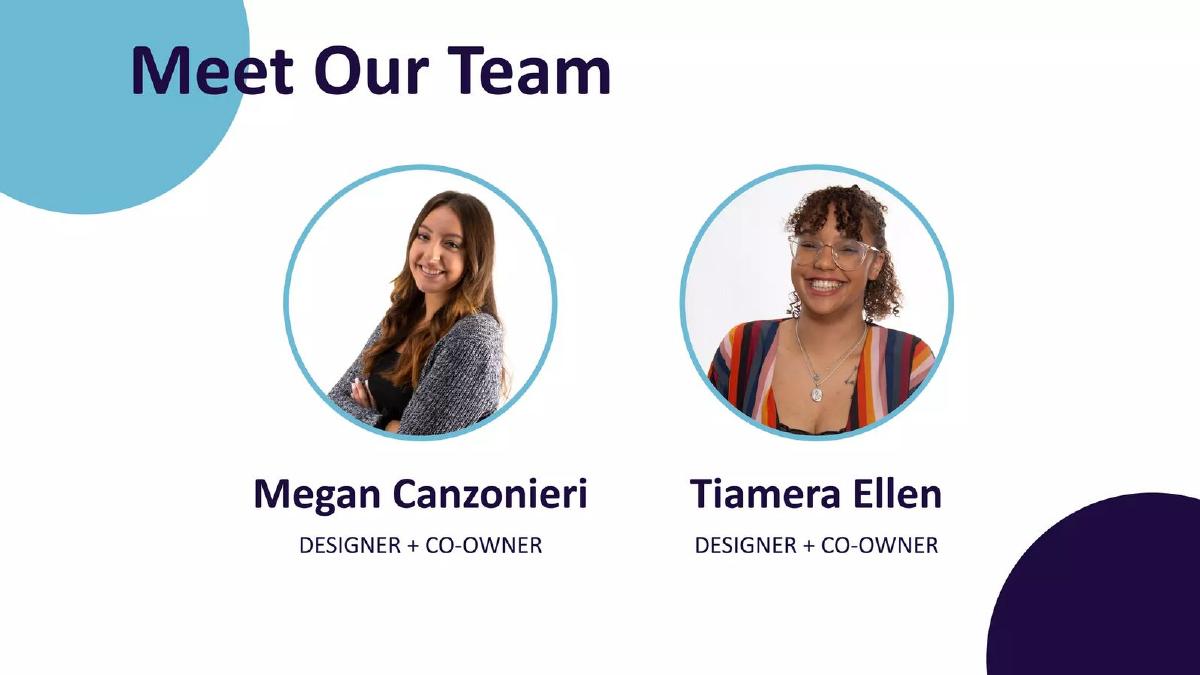
The deck opens with a standard title slide featuring the tagline "Never miss an opportunity" and the company URL. Slide 2 introduces the founders, Megan Canzonieri and Tiamera Ellen. Both are listed as Designers and Co-Owners. This is a notable choice; usually, a two-person founding team will split roles between technical (CTO) and business (CEO). By labeling both as designers, the deck signals that the product's value proposition is heavily rooted in aesthetics and user experience rather than proprietary technology or complex backend infrastructure.
The Emotional Narrative (Slides 3-6)
Slides 3 through 5 are wordless, featuring high-resolution stock photography of business professionals in various states of interaction. Slide 3 shows a positive interaction, Slide 4 shows a rejection, and Slide 5 shows a man in distress. This is a classic "Problem/Solution" setup using visual storytelling. Slide 6 resolves this tension with a photo of a celebrating professional and the text: "Be more like this guy with Cloud Card in your pocket." While visually clean, this section spends 16% of the deck on abstract emotions rather than hard data about the networking pain points they are solving.
Product Walkthrough: The Core Experience (Slides 7-11)
The deck devotes five slides to a "Signing Up Demo" and various feature walkthroughs. Slide 7 shows the onboarding process, offering users the choice to upload an existing card or choose a template. Slide 8 details the profile page, which includes social media links (LinkedIn, Instagram, Twitter), an "About" section, and a skills bar. Slide 9 demonstrates the contact addition process via QR code scanning or physical card scanning. Slide 10 shows the contact list in both grid and list views, and Slide 11 highlights the in-app messaging feature. These slides are well-designed and provide a clear understanding of the UI, but they lack callouts for unique technical features that would prevent a competitor from easily replicating the app.
Market Opportunity and Solution (Slides 12-13)
Slide 12 provides the first hard metric: "The business card industry was worth $1.2 billion in 2017 with 27 million cards printed daily." This establishes a large Total Addressable Market (TAM). Slide 13 officially introduces the solution, claiming Cloud Card is "Convenient," "Conveys More Information," and helps users "Stay Organized." This is the "Why Now" of the deck, though it is placed after the product demo, which is a non-traditional sequence.
Competitive Analysis (Slides 14-15)
Slide 14 uses a standard competitive matrix. Cloud Card compares itself to Haystack, CamCard (represented by a 'CC' logo), and Vistaprint. The matrix claims Cloud Card is the only solution offering in-app messaging and personalized design. Interestingly, it notes that Haystack requires different emails for multiple cards, whereas Cloud Card does not. Slide 15 reinforces these advantages with a bulleted list, emphasizing "In-App Messaging" as the primary differentiator in the digital space.
Financials and Revenue Model (Slides 16-17)
Slide 16 breaks down the financial plan. The startup costs are remarkably low, totaling just $15,000 ($10k for development, plus hosting and marketing). Ongoing costs are projected at $7,000. The revenue model is a freemium approach:
In-App Purchases: $1.99 - $4.99 · Premium Annual: $5.99 / month · Premium Monthly: $8.99 / month
The slide also notes that competitors have 100 million users with a 2% conversion rate (2 million converted). Slide 17 is a high-impact slide stating that only 306 annual subscribers are needed to reach breakeven. This low barrier to entry suggests a very lean operation but may raise questions for investors about the scalability and defensibility of the business.
Go-To-Market and Validation (Slides 18-19)
Slide 18 outlines the marketing strategy. The target is business professionals aged 22-50. Channels include LinkedIn, Spotify ads on business podcasts, and conference sponsorships. They mention a specific win: "Lined up our first podcast: Ecommerce Uncensored." Slide 19 , titled "Validation," reveals the early-stage nature of the project. It lists 107 website views, 10 download button clicks, 2 form submissions, 24 Instagram followers, and 32 Facebook likes. For a pitch deck, these numbers are extremely low and indicate the company is in the concept validation phase rather than the growth phase.
Closing and Future Roadmap (Slides 20-24)
The deck concludes by repeating the mission statement (Slide 20) and the team slide (Slide 21). Slide 22 looks forward, mentioning future integrations with printing services, a resume builder, and LinkedIn connectivity. Slide 23 addresses the "Post COVID19 World," noting that the app reduces physical contact and allows for easy sharing through Zoom—a timely addition given the April 2020 date. The final slide (Slide 24) is an FAQ addressing compatibility and multi-card functionality.
What Cloud Card Does Well
The deck excels at UI/UX visualization. By using high-fidelity mockups across five consecutive slides, the founders leave no doubt about how the app functions. The financial section is also refreshingly simple; by identifying a specific breakeven number (306 subscribers), they make the path to a viable small business seem highly attainable. The inclusion of a COVID-19 specific slide shows adaptability to current market conditions, which was a critical requirement for any business raising or launching in early 2020.
What Is Missing from the Deck
The most glaring omission is a lack of significant traction. While the founders are honest about their 107 website views, these metrics are too low to prove market demand. Furthermore, the deck lacks a technical roadmap or a description of the "Business Card Scanner" technology—is it proprietary OCR (Optical Character Recognition) or a third-party API? Investors would also likely want to see more robust founder bios; "Designer + Co-Owner" does not explain why this team is uniquely qualified to win a competitive market against established players like LinkedIn or specialized apps like Haystack. Finally, there is no specific "Ask" slide detailing how much capital they are raising and exactly how that money will be allocated beyond the $15,000 startup estimate.
What a Founder Should Copy
Founders should emulate the clarity of the competitive matrix on Slide 14. It clearly identifies specific feature gaps in the market (like in-app messaging) rather than just claiming to be "better." The use of a FAQ slide (Slide 24) is also a smart way to preempt common objections regarding compatibility and user behavior. Lastly, the "Breakeven" slide (Slide 17) is a powerful way to demonstrate fiscal responsibility and a clear understanding of unit economics, even if the overall scale of the project is modest.
Frequently asked questions
- What is the core problem Cloud Card is solving?
- Cloud Card addresses the waste and inconvenience of the physical business card industry. According to slide 12, 27 million cards are printed daily in a $1.2 billion industry. The deck uses a series of emotional stock photos (Slides 3-5) to imply that traditional networking is frustrating or ineffective, offering a digital alternative that is more 'convenient' and helps users 'stay organized' (Slide 13).
- How does the app generate revenue?
- The company employs a freemium model detailed on slide 16. Revenue streams include advertising, in-app purchases ranging from $1.99 to $4.99, and two premium subscription tiers. Users can pay $5.99 per month if billed annually or $8.99 per month for a month-to-month plan. The deck also mentions that competitors have 100 million users with about 2 million converted to paid plans.
- Who are the competitors and how does Cloud Card differentiate?
- Slide 14 compares Cloud Card against Haystack, 'CC' (likely CamCard), and Vistaprint. Cloud Card claims to be the only one offering the full suite of features including in-app messaging, personalized design, and multiple cards without requiring different email addresses. It specifically highlights 'In-App Messaging' as a key advantage not found in the digital competitors listed.
- What is the current stage of the product and company?
- Based on the 'Validation' slide (Slide 19) and the 'Go To Market Strategy' (Slide 18), the company appears to be in the pre-launch or very early beta stage as of April 2020. The app development cost is still listed as an 'estimate' of $10k, and the validation metrics show very low engagement (107 website views and 2 form submissions), suggesting the product was not yet widely available.
- What are the founders' backgrounds?
- The team consists of two co-owners, Megan Canzonieri and Tiamera Ellen, both identified as 'Designer + Co-Owner' on slide 2 and slide 21. The deck does not provide professional histories, previous startup experience, or specific educational backgrounds, focusing instead on their roles as the creative leads for the product's design.