The CloudAcademy pitch deck is a masterclass in brevity, relying on strong financial growth and high-tier enterprise logos to tell its story. Operating in the $200 billion cloud market, the company showcases a rapid revenue climb from $9,367 in Q2 2014 to a forecasted $95,000 in Q1 2015. The core value proposition centers on a high-margin SaaS model (90%) that delivers courses, quizzes, and hands-on labs to a broad technical audience. While the deck lacks a formal team slide or a specific capital ask in the provided pages, the inclusion of 1,200+ customers and logos like Deloitte and Accentur…
Key takeaways
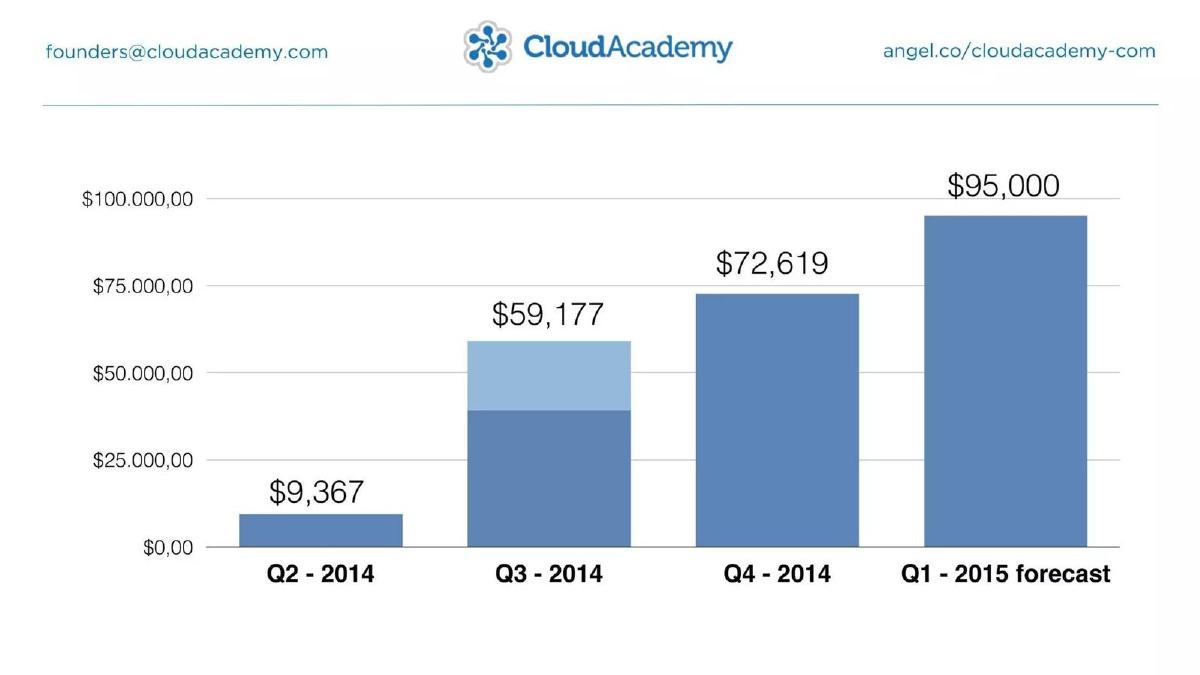
- Revenue grew significantly within a single year, moving from $9,367 in Q2 2014 to a $95,000 forecast for Q1 2015 (Slide 2).
- The company operates with an exceptionally high 90% margin, a figure highlighted twice to emphasize capital efficiency (Slides 7 and 8).
- CloudAcademy has secured high-value enterprise customers including Deloitte, Accenture, Datapipe, and CSC (Slide 8).
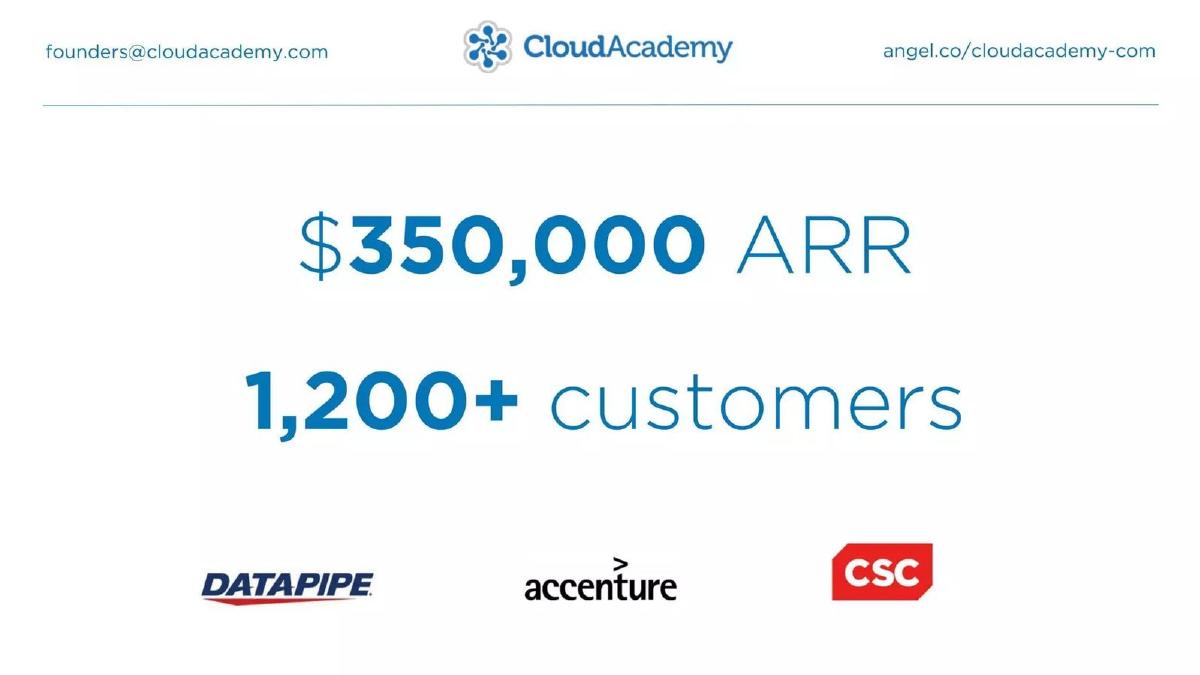
- The platform has scaled to over 1,200 customers and reached $350,000 in Annual Recurring Revenue (Slide 8).
- The product offering is categorized into three pillars: Courses, Quizzes, and Hands-on Labs (Slide 5).
- The target audience is broad, encompassing Developers, System Administrators, IT Managers/Consultants, and Sales people (Slide 6).
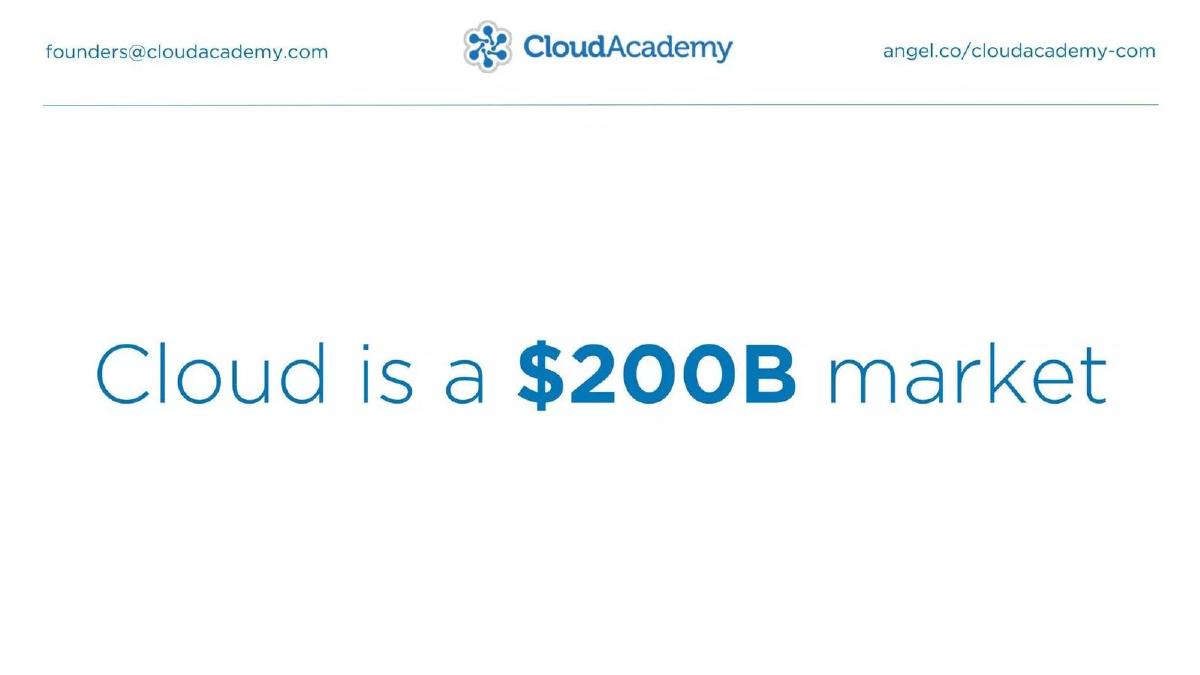
- The deck identifies a total addressable market for 'Cloud' at $200 billion, though it does not break down the specific training sub-sector (Slide 3).
- The business model is strictly defined as a SaaS model, supporting the high-margin claims (Slide 7).
CloudAcademy Pitch Deck Analysis
CloudAcademy’s deck is a lean, data-driven presentation that focuses heavily on traction and business model efficiency. In an era where many EdTech companies struggle with high content production costs and low margins, CloudAcademy leads with its 90% margin and enterprise-grade customer list. The deck is designed to prove that the company has found product-market fit in a massive industry and is ready to scale.
Slide 1: Title Slide
The title slide is minimalist, featuring the CloudAcademy logo and the tagline "Learn Cloud Computing." It includes contact information for the founders and a link to their AngelList profile. The branding is clean and professional, establishing an immediate association with technology and education. By including the AngelList link directly on the cover, the founders signal transparency and an active fundraising posture.
Slide 2: Traction and Revenue Growth
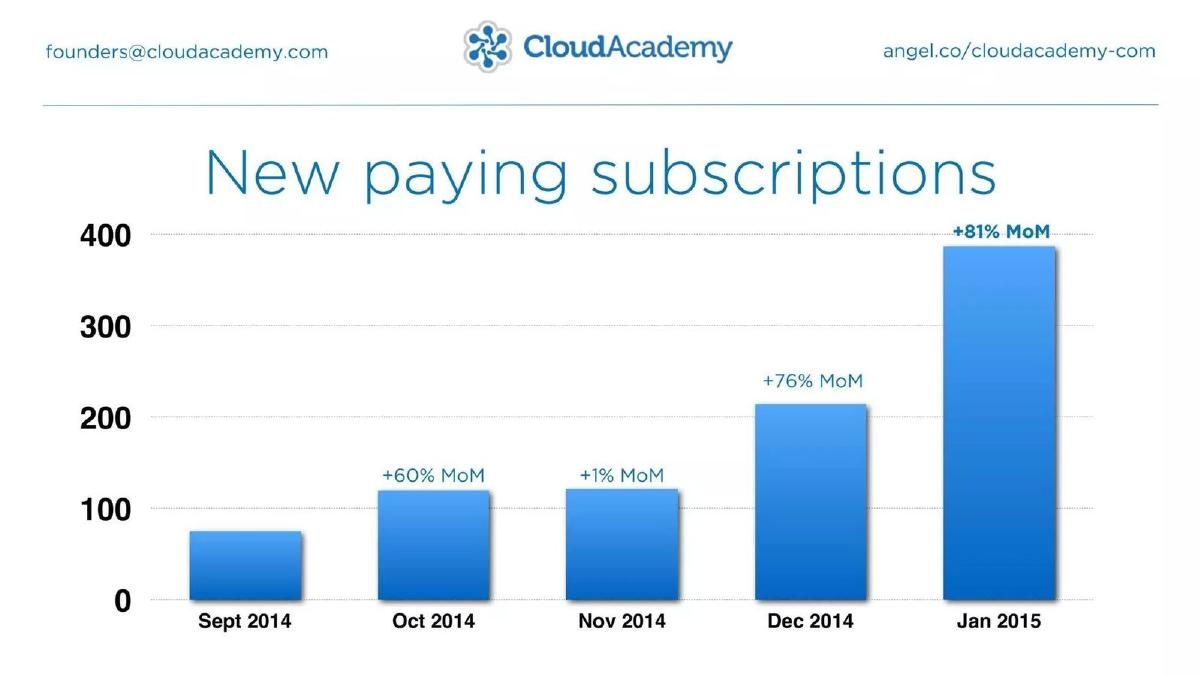
This is the most critical slide in the early part of the deck. It shows a bar chart of quarterly revenue for 2014. The growth is aggressive: $9,367 in Q2 , $59,177 in Q3 , and $72,619 in Q4 . It concludes with a $95,000 forecast for Q1 2015 . The use of a forecast for the upcoming quarter suggests this deck was likely used in late 2014 or very early 2015. The steep incline of the bars provides a visual representation of momentum that is hard for investors to ignore.
Slide 3: Market Opportunity
CloudAcademy keeps its market slide incredibly simple: "Cloud is a $200B market." While this is a massive headline figure, it refers to the total cloud computing market rather than the specific cloud training market. However, in a pitch deck context, this serves to show the ceiling of the industry they are supporting. The implication is that as the cloud market grows, the need for skilled professionals to manage that $200B infrastructure grows proportionally.
Slide 4: The Problem (Visual)
This slide features a photograph of a traditional, physical classroom setting with a teacher pointing at a projector screen and students sitting at desktop computers. There is no text on this slide. The intent is clearly to contrast the "old way" of IT training—expensive, location-dependent, and slow—with the digital, scalable solution CloudAcademy provides. It sets the stage for the "Solution" slide without needing to write a single bullet point.
Slide 5: The Solution
The company positions itself as "The first choice for Cloud training worldwide." It breaks the product down into three distinct icons: Courses, Quizzes, and Hands-on Labs. The inclusion of "Hands-on Labs" is a key differentiator in technical education, as it suggests the platform provides actual cloud environments for students to test their skills, rather than just passive video consumption.
Slide 6: Target Audience
This slide lists the users of the platform: Developers, System Administrators, IT Managers/Consultants, and Sales people. By including "Sales people," CloudAcademy demonstrates an understanding that cloud literacy isn't just for coders; it is a requirement for the entire enterprise ecosystem, which significantly expands their Total Addressable Market (TAM).
Slide 7: Business Model
This slide is incredibly sparse but impactful. It lists two points: "90% margin" and "SaaS model." For a venture capitalist, these are the two most important characteristics of a scalable software business. The 90% margin is particularly high for an education company, suggesting that their content delivery and lab infrastructure are highly automated and cost-effective.
Slide 8: Key Metrics and Social Proof
The final slide in this set consolidates the company's achievements. It lists $350,000 ARR , 1,200+ Customers , and reiterates the 90% Margin . On the right side of the slide, it displays logos of major enterprise customers: Datapipe, Deloitte, Accenture, and CSC. Having these logos alongside the customer count proves that CloudAcademy isn't just a B2C play for individual hobbyists; it is a trusted partner for global consulting firms that need to upskill thousands of employees.
What CloudAcademy Does Well
The deck excels at brevity and impact . By focusing on a few key numbers—specifically the revenue growth and the 90% margin—the founders avoid the trap of over-explaining the product features. They allow the traction to speak for the product's quality. The inclusion of high-tier enterprise logos like Deloitte and Accenture provides immediate validation, suggesting that the platform is robust enough for corporate environments.
What is Missing from the Deck
Based on the slides provided, there are several glaring omissions that a founder would need to address in a full pitch:
Team Slide: There is no mention of who is building this. In early-stage investing, the team is often as important as the metrics. · The Ask: The deck does not state how much money they are raising or what the milestones for the next 18 months look like. · Competition: There is no mention of competitors like A Cloud Guru, Linux Academy, or Pluralsight, which were active during this period. · Unit Economics: While they mention a 90% margin, they don't show Customer Acquisition Cost (CAC) or Lifetime Value (LTV), which are vital for evaluating a SaaS business.
Founder's Guide: What to Copy
Founders should emulate CloudAcademy's "Metric-First" approach . If you have strong growth, put it on Slide 2. Don't make investors wait until the end of the deck to see if people are actually paying for your product. Additionally, the way they categorized their product into three simple pillars (Courses, Quizzes, Labs) is an excellent way to communicate a complex technical platform without getting bogged down in jargon. Finally, the use of a simple, high-contrast design ensures that the data points—like the $350k ARR—are the stars of the show.
Frequently asked questions
- What is CloudAcademy's current revenue and growth rate?
- According to Slide 2, CloudAcademy saw rapid quarterly growth in 2014. They started Q2 at $9,367, jumped to $59,177 in Q3, and reached $72,619 in Q4. By Slide 8, the company reports an Annual Recurring Revenue (ARR) of $350,000, with a Q1 2015 forecast of $95,000. This represents a nearly 10x increase in quarterly revenue over a nine-month period.
- Who is the target customer for this platform?
- CloudAcademy targets both individuals and enterprises. Slide 6 lists Developers, System Administrators, IT Managers, and Sales people as the primary users. The enterprise focus is validated on Slide 8, which lists major consulting and IT firms like Deloitte and Accenture as customers, suggesting a B2B2C or enterprise licensing approach.
- What makes CloudAcademy's business model attractive to investors?
- The primary hook is the 90% margin stated on Slides 7 and 8. In the software-as-a-service (SaaS) world, a 90% margin indicates very low COGS (Cost of Goods Sold), likely due to automated delivery of content and labs. This suggests that for every dollar of revenue, 90 cents can be reinvested into growth or R&D.
- What specific products does CloudAcademy offer?
- Slide 5 outlines the three core components of the learning experience: Courses, Quizzes, and Hands-on Labs. The 'Hands-on Labs' component is particularly important in the cloud space, as it implies a practical, sandbox environment for users to practice on actual cloud infrastructure rather than just watching videos.
- What is missing from this pitch deck?
- Based on the 8 slides provided, there is no Team slide, which is a significant omission for early-stage investors. There is also no 'Ask' slide detailing how much capital is being raised or how it will be spent. Additionally, there is no competitive landscape analysis or detailed product roadmap beyond the three core pillars.