Satgana’s pitch deck for its $30M climate tech fund focuses on the 'Seed gap' in sustainability investing. The firm argues that while late-stage capital is abundant, early-stage ventures remain underserved. The deck highlights a pan-African and European strategy, showcasing three initial investments: Mazi Mobility (Kenya), Orbio Earth (Germany), and Yeasty (France). A significant portion of the presentation is dedicated to the team's operational pedigree, featuring leaders with backgrounds at Rocket Internet, Société Générale, and Rothschild & Co. The deck also emphasizes regulatory and impac…
Key takeaways
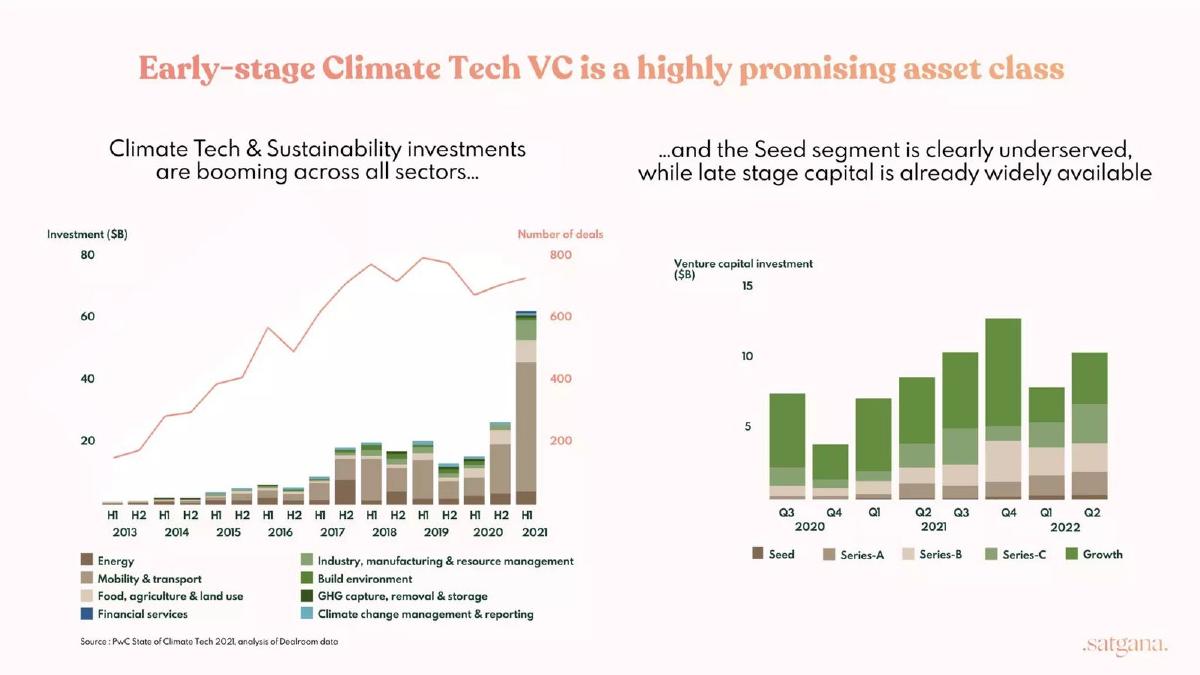
- The fund identifies a market gap where Seed-stage climate tech is underserved compared to widely available late-stage capital (Slide 3).
- Satgana positions itself as an SFDR Article 9 fund, the highest sustainability classification under EU taxonomy (Slide 6).
- The initial portfolio demonstrates geographic diversity, covering Kenya, Germany, and France (Slide 5).
- CEO Romain Diaz brings track record data from Far Ventures, citing a current TVPI of x12 and an IRR of 50%+ (Slide 7).
- The investment team is supported by a 'Chief Impact Officer' with a PhD in Computer Science and 20 years of R&D experience (Slide 7).
- The firm utilizes a gender-lens investment framework, aligning with the 2X Collaborative (Slide 6).
- Advisors include founders of venture-backed startups like Plan A, which has raised $15m (Slide 8).
- The strategy targets multiple UN Sustainable Development Goals, specifically SDGs 5, 11, 12, 13, 14, and 15 (Slide 6).
Satgana Pitch Deck Teardown
Satgana is a next-generation Climate Tech Venture Capital firm. Their LP (Limited Partner) deck is designed to convince institutional and private investors that the early-stage climate market is not just a moral imperative, but a high-alpha financial opportunity. The deck follows a logical progression from macro-market trends to specific team execution capabilities.
Slide 1: Title and Mission
The opening slide establishes the brand identity. The tagline, "Next generation Climate Tech Venture Capital firm on a mission to invest in the Future of Earth," sets a high-level purpose. The imagery of a mountain range at sunrise reinforces the environmental theme without being overly clinical. It is a standard, clean entry point for an LP presentation.
Slide 2 & 3: The Opportunity and Thesis
Slide 3 is the most data-dense portion of the market thesis. It uses two charts to justify the fund's existence. The first chart, citing PwC and Dealroom data, shows that Climate Tech and Sustainability investments are "booming across all sectors," with H1 2021 seeing a massive spike in both deal count (over 700) and total investment (exceeding $60B). The second chart is the "hook": it shows that while Series C and Growth capital are widely available, the Seed segment is "clearly underserved." By visualizing the capital stack, Satgana makes a compelling case that they are entering a less competitive, higher-upside segment of the market.
Slide 4 & 5: Strategy and Initial Portfolio
Slide 5 provides proof of execution. Rather than just talking about what they will do, Satgana shows what they have done. They list three companies: Mazi Mobility in Kenya (mass mobility), Orbio Earth in Germany (methane intelligence), and Yeasty in France (alternative protein). This slide is crucial because it proves the team can source deals across two continents and three distinct sub-sectors of climate tech. It validates the "pan-African and European" claim made later in the deck.
Slide 6: Impact and Compliance
For modern LPs, especially in Europe, regulatory compliance is a major selling point. Slide 6 highlights that Satgana is an SFDR Article 9 fund . In the world of EU sustainable finance, Article 9 is the highest standard, reserved for funds that have sustainable investment as their core objective. The slide also lists alignment with the 2X Challenge (gender-lens investing) and B-Corp intent. This slide serves to de-risk the investment for ESG-mandated LPs by showing that the fund's impact reporting will be rigorous and standardized.
Slide 7: The Management Team
LPs invest in people, and Slide 7 is a comprehensive look at the "purpose-driven team." The deck highlights Romain Diaz (CEO) , who brings a track record from Far Ventures with a stated TVPI of x12 and IRR of 50%+ . This is a vital metric; it moves the conversation from "impact" to "returns." The rest of the team is balanced between finance (Isabelle Albert, ex-Société Générale; Alexandre Perry, ex-Rothschild & Co) and technical expertise (Julien Zory, PhD). The inclusion of an Investment Analyst and a Marketing Manager suggests a full-stack operational approach rather than a lean, two-person partnership.
Slide 8: The Advisory Board
Slide 8 lists eight advisors who add specialized layers of credibility. Notable inclusions are Lubomila Jordanova (CEO of Plan A, which has raised $15m) and Michael Napper (former Global Head of IT at Credit Suisse and JP Morgan). The advisors cover technical, gender-lens, and institutional finance angles, providing a safety net of expertise that a first-time fund often needs to demonstrate to LPs.
What Works in This Deck
The "Seed Gap" Argument: Slide 3 clearly identifies a market inefficiency. LPs like to see that a fund isn't just following the herd but is positioning itself where capital is scarce. · Track Record Transparency: Including specific IRR and TVPI figures for the CEO's previous venture building (Slide 7) provides a quantitative basis for trust. · Regulatory Sophistication: Mentioning SFDR Article 9 and the EU Taxonomy shows the team understands the complex regulatory landscape of European sustainable finance. · Geographic Arbitrage: By investing in both Europe and Africa, the fund offers LPs a unique diversification profile that few climate funds can match.
What Is Omitted
Fund Terms: The provided slides do not list the management fee, carry structure, or the specific hurdle rate. While these are often in a separate term sheet, their absence in a pitch deck teardown is notable. · Pipeline Depth: While three portfolio companies are shown, there is no mention of the current pipeline size or the number of deals reviewed to reach those three investments. · Exit Strategy: There is no discussion of how the fund expects to exit these early-stage positions, especially in the African market where liquidity events can be more complex than in Europe. · Target Fund Size: While the source listing mentions $30M, the slides themselves do not explicitly state the total capital call or the minimum ticket size for LPs.
Founder Takeaways
Lead with the Gap: If you are raising a fund or a startup, don't just say the market is big. Show exactly where the market is broken or underserved, as Satgana does on Slide 3. · Prove the "How": Satgana doesn't just say they care about impact; they list the specific frameworks (SFDR, SDG, IMP, 2X) they use to measure it. Specificity equals credibility. · Balance the Team: A climate fund needs more than just "finance guys." Satgana’s inclusion of a PhD Chief Impact Officer and a Venture Partner with deep R&D experience shows they can evaluate the underlying technology, not just the spreadsheets. · Use Social Proof: If you are a new firm, leverage an advisory board that fills your experience gaps. Satgana’s advisors from JP Morgan and Plan A signal to LPs that the firm is well-connected in both traditional finance and the startup ecosystem.
Frequently asked questions
- What is Satgana's primary investment thesis?
- Satgana focuses on early-stage climate tech, specifically targeting the Seed segment. They argue that while total investment in the sector is booming (reaching over $60B in H1 2021), the capital is disproportionately concentrated in later stages (Series C and Growth), leaving a lucrative opening for early-stage specialists who can provide hands-on support.
- Which geographic regions does the fund cover?
- The fund operates across Europe and Africa. This is evidenced by their initial investments in Kenya (Mazi Mobility), Germany (Orbio Earth), and France (Yeasty). The team also highlights experience in both markets, with leadership having worked at African venture builders and European financial institutions.
- How does Satgana measure its environmental and social impact?
- The firm employs several rigorous frameworks, including SFDR Article 9 compliance, alignment with specific UN Sustainable Development Goals, and the Impact Management Project (IMP) standards. They also indicate an intent for B-Corp certification for both the fund and its portfolio companies.
- What is the professional background of the management team?
- The team combines venture building, investment banking, and sustainability expertise. Key figures include CEO Romain Diaz (ex-Rocket Internet), COO Isabelle Albert (ex-Société Générale), and Investment Directors with experience at Rothschild & Co and family offices managing over €1bn in assets.
- What specific climate sectors are mentioned in the deck?
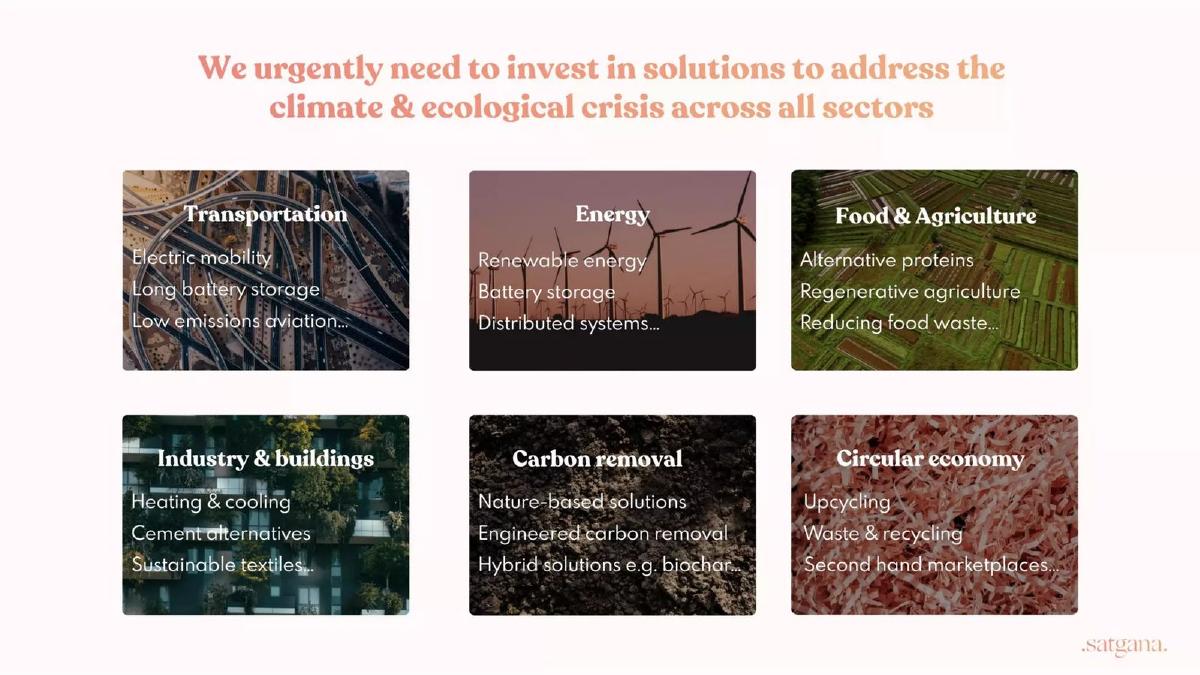
- The deck lists several focus areas including Energy, Mobility & Transport, Food & Agriculture, GHG capture/removal, and Climate change management. Their active investments specifically touch on mass mobility, methane intelligence, and alternative proteins.