Clear Blue Technologies’ 2019 presentation serves as a post-listing investor update, emphasizing their transition from a hardware provider to an 'Energy-as-a-Service' (EaaS) leader. The deck highlights a strong financial performance in 2018, reporting $3.78M in revenue with 65% year-over-year growth and a 25% gross profit margin. With 3,712 units managed across 35 countries, the company positions its patented predictive energy forecasting and remote management software as key differentiators. The narrative focuses on the Total Cost of Ownership (TCO) advantages for telecom and street infrastr…
Key takeaways
- The company reported $3.78M in 2018 revenue with a 65% year-over-year growth rate (Slide 5).
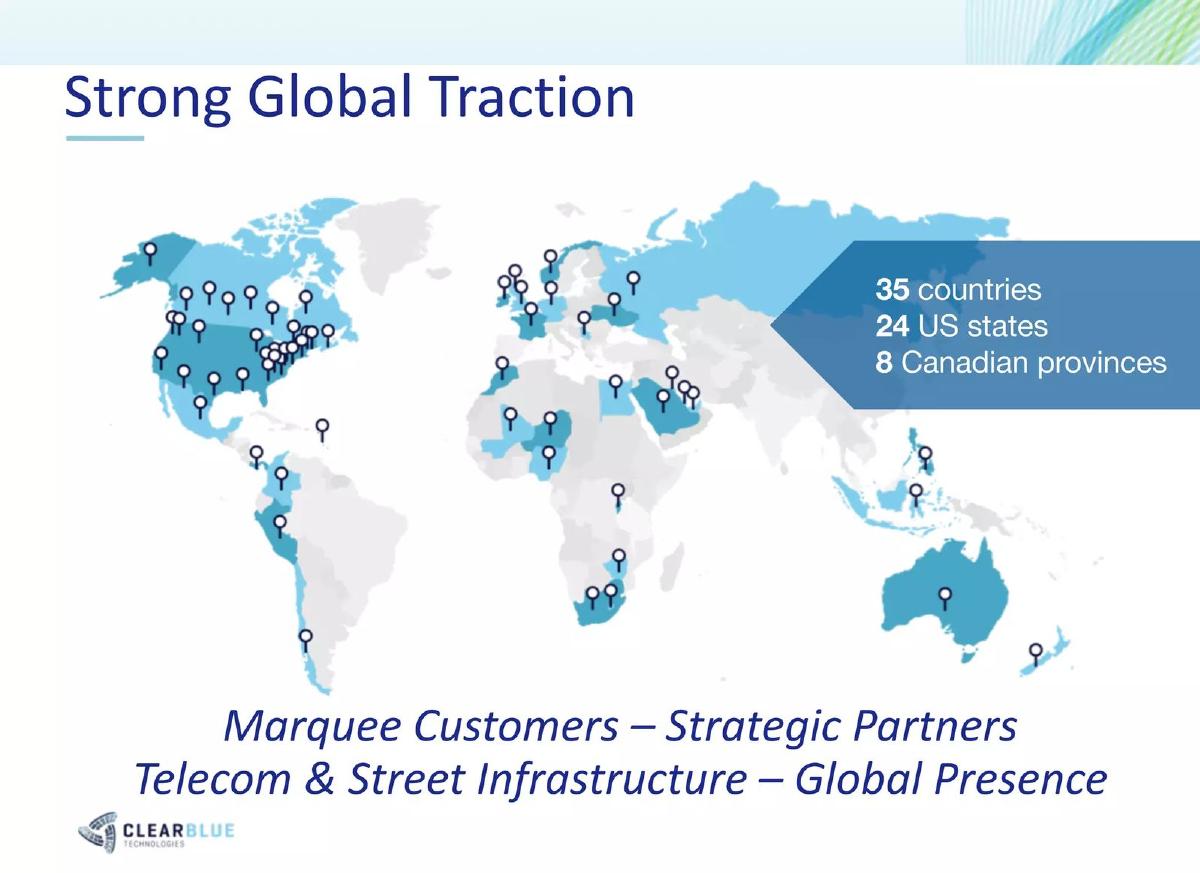
- Clear Blue manages 3,712 units across 35 different countries as of the presentation date (Slide 5).
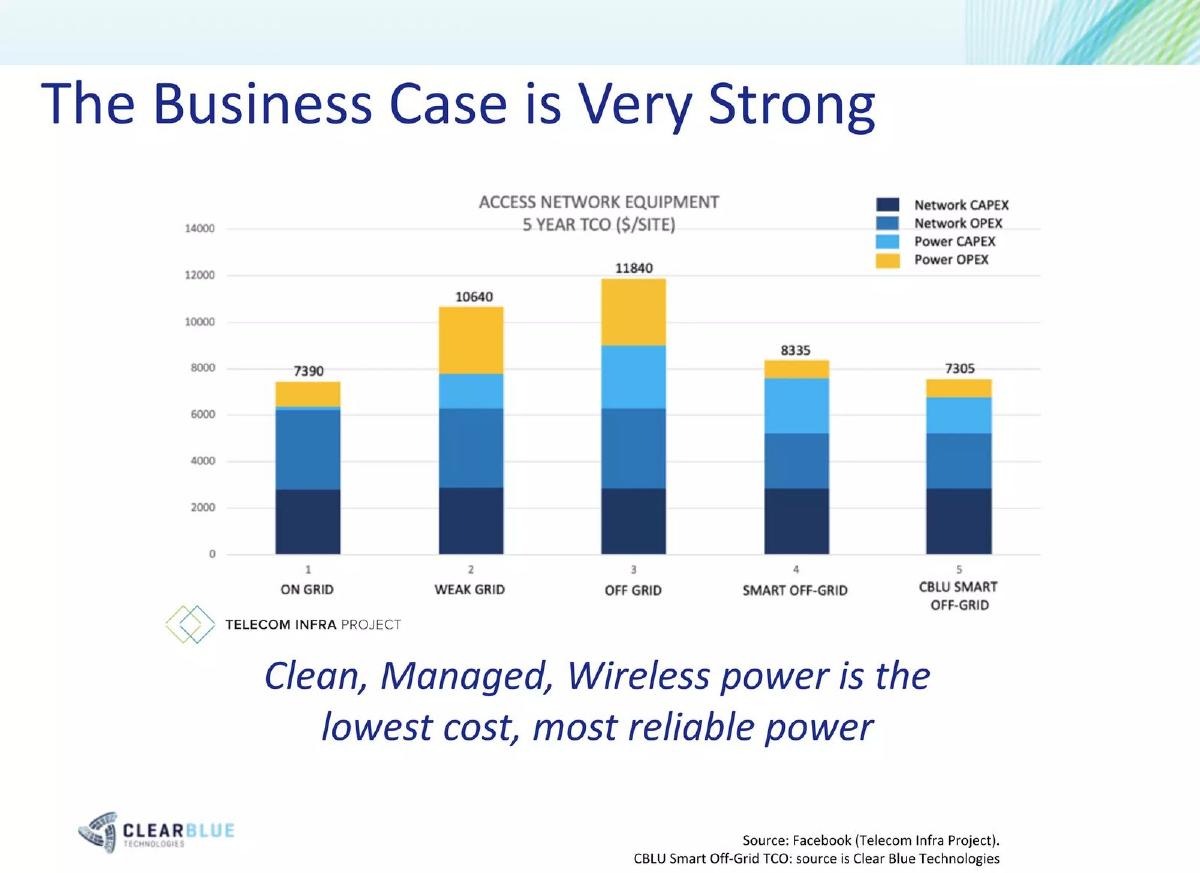
- The 'CBLU Smart Off-Grid' solution claims a 5-year TCO of $7,305, which is lower than traditional on-grid costs of $7,390 (Slide 3).
- Intellectual property is a core pillar, with specific patents granted in 2012, 2013, 2015, and 2017 covering remote management and dynamic charging (Slide 6).
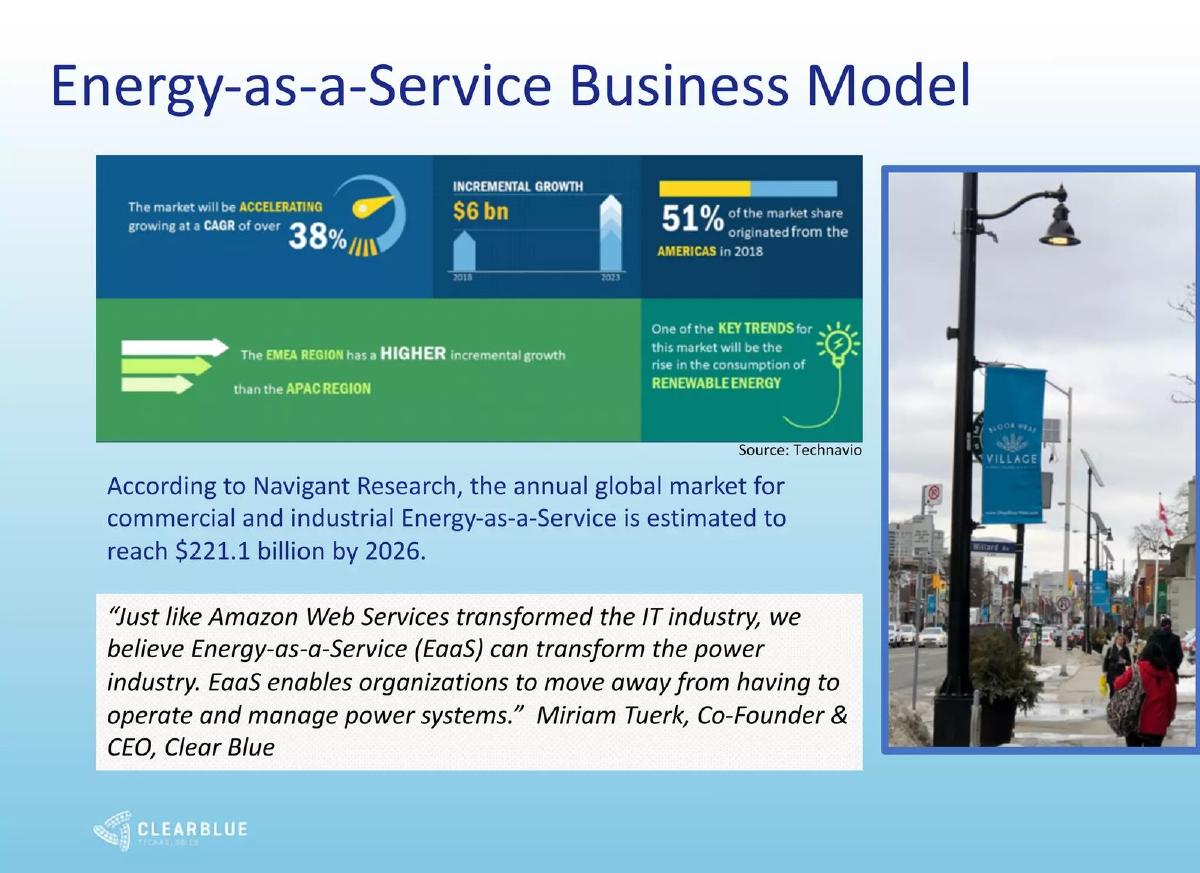
- The business model is shifting toward 'Energy-as-a-Service' (EaaS) to drive recurring revenue (Slide 7).
- The company targets four primary key markets: Lighting, Telecom, Smart City, and Internet of Things (Slide 5).
- A diverse customer base is presented through logos including the USDA, City of Toronto, and Alexandria, Egypt (Slide 4).
- The presentation concludes with a visual confirmation of their public listing on the TSX Venture Exchange under the ticker CBLU (Slide 8).
Clear Blue Technologies: A Public Market Investor Update
The 2019 investor presentation for Clear Blue Technologies International Inc. is less of a traditional 'pitch' for venture capital and more of a performance report for public market investors. Having already listed on the TSX Venture Exchange (TSXV: CBLU), the company uses these slides to validate its business model, showcase its technological moat, and outline a path toward recurring revenue through service-based contracts. The deck is structured to move from technical differentiation to financial proof points, ending with a clear roadmap for geographic and sectoral expansion.
Slide 1: Title and Positioning
The opening slide introduces the company as 'Clear Blue Technologies International Inc.' and establishes their category: 'The Smart Off-Grid Company.' The visual design is clean, using a light blue palette and a silhouette of a telecom tower and streetlights, which immediately signals their primary infrastructure focus. There is no clutter here; the brand identity is the central focus.
Slide 2: Patented Smart Off-Grid Technology
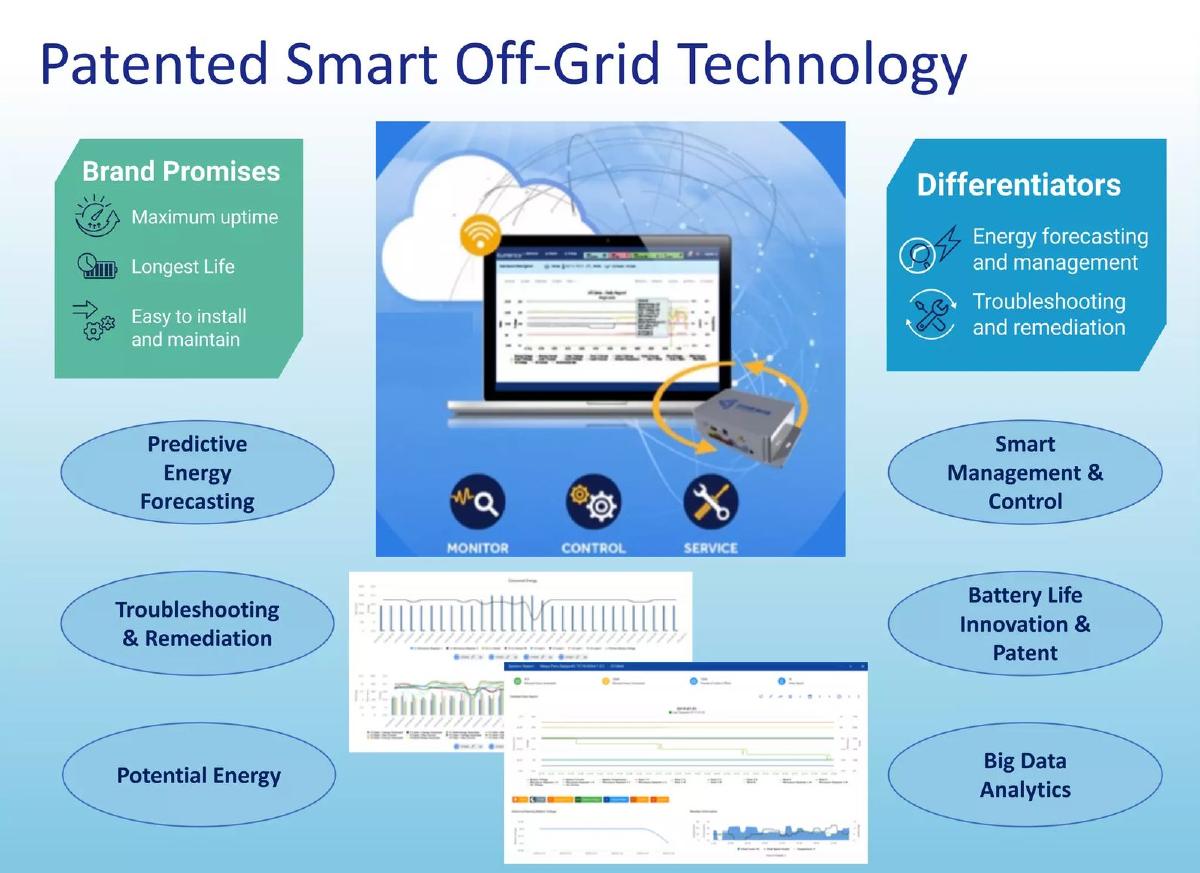
This slide serves as the technical foundation of the deck. It breaks down the product into three pillars: Monitor, Control, and Service. The company lists its 'Brand Promises' as maximum uptime, longest life, and ease of installation. More importantly, it highlights 'Differentiators' such as energy forecasting and troubleshooting. The inclusion of 'Big Data Analytics' and 'Predictive Energy Forecasting' suggests that Clear Blue is not just a battery or solar company, but a software-driven energy management firm. The mention of a 'Battery Life Innovation & Patent' is a critical detail for investors concerned about the high replacement costs typically associated with off-grid systems.
Slide 3: The Economic Argument
Slide 3, titled 'The Business Case is Very Strong,' is perhaps the most important slide for a hardware-enabled service company. It features a bar chart comparing the 5-year Total Cost of Ownership (TCO) per site across five scenarios: On Grid, Weak Grid, Off Grid, Smart Off-Grid, and finally, 'CBLU Smart Off-Grid.' The data, attributed to the Telecom Infra Project (Facebook), shows that Clear Blue’s solution costs $7,305 over five years, which is lower than the $7,390 cost of a traditional 'On Grid' connection. By positioning their technology as cheaper than the grid itself, they remove the 'sustainability premium' barrier that often hinders green-tech adoption.
Slide 4: Customer Validation
A standard but effective logo wall. The 'Street Infrastructure Example Customers' slide includes a mix of government bodies (USDA, New York State DOT, City of Toronto, City of Harare), educational institutions (UIC, Salem State University), and private enterprises (Boston Scientific, HyVee). The inclusion of 'Alexandria, Egypt' and 'City of Harare' reinforces the company’s international reach mentioned later in the deck. This slide serves to de-risk the investment by showing that diverse, high-credit-quality organizations have already vetted and deployed the technology.
Slide 5: Financial and Operational Traction
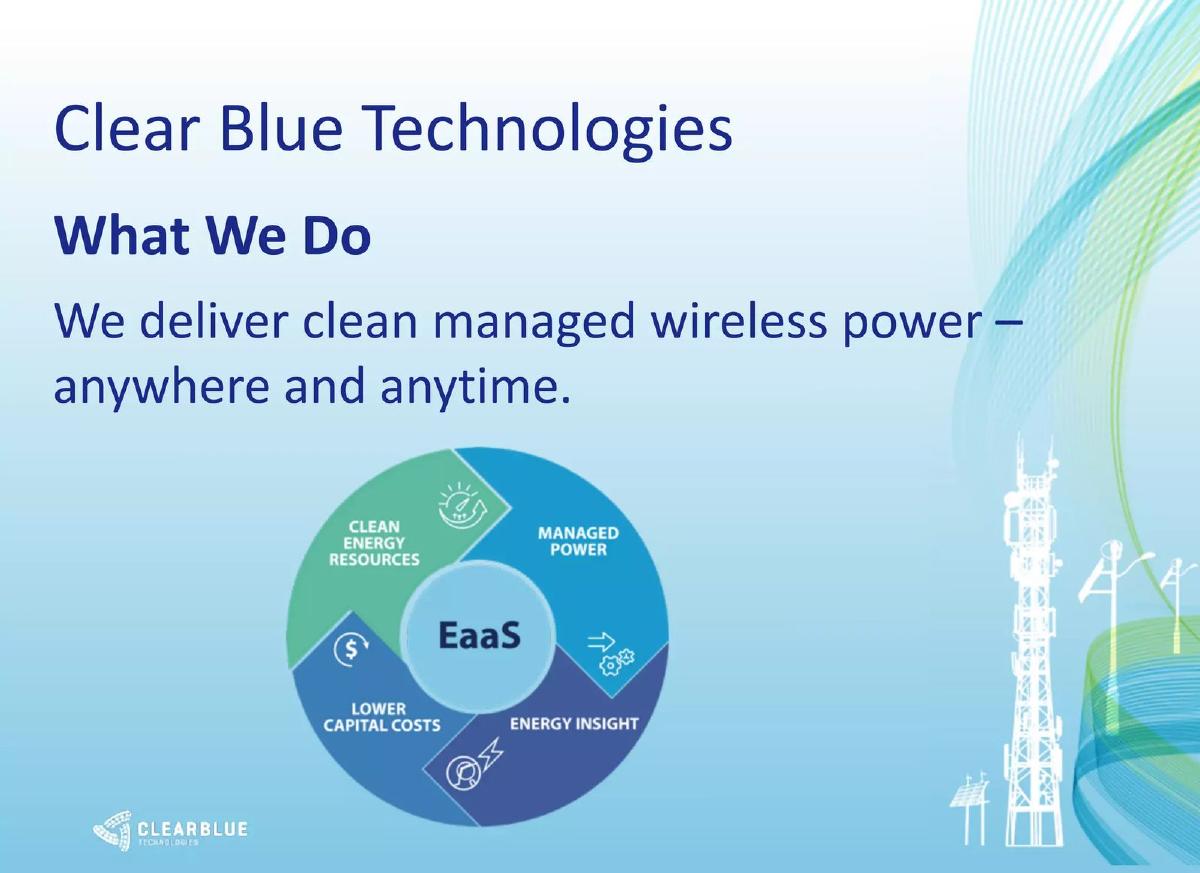
Titled 'Who We Are,' this slide provides the hard metrics investors crave. It lists $3.78M in 2018 revenue, a 65% year-over-year growth rate, and a 25% gross profit margin. The scale is quantified by '3712 Units under management in 35 countries.' The slide also introduces the 'EaaS' (Energy-as-a-Service) model, which combines clean energy resources, managed power, energy insight, and lower capital costs. This is a strategic pivot intended to appeal to investors who value the high multiples associated with recurring SaaS-like revenue over one-time hardware sales.
Slide 6: Intellectual Property Roadmap
Clear Blue uses a timeline to display its patent history from 2012 to 2018. By showing specific milestones—such as the 2013 patent for 'Predictive Performance Analytics Integrated with Weather Forecasting' and the 2015 patent for 'Dynamic Charging'—the company demonstrates a consistent track record of innovation. This timeline suggests that their current market position is protected by years of R&D, making it difficult for new entrants to replicate their 'Smart Off-Grid' efficiency.
Slide 7: Growth Strategy
The growth strategy is presented in three clear horizontal chevrons. First, they aim for 'Enhanced penetration of North American & African lighting & Smart City market.' Second, they target the 'Telecom sector first installs and key partnerships leading to large scale rollouts.' Third, they emphasize 'Energy as a Service to drive recurring revenue.' The visual pairing of telecom towers and streetlights with the EaaS circle diagram reinforces that their software is the connective tissue across different hardware applications.
Slide 8: Public Market Status
This slide features a photograph of the team at the TSX Venture Exchange with the ticker 'TSXV: CBLU' prominently displayed. The caption 'THE MARKET IS OPEN' serves as a final piece of social proof. For an investor, this indicates liquidity and a level of regulatory oversight that private startups do not have. It transitions the deck from a 'pitch' to a 'corporate update.'
Slide 9: Contact Information
The final slide provides direct lines to Sales, Media, and Investor Relations. Notably, it lists Miriam Tuerk, Co-Founder and CEO, as the primary contact for Investor Relations, providing her phone number and email. This level of accessibility is common in small-cap public companies looking to build relationships with retail and institutional investors.
What Works Well in This Deck
Economic Clarity: The TCO comparison on Slide 3 is excellent. It doesn't just say the technology is 'good'; it says it is $85 cheaper than the grid over five years. In infrastructure, cost is the ultimate driver, and Clear Blue leads with it.
Metric Transparency: Slide 5 provides a clear snapshot of the business. Revenue, growth, margin, and unit count are all presented without obfuscation. This allows an analyst to quickly calculate the average revenue per unit and assess the health of the growth.
IP Documentation: Rather than just saying 'we have patents,' Slide 6 explains what those patents actually cover. This helps investors understand the specific technical advantages (like weather-integrated forecasting) that lead to the cost savings claimed earlier.
What Is Missing from the Deck
Unit Economics Detail: While the 25% gross profit margin is stated, there is no breakdown of the margin difference between hardware sales and the EaaS recurring revenue. Investors would want to know if the service component carries a significantly higher margin.
Competitive Landscape: The deck assumes a vacuum. There is no mention of other off-grid competitors or how Clear Blue compares to traditional diesel generator solutions, which are the incumbent 'standard' for off-grid telecom in many of their target markets.
Management Team Bios: While the CEO is listed on the contact slide and the team is pictured at the TSX, there are no professional biographies. For a public company, the background and track record of the executive team and the board of directors are critical for building investor confidence.
Lessons for Other Founders
Quantify the 'Un-Green' Benefit: Clear Blue succeeds because they don't just sell 'clean energy'; they sell 'cheaper energy.' If you are building a sustainability startup, your primary pitch should be an economic one where the environmental benefit is a secondary, 'free' bonus.
Show the Evolution of IP: A timeline of patents is more persuasive than a simple list. It shows that your technology is an evolving platform rather than a single static invention. It demonstrates a culture of continuous R&D.
Bridge Hardware to Service: If you sell hardware, you must show a path to recurring revenue. Clear Blue’s 'EaaS' branding is a perfect example of how to frame a service contract as a modern, tech-forward offering that increases the lifetime value of every customer.
Frequently asked questions
- What is the primary value proposition of Clear Blue Technologies?
- Clear Blue Technologies positions itself as 'The Smart Off-Grid Company.' Their primary value proposition is providing clean, managed, wireless power that is more reliable and cost-effective than traditional grid or standard off-grid solutions. According to Slide 3, their technology reduces the 5-year Total Cost of Ownership for telecom sites to $7,305, outperforming even standard on-grid connections.
- How does the company generate revenue?
- The company utilizes a multi-pronged revenue approach. Slide 5 identifies their offerings as Smart Off-Grid Controllers, Illumience Cloud Control Software, and Nano-grid Total Power Solutions. Crucially, Slide 7 highlights a strategic shift toward 'Energy-as-a-Service' (EaaS), which is designed to convert one-time hardware sales into long-term recurring revenue through managed power and energy insights.
- What is the status of their intellectual property?
- Clear Blue has a documented history of patenting their core technology. Slide 6 shows a timeline of patents: 2012 (Remote management and control), 2013 (Predictive performance analytics with weather forecasting), 2015 (Dynamic charging), and 2017 (Monitoring and maintenance of remote autonomously powered lighting). This suggests a defensible moat around their software-hardware integration.
- Which geographic markets and sectors are they targeting?
- The company has a global footprint with units in 35 countries. Their growth strategy, detailed on Slide 7, focuses on enhancing penetration in the North American and African lighting and Smart City markets. They are also targeting the telecom sector for large-scale rollouts. Slide 5 lists their key sectors as Lighting, Telecom, Smart City, and IoT.
- What are the company's key financial metrics from 2018?
- As shown on Slide 5, Clear Blue Technologies reported $3.78M in revenue for 2018. This represented a 65% increase over the previous year. The company maintained a 25% gross profit margin during this period, while scaling their managed unit count to over 3,700 installations worldwide.