Cleary’s 18-slide Seed deck is a masterclass in the 'wedge' strategy, positioning automated onboarding as the entry point to a comprehensive employee experience platform. By targeting the People Team and addressing the specific pains of distributed work—such as information overload and cultural disconnection—Cleary demonstrates a clear path from a $10k ACV 'Onboarding Pro' product to a $50k ACV full platform. The deck relies heavily on high-quality logos like DoorDash and Flexport to validate their retention-first approach. While the deck omits a traditional team slide and detailed unit econo…
Key takeaways
- Cleary utilizes a 'land and expand' strategy, using onboarding as a wedge to sell a full employee experience platform (Slide 4).
- The company identifies a $10b domestic TAM consisting of 100m US knowledge workers (Slide 8).
- Cleary targets three distinct segments: Startups (<50 FTEs), Mid-Market (150-500 FTEs), and Enterprise (500-5000 FTEs) (Slide 5).
- The GTM strategy projects an ACV increase from $10k for onboarding-only to $50k for the full platform (Slide 5).
- Traction is demonstrated through departmental expansion at DoorDash and user growth at Scale (Slide 6).
- The deck explicitly states a goal of growing >3x ARR and adding 50 new logos in the next 4 quarters (Slide 7).
- Cleary positions itself against 'legacy intranets,' which they describe as static 'junk-drawers' for old information (Slide 9).
- The $4.5M-$5M raise was led by MoonShots Capital with participation from Liberty City Ventures and others (Slide 7).
The Digital Employee Experience: A Post-COVID Playbook
Cleary’s 2022 Seed deck arrived at a pivotal moment for HR tech. As distributed work shifted from a temporary emergency to a permanent fixture, the 'intranet' needed a rebrand. Cleary’s deck, which secured $4.5M, focuses on the 'Digital Employee Experience' (DEX), arguing that the tools used to build culture and efficiency in a physical office are no longer fit for purpose. The deck is structured to move the investor from a macro problem (work has changed) to a specific, high-velocity entry point (onboarding).
Slides 1-3: The Macro Shift and the Problem Venn Diagram
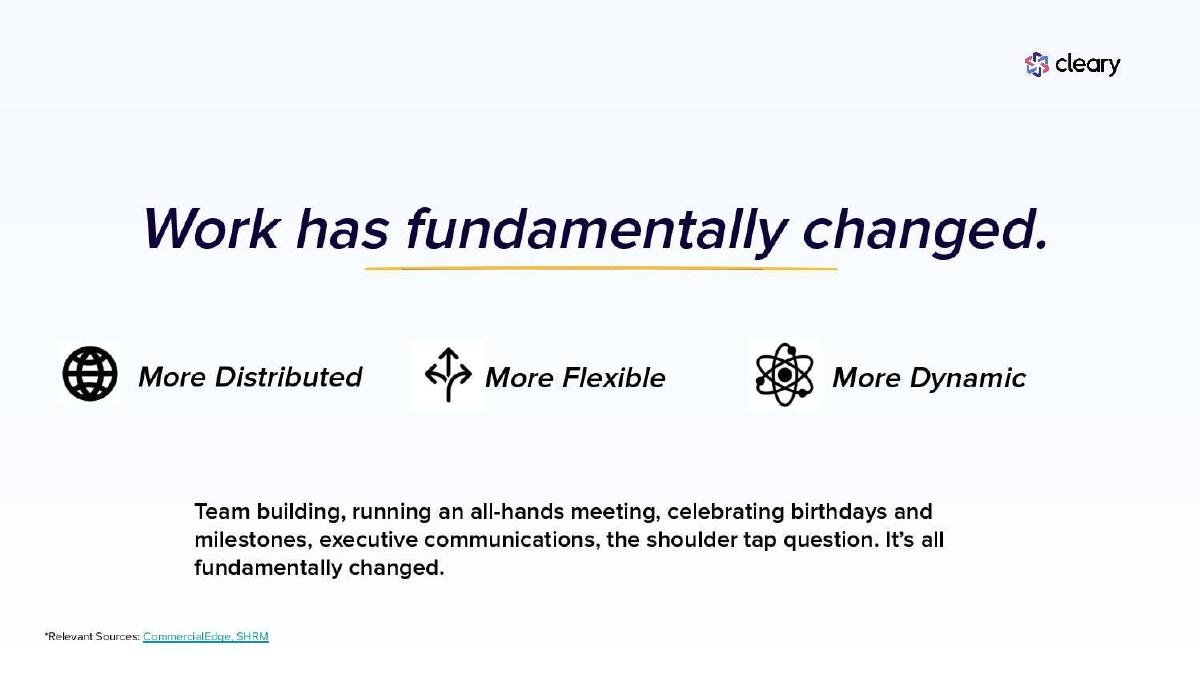
Slide 1 sets the stage with a clear value proposition: 'The Digital Employee Experience Platform for distributed teams.' It immediately identifies the target audience—distributed teams—and the mission—democratizing access to world-class employee experiences. Slide 2 reinforces this by stating 'Work has fundamentally changed,' citing that it is now more distributed, flexible, and dynamic. This is a standard but necessary 'Why Now' slide for the 2022 era.
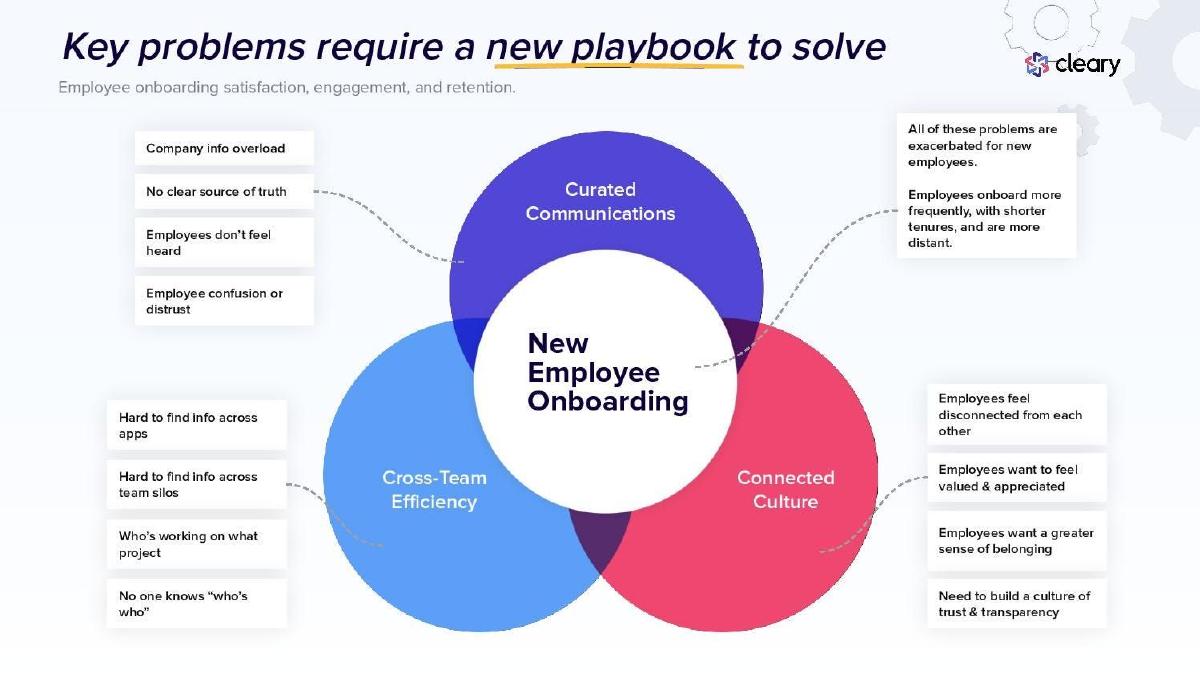
Slide 3 introduces a Venn diagram to categorize the 'new playbook' required for modern HR. The three pillars are Curated Communications, Cross-Team Efficiency, and Connected Culture. At the center of this intersection is 'New Employee Onboarding.' This is a critical strategic move; by placing onboarding at the center, Cleary justifies why they start there. They list specific pain points like 'Company info overload,' 'No clear source of truth,' and 'Employees don't feel heard' to ground the abstract concept of 'culture' in tangible business problems.
Slide 4: The Solution and the Wedge Strategy
Slide 4 is perhaps the most important slide for a Seed-stage investor. It outlines the 'Cleary Solution' and explicitly mentions a 'land and expand strategy.' The slide is split into two sections: the 'Cleary Onboarding Experience' (the wedge) and the 'Cleary Full Employee Experience Platform' (the destination). The onboarding module includes automated journeys and buddy programs, while the full platform expands into Communications, Culture, Directory, Search, and Events. This visualizes the product roadmap and the upsell potential in a single view.
Slide 5: GTM Strategy and Tiered ACV
Slide 5 provides a detailed Go-To-Market (GTM) breakdown. It categorizes the market into three segments with corresponding personas and sales motions. Notably, it lists 'Expected ACV' (Annual Contract Value) for each: $0 for the free startup tier, $10k for the 'Onboarding Pro' mid-market tier, and $50k for the 'Employee Experience Platform' enterprise tier. This transparency regarding deal size helps investors model the revenue potential and understand the sales complexity, which ranges from a simple 'Onboarding Call' to a '90-120 day cycle' involving a committee decision.
Slide 6: Traction and the Power of Logos
Slide 6, titled 'Customer Retention is the name of the game,' uses three case studies to demonstrate different growth levers. First, 'Departmental Expansion' is shown via DoorDash, where Cleary started in the engineering org and expanded to Product and Analytics. Second, 'Growth by Users' is shown via Scale, where user count grew 3x alongside company growth. Third, 'Use Case Expansion' is shown via Flexport, where additional fees were generated for native video and multi-language support. While the specific retention percentages are redacted in this version, the use of high-growth tech logos provides significant social proof.
Slide 7: The Ask and Future Targets
Slide 7, 'The Fundraise,' is direct. It states the goal of growing >3x ARR and adding 50 new logos in the next 4 quarters. It confirms the raise amount of $4.5M-$5M and lists the cap table, led by MoonShots Capital. This slide serves as a transition from what has been achieved to what the new capital will unlock, specifically focusing on expanding the GTM team to hit 'aggressive growth targets.'
Slide 8: Market Opportunity and TAM
Slide 8 quantifies the opportunity. Cleary claims a '$10b domestic TAM' based on 100m US knowledge workers. They narrow their 'current focus' to a $6b market of companies with 100+ employees. The slide also looks toward a 'Long Term Vision' of a $100b market involving 1b knowledge workers worldwide. By breaking the TAM into 'Current Focus,' 'Near Term Focus,' and 'Long Term Vision,' the founders show they are disciplined about their immediate target while remaining ambitious about the ceiling.
Slide 9: The FAQ and Competitive Positioning
The final slide in the provided set is an FAQ that addresses common investor objections. It tackles the budget question ('Do People and HR Teams have enough budget?'), the category question ('What does an Intranet have to do with Onboarding?'), and the uniqueness question. The answer to the budget question is particularly insightful, noting that 'Remote Working Tools' is becoming a new budget category managed by HR, rather than just a sub-item of IT. This reframing is essential for justifying Cleary's existence in a crowded SaaS landscape.
What Cleary Does Well
Cleary excels at defining a clear 'wedge' strategy. Many HR tech companies try to sell 'culture' or 'engagement,' which are notoriously difficult to measure and sell. By focusing on onboarding—a process with a clear start, end, and owner—Cleary creates a 'must-have' entry point. The deck effectively communicates how this initial sale leads to a much larger platform play, which is exactly what Seed investors want to see: a high-velocity entry point with a high-ceiling expansion path.
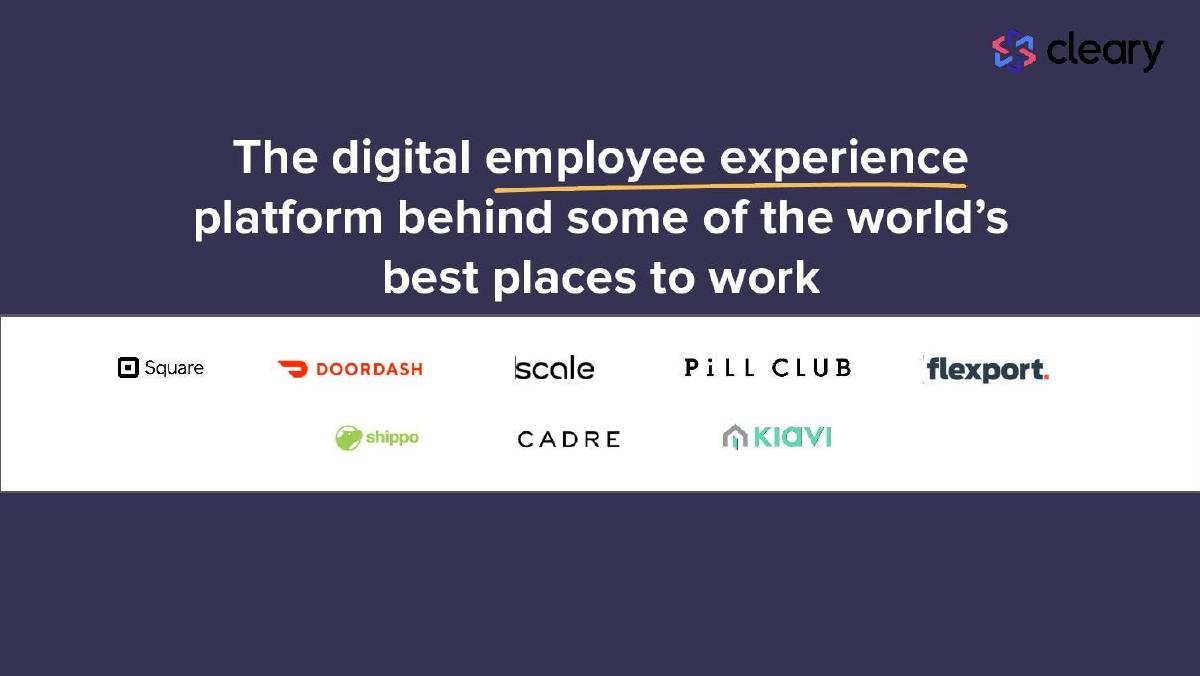
The use of specific logos like DoorDash and Flexport is also a major strength. For a Seed-stage company, having name-brand tech companies as early adopters suggests that the product can meet the rigorous demands of fast-scaling organizations. Furthermore, the GTM slide is unusually detailed for a Seed deck, providing clear ACV targets and sales cycle lengths that show the founders have a firm grasp on their unit economics.
What is Missing from the Deck
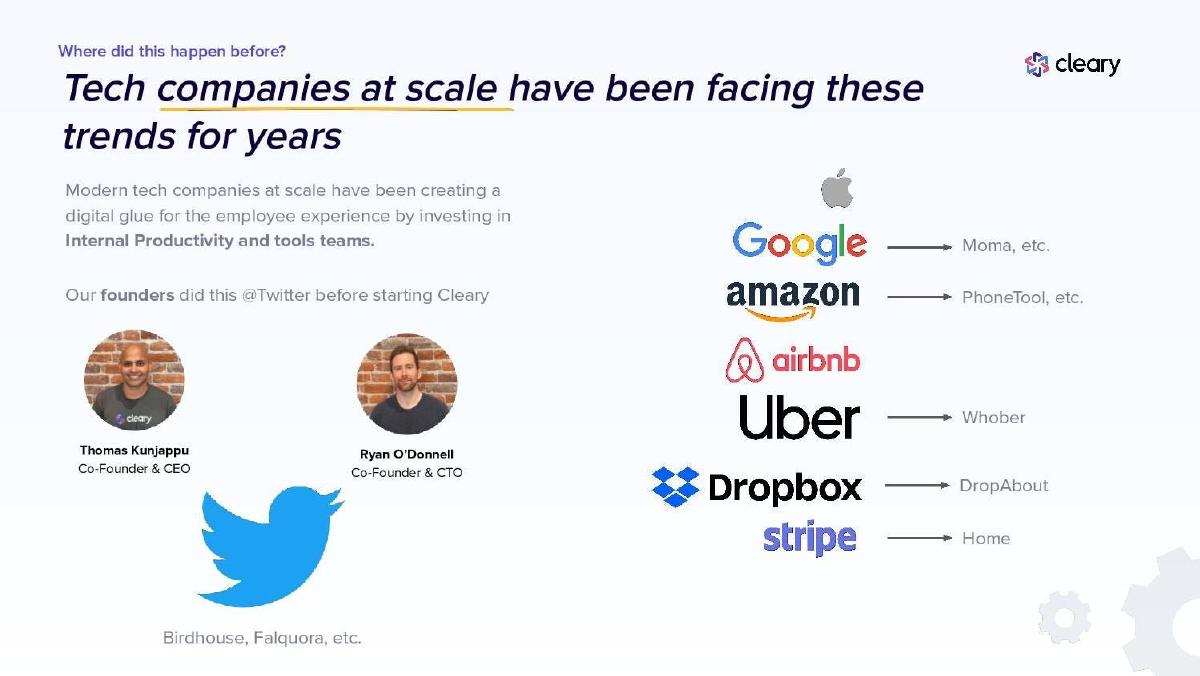
The most glaring omission in the provided slides is a dedicated Team Slide. While the publisher summary mentions Cleary helps tech companies, the deck itself does not highlight the founders' backgrounds or their specific 'founder-market fit.' In HR tech, where trust and organizational empathy are paramount, knowing who is building the tool is often as important as the tool itself.
Additionally, while the deck mentions 'Expected ACV,' it lacks a slide on current revenue or specific growth rates (other than the redacted traction slide). Investors usually look for a 'Financials' or 'Metrics' slide that shows the month-over-month growth leading up to the raise. Finally, there is no explicit competitor matrix. While the FAQ mentions 'legacy intranets,' it doesn't address modern competitors like Lattice, Culture Amp, or Guru, which often overlap with Cleary’s feature set.
Founder Takeaways: The Wedge and the Budget
Founders should study Cleary’s 'land and expand' visualization on Slide 4. It is a perfect example of how to present a complex platform as a series of manageable steps. If your product does 'everything,' you run the risk of sounding unfocused. By highlighting one module as the 'wedge,' you give the sales team (and the investor) a clear starting point.
Another takeaway is the 'Budget Category' argument in the FAQ. If you are building in a new or shifting category, you must explain whose budget you are taking. Cleary’s assertion that 'Remote Working Tools' is a new, HR-managed budget line is a powerful way to overcome the 'we don't have money for this' objection. Founders should be prepared to explain not just what their product does, but which line item on a P&L it replaces or augments.
Frequently asked questions
- What is Cleary's core product wedge?
- Cleary uses 'Automated Onboarding Journeys' as its primary entry point. According to Slide 4, this 'land and expand' strategy allows them to enter a company via the People Team's onboarding needs before expanding into communications, culture, directory, search, and events modules.
- How does Cleary differentiate itself from a traditional intranet?
- On Slide 9, Cleary argues that legacy intranets are static 'junk-drawers.' They differentiate by being a 'digital lobby' that is personalized to the employee's journey, integrating workflows and analytics rather than just serving as a document repository.
- What are the specific target customer segments?
- Slide 5 breaks down three tiers: Startups under 50 employees (Free Tier), Mid-Market companies with 150-500 employees (Onboarding Pro), and Enterprise companies with up to 5,000 employees (Full Platform).
- Which investors participated in the $4.5M round?
- As shown on Slide 7, the round was led by MoonShots Capital. Other participants included Liberty City Ventures, SeaChange, CrossLink Capital, Quiet Capital, and angel investor Hiten Shah.
- What metrics does Cleary use to prove traction?
- Slide 6 focuses on 'Customer Retention' as the primary metric. While specific percentages are redacted in the public version, they cite departmental expansion at DoorDash and 3x user growth at Scale as evidence of platform stickiness.