Contrarian Ventures' pitch deck for their $101M Fund II is a study in vertical specialization. Moving from a €12.5m Fund I to a significantly larger vehicle, the firm leans heavily into its role as an ecosystem builder rather than just a capital allocator. The deck highlights a 'community moat' consisting of summits, newsletters, and awards that generate proprietary deal flow. With a clear focus on the '1.5°C Paris Agreement Target,' the firm maps out a granular opportunity landscape across energy, mobility, and industry. The deck is notable for its transparency regarding capital allocation,…
Key takeaways
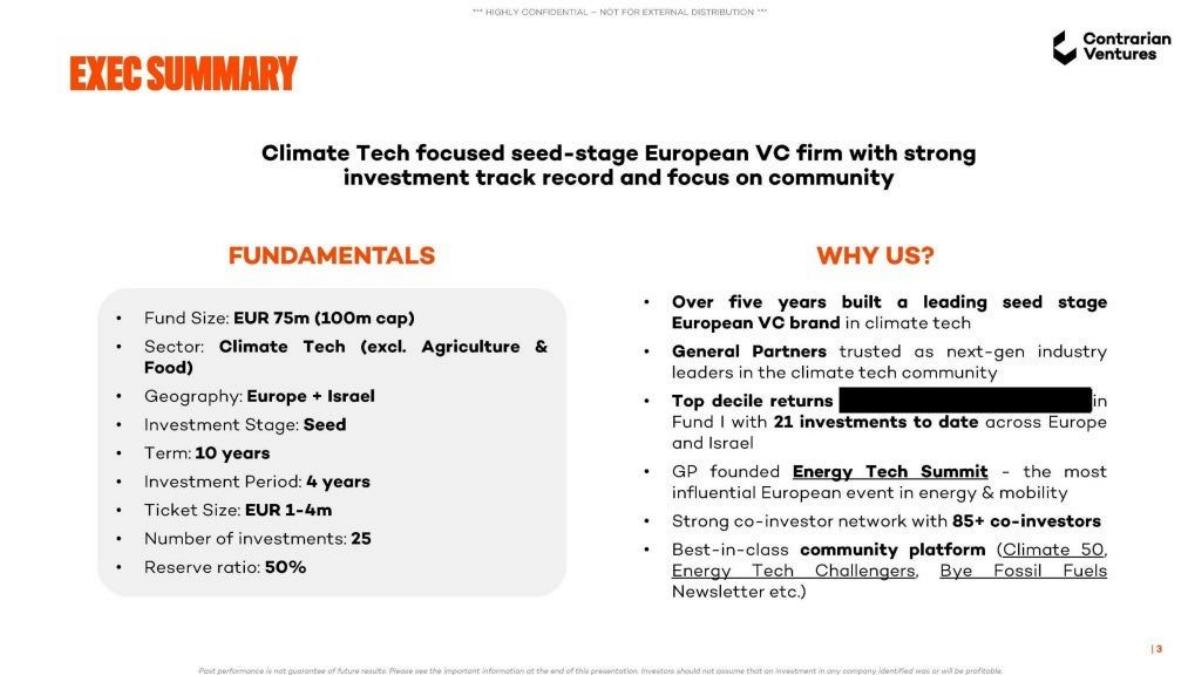
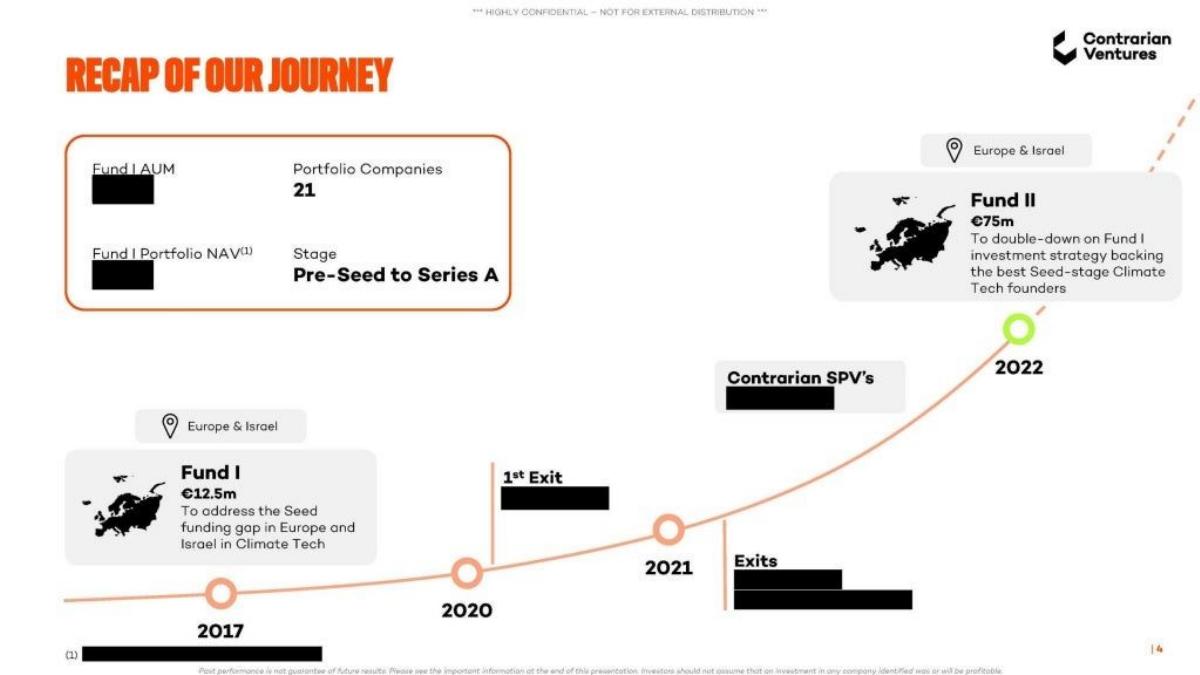
- The firm demonstrates a clear scaling trajectory, moving from a €12.5m Fund I in 2017 to a €75m target for Fund II in 2022 (Slide 4).
- Contrarian Ventures positions its investment thesis around the '1.5°C Paris Agreement Target,' citing a $125tn investment need by 2050 (Slide 7).
- The deck identifies a 'community moat' through four distinct platforms, including the Energy Tech Summit with 1,500+ attendees (Slide 16).
- Capital allocation is highly specific, targeting 60% software, 20% hardware-enabled software, and 20% pure hardware across 25 companies (Slide 13).
- The team slide emphasizes deep financial and sector-specific backgrounds, including experience at BoA Merrill Lynch, BP, and Goldman Sachs (Slide 10).
- The firm focuses geographically on Europe and Israel to address a perceived seed-stage funding gap in climate tech (Slide 4).
- The deck uses a 'Generational Opportunity' framework to justify the massive capital requirements for net-zero goals across transport, industry, and buildings (Slide 7).
- Proprietary deal flow is signaled through the 'Energy Tech Challengers' platform, which involves 400+ participants (Slide 16).
Introduction: The Shift from Niche to Generational Asset Class
Contrarian Ventures’ pitch deck for their $101M Fund II (originally targeted at €75m as per the slides) represents a pivotal moment in climate-tech investing. The deck, dated July 2022, moves away from the speculative nature of early 'cleantech' and instead frames the sector as a 'Generational Opportunity' backed by massive regulatory tailwinds like the U.S. Inflation Reduction Act and the EU Green Deal. This teardown analyzes how the firm uses data-driven urgency and ecosystem dominance to secure LP commitments.
Slide 1: The Hook
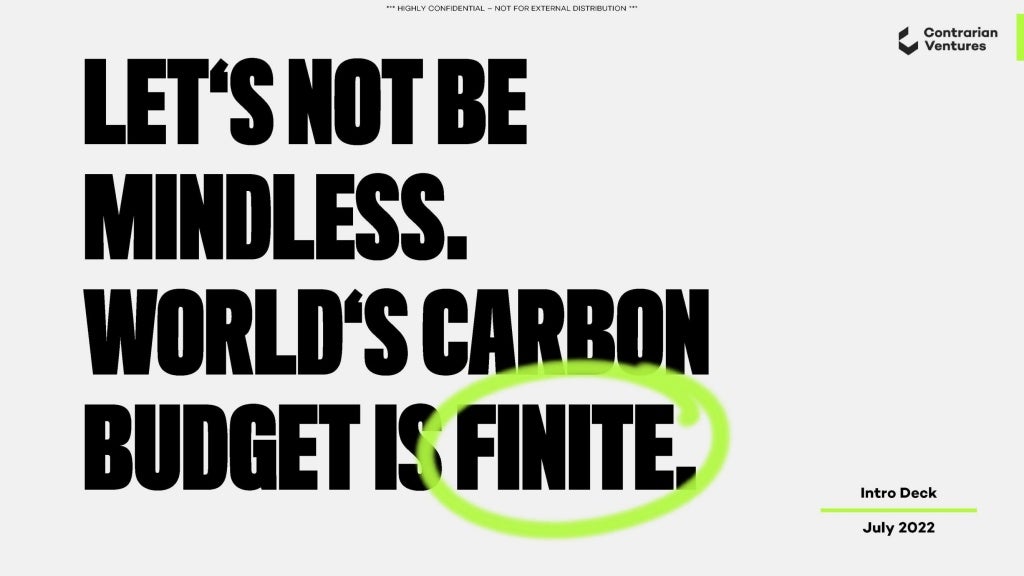
The cover slide sets a confrontational and urgent tone: "LET’S NOT BE MINDLESS. WORLD’S CARBON BUDGET IS FINITE." This is a departure from standard corporate branding. By circling the word "FINITE," the firm immediately establishes a thesis based on scarcity and the physical limits of the planet. It signals that this is not just a financial vehicle, but a mission-aligned fund. The branding is minimalist, using high-contrast black and white with a neon green accent, positioning the firm as a modern, high-conviction player in the space.
Slide 4: Recap of Our Journey
This slide is critical for establishing credibility. It tracks the firm's evolution from 2017 to 2022. Key data points include:
Fund I (2017): €12.5m AUM, focused on the seed funding gap in Europe and Israel. · Portfolio: 21 companies in Fund I, ranging from Pre-Seed to Series A. · Exits: The slide shows a timeline of exits starting in 2020, though specific names and multiples are redacted in this version. · Fund II (2022): A target of €75m to "double-down" on the successful strategy of Fund I.
The upward-curving orange line visually reinforces growth and momentum. By showing a clear progression from a small pilot fund to a larger institutional vehicle, Contrarian Ventures demonstrates that their model is repeatable and ready for scale.
Slide 7: Generational Opportunity
This slide provides the macro justification for the fund. It centers on a large graph of Global Carbon Emissions, showing the steep decline required to meet the 1.5°C Paris Agreement Target. The slide lists staggering investment figures to frame the TAM (Total Addressable Market):
$369bn: U.S. Inflation Reduction Act. · €1tn: Pledged by EU Green Deal. · $4tn: Investments required annually. · $125tn: Total investments needed by 2050.
By breaking down net-zero goals by sector (70% renewable electricity, 45% transport electrification, 90% low-emission heavy industry), the firm shows LPs exactly where the capital must flow. This slide transforms climate change from a philanthropic concern into the largest capital reallocation event in history.
Slide 10: A Proven Investment Team
VC is a people business, and slide 10 highlights the institutional pedigree of the leadership. Rokas Peciulaitis (Founder & Managing Partner) brings trading experience from BoA Merrill Lynch and status as a Kauffman Fellow. Tomas Kemtys (General Partner) adds transactional depth with $6bn+ in executed transactions at Centerview Partners. The slide also lists a robust support structure of analysts, operations managers, and venture partners with logos from Goldman Sachs, BP, and Trafigura. This mix of high-finance backgrounds and sector-specific expertise is designed to de-risk the investment for LPs who may be wary of the technical complexities of climate tech.
Slide 13: Opportunity Landscape
This is perhaps the most functional slide in the deck. It maps out the fund's 'Sector Transitions' across New Energy, Smart Mobility, and Buildings & Industry. What makes this slide stand out is the Fund II Capital Allocation Target sidebar. It explicitly commits to a portfolio construction of:
60% Software: 15 Companies. · 20% Hardware-Enabled Software: 5 Companies. · 20% Hardware: 5 Companies.
This transparency is rare in pitch decks. It tells LPs exactly what kind of risk profile to expect. By weighting the portfolio toward software, Contrarian Ventures addresses the historical 'Cleantech 1.0' failure where funds were over-exposed to capital-intensive hardware. It shows a sophisticated understanding of venture returns while still maintaining a foothold in the physical innovations necessary for decarbonization.
Slide 16: Community is Our Moat
In a crowded VC market, 'value-add' is often a hollow claim. Contrarian Ventures attempts to prove it here. They list four proprietary platforms that serve as their 'moat':
Energy Tech Summit: 1,500+ attendees. · Energy Tech Challengers: 400+ participants. · Climate 50: 200+ VC funds. · Bye, Fossil Fuels: 2,000+ newsletter subscribers.
These are not just marketing activities; they are deal-flow engines. By organizing the primary summit for the sector in Europe, the firm ensures they see every relevant seed-stage deal before their competitors. This slide effectively argues that Contrarian Ventures is the 'center of gravity' for European climate tech.
Slide 19: Why Partner With Us?
This is a transition slide that leads into the final pitch. While the slide itself is just text, its placement after the data-heavy sections on opportunity and moat serves to prompt the LP to synthesize the information. It shifts the conversation from 'what we do' to 'why you should be part of this.' It acts as a psychological reset before the final 'ask' and closing arguments.
What Works in This Deck
1. Vertical Authority: The deck does not try to be everything to everyone. It is laser-focused on climate tech in Europe and Israel. The use of specific sector transitions (Slide 13) and the 1.5°C target (Slide 7) establishes the firm as a specialist rather than a generalist dipping into a hot trend.
2. Structural Transparency: The capital allocation breakdown on Slide 13 is a masterstroke. It provides LPs with a clear vision of the fund's risk-return profile and prevents any ambiguity about their stance on hardware versus software.
3. Evidence of Ecosystem: Slide 16 provides tangible proof of the firm's influence. Many VCs claim to have a 'network,' but Contrarian Ventures quantifies it with attendee counts and subscriber numbers for platforms they built from scratch.
What is Missing
1. Specific Fund I Performance: While Slide 4 mentions 'Exits,' the actual names of the companies and the realized/unrealized multiples (TVPI, DPI, IRR) are not visible in this version. For a Fund II raise, these are the most important metrics for institutional LPs.
2. Case Studies: The deck would benefit from 1-2 slides detailing specific 'winners' from Fund I. Showing how the firm identified a seed-stage company, supported its growth through their 'community moat,' and helped it reach a Series A or B would validate the entire thesis.
3. Competitive Landscape: The deck mentions 'Climate 50' (a list of other VCs), but it doesn't explicitly state how Contrarian Ventures wins against larger multi-stage funds or other climate-specific competitors in the region.
What Founders and VCs Should Copy
1. The 'Moat' Framework: If you are building a fund or a company, don't just say you have a network. Show the platforms you own that generate that network. Contrarian’s use of summits and newsletters as a 'moat' is a blueprint for vertical-specific firms.
2. The Urgency Slide: Slide 7 is an excellent example of how to use macro data to create a sense of inevitability. It frames the investment not as a gamble, but as a necessary response to a global shift.
3. Clear Allocation Targets: Whether you are a founder pitching a budget or a VC pitching a fund, being specific about where the money goes (as seen on Slide 13) builds immense trust with the person holding the checkbook.
Frequently asked questions
- What is the primary investment focus of Contrarian Ventures Fund II?
- According to slide 13, the fund focuses on three main 'Sector Transitions': New Energy (Solar, Wind, Storage), Smart Mobility (Electrified transport, Next-gen aviation), and Buildings & Industry (Low-carbon heating, Circular economy). They also target cross-cutting technologies like Hydrogen and CCUS. The fund aims to back 25 companies in total, with a heavy lean toward software solutions.
- How does Contrarian Ventures define its competitive advantage or 'moat'?
- Slide 16 explicitly states that 'Community is our moat.' The firm manages four key platforms: the Energy Tech Summit (1,500+ attendees), Energy Tech Challengers (400+ participants), Climate 50 (200+ VC funds), and the 'Bye, Fossil Fuels' newsletter (2,000+ subscribers). These platforms are designed to provide portfolio companies with exclusive access to capital, talent, and corporate partners.
- What geographical regions does the fund target?
- As shown on slide 4, the firm focuses exclusively on Europe and Israel. This strategy began with Fund I in 2017 and continues with Fund II, aiming to address the specific seed-stage funding gap within these markets for climate-tech entrepreneurs.
- What are the specific capital allocation targets for the new fund?
- Slide 13 provides a detailed breakdown of the Fund II Capital Allocation Target. They plan to invest in 25 companies. The portfolio composition is targeted at 60% Software (15 companies), 20% Hardware-Enabled Software (5 companies), and 20% pure Hardware (5 companies).
- What is the team's background and experience?
- Slide 10 highlights a team with significant institutional finance and sector experience. Founder Rokas Peciulaitis was previously a trader at BoA Merrill Lynch, while General Partner Tomas Kemtys spent 5 years at Centerview Partners. Other team members and advisors bring experience from firms like BNP Paribas, BP, Goldman Sachs, and Trafigura.