ClinicalSolutions.io positions itself as a marketplace for clinical trials, aiming to streamline the recruitment process which currently suffers from long timelines and high costs. The deck utilizes a clear problem-solution framework, starting with a persona-based 'Sarah's Problem' and transitioning into a quantitative breakdown of trial costs, citing figures like $7,500 for randomization and a 300-day timeline on slide 3. The business model is presented with stark simplicity, showing a $77 cost against a $299 price point on slide 6. While the deck excels at visual clarity and defining the tw…
Key takeaways
- The deck identifies a 300-day window for clinical trial randomization as a primary industry bottleneck on slide 3.
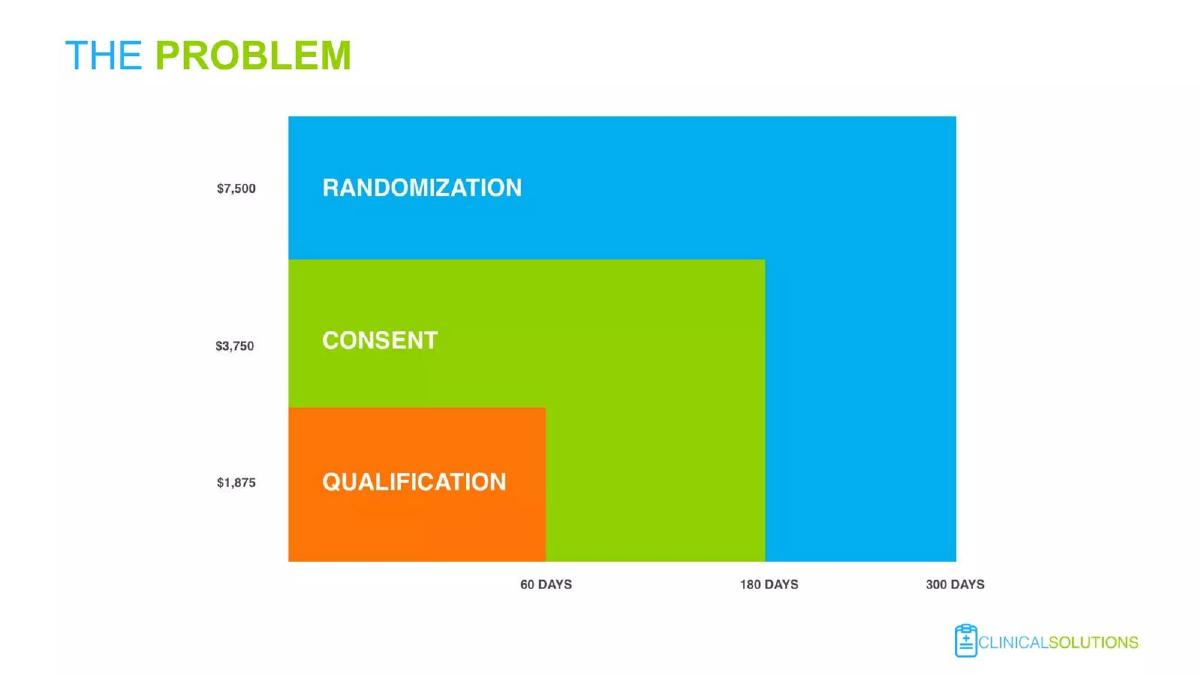
- Recruitment costs are quantified at three stages: $1,875 for Qualification, $3,750 for Consent, and $7,500 for Randomization on slide 3.
- The product interface for volunteers includes a 'Matched Trials' feature with percentage-based compatibility scores, such as 97.5% on slide 4.
- The platform operates as a two-sided marketplace, connecting 'Volunteers' via inbound marketing and 'Researchers' via outbound marketing on slide 7.
- Unit economics are stated as a $77 cost, a $299 price, and a $744 value on slide 6, though the 'value' metric is not defined.
- The 'Ask' slide (slide 8) contains 20 logos of major healthcare and research institutions but lacks a specific dollar amount or equity offer.
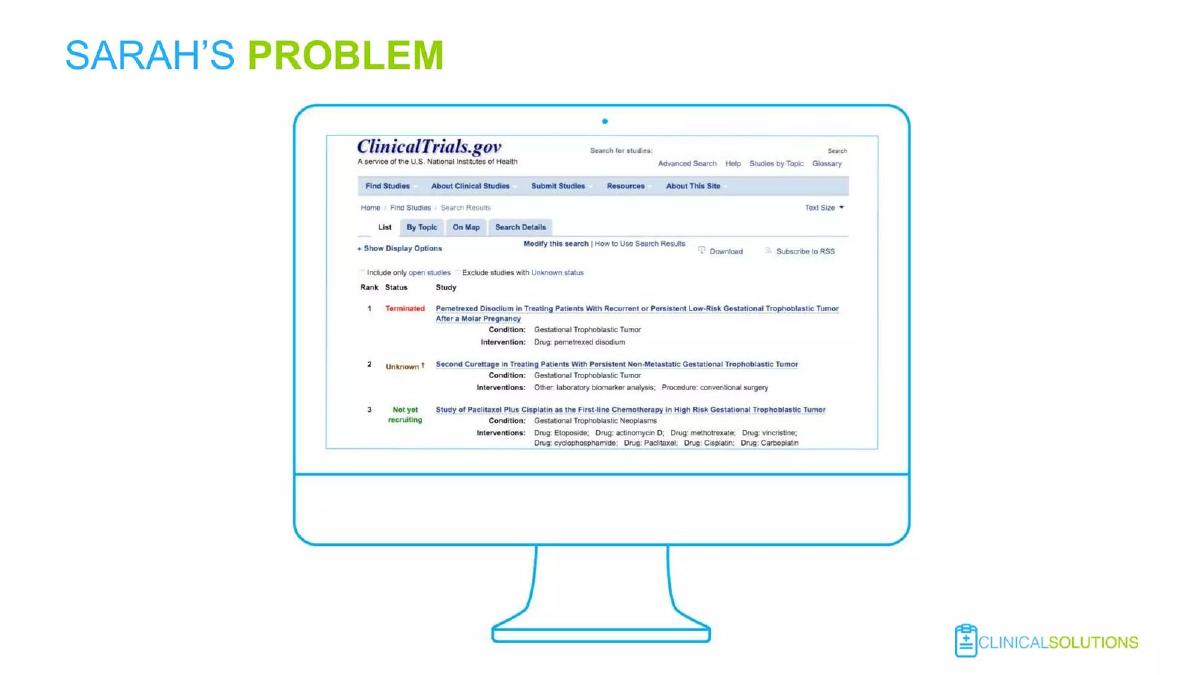
- The deck utilizes a 'Sarah's Problem' persona to illustrate the poor user experience of the existing ClinicalTrials.gov government database on slide 2.
- Marketing strategy is visualized as a 'Converged Media' model encompassing Paid, Earned, Shared, and Owned media on slide 7.
Executive Summary: The Marketplace Approach to Clinical Research
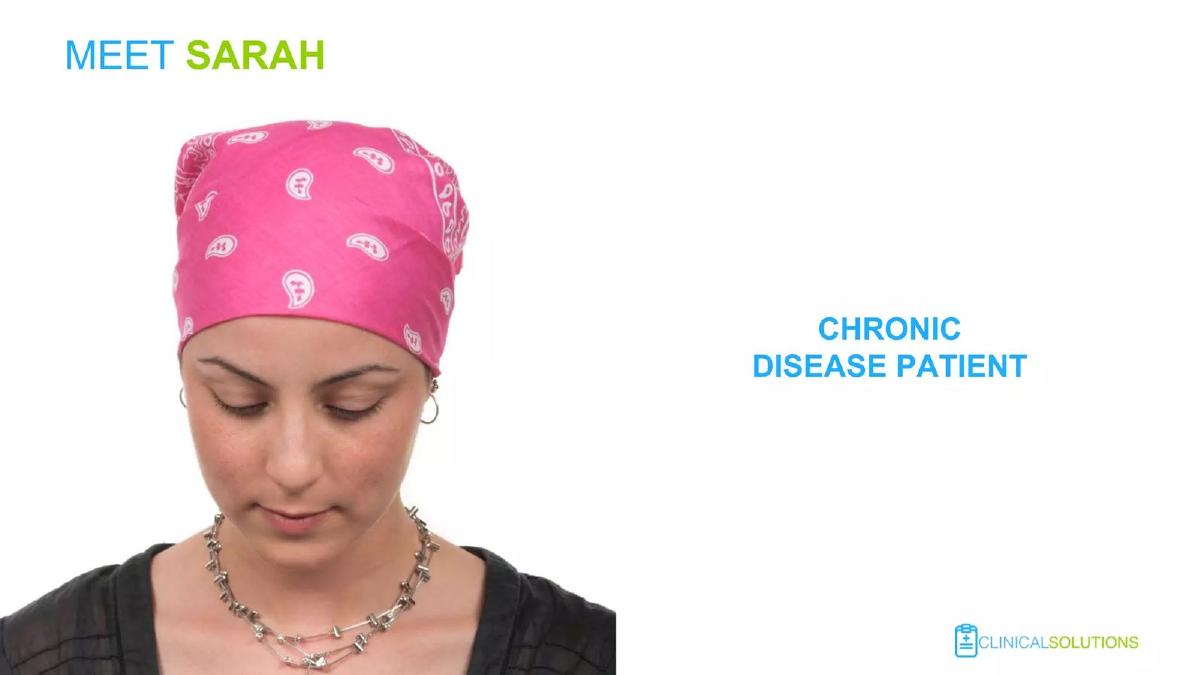
ClinicalSolutions.io emerged from the Health Wildcatters accelerator with a clear focus on the 'recruitment gap' in the life sciences industry. The deck is a study in minimalism, opting for large-scale graphics and sparse text to convey a narrative of efficiency. By framing the problem through both a patient persona ('Sarah') and a CFO's perspective (cost per randomization), the deck attempts to bridge the emotional and financial drivers of the healthcare industry. However, the version of the deck analyzed here leaves significant questions regarding the team's pedigree and the specific capital requirements for the next phase of growth.
Slide 1: Title Slide
The deck opens with a clean, white background featuring the company logo: a blue clipboard icon with a plus sign and an equals sign. The tagline is descriptive and functional: "a marketplace for clinical trials." This immediately categorizes the business model for the investor, signaling a two-sided platform play rather than a biotech or drug-discovery play.
Slide 2: Sarah's Problem
This slide uses a classic 'persona' approach to illustrate the user experience friction. It shows a screenshot of the official ClinicalTrials.gov website inside a monitor frame. The screenshot highlights a list of search results with statuses like "Terminated," "Unknown," and "Not yet recruiting." By labeling this "SARAH'S PROBLEM," the deck implies that the current government-mandated search tool is difficult for patients to navigate, leading to low enrollment rates. There is no text on this slide other than the header, forcing the presenter to explain the specific pain points of the legacy system.
Slide 3: The Quantitative Problem
Slide 3 shifts from the patient's perspective to the researcher's financial burden. It features a nested bar chart with two axes: cost and time. The data points are specific:
Qualification: Costs $1,875 and takes 60 days. · Consent: Costs $3,750 and takes 180 days. · Randomization: Costs $7,500 and takes 300 days.
This is the strongest slide in the deck. It identifies a clear, expensive, and time-consuming bottleneck. By quantifying the problem at $7,500 per randomized patient , the founders establish the 'Total Addressable Pain' that their solution aims to mitigate.
Slide 4: The Product (Volunteer View)
The first product slide shows a tablet interface for the volunteer side of the marketplace. Key features visible in the sidebar include "Personal Profile," "Medical History," and "Matched Trials." The central UI shows trial cards with percentage matches: 97.5%, 97.0%, and 86.5% . This suggests an algorithmic matching engine that simplifies the search process shown on Slide 2, moving from a manual search to a curated recommendation engine.
Slide 5: The Product (Two-Sided Workflow)
This slide illustrates the interaction between the two sides of the marketplace. On the left is the Volunteers interface (blue frame), and on the right is the Researchers interface (green frame). The researcher view includes professional tools such as "Create & Publish New Trials," "Accepted Volunteers Library," and "Universal Applications Setting API." The arrows between the two tablets indicate a fluid exchange of data, positioning ClinicalSolutions.io as the connective tissue between patient supply and research demand.
Slide 6: The Business Model
The business model is presented with extreme brevity. Three figures are shown:
While the 4x markup from cost to price is clear, the deck fails to define what these numbers represent. It is unclear if the $299 is a monthly SaaS fee per researcher, a fee per successful match, or a fee per trial posting. Furthermore, the "Value" of $744 is not anchored to a specific metric, though it likely refers to the cost savings compared to the $1,875 qualification cost mentioned on Slide 3.
Slide 7: The Strategy
The go-to-market strategy is visualized using a four-circle Venn diagram labeled "Converged Media." The sectors include Paid, Earned, Shared, and Owned media. The slide notes that Volunteers are targeted via Inbound Marketing , while Researchers are targeted via Outbound Marketing . This is a standard marketing framework (the PESO model), but it lacks specific channels (e.g., Facebook ads for patients, LinkedIn for researchers) that would demonstrate a deep understanding of the customer acquisition cost (CAC).
Slide 8: The Ask
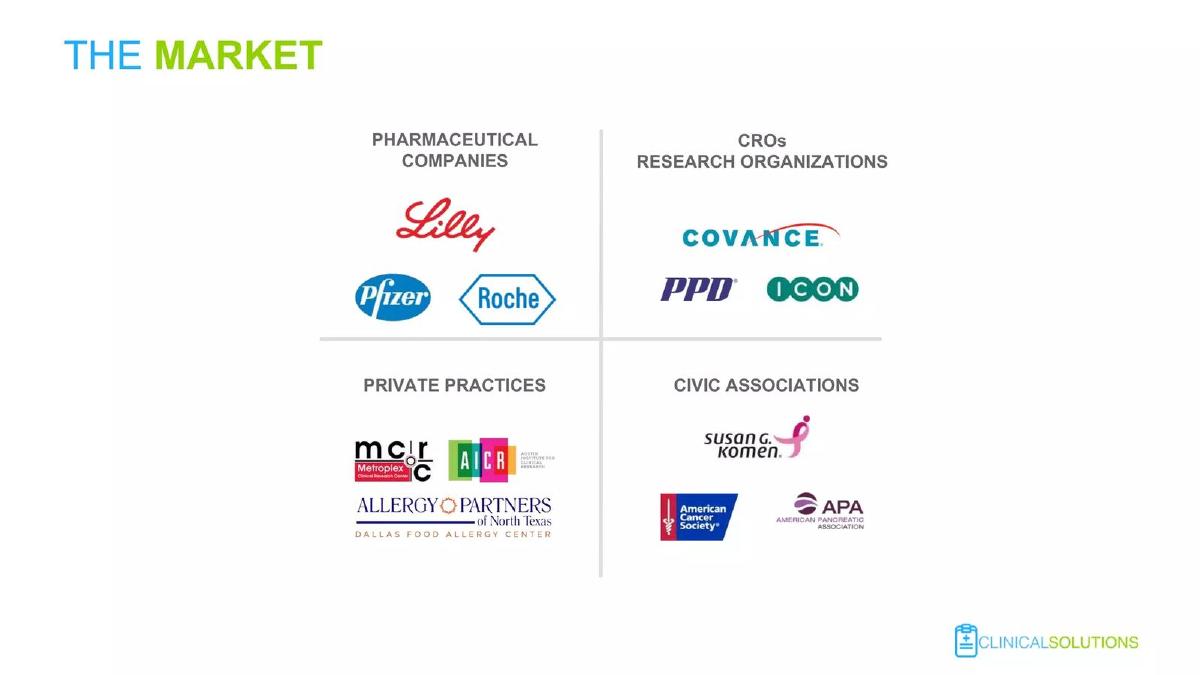
The final slide in this set is titled "THE ASK," but it does not contain a financial request. Instead, it is a wall of 20 logos, including major pharmaceutical companies like Lilly, Roche, and PPD , as well as institutions like UT Southwestern Medical Center and the American Cancer Society . In a typical pitch deck, this would be a 'Traction' or 'Partners' slide. Placing these logos under "The Ask" suggests the company is seeking introductions to these specific entities or is claiming them as the target customer profile for their next phase of growth.
What Works in This Deck
The deck's primary strength is its visual clarity . By avoiding dense blocks of text, the founders ensure that the audience stays focused on the narrative. The progression from the patient's frustration (Slide 2) to the researcher's financial drain (Slide 3) creates a compelling 'why now' for the marketplace. The use of specific figures like the 300-day timeline for randomization provides a concrete benchmark for success. If the platform can reduce that 300-day window, the value proposition is self-evident.
Furthermore, the dual-interface product slides (Slides 4 and 5) do an excellent job of showing that this is a functional platform, not just a landing page. Highlighting API settings for researchers suggests a level of technical maturity and an understanding that research organizations need to integrate this data into their existing Clinical Trial Management Systems (CTMS).
What is Missing from the Deck
The most glaring omission is the Team Slide . In early-stage healthcare investing, the pedigree of the founders—specifically their experience with HIPAA compliance, clinical regulations, and research workflows—is often more important than the initial product UI. Without a team slide, investors cannot verify if the founders have the domain expertise to sell into giants like Roche or Lilly.
The Competition Slide is also absent. Clinical trial recruitment is a crowded space, with players ranging from legacy CROs to newer digital health startups. By not addressing the competitive landscape, the deck fails to explain why ClinicalSolutions.io's matching algorithm or marketplace model is superior to existing solutions.
Finally, the Financial Ask is non-existent. A pitch deck is a fundraising tool; failing to state how much capital is being raised, what the valuation expectations are, and—most importantly—what milestones that capital will fund (e.g., "reaching 10,000 volunteers") leaves the investor without a clear call to action.
Founder Takeaways: What to Copy and What to Avoid
Copy the Problem Quantification: Slide 3 is a masterclass in defining a pain point. Don't just say the process is "slow and expensive." Say it takes 300 days and costs $7,500. Specificity builds credibility and allows investors to do their own back-of-the-envelope math on your market opportunity.
Avoid the 'Logo Soup' Ask: Never label a slide "THE ASK" and then only show logos. If you are raising money, state the amount. If you are looking for partners, call the slide "Target Partners" or "Strategic Roadmap." Confusing these two concepts makes the deck feel unfinished or evasive.
Define Your Unit Economics: While the simplicity of Slide 6 is visually appealing, it is contextually poor. If you show a 'Price' and a 'Cost,' you must define the unit. Is it per user, per month, or per successful outcome? Investors will immediately poke holes in unexplained numbers, which can derail the momentum of a pitch.
Use Personas Sparingly: The 'Sarah's Problem' slide works well here because it contrasts a modern UI against a dated government site. However, ensure that the persona's problem is directly linked to the financial problem. ClinicalSolutions.io does this well by showing how Sarah's inability to find a trial leads to the researcher's $7,500 recruitment cost.
Frequently asked questions
- What is the primary problem ClinicalSolutions.io is solving?
- According to slides 2 and 3, the company is solving the inefficiency of clinical trial recruitment. It highlights the poor user interface of the government's ClinicalTrials.gov site and the massive time and financial costs for researchers, noting that reaching the randomization phase can take up to 300 days and cost $7,500 per participant.
- How does the company make money?
- Slide 6 outlines a simple business model: a cost of $77 to acquire or process a lead, a price of $299 charged to the customer, and a perceived value of $744. However, the deck does not specify if this is a per-lead fee, a subscription, or a one-time placement fee for researchers.
- Who are the target users for this marketplace?
- Slide 5 and 7 clarify that there are two distinct user groups. 'Volunteers' (patients) use the platform to find and apply for trials that match their medical history. 'Researchers' (sponsors or CROs) use the platform to manage pre-qualified volunteers, publish new trials, and access a library of accepted volunteers.
- What is missing from the ClinicalSolutions.io pitch deck?
- The deck is missing several critical components: a Team slide (no founders or advisors are listed), a Competition slide (no mention of other recruitment platforms), and a specific financial 'Ask' (slide 8 shows logos but no funding goal). It also lacks a roadmap or traction metrics showing current user numbers.
- What does the 'Ask' slide represent if there is no dollar amount?
- Slide 8, titled 'THE ASK,' is unusual because it only displays logos of companies like Roche, Lilly, and UT Southwestern. In this context, it likely represents a target list of customers the company is 'asking' for help to reach, or a list of partners they intend to pursue, rather than a traditional investment request.