Clockworks Analytics, formerly KGS Buildings, uses this 19-slide deck to demonstrate the maturity of its automated diagnostics platform. The presentation is notable for its heavy reliance on real-world data, citing 370 million square feet of connected real estate across 25 countries (Slide 4). Rather than focusing on abstract market potential, the deck provides granular evidence of impact, such as a $1.8 million savings case study for a pharmaceutical giant (Slide 12). While the deck redacts specific ARR figures in this public version, it clearly outlines a 'Business as usual' vs. 'Investment…
Key takeaways
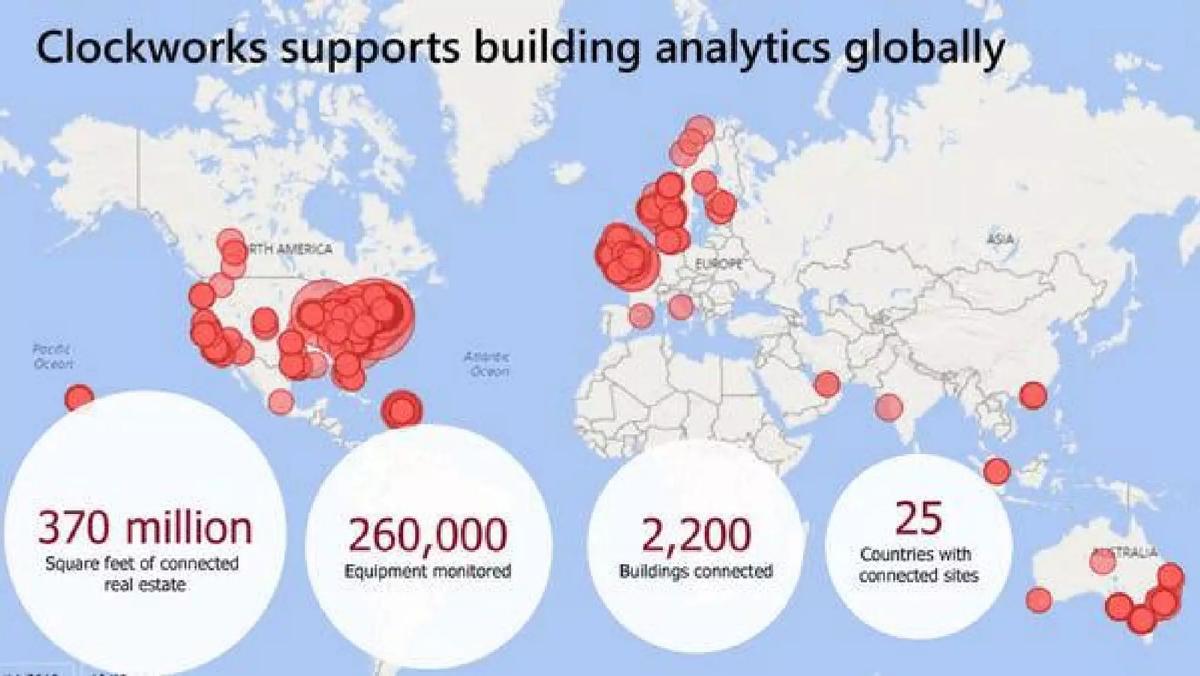
- The company monitors 260,000 pieces of equipment across 2,200 connected buildings globally as of the deck's creation (Slide 4).
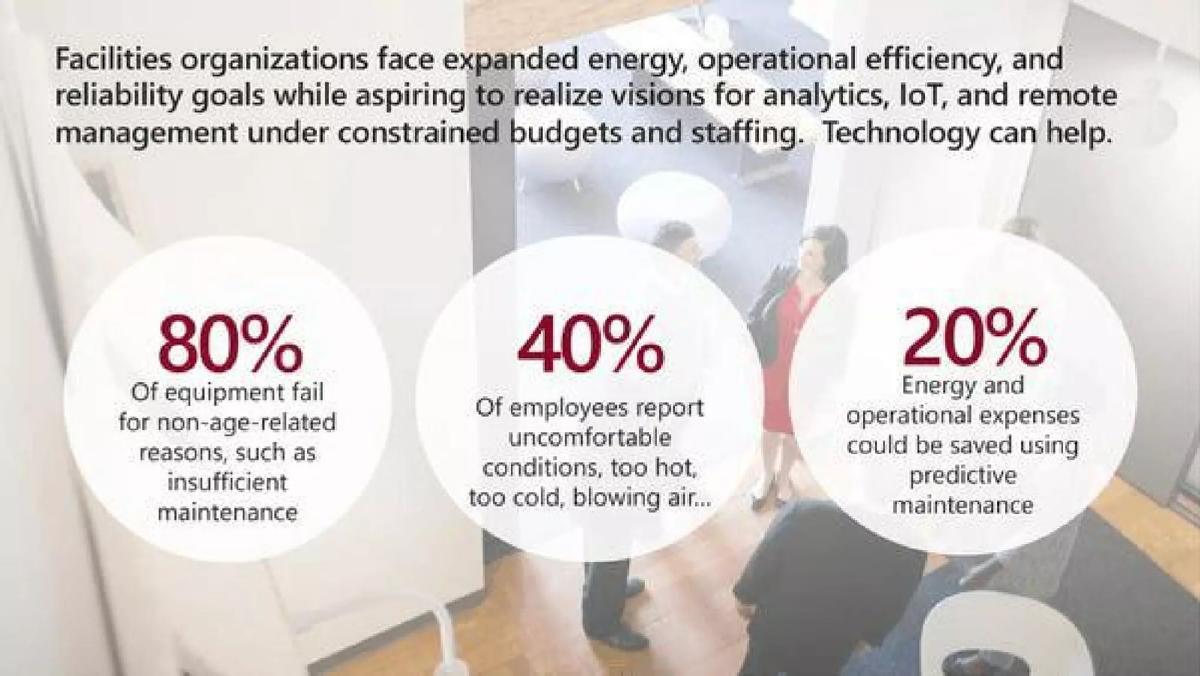
- Clockworks claims that 80% of equipment fails for non-age-related reasons, highlighting a massive opportunity for predictive maintenance (Slide 2).
- A top-tier pharmaceutical client achieved $5 million in total savings to date using the platform across 90 buildings (Slide 12).
- The deck identifies an $11 billion emerging market for building analytics according to industry analysts (Slide 15).
- The company reported 50% year-over-year revenue growth between 2018 and 2019 (Slide 15).
- There is a significant focus on channel partners, with a goal to aggressively expand into facilities management and energy services (Slide 19).
- The deck identifies $7 million in expansion ARR potential within its 27 largest existing enterprise accounts alone (Slide 15).
- The presentation lacks a team slide, a competition slide, and a specific dollar amount for the investment ask.
Overview of the Clockworks Analytics Pitch Deck
Clockworks Analytics (formerly KGS Buildings) provides a highly technical, evidence-based pitch deck that leans heavily on its established market presence. Unlike early-stage startups that sell a vision, Clockworks sells a proven engine. The deck is structured to demonstrate that the technology works at scale, the customers are satisfied, and the primary hurdle to further growth is simply the speed of market expansion and channel development. With 370 million square feet already connected (Slide 4), the narrative is one of scaling a successful model rather than finding product-market fit.
The Problem and Solution (Slides 1-3)
Slide 1 introduces the company with the tagline "Automated Insights for Smarter Facilities." The imagery of a dense urban skyline immediately establishes the target market: large-scale commercial and institutional real estate. Slide 2 defines the pain points with three compelling statistics: 80% of equipment fails for non-age-related reasons, 40% of employees are uncomfortable, and 20% of energy/operational expenses could be saved via predictive maintenance. This slide effectively quantifies the cost of doing nothing.
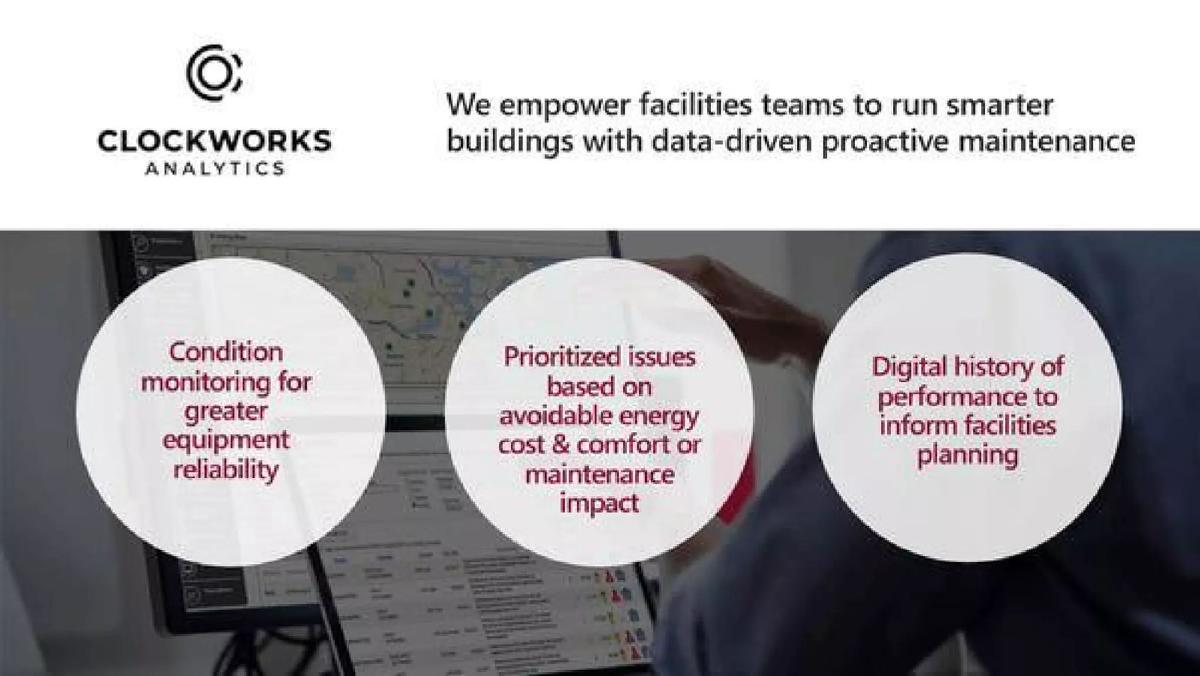
Slide 3 presents the solution as a platform that empowers facilities teams through condition monitoring, prioritized issue reporting based on cost/comfort impact, and a digital history of performance. The focus here is not just on finding faults, but on prioritizing them, which is a key workflow improvement for overwhelmed facility managers.
Global Scale and Validation (Slides 4-5)
Slide 4 is a powerful traction slide. It uses a global map dotted with clusters of connected buildings to show geographic diversity. The figures are impressive: 260,000 pieces of equipment monitored and 2,200 buildings connected across 25 countries. This establishes Clockworks as a mature player in the space.
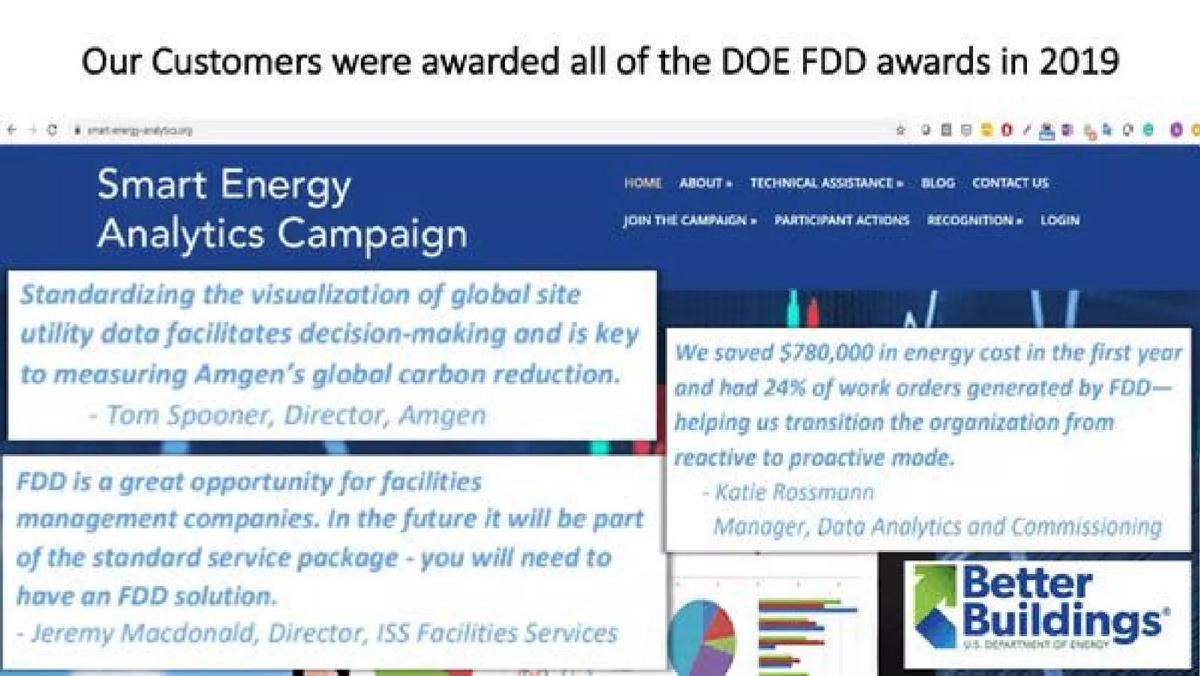
Slide 5 adds a layer of social proof by highlighting that their customers swept the 2019 Department of Energy (DOE) awards for Fault Detection and Diagnostics (FDD). By quoting directors from Amgen and ISS Facilities Services, the deck moves from self-promotion to third-party validation. The quote from Jeremy Macdonald of ISS is particularly strategic, as it suggests FDD will soon be a "standard service package," implying that the market is reaching a tipping point.
The Value Proposition and Data Evidence (Slides 6-11)
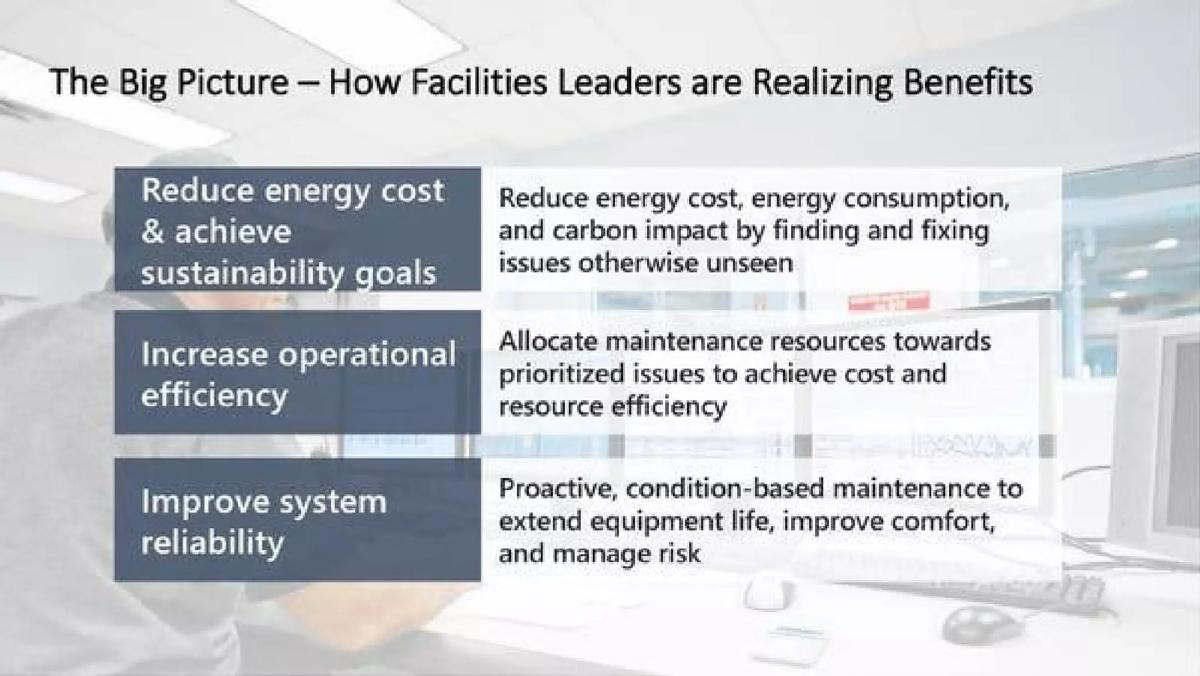
Slide 6 summarizes the "Big Picture" benefits: energy cost reduction, operational efficiency, and system reliability. The subsequent slides (7-11) serve as a technical deep dive into how these benefits manifest in the software. Slide 7 shows a dashboard for "Energy Prioritization," projecting $1,640,683 in annual task savings for a specific client. Slide 8 demonstrates how fault prevalence data informs capital budgets, showing a clear link between software insights and high-level financial planning.
Slide 9 is particularly important for the operational efficiency argument. It shows a bar chart of "Work Order Count" and "Work Order Spend," illustrating how the platform helps shift the balance from reactive/scheduled maintenance to condition-based maintenance. Slide 10 and 11 introduce "comfort metrics," showing how the data can be used to hold facilities vendors accountable. This positioning of the software as a management and accountability tool, rather than just a technical tool, broadens its appeal to executive stakeholders.
Case Studies: Pharmaceutical and Tech (Slides 12-13)
The deck uses two detailed success stories to prove the platform's versatility. Slide 12 focuses on a Fortune 500 biotechnology company. The results are quantified: $1.8 million in savings in the first two years and $5 million in total savings to date across 90 buildings. Slide 13 highlights a global information technology company that achieved a 9% energy savings and a reduction in "hot and cold calls" (employee complaints). These case studies provide the "how-to" for the savings claims made earlier in the deck.
Market Opportunity and Growth Strategy (Slides 14-16)
Slide 14 introduces the concept of "ARR Expansion Potential." It uses a bar chart to show that many existing customers are only using a fraction of their potential capacity. This is a classic SaaS growth narrative: the hardest part (customer acquisition) is done, and the next phase is increasing seat or building count within those accounts. Slide 15 quantifies the total market at $11 billion and notes that Clockworks saw 50% YoY revenue growth in 2018-2019. It also highlights a specific $7 million expansion opportunity within 27 enterprise accounts.
Slide 16 shifts the focus to "Service Partners." This indicates that Clockworks isn't just selling direct to building owners, but is also positioning itself as the "Intel Inside" for mechanical and energy service providers. This channel strategy is a key component of their scaling plan.
The Ask and Future Milestones (Slides 17-19)
The final three slides (17-19) are a progressive build of the company's growth forecast. Slide 17 shows the baseline as of December 2019, including a focus on higher education, healthcare, and one significant manufacturer reseller. Slide 18 adds the "Business as usual" forecast, projecting "$Y million ARR in 4 years" (figures are redacted in this version). Slide 19 presents the "Investment scenario," which shows a much steeper growth curve. This scenario involves expanding into government and commercial real estate, aggressive channel expansion, and product investments to connect sites faster. While the specific dollar amount of the ask is missing, the intent is clear: they need capital to accelerate the transition from the yellow line (organic growth) to the green line (accelerated growth).
What Works in the Clockworks Analytics Deck
1. Extreme Data Density: This deck does not rely on vague promises. Every claim is backed by a chart, a case study, or a specific metric. For an industrial/technical product, this level of detail is necessary to build credibility with specialized investors.
2. Clear ROI Narrative: The deck repeatedly connects technical features (fault detection) to financial outcomes (millions in savings). By showing how the software impacts both the P&L (energy savings) and the balance sheet (extending equipment life), they make a compelling business case.
3. Channel Partner Strategy: Recognizing that they cannot reach every building alone, the focus on "Service Partners Powered by Clockworks" (Slide 16) shows a sophisticated understanding of the real estate ecosystem. This suggests a scalable go-to-market strategy that doesn't rely solely on a massive internal sales force.
What is Missing from the Clockworks Analytics Deck
1. The Team Slide: This is the most glaring omission. Investors invest in people, especially in complex B2B sectors. The deck provides no information on the founders' backgrounds, their technical expertise, or the composition of the leadership team. This makes the company feel like a faceless entity.
2. Competitive Landscape: The building analytics space is crowded with players like Honeywell, Schneider Electric, and various startups. Clockworks does not explain how its "automated diagnostics" differ from the built-in analytics of major Building Management Systems (BMS) or other third-party overlays.
3. Specific Financials and Ask: While this may be due to the public nature of the deck, the redaction of ARR and the lack of a specific funding amount or use-of-funds breakdown leaves the "Investment Scenario" (Slide 19) feeling incomplete. A founder using this deck would need a supplemental document to close a deal.
What a Founder Should Copy from this Deck
1. The 'Land and Expand' Visualization: Slide 14 is a masterclass in showing internal growth potential. If you have a customer base that is only partially activated, showing the gap between "Current" and "Potential" ARR is a powerful way to demonstrate that you have a clear path to growth that doesn't require finding new leads.
2. The 'Investment Scenario' Comparison: Slides 17-19 are an excellent way to frame a funding round. Instead of just showing one hockey-stick graph, showing the difference between "Business as usual" and "Investment scenario" clearly illustrates exactly what the investor's capital is buying: speed and market breadth.
3. Use of Customer Logos and Quotes: The way Slide 5 and Slides 12-13 integrate high-profile names like Amgen and the Department of Energy is highly effective. Founders should aim to move beyond just listing logos and instead provide the specific dollar-value impact those customers realized.
Conclusion: The Clockworks Analytics deck is a professional, data-rich presentation that effectively communicates the value of a mature SaaS product in a traditional industry. While it lacks the personal touch of a team slide, its sheer volume of evidence makes it a strong example of how to pitch a technical solution to a financial audience. Total slides: 19.
Frequently asked questions
- What is the core problem Clockworks Analytics solves?
- Clockworks addresses the inefficiency of reactive building maintenance. According to Slide 2, 80% of equipment fails due to insufficient maintenance rather than age, and 40% of employees report uncomfortable building conditions. The platform moves facilities from reactive to proactive mode, targeting a 20% reduction in energy and operational expenses through automated diagnostics.
- How does the company demonstrate market traction?
- Traction is shown through massive scale and high-profile validation. Slide 4 highlights 370 million square feet under management across 25 countries. Slide 5 notes that their customers won all of the Department of Energy (DOE) Fault Detection and Diagnostics (FDD) awards in 2019, providing third-party social proof of the platform's efficacy.
- What is the 'Expansion Potential' mentioned in the deck?
- Clockworks emphasizes a 'land and expand' strategy. Slide 14 shows a bar chart of current vs. potential ARR across 26 anonymized customers, while Slide 15 quantifies this as $7 million in untapped ARR within just their top 27 enterprise accounts. This suggests the company has a strong foothold that only requires further penetration.
- What are the primary benefits for facility managers?
- As outlined on Slide 6, the benefits are three-fold: reducing energy costs and carbon impact, increasing operational efficiency by prioritizing maintenance resources, and improving system reliability to extend equipment life. The deck provides specific examples, like a global tech company achieving 9% energy savings (Slide 13).
- What is missing from this pitch deck?
- This deck is missing several critical components for a standard venture pitch. There is no team slide introducing the founders or leadership. There is no competitive landscape analysis. Most importantly, while the deck states they are seeking investment for 'channel growth,' it does not specify the amount of capital being raised or the valuation (Slide 17-19).