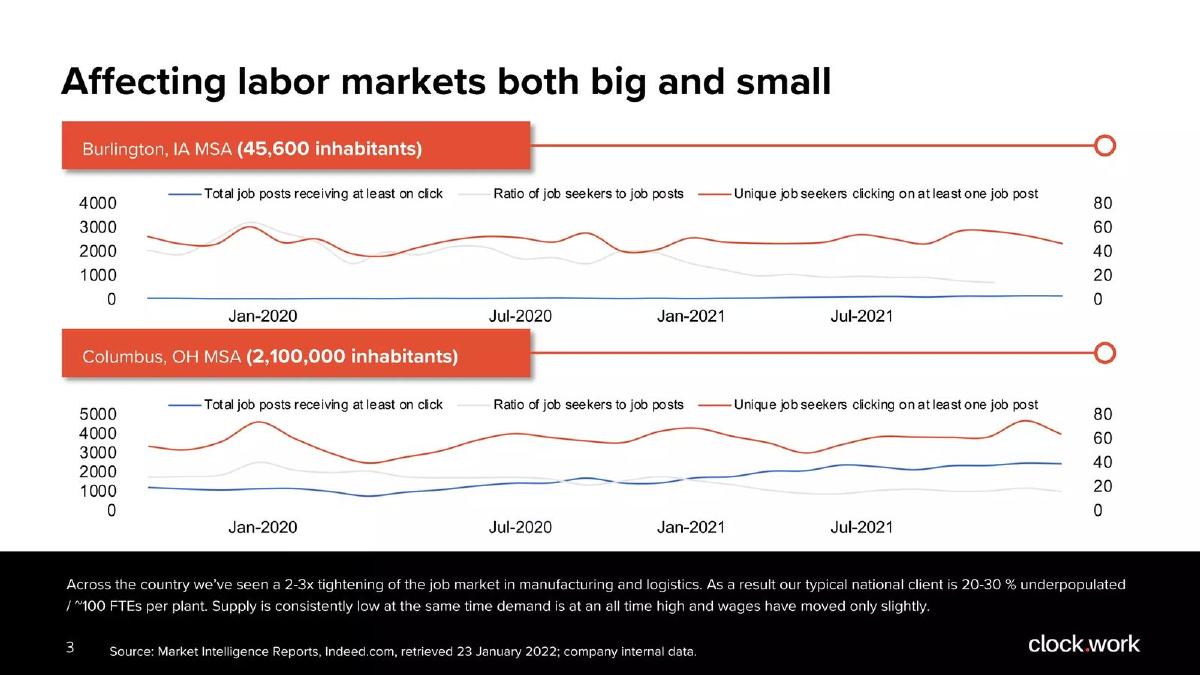
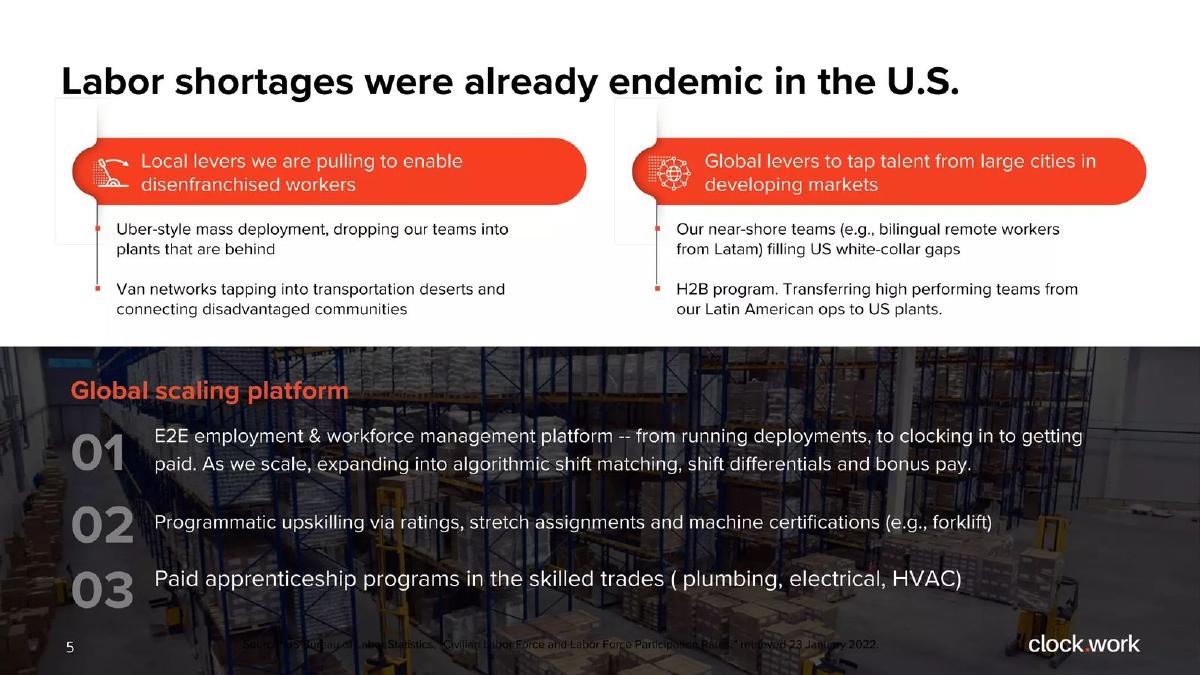
Clockwork’s Series A deck positions the company as a 'Gig 2.0' solution for the endemic labor shortages in US manufacturing and logistics. The company differentiates itself by acting as the employer of record and providing full benefits, including transportation, contrast to traditional 1099 models. A standout feature of this deck is the explicit focus on M&A; the founders plan to use $45M of their $50-60M Series A target to acquire traditional staffing agencies trading at low multiples (2-3x). This hybrid approach aims to scale Gross Merchandise Value (GMV) from $24M to $250M in just 18 mont…
Key takeaways
- The company is seeking $50-60M for its Series A round to reach $240-250M in GMV within 18 months (Slide 16).
- Clockwork claims a 6x capital efficiency ratio, having reached $24M in GMV on $4M in burn (Slide 16).
- A significant portion of the Series A funds ($45M) is earmarked for M&A roll-ups of traditional staffing agencies (Slide 16).
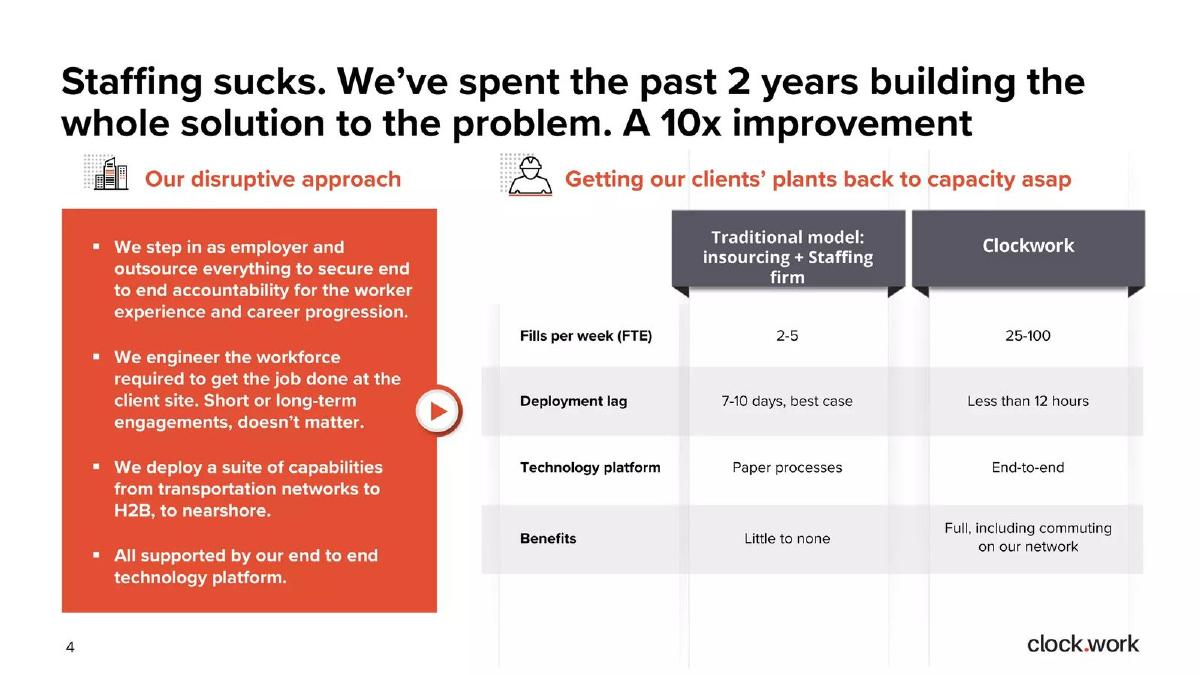
- The platform offers a 10x improvement over traditional staffing, reducing deployment lag from 7-10 days to less than 12 hours (Slide 4).
- The strategy targets a highly fragmented market of 14,000 temp and contract staffing agencies in the US (Slide 14).
- Clockwork acts as the employer of record, providing benefits and transportation, which they call 'Gig 2.0' (Slides 1, 4).
- The deck includes a specific case study with Amazon, claiming to fill over 100 critical positions per week during pandemic supply constraints (Slide 18).
- The roadmap includes expansion into LATAM, EMEA, and Turkey, moving beyond their initial launch in Romania (Slides 8, 10).
Slide 1: Title Slide
The title slide introduces Clockwork with the tagline 'Welcome to Gig 2.0. Where everyone wins.' It explicitly labels the deck as a 'Series A' presentation and notes it is 'DRAFT VERSION 0.1.' The background imagery features workers in safety gear (hard hats and vests) looking at a tablet, immediately signaling a focus on industrial or blue-collar labor sectors.
Slide 2: The Macro Problem
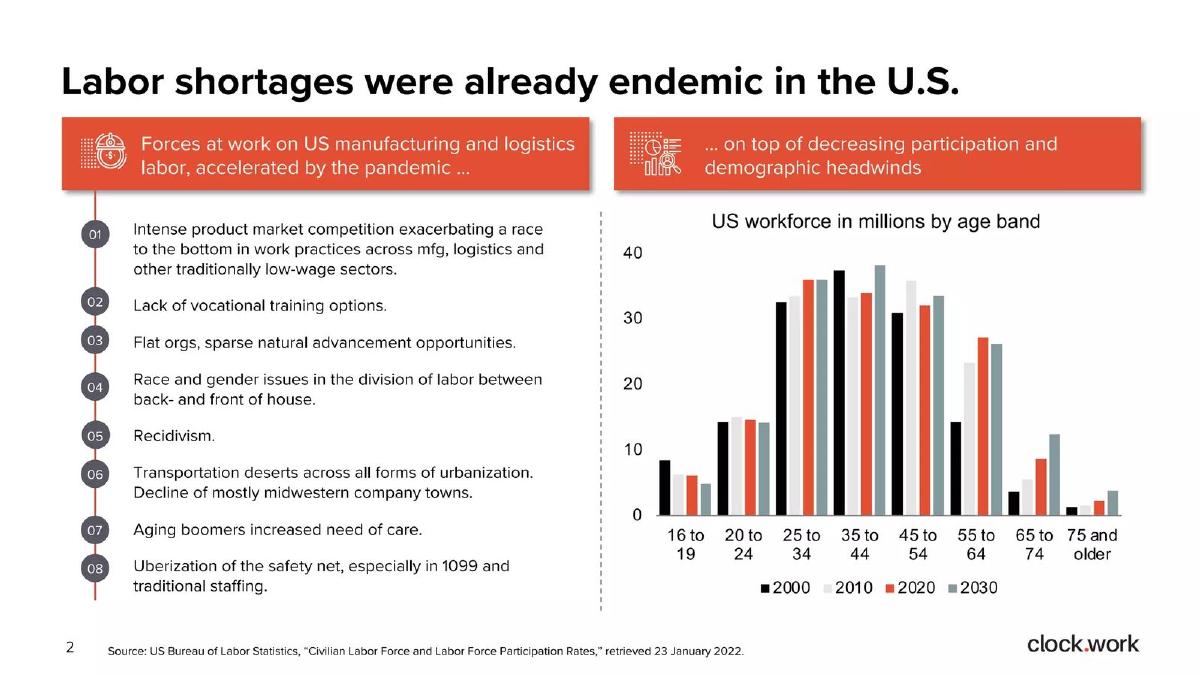
Slide 2 addresses the labor shortage in the U.S., stating these issues were 'already endemic' and 'accelerated by the pandemic.' It lists eight specific forces, including a lack of vocational training, recidivism, transportation deserts, and the 'Uberization of the safety net.' A bar chart on the right, sourced from the US Bureau of Labor Statistics, shows the US workforce in millions by age band from 2000 to 2030, highlighting demographic headwinds and decreasing participation rates.
Slide 4: The Solution and Value Proposition
This slide uses a direct headline: 'Staffing sucks. We’ve spent the past 2 years building the whole solution to the problem. A 10x improvement.' It contrasts Clockwork’s 'disruptive approach' with the 'Traditional model.' Key differentiators for Clockwork include acting as the employer, engineering the workforce for client sites, and deploying transportation networks. A comparison table claims Clockwork achieves 25-100 fills per week (FTE) compared to 2-5 for traditional firms, and reduces deployment lag from 7-10 days to 'Less than 12 hours.'
Slide 6: Product Showcase
Titled 'Leading worker app,' this slide displays two smartphone mockups of the Clockwork interface. Features highlighted include 'Fast onboarding,' 'Customised job recommendations,' 'feedback capabilities,' 'Easy team tracking,' and 'Fast & easy to clock in and out of shifts.' The UI shown includes a 'Machine Operator' shift at a company called Schwan’s in Salina, Kansas, providing a concrete example of the app's application.
Slide 8: Financial Projections and Growth Roadmap
This slide outlines a 'Roadmap for continued hypergrowth' through 2027. It splits growth into 'Organic Growth' (expansion into Latam, EMEA, and US) and 'Roll-up Opportunity' (M&A). A table forecasts Total ARR growing from $194.5M in 2022 to $3,952.8M in 2027. Notably, the 'Uber-style mass deployments' line item is the largest driver, projected to reach $2,797.2M by 2027. The chart visualizes the contribution of organic growth versus M&A roll-ups to the total ARR.
Slide 10: Product and Operational Roadmap
Slide 10 provides a chronological timeline from before 2021 through '2023+.' It notes the company launched in Romania with a Web & Mobile MVP. Key milestones include a US Worker & Ops app launch in August 2021 and a Global Worker App launch in November 2021 (covering LATAM & Turkey). Future goals for 2022 and 2023 include 'Deep Automation,' child-care integration, and proctored drug tests. The slide is marked 'Option 1' in the top right corner.
Slide 12: Market Analysis
Titled 'This is a huge market, we’re focusing on top markets,' this slide presents a detailed table of Top MSAs (Metropolitan Statistical Areas). It lists cities like Los Angeles, New York, and Chicago, providing data on logistics and manufacturing employees sourced from the St. Louis Fed. The table also includes 'SIA Manufacturing & Logistics' data, showing a total US market of $30.4 billion and 647,000 FTEs. This slide serves to validate the scale of the opportunity in specific geographic hubs.
Slide 14: M&A Strategy Rationale
This slide argues that 'Fragmentation = Efficient Scaling.' It identifies a 'Target-rich Environment' of 14,000 temp and contract staffing agencies in the US, with 500 targets 'actively marketed for sale at any time.' The core of the investment thesis here is 'Favorable Economics,' noting that these traditional agencies trade at multiples of 2-3x, which is 'well below tech-enabled peers.'
Slide 16: Use of Funds and Capital Efficiency
Slide 16 is the most data-dense slide regarding the fundraise. It states the company is looking to raise '$50-60M' in February 2022 to reach '$240-250M in GMV in 18 months.' A waterfall chart shows the 'Use of funds' from April 2022 to September 2023. The largest expenditure is '$45M' for M&A. It also highlights a '6x capital-efficiency ratio,' claiming they reached $24M in GMV on $4M in burn. A footnote clarifies that GMV includes SaaS subscriptions and management fees.
Slide 18: Case Study: Amazon
The final slide in the set is a case study for Amazon. It claims Clockwork filled 'more than 100 critical positions per week' for three large Amazon warehouses in Minnesota and Nevada. It includes a quote from Lisa Hunter, Amazon Fulfillment: 'This is the only team that has able to help us in this market.' The slide emphasizes Clockwork's ability to perform where 'staffing companies and gig platforms failed' during the pandemic.
What Clockwork Does Well
Clockwork excels at identifying a specific, high-pain-point niche: blue-collar labor in logistics and manufacturing. By positioning themselves as 'Gig 2.0,' they address the primary criticisms of the first-generation gig economy (lack of benefits, lack of stability) while maintaining the technological advantages of rapid deployment. The inclusion of a high-tier case study like Amazon provides immediate enterprise-level credibility. Furthermore, the deck is refreshingly honest about its growth strategy; rather than claiming all growth will be organic, they lean into a consolidation play, showing investors exactly how they will use capital to 'buy' market share at low multiples.
What is Missing from the Clockwork Deck
The most glaring omission in the provided slides is the Team Slide . For a Series A round of $50-60M, the background and pedigree of the founders are critical, especially given the complex operational requirements of managing a transportation network and an M&A strategy. There is also a lack of Unit Economics . While GMV and ARR are projected aggressively, the deck does not show the take rate, gross margins, or the cost of acquiring a worker versus the lifetime value of that worker's placements. Finally, there is no Competitive Landscape slide. While they mention 'traditional staffing firms,' they do not address other tech-enabled competitors in the space, which is a standard requirement for a Series A pitch.
What a Founder Should Copy
Founders should emulate the Waterfall Chart for Use of Funds (Slide 16). Most decks simply use a pie chart with vague categories like 'Marketing' or 'R&D.' Clockwork’s approach shows the starting cash, the infusion of capital, specific spend amounts, and the projected 'Cash pre-Series B.' This level of financial planning signals maturity. Additionally, the Market Fragmentation Slide (Slide 14) is a masterclass in justifying an M&A strategy. By showing the sheer number of targets (14,000) and the low entry multiples (2-3x), they make a compelling case for why a large capital injection is the most efficient way to scale.
Frequently asked questions
- What is Clockwork's 'Gig 2.0' model?
- Unlike traditional gig platforms that rely on 1099 contractors, Clockwork’s 'Gig 2.0' model involves the company stepping in as the employer of record. According to slide 4, they provide full benefits, including commuting on their own transportation network. This approach is designed to secure end-to-end accountability for the worker experience and career progression in traditionally low-wage sectors like manufacturing and logistics.
- How does Clockwork plan to use its Series A funding?
- Clockwork is raising $50-60M with a very specific allocation plan detailed on slide 16. The largest portion, $45M, is dedicated to M&A (mergers and acquisitions) to roll up traditional staffing firms. The remainder is split between US organic growth ($4M), LATAM organic growth ($3M), geographic expansion ($2M), and engineering ($4M). They expect this investment to drive them to $250M GMV.
- What are the key performance metrics mentioned in the deck?
- The deck focuses heavily on Gross Merchandise Value (GMV). Slide 16 notes they reached $24M in GMV on $4M in burn. They also highlight operational efficiency on slide 4, claiming 25-100 fills per week compared to 2-5 for traditional models, and a deployment lag of less than 12 hours versus 7-10 days for competitors.
- What is the rationale behind the M&A strategy?
- Slide 14 explains that the staffing market is highly fragmented with over 14,000 agencies in the US. Clockwork identifies 500 targets 'immediately addressable' for sale. They aim to acquire these firms at 'favorable rates' of 2-3x multiples, which are significantly lower than tech-enabled peer multiples, allowing for efficient scaling through consolidation.
- Does the deck show the product in action?
- Yes, slide 6 displays the 'Leading worker app,' showing mobile interfaces for clocking in, team tracking, and job recommendations. The roadmap on slide 10 further details tech milestones, including the launch of a Web & Mobile MVP in Romania and subsequent US and Global worker app launches in 2021.