Martian’s 8-slide seed deck is a focused technical argument for the necessity of an LLM router. By highlighting the explosion of models on Hugging Face—growing from 45,000 in May 2022 to 250,000 by July 2023—the company establishes a clear market pain point: companies don't know which model to use. The deck leans heavily on 'Model Mapping,' a proprietary interpretability technique that converts 'black box' transformers into understandable programs. While the deck lacks traditional slides for team, competition, and financial asks, it successfully raised $9M by positioning its router as the fir…
Key takeaways
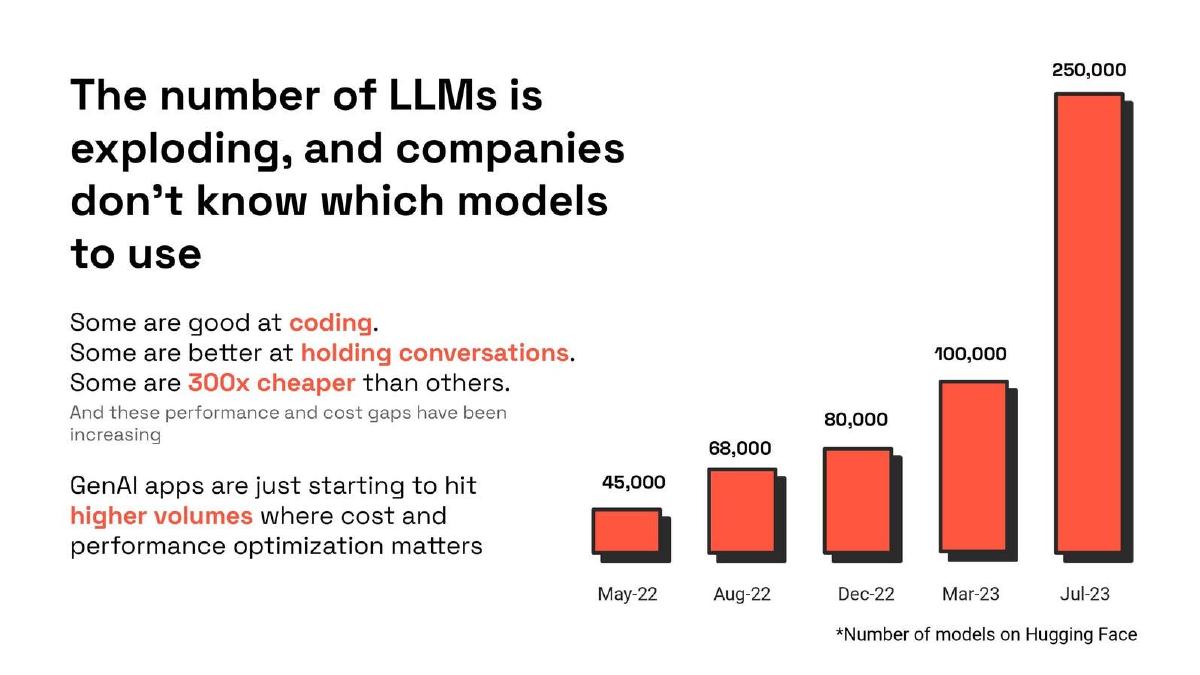
- The deck uses a dramatic bar chart on Slide 2 to show Hugging Face models growing from 45,000 to 250,000 in just over a year.
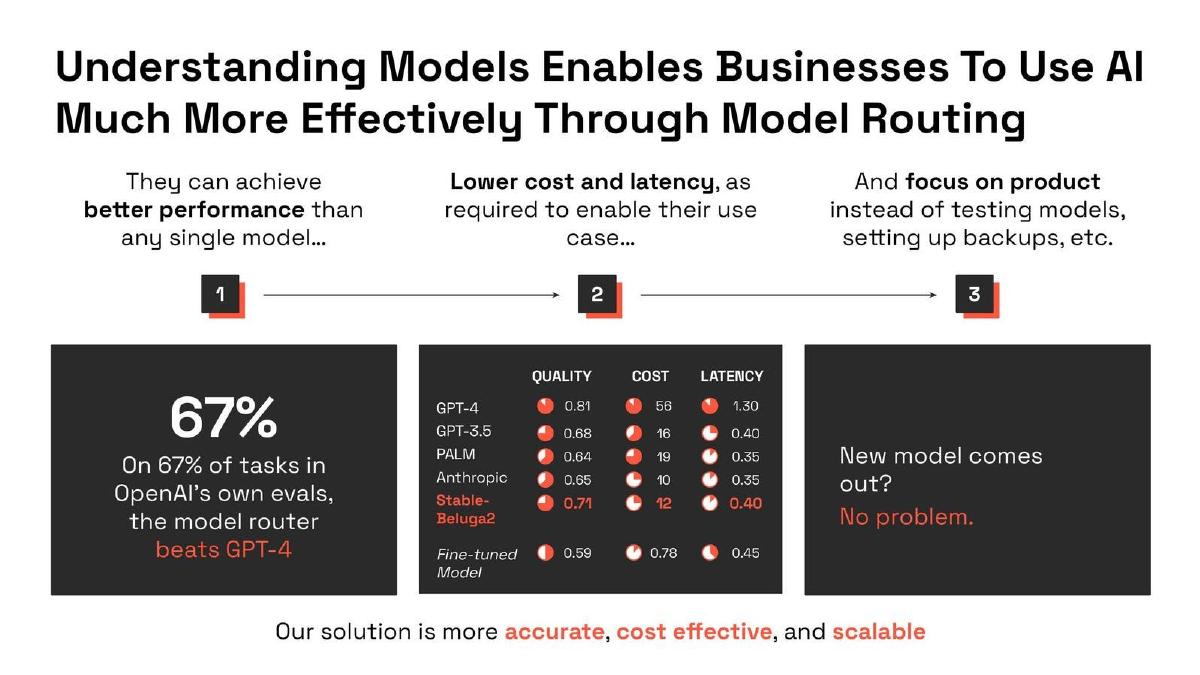
- Martian claims their router beats GPT-4 on 67% of tasks in OpenAI’s own evaluations, as stated on Slide 6.
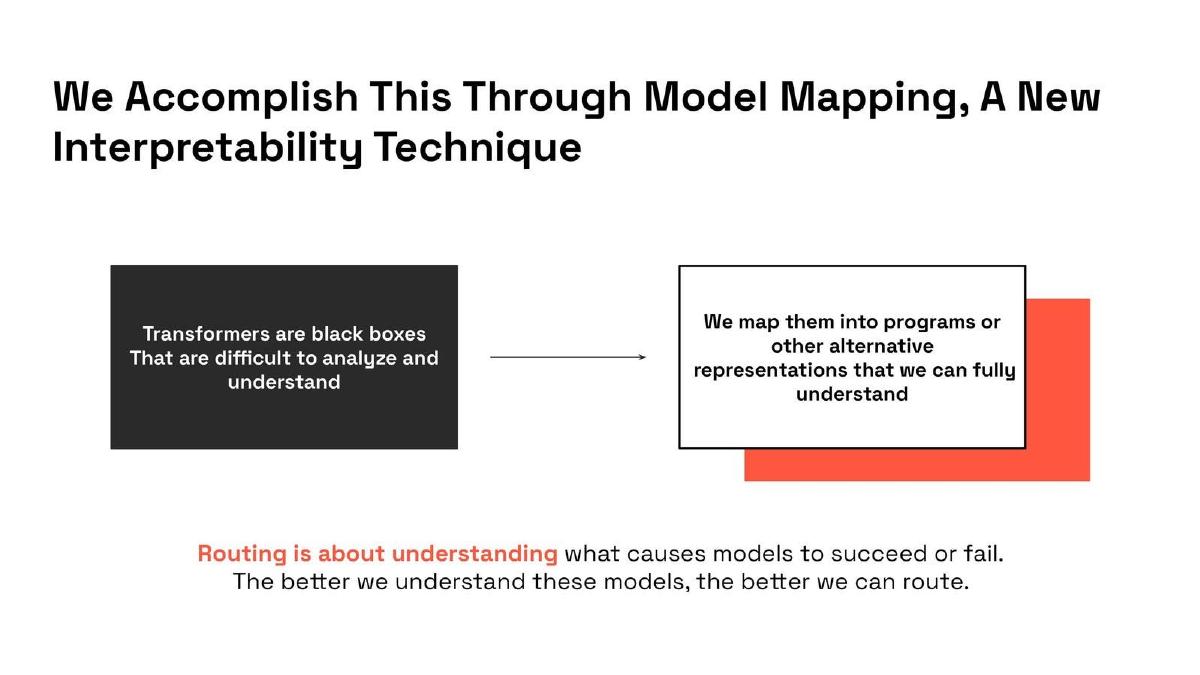
- The core technical differentiator is 'Model Mapping,' which Slide 5 describes as converting black-box transformers into understandable programs.
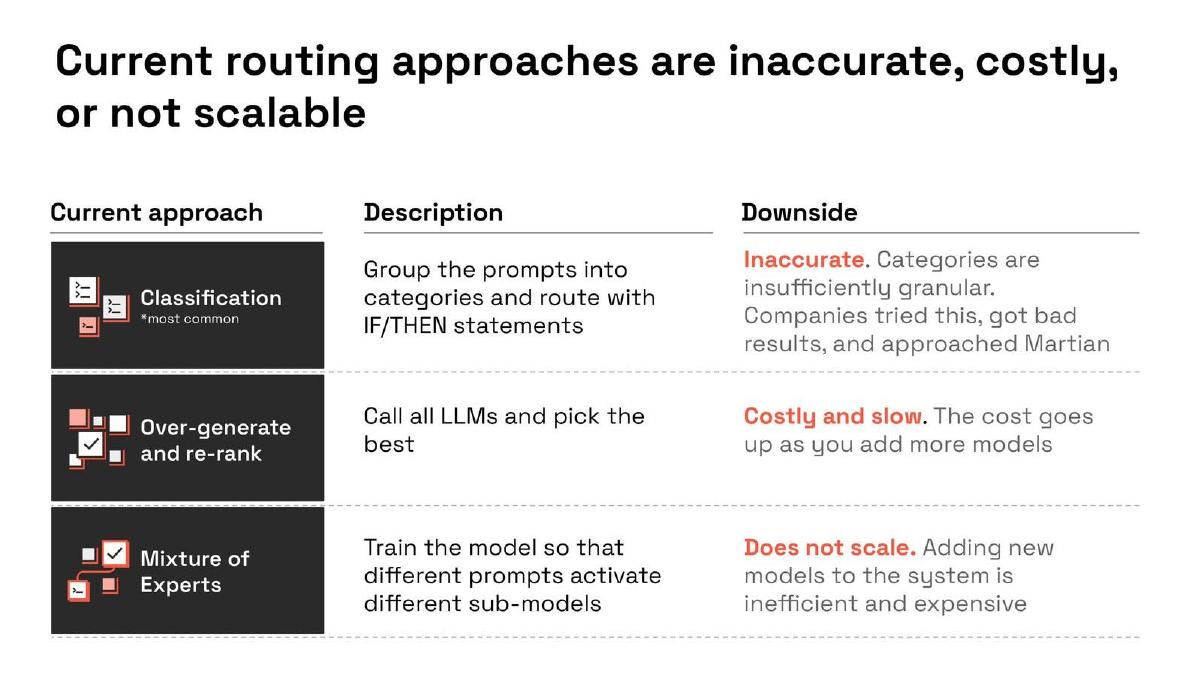
- Slide 4 provides a competitive analysis of current routing methods, labeling 'Classification' as inaccurate and 'Mixture of Experts' as non-scalable.
- The deck omits a team slide entirely, relying instead on the strength of the technical vision and reported $9M seed round success.
- Slide 6 presents a quality-cost-latency matrix comparing GPT-4, GPT-3.5, PaLM, Anthropic, and Stable-Beluga2.
- The 'Broader Vision' on Slide 7 suggests the router is just the first step toward building AI IDEs, debuggers, and automatic refactoring tools.
- There is no explicit 'Ask' slide detailing how the $9M will be spent or what the specific valuation targets are.
The $9M Technical Thesis: Martian's Seed Deck Teardown
Martian’s pitch deck is a fascinating study in the 'Technical Vision' style of fundraising. Raising a reported $9M Seed round in 2024, the company didn't rely on a 20-slide deck covering every operational detail. Instead, they focused on a singular, high-conviction thesis: the AI world is getting too complex for humans to manage manually, and the solution lies in model interpretability. This teardown examines how they used just 8 slides to secure significant capital in a crowded AI market.
Slide 1: The Identity
The title slide is minimalist. It introduces the company name, Martian, and the tagline: 'The Model Router.' The sub-headline, 'Dynamically route every prompt to the best LLM,' immediately tells the investor exactly what the product does. There is no fluff about 'democratizing AI' or 'changing the world'—just a functional description of the tool.
Slide 2: The Exploding Complexity Problem
Slide 2 establishes the 'Why Now.' It features a bar chart showing the number of models on Hugging Face. The data points are specific: 45,000 in May 2022, growing to 250,000 by July 2023. This 5x growth in just over a year creates a sense of urgency. The slide notes that some models are '300x cheaper than others' and that performance gaps are increasing. This frames the problem not just as a technical challenge, but as a massive financial optimization opportunity for companies hitting high volumes of GenAI traffic.
Slide 3: The Functional Solution
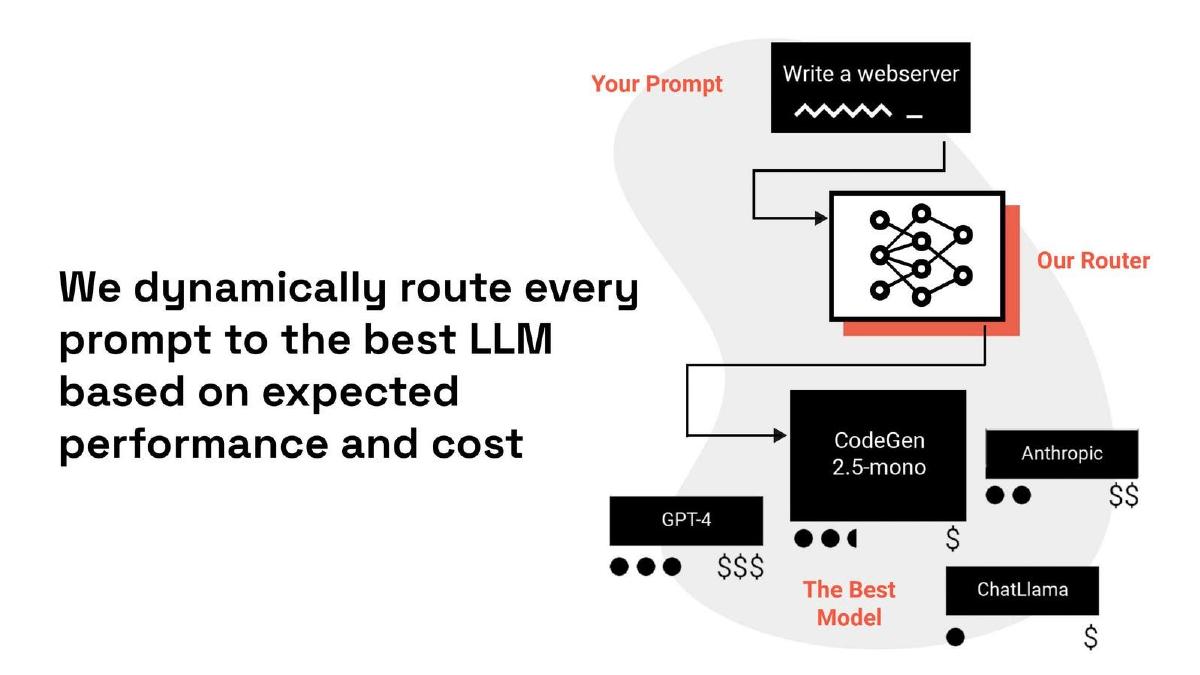
This slide provides a high-level architectural diagram. It shows a user prompt ('Write a webserver') entering 'Our Router,' which then selects between GPT-4 ($$$), CodeGen 2.5-mono ($), Anthropic ($$), and ChatLlama ($). By labeling CodeGen as 'The Best Model' for this specific coding task, Martian illustrates the core value proposition: using a cheaper, specialized model to achieve a better result than a generic, expensive one.
Slide 4: Competitive Landscape and Limitations
Martian uses Slide 4 to dismiss current industry standards. They categorize existing approaches into three buckets: Classification (labeled 'Inaccurate'), Over-generate and re-rank (labeled 'Costly and slow'), and Mixture of Experts (labeled 'Does not scale'). By pointing out that 'Companies tried [Classification], got bad results, and approached Martian,' they use anecdotal social proof to validate their technical superiority without naming specific customers.
Slide 5: The Secret Sauce - Model Mapping
This is the 'Technical Moat' slide. Martian introduces 'Model Mapping,' which they define as a 'New Interpretability Technique.' The slide contrasts the current state—where Transformers are 'black boxes'—with Martian’s approach of mapping them into 'programs or other alternative representations that we can fully understand.' The logic is simple: you cannot route effectively if you don't understand why a model succeeds or fails. This positions Martian as a deep-tech play rather than a simple API wrapper.
Slide 6: Performance Proof Points
Slide 6 delivers the 'Wow' metric. It states in large text: '67% - On 67% of tasks in OpenAI’s own evals, the model router beats GPT-4.' This is a bold claim, especially considering GPT-4 was the industry benchmark at the time of the raise. The slide also includes a comparison table of Quality, Cost, and Latency across five different models, showing how Martian’s routing logic handles new models (like Stable-Beluga2) seamlessly.
Slide 7: The Broader Infrastructure Vision
To justify a $9M seed round, a company needs to be more than a single-feature tool. Slide 7 expands the scope. It argues that if we can understand AI as well as we understand traditional code, we can build 'IDEs, debuggers, testers, formal verifiers, and optimizers.' Martian claims this is where the 'majority of value in the AI infrastructure stack will accrue,' positioning the router as merely the 'first such tool' in a much larger ecosystem.
Slide 8: The Closing
The final slide mirrors the first, reinforcing the brand and the core mission. It provides the URL 'withmartian.com' and repeats the 'Model Router' positioning. It is clean, professional, and stays on message.
What Works in the Martian Deck
The 'Why Now' is Undeniable: Slide 2’s chart on the explosion of models is the strongest part of the deck. It visualizes a trend that every AI investor is feeling: the market is moving too fast for static model choices. By quantifying the growth from 45k to 250k models, they turn a vague feeling into a concrete investment thesis.
Focus on Economics: The deck repeatedly mentions cost. In a world where LLM API bills are a top-three expense for many startups, the promise of a '300x cheaper' model (Slide 2) and a router that optimizes for cost (Slide 6) is a powerful hook for VCs looking for sustainable business models.
Technical Authority: By introducing a new term ('Model Mapping') and framing it as a breakthrough in interpretability, Martian avoids being categorized as a 'wrapper.' They are pitching a fundamental advancement in how we interact with neural networks, which commands a higher valuation than a simple logic-gate router.
What is Missing from the Martian Deck
The Team: This is the most glaring omission. In a $9M seed round, the pedigree of the founders is usually the primary driver of the deal. While the publisher-reported facts confirm the round was successful, the deck itself provides zero information on who is building this technology. This suggests the deck was likely used in conjunction with a strong verbal pitch or that the founders had significant prior reputations in the AI space.
Business Model and Go-To-Market: There is no mention of how Martian makes money. Is it a SaaS fee? A percentage of the savings? A per-token tax? Similarly, there is no plan for how they will acquire customers or which industries they are targeting first. This deck assumes the 'Product-Market Fit' is so obvious that the 'how' of the business can be figured out later.
The Ask: The deck does not state how much money is being raised or what the milestones are for the next 18 months. While this is common in 'leaked' decks or decks used for initial intros, it leaves the reader wondering about the capital intensity of the 'Model Mapping' research.
Founder Takeaways: What to Copy
Use specific benchmarks: Don't just say your tool is 'better.' Say it beats the market leader on '67% of tasks' using a 'standard evaluation framework' (Slide 6). · Address the 'Black Box' problem: If you are building in AI, investors are worried about your moat. Martian addresses this by claiming a proprietary way to 'see inside' the models (Slide 5). · Create a 'Vision Ladder': Start with a narrow, useful tool (the router) and show how it leads to a massive platform (AI infrastructure stack). This gives investors a clear entry point and a huge potential exit (Slide 7). · Keep it visual: Martian uses diagrams to explain complex routing logic and interpretability. This is much more effective than walls of text for explaining technical products.
Frequently asked questions
- What is the primary problem Martian is solving?
- According to Slide 2, the number of LLMs is exploding (250,000+ on Hugging Face), and companies struggle to choose the right one. Some models are 300x cheaper than others, and performance varies wildly across coding and conversation tasks. Martian aims to eliminate this confusion by dynamically routing prompts to the most efficient model for a specific task.
- How does Martian's technology differ from standard LLM routers?
- Slide 5 introduces 'Model Mapping,' a new interpretability technique. While most routers use simple classification or 'Mixture of Experts' (which Slide 4 calls inefficient), Martian claims to map black-box transformers into programs they can fully understand. This deeper understanding allows for more accurate routing based on why a model succeeds or fails.
- Does the deck provide evidence of performance?
- Yes, Slide 6 claims that Martian's model router beats GPT-4 on 67% of tasks using OpenAI’s own evaluation framework. It also includes a comparison table showing how different models like PaLM and Anthropic stack up against GPT-4 in terms of quality, cost, and latency.
- What is missing from the Martian pitch deck?
- The deck is notably missing several standard slides: there is no Team slide, no Go-To-Market strategy, no Financials/Projections, and no 'Ask' slide. It functions more as a technical whitepaper or a vision deck than a comprehensive business plan, which is common for high-profile AI seed rounds.
- What is Martian's long-term vision beyond routing?
- Slide 7 explains that the router is just the first tool. By converting AI into understandable programs, Martian plans to build a full suite of infrastructure tools, including AI-specific IDEs, debuggers, testers, formal verifiers, and automatic refactoring tools. They believe this is where the majority of value in the AI stack will accrue.