The 2016 Poctor pitch deck presents a technical solution for secure healthcare communications, branded as the Poctor Secure Network (PSN). Rather than focusing on a specific telemedicine app interface, the deck prioritizes the underlying infrastructure required to maintain HIPAA compliance for 1.1 million medical providers and 242 million adult patients in the U.S. The team is led by a practicing physician and a developer with two decades of experience, supported by advisors from high-security backgrounds like MIT/Lincoln Labs. While the deck identifies a significant market opportunity and li…
Key takeaways
- The company positions itself as a secure network provider rather than just a telemedicine app, citing a need for secure networks for 1.1 million medical providers (Slide 3).
- The technical architecture relies on a distributed server configuration using SSL, SSH, and Private VPN protocols across multiple states (Slide 4).
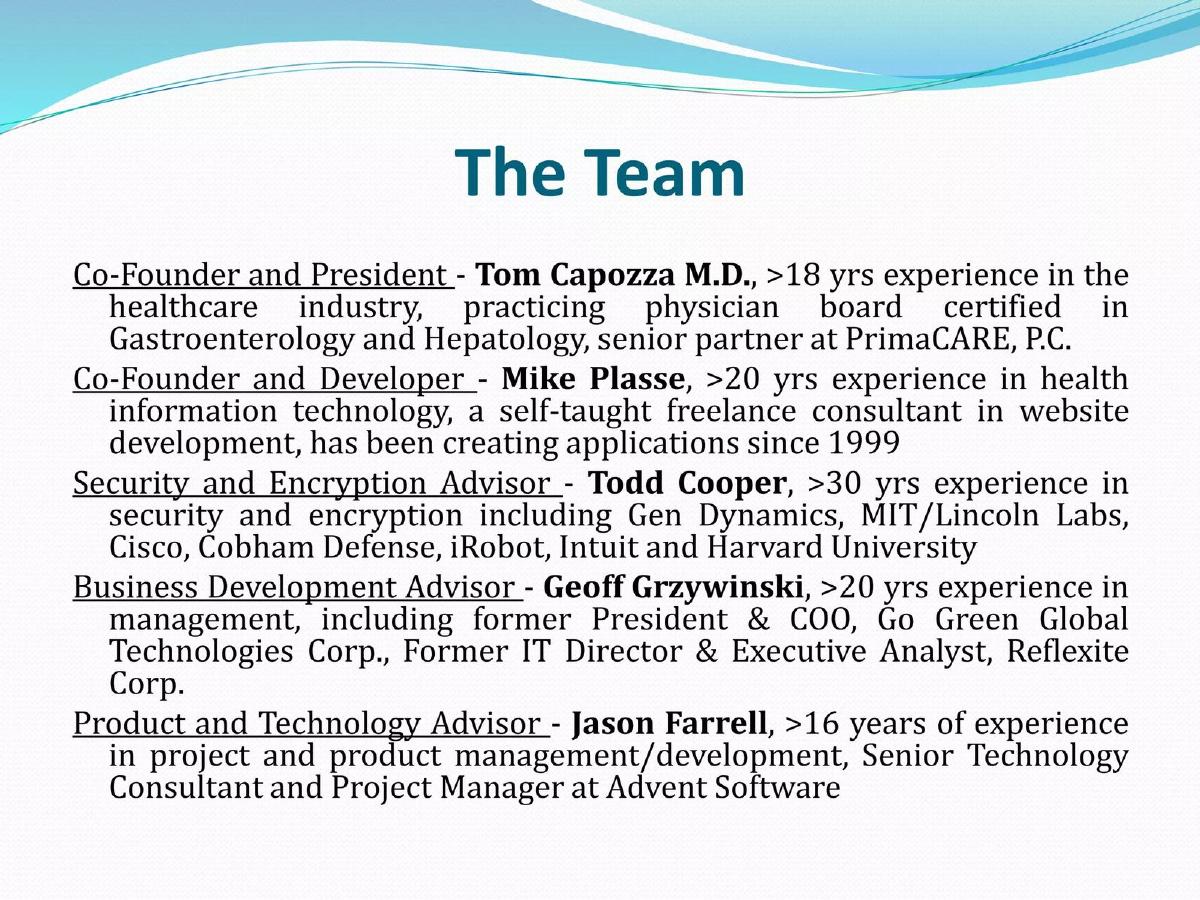
- The team is led by Dr. Tom Capozza, a board-certified physician with over 18 years of experience in Gastroenterology and Hepatology (Slide 2).
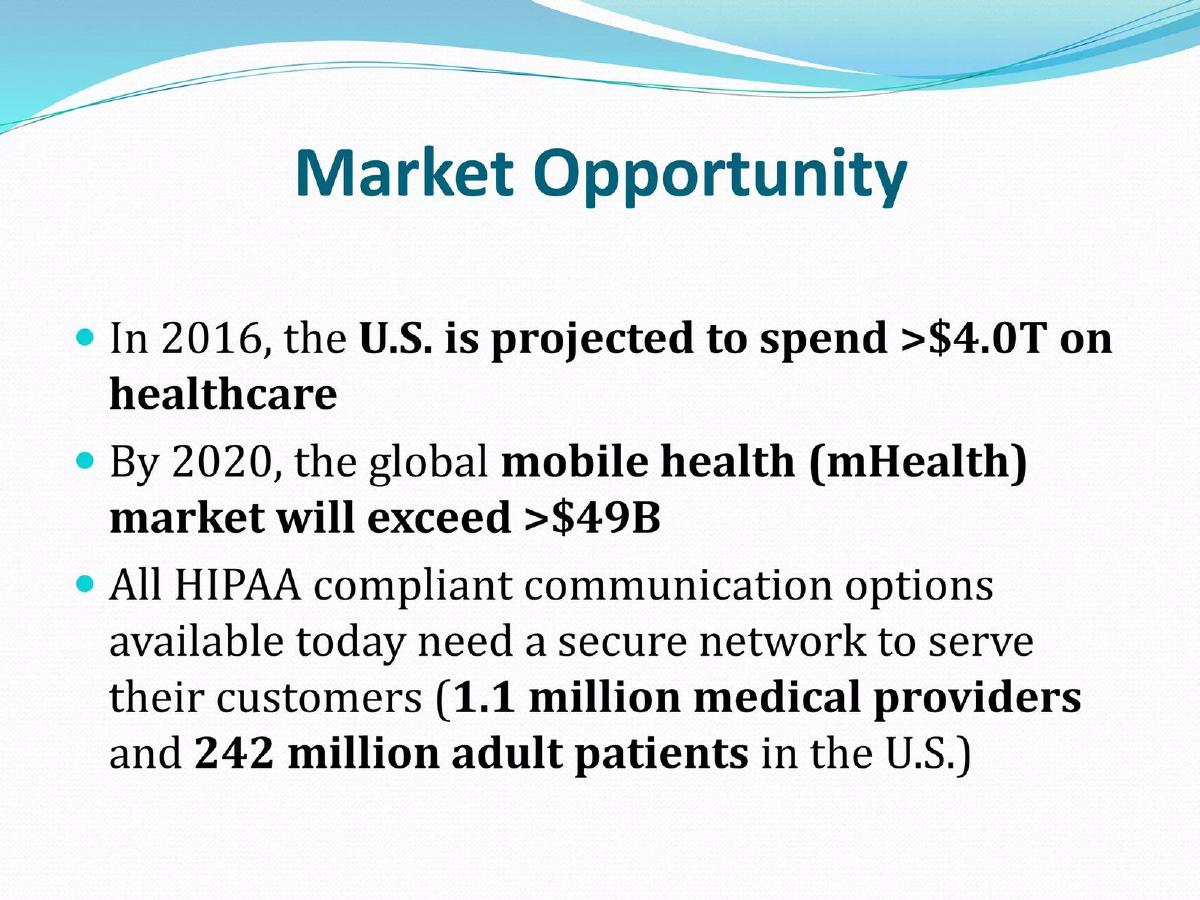
- Market sizing is based on a projected $4.0T U.S. healthcare spend in 2016 and a global mHealth market exceeding $49B by 2020 (Slide 3).
- The growth strategy includes vertical expansion into virtual currency, i-gaming, and the financial industry (Slide 5).
- Competition is clearly identified, including sector-specific players like Medable, Aptible, TrueVault, and Catalyze (Slide 6).
- The deck claims a 'one-of-a-kind solution' based on unique data routing and layered encryption (Slide 7).
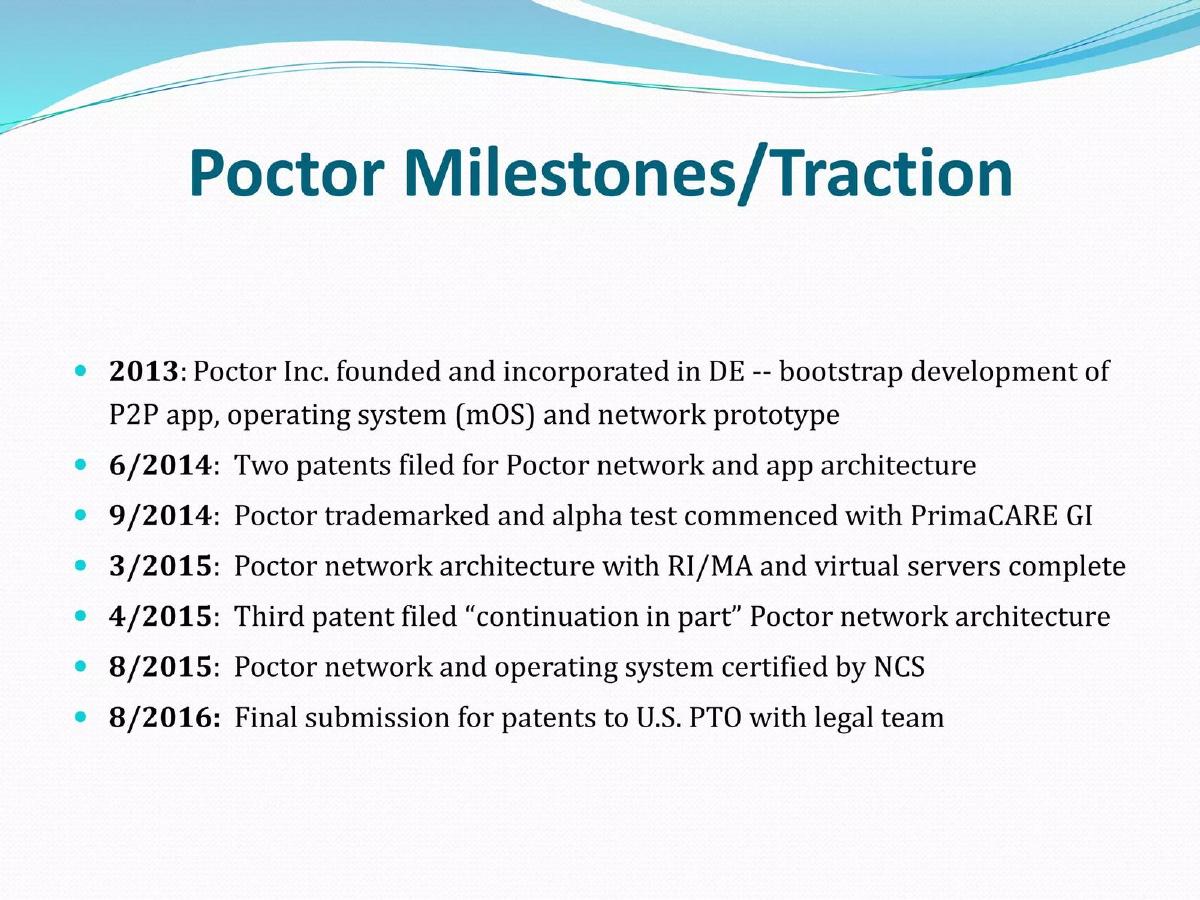
- There is no mention of current revenue, user traction, or a specific dollar amount for the funding round in the provided slides.
Poctor Pitch Deck Analysis
The Poctor pitch deck from 2016 represents a specific era in digital health where the primary hurdle was not just user adoption, but the technical and legal complexities of HIPAA compliance. The deck focuses heavily on the 'plumbing' of healthcare communication—the secure network—rather than the 'faucets' or the user-facing application features.
Slide 1: Title Slide
The cover slide introduces Poctor, Inc. with the tagline "Your Doctor in Your Pocket." The branding uses standard medical blue tones and a logo featuring a cross inside an atomic or orbital structure, signaling a blend of medicine and technology. The date is clearly marked as 2016, which is helpful for context regarding the market figures that follow.
Slide 2: The Team
The team slide is text-heavy but establishes strong domain authority. Tom Capozza M.D. (Co-Founder and President) brings over 18 years of clinical experience, which is vital for a healthcare startup to ensure the product meets actual medical workflows. Mike Plasse (Co-Founder and Developer) provides the technical counterweight with 20 years in health IT. The advisors, particularly Todd Cooper with 30 years in security and encryption from institutions like MIT/Lincoln Labs and Gen Dynamics, add significant credibility to the company's claims of a 'secure network.'
Slide 3: Market Opportunity
Poctor uses top-down market sizing. They cite a projected $4.0T U.S. healthcare spend for 2016 and a global mobile health (mHealth) market exceeding $49B by 2020. More importantly, they identify their specific target audience: 1.1 million medical providers and 242 million adult patients in the U.S. The slide argues that all existing HIPAA-compliant options need a more secure network to serve these customers effectively.
Slide 4: Poctor Secure Network (PSN)
This slide provides a technical diagram of the Poctor Secure Network (PSN) . It illustrates a hub-and-spoke model where users connect via SSL to a central Directory Server , which then routes traffic through SSH and Private VPNs to distributed servers in various states (NY, MA, RI, PA, VT, AZ). This visualizes the 'distributed server configuration' mentioned later in the deck and emphasizes the infrastructure-first approach of the company.
Slide 5: Marketing and Growth
The growth strategy is divided into three categories. First, strategic partnerships with secure messaging and telemedicine providers. Second, traditional medical conventions and journals to reach the 1.1 million providers mentioned earlier. Third, a vertical licensing play. This is a significant pivot or expansion, suggesting the PSN could be sold to the financial, i-gaming, or virtual currency industries. This indicates the founders view their core IP as the secure transportation layer rather than the medical application itself.
Slide 6: Competition
The competition slide is a simple logo cloud. It includes Medable, Aptible, TrueVault, Catalyze, ClearDATA, and Firehost . By listing these specific companies, Poctor acknowledges they are entering a crowded field of HIPAA-compliant cloud and backend providers. However, the deck does not provide a feature-by-feature comparison or a 'magic quadrant' to show exactly where Poctor wins against these established names.
Slide 7: The PSN Advantage
The final slide in this set summarizes the value proposition. It reiterates that the distributed server configuration is a 'one-of-a-kind solution.' It claims that unique routing of data, tagging of information, and layered encryption will provide a new healthcare industry standard. The slide emphasizes that once established nationwide, the network can be leveraged for any industry with interstate business, reinforcing the infrastructure-as-a-service (IaaS) potential of the startup.
What Works in the Poctor Deck
The deck excels at establishing technical and professional credibility . In the healthcare space, having a practicing physician as a co-founder is a major asset, as it suggests the solution won't be hindered by a lack of understanding of clinical environments. The inclusion of a security advisor from MIT/Lincoln Labs is a strategic move to bolster the 'Secure Network' claims.
Furthermore, the technical diagram on Slide 4 is a welcome addition. Many early-stage decks remain too abstract; by showing the actual flow of data (SSL, SSH, Directory Servers), Poctor gives investors something concrete to evaluate. The identification of a vertical licensing strategy also shows the founders are thinking about the scalability of their technology beyond a single niche.
What is Missing from the Poctor Deck
The most glaring omission is the Product Slide . Despite the tagline 'Your Doctor in Your Pocket,' there are no screenshots, mockups, or descriptions of the user interface. An investor cannot tell if this is a video conferencing tool, a text-based chat app, or a file-sharing portal for doctors. The deck describes the 'pipes' but never shows the 'water.'
Additionally, there is a complete lack of Traction and Financials . There are no mentions of pilot programs, beta users, or revenue. There is also no Ask Slide in the provided set, leaving the reader wondering how much capital is needed and what milestones that capital will achieve. Finally, the Competition Slide lacks analysis; simply showing logos doesn't explain why Poctor is a better investment than Aptible or ClearDATA.
Founder Takeaways
Lead with Authority: If you are in a highly regulated industry like healthcare, ensure your team slide highlights deep domain expertise and high-level advisors to build trust early. · Visualize the Tech: For infrastructure startups, a simple architecture diagram can be more effective than three slides of bullet points. It shows you have a plan for how the system actually functions. · Define the 'What': Don't let your technical infrastructure overshadow your product. If you have a consumer-facing tagline, you must show the consumer-facing product. · Contextualize Competition: A logo cloud is a start, but a competitive matrix that highlights your unique 'moat' (like Poctor's interstate routing) is much more persuasive to analysts.
Frequently asked questions
- What is the core product Poctor is pitching?
- Poctor is pitching the Poctor Secure Network (PSN), a distributed server and network architecture designed for secure, HIPAA-compliant data transportation. While the tagline is 'Your Doctor in Your Pocket,' the technical slides suggest the product is the underlying infrastructure that allows medical providers and patients to communicate safely across state lines using layered encryption and private VPNs.
- Who are the key members of the Poctor team?
- The team is led by Co-Founder and President Tom Capozza, M.D., a practicing physician with 18+ years of experience, and Co-Founder/Developer Mike Plasse, who has 20+ years in health IT. They are supported by advisors with backgrounds in high-stakes security and business development, including individuals from MIT/Lincoln Labs, Go Green Global Technologies, and Advent Software.
- How does Poctor plan to acquire customers?
- The marketing strategy relies on three pillars: strategic partnerships with telemedicine and insurance organizations, presence at annual medical conventions and online journals, and vertical licensing. They intend to license the PSN to other industries requiring secure data transportation, such as finance and i-gaming, once the network is established nationwide.
- What competitive advantages does Poctor claim?
- Poctor claims a 'Best-of-Breed' solution based on its unique routing of data, tagging of information, and layered encryption. Slide 7 emphasizes that their distributed server configuration is a one-of-a-kind architecture that can be leveraged for any industry with interstate business, positioning them as a potential new standard for healthcare data transportation.
- What critical information is missing from this pitch deck?
- The deck is missing several standard venture components. There are no financial slides (revenue, burn rate, or projections), no specific 'Ask' detailing how much capital is being raised, and no slide showing the actual user interface of the 'Doctor in Your Pocket' app. It also lacks a timeline or roadmap for development and deployment.