The Polar Pants pitch deck outlines a clear value proposition in the technical apparel space, targeting the gap between casual sweatpants and non-functional formalwear. With a total production cost of $30 per unit and a direct-to-consumer sales price of $140, the business model demonstrates a robust 78% gross margin for direct sales. The deck excels at defining its competitive positioning through a feature matrix and a 2x2 quadrant, clearly identifying its niche as 'formal yet insulated.' However, the presentation is notably missing a team slide, any mention of a specific funding ask, and his…
Key takeaways
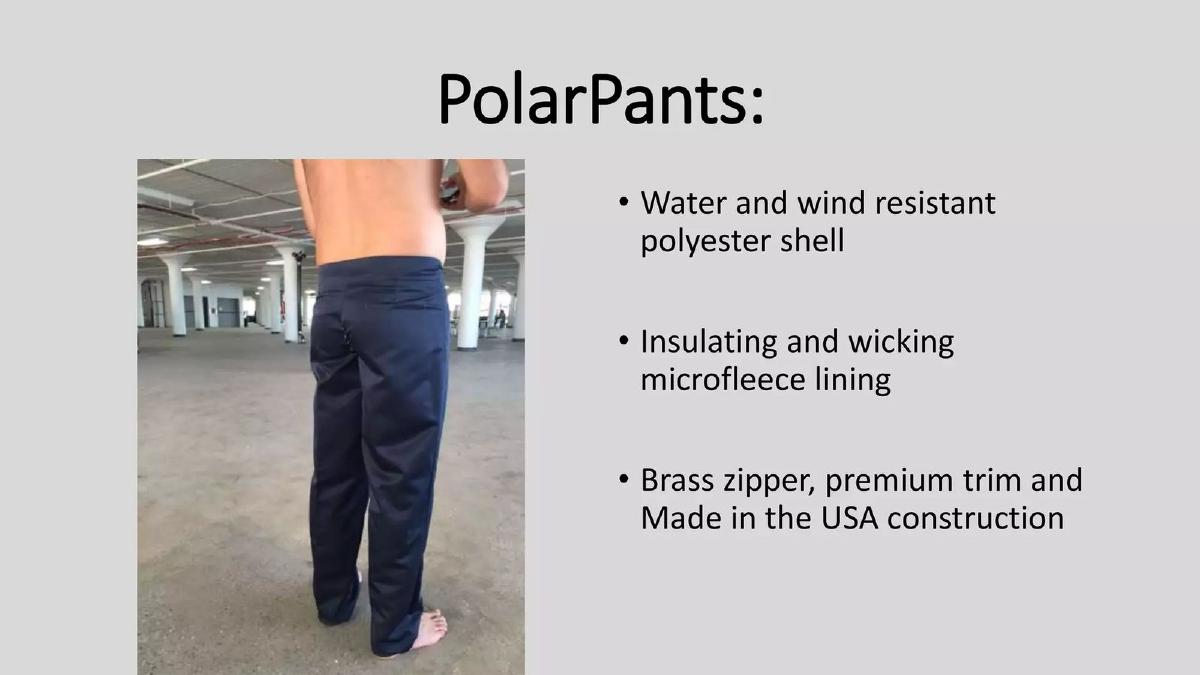
- The product features a water and wind-resistant polyester shell with an insulating microfleece lining (Slide 3).
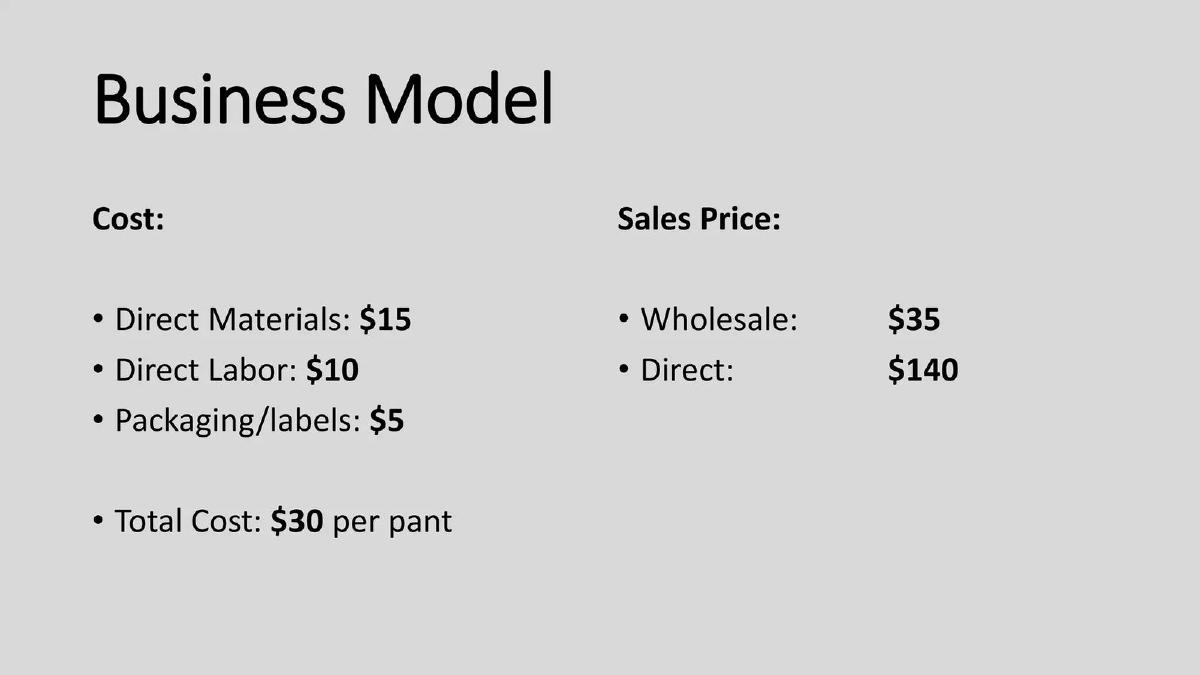
- Unit economics are highly favorable for direct sales, with a $30 total cost and a $140 direct sales price (Slide 4).
- Wholesale pricing is set at $35, leaving a slim $5 margin compared to the $110 margin on direct sales (Slide 4).
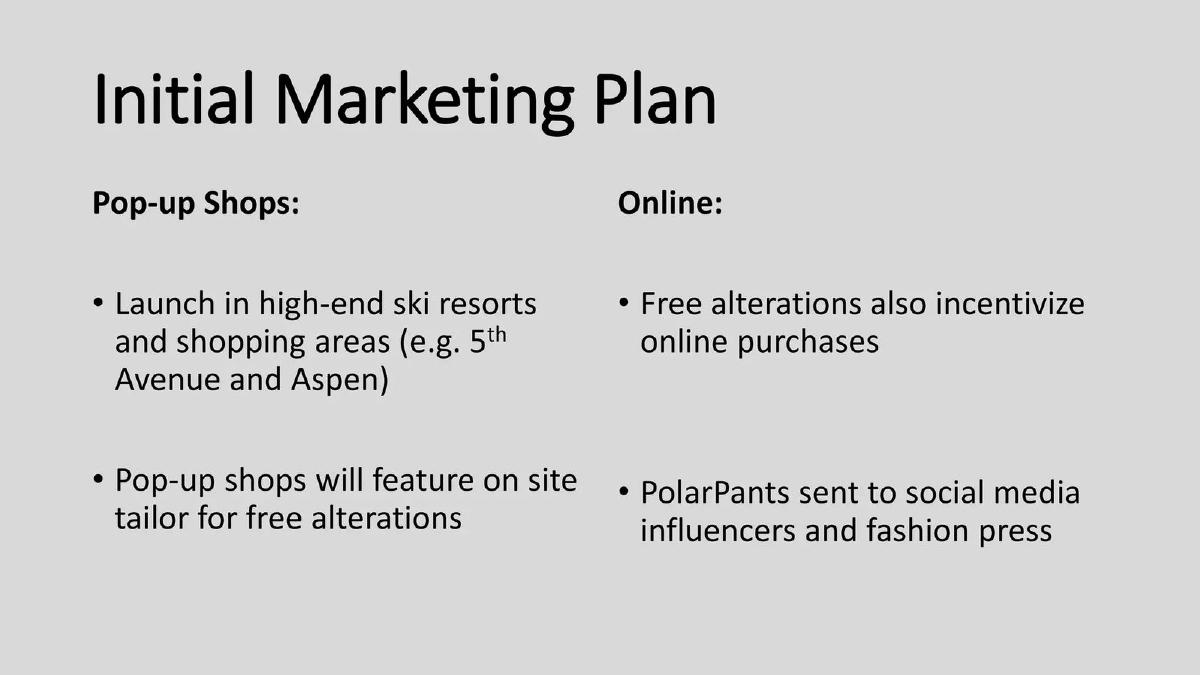
- The initial marketing plan relies on pop-up shops in affluent areas like Aspen and 5th Avenue to establish brand prestige (Slide 5).
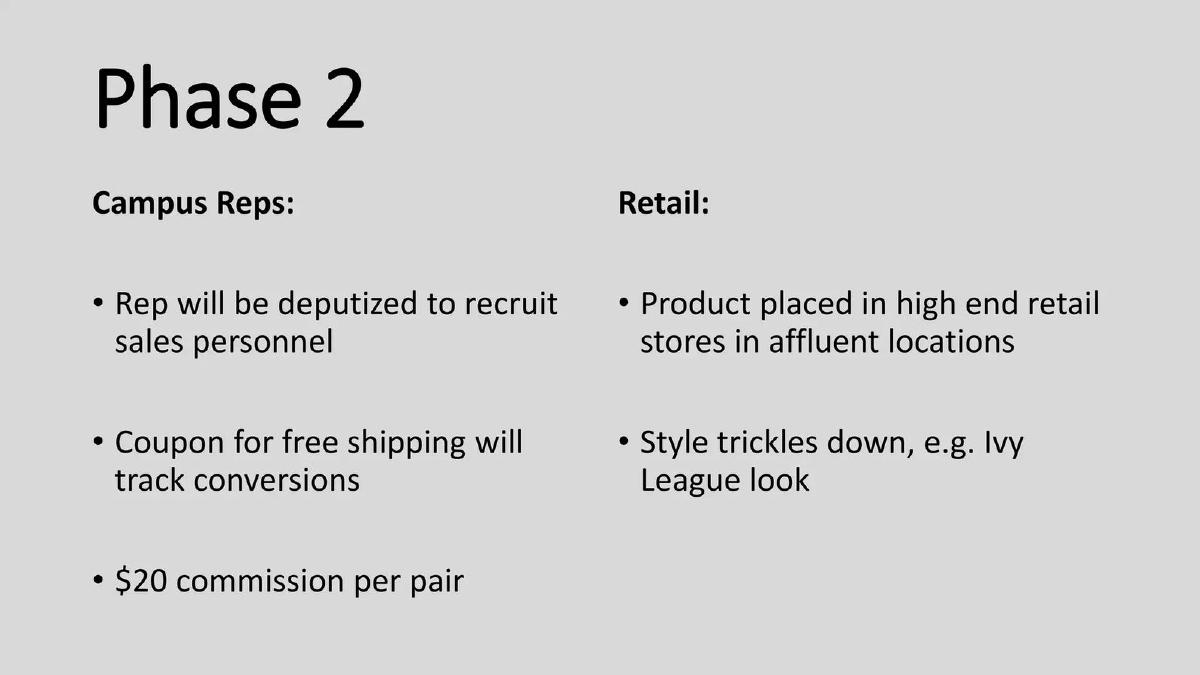
- Phase 2 of the growth strategy involves a campus representative program offering a $20 commission per pair (Slide 6).
- The competitive matrix positions Polar Pants as the only option that is simultaneously formal, water/wind resistant, and insulated (Slide 9).
- The deck completely omits a management team slide, leaving the founders' expertise unknown.
- There is no financial 'ask' or valuation mentioned anywhere in the 10-slide presentation.
Company Overview
Polar Pants, operating under the parent entity Polar Designs, is a technical apparel startup focused on a specific niche: weather-resistant formal trousers. The deck positions the product as a solution for individuals who need the aesthetic of a khaki or corduroy pant but the performance of outdoor gear. By utilizing a polyester shell and microfleece lining, the company attempts to disrupt the traditional winter wardrobe.
Slide 1: Title Slide
The deck opens with the Polar Pants logo. The branding features a polar bear silhouette inside a green circle, surrounded by a purple border with the text "Polar Pants by Polar Designs." It is a straightforward, literal representation of the brand name, emphasizing the cold-weather utility of the product.
Slide 2: The Problem
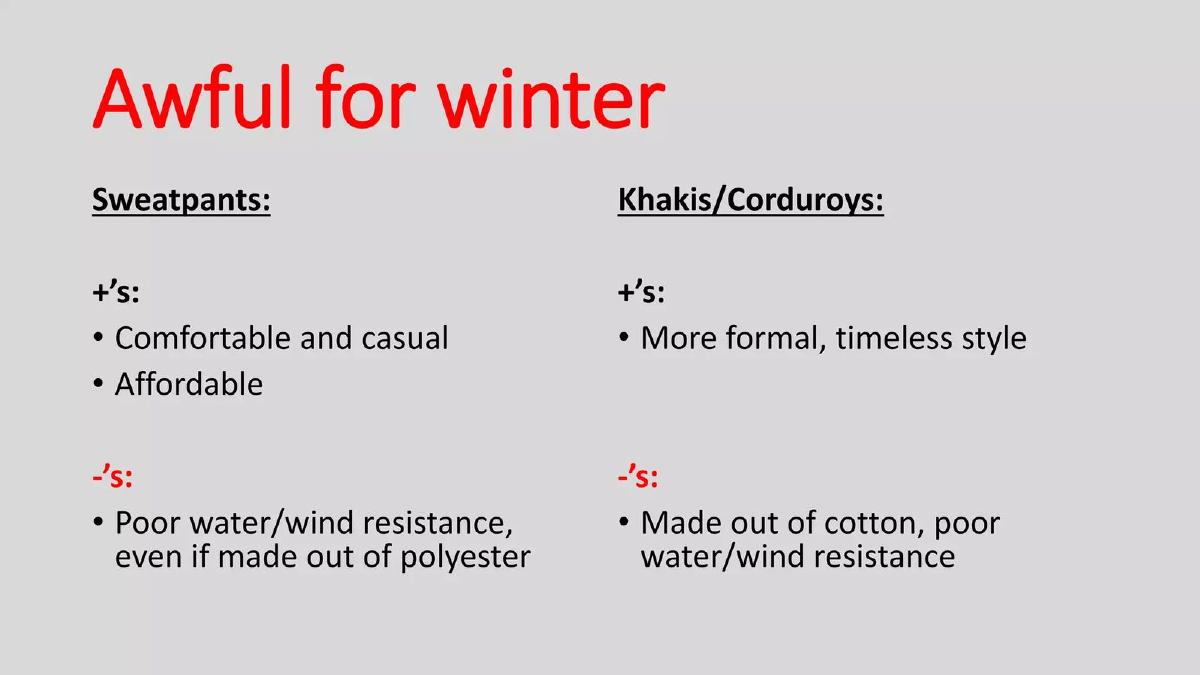
Titled "Awful for winter," this slide sets up a binary choice between two suboptimal options. On the left, Sweatpants are credited for being comfortable and affordable but criticized for "Poor water/wind resistance." On the right, Khakis/Corduroys are noted for their "timeless style" but panned for being made of cotton, which offers "poor water/wind resistance." This slide effectively establishes the 'white space' in the market for a product that combines the 'plus' attributes of both categories.
Slide 3: The Solution
This slide introduces the product with a photo of a prototype (a dark navy pant) and three key technical specifications: a "Water and wind resistant polyester shell," an "Insulating and wicking microfleece lining," and "Brass zipper, premium trim and Made in the USA construction." The mention of domestic manufacturing is a strategic choice often used to justify premium pricing and appeal to a specific consumer demographic.
Slide 4: Business Model
The business model slide provides a granular look at unit economics. The Total Cost is stated as $30 per pant , comprising $15 for materials, $10 for labor, and $5 for packaging. The Sales Price is split into two channels: Wholesale at $35 and Direct at $140 . The discrepancy between these two margins is massive. At wholesale, the company only nets $5 per unit (a 14% margin), whereas the direct-to-consumer (DTC) channel nets $110 per unit (a 78% margin). This suggests the company is heavily incentivized to prioritize its own e-commerce and pop-up channels over third-party retail.
Slide 5: Initial Marketing Plan
The go-to-market strategy focuses on high-intent, high-affluence locations. Pop-up Shops are planned for "high-end ski resorts and shopping areas" like Aspen and 5th Avenue . A unique value-add mentioned is an "on site tailor for free alterations," which addresses the fit risk inherent in online apparel. For the Online channel, the company plans to use social media influencers and fashion press, while offering free alterations to incentivize digital purchases.
Slide 6: Phase 2 Growth
The second phase of the marketing plan introduces a Campus Rep program. Reps are "deputized to recruit sales personnel" and earn a $20 commission per pair . Conversions are tracked via free shipping coupons. On the Retail side, the goal is to place products in "high end retail stores in affluent locations" to foster an "Ivy League look." This indicates a desire to move from a functional utility brand to a lifestyle brand.
Slide 7: Milestones and Timeline
The timeline covers the year 2015. Key dates include Design Finalized (Feb '15) , Materials sourced (Apr '15) , First fitting (Aug '15) , and 1st production run (Oct '15) . The marketing push is timed for the winter season, with online marketing starting in November and "Xmas pop-up shops" in December. There is a typo on the final bullet point, which lists "Feb '15" for ski resort pop-up shops, likely intended to be Feb '16.
Slide 8: Market Positioning (2x2 Matrix)
This visual slide uses a standard 2x2 quadrant to map the competition. The vertical axis ranges from Casual to Formal , and the horizontal axis ranges from Low Price ($) to High Price ($$$) . Polar Pants is not explicitly labeled with a logo here, but the surrounding imagery suggests they are targeting the top-right quadrant: High Price and Formal. It shows sweatpants in the bottom-left (Casual/Cheap) and technical joggers in the bottom-right (Casual/Expensive).
Slide 9: Competitive Matrix
This slide uses a "Y/N" (Yes/No) table to compare Polar Pants against five alternatives: Khakis, Corduroys, Wool Pants, Sweatpants, and Technical Pants. Polar Pants is the only row that receives a "Y" for Formal, Water/Wind Resistant, and Insulated . It is marked "N" for Cheap , reinforcing its position as a premium product. Interestingly, Wool Pants are noted as being water/wind resistant but not insulated.
Slide 10: Conclusion
The final slide summarizes the value proposition in three bullet points: "Timeless style, modern materials," "Look cool, stay warm," and "Water and wind resistant." It serves as a simple wrap-up of the core brand promise.
What Polar Pants Does Well
The deck is exceptionally clear about its unit economics . Many early-stage decks hide their margins or provide vague estimates, but Polar Pants explicitly lists the cost of labor, materials, and packaging. This transparency allows an analyst to immediately see the viability of the DTC model.
The competitive positioning is also a highlight. By using both a 2x2 matrix and a feature table, the founders make a compelling case for why this specific product needs to exist. They aren't just making "better pants"; they are filling a specific functional gap that traditional formalwear ignores.
What is Missing from the Deck
The most glaring omission is the Team Slide . In early-stage venture or angel investing, the team is often more important than the product. Without knowing if the founders have backgrounds in fashion design, supply chain management, or retail marketing, it is impossible to assess the execution risk.
There is also no Financial Ask . A pitch deck is a fundraising tool, yet this document fails to mention how much capital is being sought, what the valuation is, or how the funds will be allocated (e.g., how much goes to the production run vs. the Aspen pop-up). Additionally, there is no mention of Market Size (TAM/SAM/SOM) . While the niche is well-defined, the deck doesn't quantify how many people actually want to buy $140 insulated khakis.
Founder Takeaways
Be Transparent with Margins: If your unit economics are a strength (like the 78% DTC margin here), put them front and center. It proves you understand the mechanics of your business. · Define Your 'White Space': Use a competitive matrix to show exactly which features your competitors lack. Polar Pants successfully showed that 'Formal' and 'Insulated' rarely overlap in the current market. · Seasonal Timing: The timeline slide shows a clear understanding of the fashion calendar. Launching a winter-specific product with a production run in October and marketing in November/December is logical and shows operational awareness. · Don't Forget the 'Who': Never leave out a team slide. Investors need to know why you are the right person to solve this specific problem. · Include an 'Ask': Always end with a clear statement of what you need from the person viewing the deck.
Frequently asked questions
- What is the core problem Polar Pants aims to solve?
- According to Slide 2, existing winter legwear options are 'Awful for winter.' Sweatpants are comfortable but lack wind/water resistance, while khakis and corduroys offer style but fail to provide warmth or protection against the elements due to their cotton construction. Polar Pants aims to bridge this gap by offering a formal aesthetic with technical performance.
- How does the company plan to acquire customers?
- The strategy is two-fold. Initially, they plan to use high-end pop-up shops with on-site tailors and influencer marketing (Slide 5). Phase 2 introduces a 'Campus Rep' model where students earn a $20 commission per sale, alongside placement in affluent retail stores to create an 'Ivy League look' (Slide 6).
- What are the specific manufacturing costs?
- Slide 4 breaks down the $30 total cost per pant: $15 for direct materials, $10 for direct labor, and $5 for packaging and labels. The deck also notes that the construction is 'Made in the USA,' which justifies the higher labor cost relative to offshore manufacturing.
- How does Polar Pants differentiate itself from 'Technical Pants'?
- While both categories are water-resistant and insulated, Slide 9 (the competitive matrix) shows that 'Technical Pants' are not considered 'formal.' Polar Pants claims the 'formal' category for itself, targeting users who need to look professional in cold, wet environments.
- What is missing from this pitch deck that an investor would need?
- The deck is missing several critical components: a Team slide (who is building this?), a Market Size slide (how big is the technical formalwear market?), a Financial Projections slide (revenue targets), and most importantly, the 'Ask' (how much money are they raising and what for?).