Ponos, featured at a 2016 Techstars Startup Next Demo Day, aims to 'democratize food' through an automated, cloud-enabled hydroponic system. The deck relies heavily on technical specifications and environmental impact metrics, claiming 90% less water usage and 4-5 times faster growth compared to traditional methods. While the presentation excels at explaining the 'how'—detailing sensors, actuators, and pH targets—it is notably silent on business fundamentals. There is no mention of unit costs, target pricing, market size, or a specific investment ask. The deck functions more as a technical pr…
Key takeaways
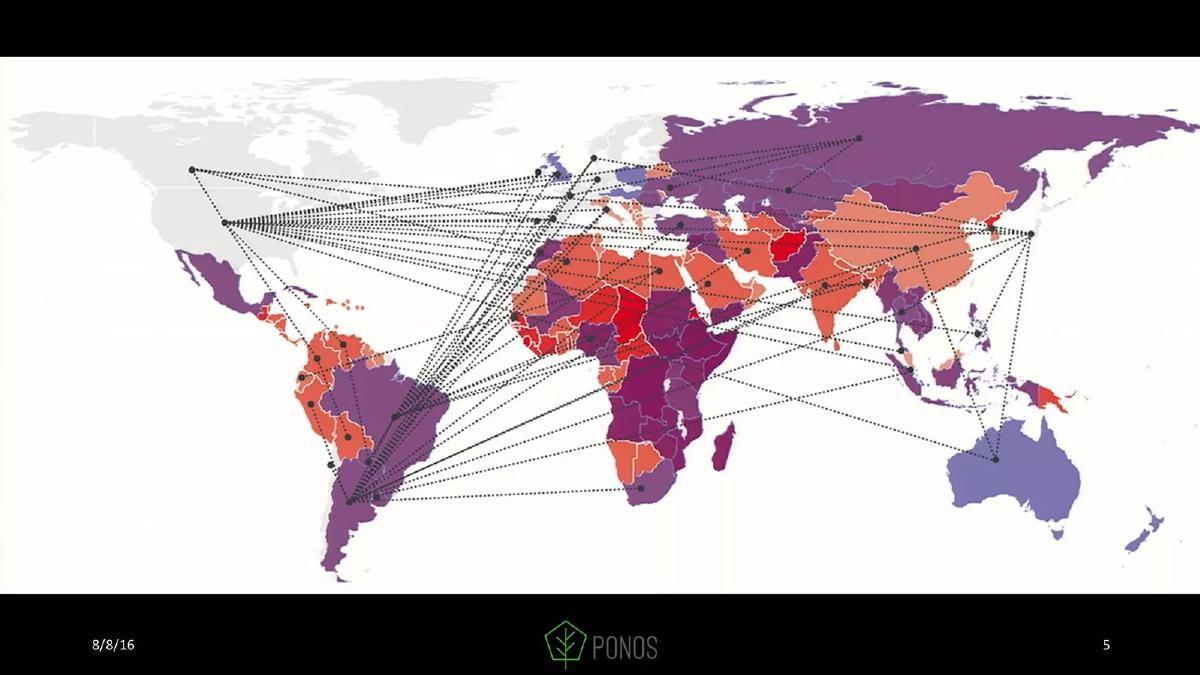
- The company positions its product as a solution to global food insecurity, using heat maps to illustrate the problem on slides 5 and 21.
- Ponos claims significant efficiency gains, including 90% less water usage and growth rates 4-5 times faster than traditional farming (Slide 9).
- The system is highly technical, featuring machine learning, environment sensors, and a 'smart chip' for automation (Slide 13).
- The deck cites NASA research as the basis for its focus on Photosynthetic Active Radiation (PAR) and pH balance (Slide 25).
- A detailed list of actuators on slide 33 reveals a complex hardware stack including five different peristaltic pumps and a water heater.
- The presentation lacks a team slide, failing to identify the founders or their technical qualifications.
- There is no financial data, market analysis, or specific funding request provided in the 37-slide deck.
- The product design is a self-contained, aesthetically clean cabinet intended for indoor use, as shown in the rendering on slide 9.
Ponos Pitch Deck Analysis: Technical Depth vs. Business Breadth
The Ponos deck, presented at the Techstars Startup Next Demo Day in 2016, is a study in technical specificity. With 37 slides in total, the company spends a significant amount of time detailing the mechanics of their automated hydroponic system. However, the deck struggles to bridge the gap between a high-level social mission and the granular details of hardware engineering, often skipping the vital business metrics that sit in the middle.
Slide 1: The Vision
The title slide sets a broad, ambitious tone: "BRINGING FOOD PRODUCTION INTO THE 21ST CENTURY." The background image of a traditional, vast agricultural field creates a sharp contrast with the actual product—a compact, indoor growing cabinet. The Ponos logo, a stylized leaf inside a pentagon, suggests a blend of nature and structured technology. This slide establishes the company as an ag-tech play with a focus on modernization.
Slide 5 & 21: The Global Problem
Ponos uses global heat maps to establish the 'Problem' phase of the pitch. Slide 5 shows a map with dotted lines connecting various regions, likely representing global food supply chains or trade dependencies. Slide 21 is explicitly labeled "FOOD INSECURE" and uses a red color scale to highlight regions suffering from food instability. By starting with a global crisis, Ponos attempts to frame their hardware as a humanitarian necessity rather than just a high-end appliance. However, the deck does not explicitly explain how a sophisticated, electricity-dependent cabinet solves food insecurity in the most impacted (and often infrastructure-poor) red zones on the map.
Slide 9: The Product and Efficiency Claims
This is the core 'Solution' slide. It features a 3D rendering of the Ponos unit—a clean, white cabinet with glass doors containing flourishing tomato and pepper plants. The slide lists four key metrics:
90% LESS WATER · LESS ENERGY THAN A TV · 4-5 TIMES FASTER GROWTH · AUTOMATED
These are powerful claims, particularly the water efficiency and growth speed. The comparison of energy usage to a television is a clever way to make industrial-sounding technology feel relatable for a home or office environment.
Slide 13: The Tech Stack
Slide 13 moves into the 'How.' It uses icons to list the system's features, including Connected, Optimized LEDs, Environment Sensors, Smart Chip, Cloud Enabled, Machine Learning, Smartphone App, HD Camera, and Social Sharing. This slide confirms that Ponos is as much a software and data company as it is a hardware company. The inclusion of 'Social Sharing' is an interesting choice, suggesting a community aspect where users might share their growing successes or 'recipes' for specific plants.
Slide 17: The Call to Engagement
Midway through the deck, slide 17 offers a 'Thanks' with the hashtag #DEMOCRATIZEFOOD and social media handles for Instagram, Twitter, and Facebook (@GetPonos). This serves as a transition point, likely moving from the high-level pitch into the deeper technical appendix that follows in the full 37-slide version.
Slide 25, 29, & 33: Technical Specifications
These slides represent a deep dive into the science of hydroponics. Slide 25 invokes NASA to validate their focus on Photosynthetic Active Radiation (PAR), pH Balance, and Electrical Conductivity. This is a classic 'authority play' to build trust in their methodology. Slide 29 provides a highly detailed chart of "PH TARGETS" for a wide variety of plants, from azaleas to watermelons. Slide 33, titled "STEP 6: ACTUATORS (DEEP WATER + DRIP)," lists the internal hardware required to maintain these environments, including a water pump, four different peristaltic pumps (for nutrients and pH adjustment), a circulator, a heater, and lights. The complexity of this list highlights a potential risk: the high cost of goods sold (COGS) and multiple points of mechanical failure.
Slide 37: Repeatability
The final slide shown, "STEP 9: REPEATABILITY," features the logo for Ansible (a red circle with a white 'A'). In a technical context, Ansible is an automation tool used for configuration management. Its inclusion here suggests that Ponos is using professional-grade software automation to ensure that the growing conditions can be replicated exactly across different units and locations. It reinforces the 'Machine Learning' and 'Cloud Enabled' claims made earlier.
What Works
The technical depth is the strongest part of this deck. By citing NASA and providing detailed pH charts, Ponos demonstrates that they have done the homework required to build a functioning hydroponic system. The efficiency metrics (90% less water) are clear and compelling. The product rendering on slide 9 is professional and helps the audience visualize exactly what the company is building, moving it from a concept to a tangible object.
What is Missing
The most glaring omission is the Business Case. Across these slides, there is no mention of:
The Team: Who is building this? Do they have hardware or agronomy expertise? · Market Size: Is this for hobbyists, restaurants, or schools? How big is that market? · Unit Economics: How much does it cost to build one unit, and what is the target retail price? · Competition: How does Ponos differ from existing systems like AeroGarden or industrial players? · The Ask: How much money are they raising, and what will they do with it?
Without these elements, the deck feels more like a product manual or a project proposal than a startup pitch intended to generate a return for investors.
Founder Takeaways
Founders should look to Ponos for how to present technical validation. Using recognized authorities (NASA) and specific scientific metrics (PAR, pH) can help overcome skepticism about a product's efficacy. However, founders must avoid the 'engineer's trap' of focusing so much on how the product works that they forget to explain how the business works. A demo day deck needs to prove that there is a massive, reachable market and a team capable of capturing it. Ponos succeeds at the former (the problem of food insecurity) and the latter (the technical solution) but misses the connective tissue of a viable commercial strategy.
Frequently asked questions
- What is the core product Ponos is developing?
- Ponos is developing an automated, indoor hydroponic growing system. Based on slide 9, the product is a white, cabinet-like enclosure with glass doors, designed to grow plants like tomatoes and peppers. It utilizes 'Deep Water + Drip' technology (Slide 33) and is controlled via a smartphone app, featuring integrated LEDs, sensors, and cameras for remote monitoring and automated care.
- What are the primary value propositions for the Ponos system?
- The primary value propositions are efficiency and ease of use. Slide 9 highlights that the system uses 90% less water than traditional methods, consumes less energy than a television, and achieves 4-5 times faster growth. Automation is a key selling point, intended to reduce the labor and expertise required for successful hydroponic farming.
- How does Ponos approach the technical side of plant growth?
- The company takes a data-driven approach, citing NASA standards for Photosynthetic Active Radiation (PAR) and pH balance on slide 25. They provide detailed pH targets for dozens of plant varieties (Slide 29) and use a suite of sensors and actuators to maintain these levels. The inclusion of 'Machine Learning' on slide 13 suggests they aim to optimize growth cycles over time.
- Is there a clear business model or market strategy in the deck?
- No. The provided slides are entirely focused on the problem (food insecurity) and the technical solution. There is no information regarding the manufacturing cost, the retail price, the target customer (B2B vs. B2C), or the go-to-market strategy. The deck lacks the standard financial projections and market sizing slides found in most venture pitches.
- What is missing from this pitch deck that an investor would need?
- The deck is missing several critical components: a team slide, a competition analysis, unit economics, a roadmap, and a specific funding ask. While it proves the technical complexity of the build, it fails to explain how the company will become a profitable business or who is leading the effort.