PositiveID’s March 2018 deck positions the company as a leader in point-of-need molecular diagnostics and medical devices. The presentation highlights a 2016 record revenue of $5.6 million and a portfolio of 22 patents. The core value proposition centers on the FireflyDX system, which claims to reduce testing costs from $25,000 to $5,000 and result times to under 30 minutes. While the deck boasts high-profile partners like NASA and Boeing, the financial disclosures on slide 11 paint a difficult picture: a stockholders' deficit of $8.99 million and just $25,000 in cash as of September 2017. Th…
Key takeaways
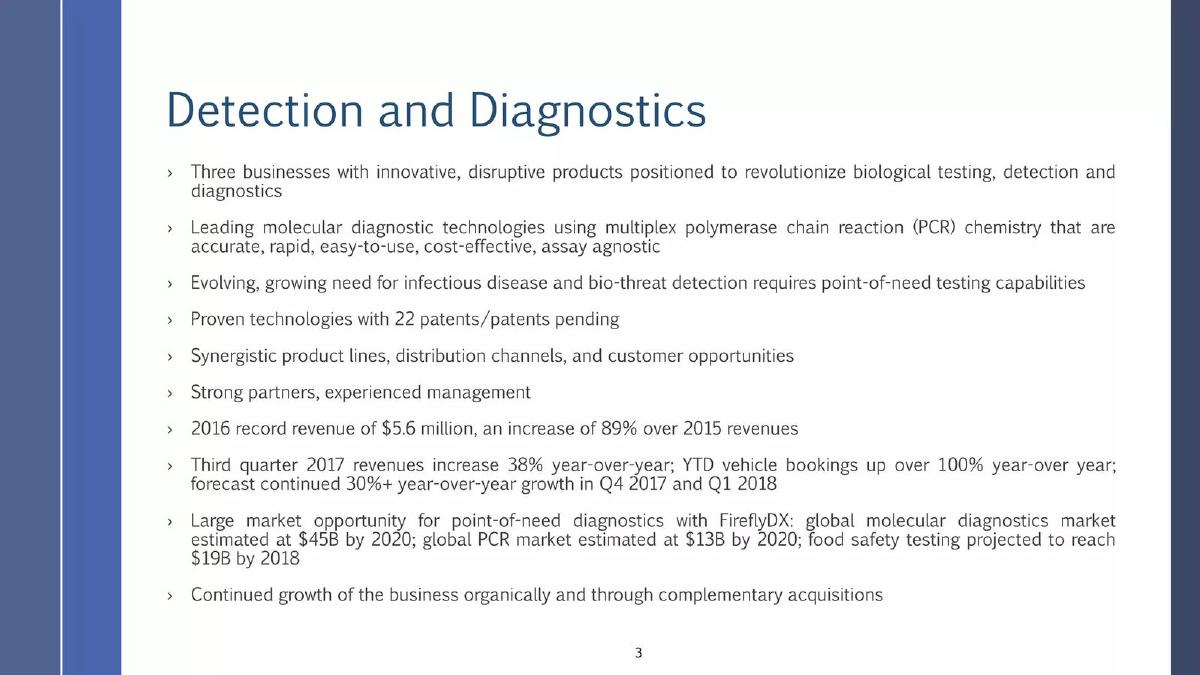
- The company reported 2016 record revenue of $5.6 million, representing an 89% increase over 2015 (Slide 3).
- PositiveID holds 22 patents or patents pending for its diagnostic technologies (Slide 3).
- The FireflyDX system aims to disrupt the market by offering a $5,000 system cost compared to the $25K-$75K cost of current systems (Slide 7).
- The Caregiver thermometer is FDA-cleared and targeted a $1M+ run-rate revenue by the second half of 2018 (Slide 9).
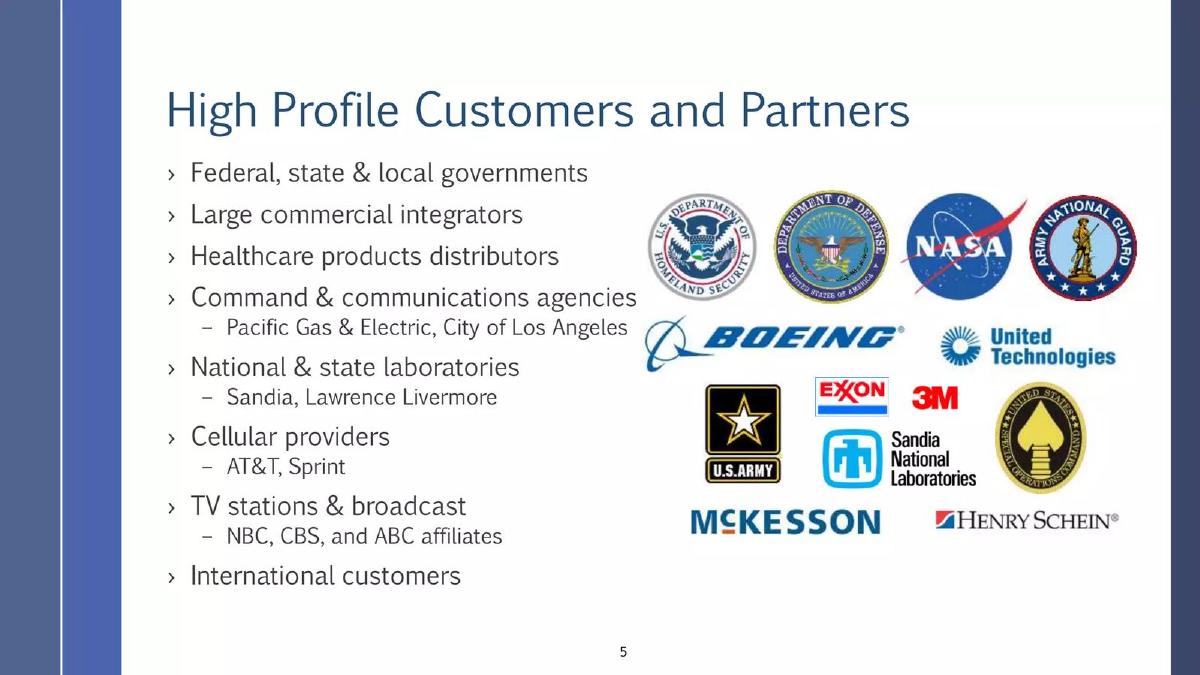
- The company lists prestigious partners and customers including NASA, Boeing, 3M, and the U.S. Army (Slide 5).
- Financial health is a major concern, with only $25,000 in cash reported as of 9/30/17 (Slide 11).
- The balance sheet shows $6.148 million in convertible debt and a total stockholders' deficit of $8.996 million (Slide 11).
- Management and the Board control 60.2% of the company on a diluted basis through Series II Preferred shares (Slide 11).
PositiveID Investor Presentation: A Detailed Slide Walkthrough
Slide 1: Title Slide
The title slide is minimalist, featuring the PositiveID logo and the date 'March 2018.' To the left, a graphic of a DNA double helix reinforces the company's focus on molecular diagnostics and biological testing. There is no tagline or mission statement present on this opening slide.
Slide 3: Detection and Diagnostics Overview
This slide serves as an executive summary for the diagnostics arm of the business. It claims the company has three businesses with 'innovative, disruptive products' focused on PCR (polymerase chain reaction) chemistry. Key metrics included here are 22 patents/patents pending and 2016 record revenue of $5.6 million, which was an 89% increase over the previous year. The slide also notes that Q3 2017 revenues increased 38% year-over-year. Market opportunity figures are cited: a $45B molecular diagnostics market by 2020 and a $19B food safety testing market by 2018.
Slide 5: High Profile Customers and Partners
Slide 5 is a 'logo slide' intended to build credibility through association. It categorizes partners into federal/state/local governments, large commercial integrators, healthcare distributors, and cellular providers. Notable logos include NASA, Boeing, the U.S. Army, 3M, Exxon, and McKesson. While the slide lists these as 'Customers and Partners,' it does not specify the nature of the contracts or the revenue generated from these specific entities.
Slide 7: FireflyDX Advantages
This slide uses a three-column table to compare 'Current Systems' against the 'FireflyDX' product. The comparison is aggressive: it claims a reduction in system cost from a range of $25K-$75K down to $5K. It also highlights a reduction in time-to-result from 'hours or even days' to 'within 30 minutes.' Other benefits listed include a CLIA waiver due to minimal training requirements and the ability to use any commercially available assay, which the company claims removes the need to submit assays to the FDA for approval.
Slide 9: Medical Devices - Thermomedics
Focusing on the Thermomedics subsidiary, this slide details the 'Caregiver' thermometer. It is described as an FDA-cleared, clinical-grade infrared thermometer. The slide emphasizes cost savings for medical facilities by eliminating the need for probe covers (saving up to $0.10 per temp). Strategic milestones mentioned include the launch of a Bluetooth-enabled version in Q1 2018 and a target of $1M+ run-rate revenue by the second half of 2018. The slide also references the global market for infrared thermometers exceeding $1 billion by 2020, driven by concerns over infectious diseases like Ebola.
Slide 11: Capitalization and Balance Sheet
This is the most data-dense slide in the deck, providing a snapshot of the company's financial health as of late 2017. The capitalization table shows 359 million common shares and 542 million Series II Preferred shares held by the Board and Management, giving the latter 60.2% ownership on a diluted basis. The balance sheet section is concerning: cash dropped from $40,000 in December 2016 to $25,000 in September 2017. Total current liabilities stand at $11.36 million, contributing to a stockholders' deficit of $8.99 million. The slide also notes $6.148 million in convertible debt with embedded derivatives.
What PositiveID Does Well
The deck excels at articulating a clear value proposition for its hardware. By using a direct comparison table on Slide 7, the company makes a compelling case for the FireflyDX's cost and time efficiencies. They successfully frame their technology as a solution to a 'growing need for infectious disease and bio-threat detection' at the point of need. The inclusion of a specific, FDA-cleared product like the Caregiver thermometer provides a sense of near-term commercial viability that offsets the more R&D-heavy diagnostic side of the business. Furthermore, the use of high-profile logos creates an immediate sense of institutional trust, even if the specific details of those relationships are not disclosed.
What is Missing from the PositiveID Deck
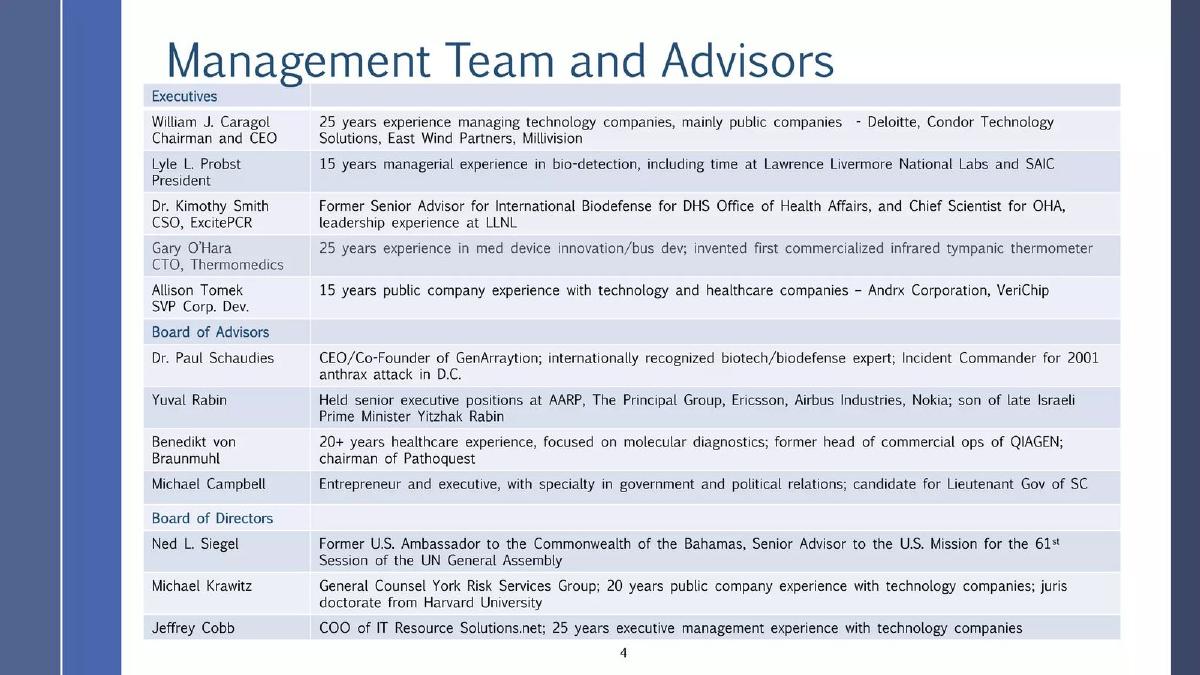
Despite the 12-slide count (of which 6 were reviewed), there are significant omissions. There is no dedicated 'Team' slide in the provided selection, which is a critical component for evaluating the 'experienced management' claimed on Slide 3. There is also a lack of a clear 'Ask' slide; while the capitalization table suggests a need for funding, the deck does not specify how much capital is being raised or how it will be deployed. Most importantly, the deck lacks a clear path to profitability or a plan to address the $11 million in current liabilities. While they forecast run-rate revenue for a subsidiary, they do not provide a consolidated financial forecast that explains how the company will survive its current cash crunch.
Founder Takeaways: Lessons from the PositiveID Deck
Transparency in Financials: PositiveID deserves credit for including a detailed capitalization and balance sheet slide. Many early-stage decks hide these figures, but for a company with significant debt or a complex share structure, being upfront is necessary for due diligence. However, a founder should always pair a 'bad' balance sheet slide with a 'use of proceeds' slide that explains how new capital will fix the situation.
The Power of Comparison: The table on Slide 7 is a masterclass in positioning. By breaking down the 'Current System' pain points (cost, time, training) and showing how their product solves each one, they make the investment thesis easy to understand. Founders should adopt this 'Status Quo vs. Our Solution' format to highlight their competitive advantages.
Diversification vs. Focus: This deck shows a company operating in two distinct fields: PCR diagnostics and infrared thermometers. While this shows breadth, it can also signal a lack of focus to investors. If you are presenting multiple business units, you must clearly explain the 'synergy' (as attempted on Slide 3) to justify why you aren't just focusing on one high-growth product.
Logo Credibility: If you have worked with NASA or Boeing, put them front and center. However, be prepared to answer exactly what you did for them. A logo slide without context can sometimes backfire if the 'partnership' was merely a one-off small purchase rather than a strategic alliance.
Frequently asked questions
- What is the primary product focus of PositiveID?
- PositiveID focuses on two main areas: detection/diagnostics and medical devices. Their flagship diagnostic product is the FireflyDX, a portable point-of-need PCR testing system. In the medical device segment, they market the Caregiver thermometer, a clinical-grade infrared forehead thermometer that connects wirelessly to patient monitoring stations.
- How does FireflyDX compare to traditional lab testing?
- According to slide 7, FireflyDX offers significant advantages over 'Current Systems.' It provides results in under 30 minutes compared to hours or days, costs $5,000 versus $25K-$75K, and requires minimal training. It also uses standard lab volumes and any commercially available assay, which broadens the user pool without needing specific FDA approval for every assay.
- What is the company's current financial position based on the deck?
- The financial position appears strained. Slide 11 shows that as of September 30, 2017, the company had only $25,000 in cash against $11.36 million in total current liabilities. Furthermore, the company reported a stockholders' deficit of nearly $9 million and carried over $6 million in convertible debt.
- Who are PositiveID's notable partners?
- Slide 5 displays an impressive array of logos, including government agencies like NASA, the U.S. Army, and Homeland Security. Commercial partners and customers listed include Boeing, Exxon, 3M, McKesson, and Henry Schein. The deck also mentions utility companies like Pacific Gas & Electric and national laboratories like Sandia.
- What are the growth projections for the medical device segment?
- Slide 9 forecasts sales growth of more than 30% for Q4 2017 and Q1 2018 for the Thermomedics division. The company was targeting a $1M+ run-rate revenue by the second half of 2018 and aimed to be cash flow positive from operations for that specific subsidiary.