Ovom’s 11-slide deck focuses on the 'full-stack' healthcare model, arguing that fertility care requires a physical-digital hybrid to be effective. By identifying a gap between low-success legacy clinics and detached digital-only platforms, Ovom positions its AI-enabled reproductive care units as a solution to high costs and low success rates. The deck highlights specific efficiency gains, such as a projected 15-30% increase in success rates and a 50% reduction in patient life disruption. While the deck excels at competitive positioning and product roadmap visualization, it notably omits a ded…
Key takeaways
- The deck identifies a market failure where >95% of patients are either unsatisfied or without care due to current structures (Slide 2).
- Ovom targets a 15-30% increase in treatment success rates through its AI-enabled ecosystem (Slide 4).
- The business model aims to reduce treatment costs by 20-30% while introducing success-based pricing (Slide 4).
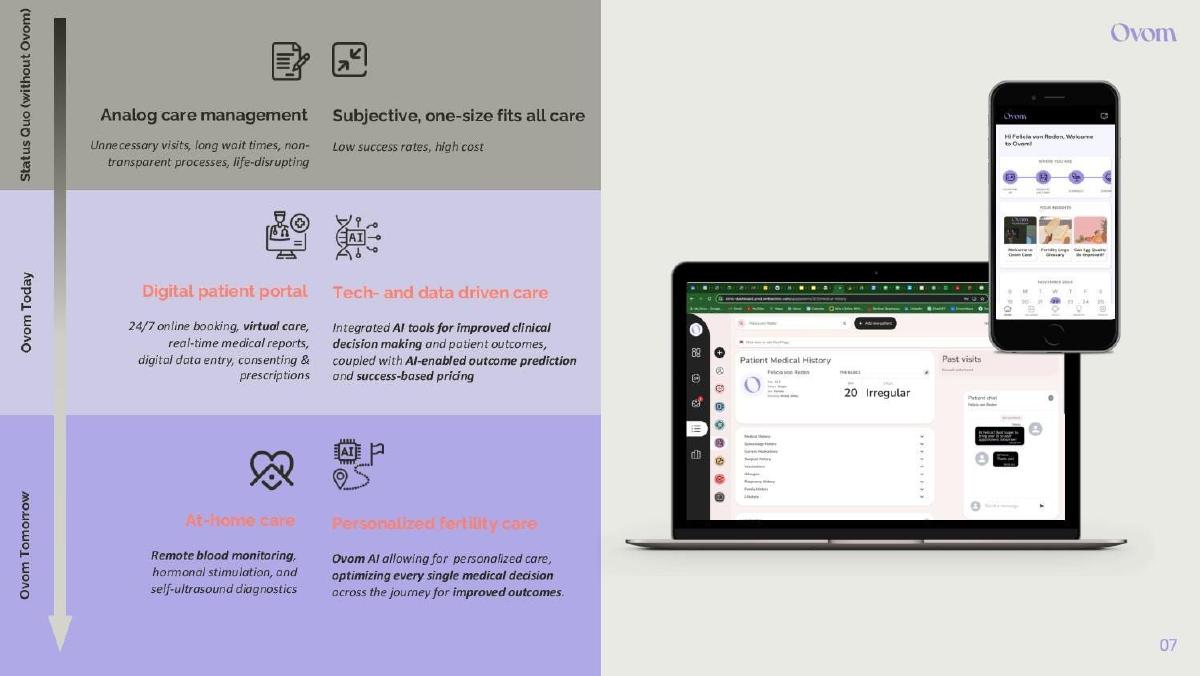
- The product roadmap transitions from 'Analog' to 'At-home care,' including remote blood monitoring and self-ultrasound diagnostics (Slide 7).
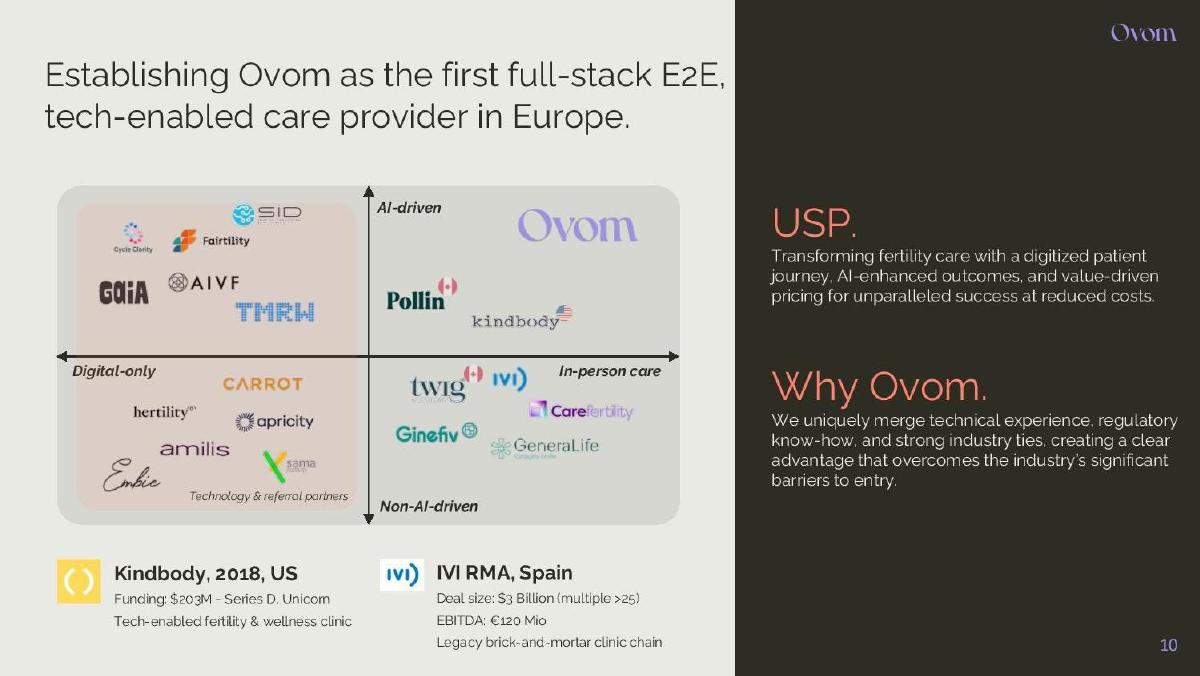
- Competitive positioning places Ovom in a unique 'AI-driven + In-person care' quadrant, distinct from digital-only players like Gaia or legacy chains like IVI (Slide 10).
- The deck cites IVI RMA as a benchmark for the sector, noting a $3 Billion deal size and €120 Mio EBITDA (Slide 10).
- Ovom defines its 'Technology Ecosystem' as a trio of a Patient Companion Portal, Clinic Management System, and AI medical decision support tools (Slide 4).
- The deck omits a team slide, financial projections, and a specific funding ask, focusing instead on the clinical and technological value proposition.
The Hybrid Healthcare Thesis
Ovom’s pitch deck is a clinical study in positioning. In a market often split between high-cost legacy clinics and venture-backed digital platforms that lack medical infrastructure, Ovom argues for a 'full-stack' approach. As reported by Business Insider, the company raised a $1.4M pre-seed round in 2024 to execute this vision in Europe. The deck consists of 11 slides, though the version analyzed here focuses on the core narrative: the failure of current care, the technological solution, the product roadmap, and the competitive landscape.
Slide 1: Title and Vision
The opening slide sets a tonal balance between 'compassion' and 'tech.' The imagery features diverse families and children, grounding the high-tech AI pitch in human outcomes. The subtitle, 'Creating tech- and AI-enabled reproductive care clinics,' immediately informs the investor that this is not just a software play; it involves physical infrastructure.
Slide 2: The Problem Statement
Slide 2 identifies a systemic failure in reproductive health. It claims that current care structures leave '>95% of patients either unsatisfied or entirely without care.' The slide breaks down the problem into three pillars: Not affordable (citing costs of >6k€ per cycle and an average of 3 cycles required), Low success rates (below 35% per cycle), and Broken processes (described as non-digitalized and non-data driven). This slide is effective because it uses hard numbers to quantify the pain points, setting a high bar for the proposed solution.
Slide 3: Brand Identity
Slide 3 is a transition slide featuring the company logo. While it provides a visual break, in an 11-slide deck, this space could have been used for market sizing or regulatory milestones. It reinforces the brand but adds no new data to the investment thesis.
Slide 4: The Solution and Ecosystem
This is the 'meat' of the deck. Ovom introduces its two-pronged approach: the Ovom Technology Ecosystem and Ovom Reproductive Care Units . The technology side includes a Patient Companion Portal, a Clinic Management System, and AI medical decision support tools. The physical side consists of restructured clinics with high-tech labs and 'decentralized satellites.' The slide lists three key performance indicators (KPIs) for their model: a 15-30% increase in success rates, a 20-30% reduction in costs, and a 50% reduction in patient life disruption. These are bold claims for a pre-seed company, implying they have either internal pilot data or a very specific clinical methodology.
Slide 5: Brand Continuity
Similar to Slide 3, this is a brand-focused slide. It maintains the aesthetic but lacks informational density. In a teardown context, these slides represent missed opportunities to discuss the regulatory landscape in Germany/Europe or the specific AI training data sets the company intends to use.
Slide 6: Visual Transition
Another brand-heavy slide. The repetition of the logo and lifestyle imagery suggests a deck designed for a high-touch presentation rather than a 'send-ahead' document. However, it keeps the focus on the 'Compassion meets tech' theme.
Slide 7: Product Roadmap and Status Quo
Slide 7 provides a vertical timeline of the patient experience. It contrasts the Status Quo (analog, subjective, one-size-fits-all) with Ovom Today (digital portal, AI decision making, success-based pricing) and Ovom Tomorrow (at-home care, remote blood monitoring, self-ultrasound). The inclusion of 'self-ultrasound diagnostics' is a significant technological claim that suggests a move toward extreme decentralization of fertility care. The slide also shows UI mockups for both a mobile patient app and a desktop clinician dashboard, proving the software component is already in development.
Slide 8: Brand Reinforcement
This slide continues the pattern of visual breaks. For a pre-seed deck, the high production value of the imagery suggests a strong focus on the patient-facing brand, which is critical in a 'private pay' healthcare sector like fertility.
Slide 9: Visual Break
Another transition slide. By this point in the deck, an investor would be looking for the 'Team' or 'Financials' slides, which are not present in this sequence.
Slide 10: Competitive Landscape and Market Proof
Slide 10 is a standard 2x2 matrix, but with high-quality benchmarks. Ovom places itself in the top-right quadrant: 'AI-driven' and 'In-person care.' It distinguishes itself from 'Digital-only' players like Gaia, Carrot, and Apricity, and 'Non-AI-driven' legacy clinics like IVI and Ginefiv. Crucially, it provides market validation at the bottom: Kindbody (US, $203M raised, Unicorn) and IVI RMA (Spain, $3 Billion deal size, €120M EBITDA). This slide successfully argues that while the 'full-stack' model is capital intensive, the exit opportunities are massive.
Slide 11: Contact and Closing
The final slide provides a contact email for Felicia von Reden. It mirrors the title slide’s imagery, closing the narrative loop.
What Ovom Does Well
Clear Positioning: The deck does an excellent job of explaining why digital-only solutions aren't enough for fertility care. By emphasizing 'Reproductive Care Units,' they acknowledge the physical reality of the medical procedure while promising to fix the 'analog' inefficiencies of legacy clinics.
Quantified Improvements: Instead of vague promises of 'better care,' Slide 4 gives specific percentages (15-30% success increase, 20-30% cost decrease). This gives investors a clear metric to hold the founders accountable to during due diligence.
Benchmark Validation: Including the EBITDA and deal size for IVI RMA (Slide 10) is a smart move. It shows the founders understand the 'end game' of the industry and are targeting a market with proven, multi-billion dollar exits.
What is Missing from the Deck
The Team Slide: In the provided sequence, there is no slide detailing the founders' backgrounds. In healthcare, especially AI-driven clinical care, the pedigree of the medical and technical team is often the most important factor for a pre-seed investor. Without seeing the clinical expertise on the team, the claims about 'AI medical decision support' remain unverified.
The Ask and Use of Funds: The deck does not state how much they are raising (though we know from external reports it was $1.4M) or how they plan to spend it. Investors need to know if the capital is going toward building the AI, opening the first clinic, or navigating regulatory hurdles.
Unit Economics: While they mention a 20-30% reduction in treatment costs, they don't explain how. Is it through lower lab overhead, faster patient throughput, or reduced staffing? A slide on the 'Clinic of the Future' economics would have strengthened the case for the full-stack model.
Founder's Playbook: What to Copy
The 'Status Quo vs. Tomorrow' Framework: Slide 7 is a masterclass in showing product evolution. By breaking the roadmap into 'Today' and 'Tomorrow,' the founders show they have a functional MVP (the portal) but also a visionary long-term goal (remote diagnostics). This allows them to raise money on the vision while proving they can execute on the basics.
The 2x2 Matrix with Context: Many founders use a 2x2 matrix but fail to explain why the other quadrants are inferior. Ovom’s Slide 10 explicitly states their USP: 'Transforming fertility care with a digitized patient journey... for unparalleled success at reduced costs.' They don't just say they are different; they say they are the only ones merging AI with physical care in their region.
Focus on Patient Disruption: Most healthcare decks focus only on clinical outcomes. Ovom’s inclusion of 'patient life disruption' as a key metric (Slide 4) shows a deep understanding of the customer. In fertility, the 'process' is often as painful as the 'price,' and addressing the logistical burden is a strong selling point for a consumer-facing healthcare brand.
Frequently asked questions
- What is Ovom's core value proposition?
- Ovom positions itself as a 'full-stack E2E, tech-enabled care provider.' It combines physical reproductive care units (clinics and satellites) with a proprietary technology ecosystem including AI decision support. According to Slide 4, this hybrid approach aims to increase success rates by 15-30% while reducing costs by 20-30% and patient life disruption by 50%.
- How does Ovom differentiate itself from competitors?
- On Slide 10, Ovom uses a 2x2 matrix to separate itself from 'Digital-only' platforms (like Carrot or Gaia) and 'Non-AI-driven' legacy clinics (like IVI or Ginefiv). They claim to be the only provider merging AI-driven decision tools with in-person clinical care in the European market.
- What specific AI tools does the deck mention?
- Slide 7 details integrated AI tools for clinical decision-making, outcome prediction, and success-based pricing. The future roadmap ('Ovom Tomorrow') includes AI-optimized medical decisions across the entire patient journey and remote diagnostic tools like self-ultrasound.
- What are the primary pain points in current fertility care according to the deck?
- Slide 2 identifies three main failures: lack of affordability (>6k€ per cycle with an average of 3 cycles needed), low success rates (below 35% live birth rate per cycle), and broken, non-digitalized processes that lead to poor patient experiences.
- What financial benchmarks does the deck use to show market potential?
- Slide 10 highlights two major industry players: Kindbody (US), which raised $203M at a Unicorn valuation, and IVI RMA (Spain), which had a $3 Billion deal size with €120M EBITDA. These serve as 'proof of exit' and scale potential for the fertility clinic sector.