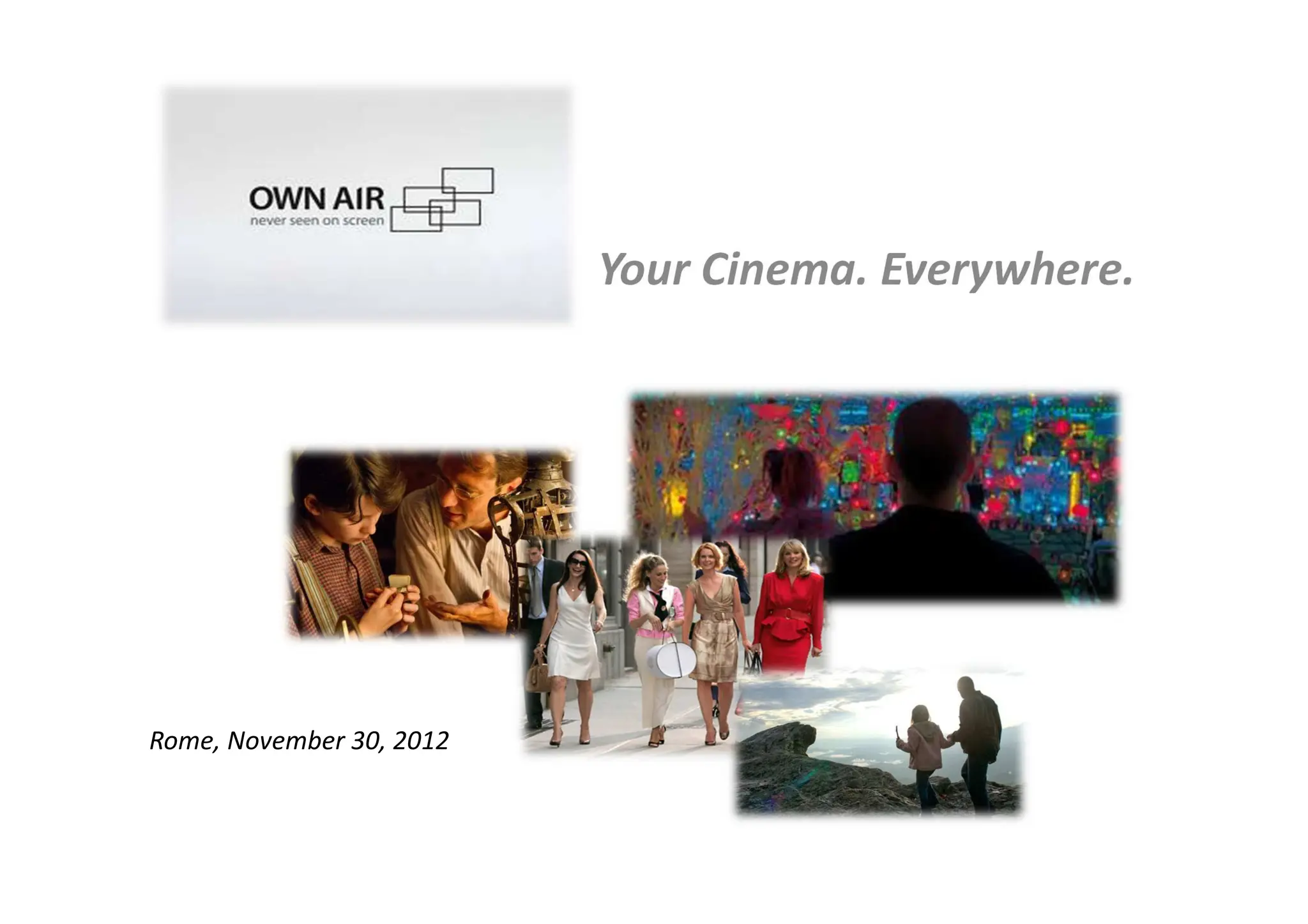
The OwnAir pitch deck, dated November 30, 2012, outlines a plan to capture the Italian digital home entertainment market, which was growing at a 73.6% CAGR at the time. The company positions itself as a comprehensive VOD solution, offering streaming, downloads, and exclusive content across multiple devices. The deck is notable for its detailed financial breakdown, including a specific CAPEX requirement of €684,513 and an equity financing ask of €540,000. While the team possesses relevant industry experience, the deck reveals a significant reliance on external technology providers, listed as a…
Key takeaways
- The Italian audiovisual sector was growing at a 73.6% CAGR in 2012, providing a strong tailwind for the business (Slide 3).
- OwnAir identified a €540,000 equity financing requirement to cover a €511,000 deficit plus a 5% safety margin (Slide 11).
- The company planned to allocate 70.2% of its €684,513 CAPEX specifically to acquiring film distribution rights (Slide 11).
- The team includes a former Senior Marketing Director at Sony Pictures Releasing Italia, providing critical industry connections (Slide 5).
- OwnAir aimed to reach EBITDA positivity and profitability within 24 months of its January 2013 launch (Slide 7).
- A competitive analysis table shows OwnAir attempting to differentiate through 'Exclusive content' and 'Produced content,' features missing from many rivals (Slide 9).
- Operating expenses are heavily weighted toward Selling Expenses (45.4%) and Salaries (45.4%), totaling over €1.9 million over three years (Slide 11).
- The deck explicitly lists 'Difficulty to switch off from an external technology provider' as a core internal weakness (Slide 9).
Introduction and Visual Identity
The OwnAir pitch deck, dated November 30, 2012, opens with a minimalist title slide. The company uses the tagline "Your Cinema. Everywhere." and a logo consisting of overlapping rectangles, suggesting screens or film frames. The imagery on Slide 1 features a collage of stills from various films, including 'Sex and the City' and 'Cinema Paradiso,' signaling a focus on mainstream and classic cinema content. The deck is positioned as an "Investment Pitch" for Own Air srl, an Italian entity based in Rome.
Slide 3: Market Opportunity
This slide establishes the macro-economic justification for the business. It cites that global internet video traffic was expected to reach 55% of all consumer traffic by 2016, growing at a 34% CAGR. More specifically for the founders, spending on digital audiovisual services in Europe reached €1.2bn in 2011. The core hook for investors is the claim that the sector in Italy was growing at a 73.6% CAGR. Two charts from IHS Screen Digest and FutureSource Consulting illustrate the decline of physical media (DVD/BD) and the sharp projected rise of Online VoD and Subscription services through 2016. The data predicts a retail value growth from €2.0 million in 2010 to €54.8 million by 2016 for the Italian market.
Slide 5: The Leadership Team
The "Who we are" slide introduces five key figures. Alfredo Borrelli (Co-Founder and President) and Lorenzo Borrelli (Co-Founder and CEO) both bring experience from Estrogeni srl, with backgrounds in advertising and finance respectively. Giuseppe Principe (Co-Founder and Partner) adds a layer of financial sophistication with an MBA and experience at E&Y and venture capital. Perhaps the most important hire for a content business is Aldo Lemme , an Advisor who spent 10 years as a Senior Marketing Director at Sony Pictures Releasing Italia. Finally, Alessandro Masi serves as Business Development Manager. The team composition suggests a strong lean toward marketing and distribution rather than pure technology.
Slide 7: Go-to-Market & Key Developments
The roadmap is presented as a linear timeline starting in January 2013. The strategy involves a tiered launch: an invite-only launch page, followed by a beta site (OwnAir.it) and a beta app. By the six-month mark, the company aimed for 10,000 registered users and the launch of referral programs. The 12-month goal was 100,000 registered users and the live launch of the full app. Long-term milestones include international expansion beyond Italy and the UK after 24 months, coinciding with becoming EBITDA positive. The terminal goal on this slide is €3M in revenue by 2015.
Slide 9: Competition & SWOT Analysis
OwnAir provides a comprehensive competitive matrix comparing itself against 12 rivals, including local Italian players like Chili-tv.it and CuboVision.it, as well as global giants like iTunes, Netflix, and LoveFilm. OwnAir claims to be the only service offering a full suite of features: streaming, download, multi-device support, iVOD, EST, subscription, free content, live streaming, and exclusive/produced content. The SWOT analysis is remarkably honest, listing "Limited resources" and "Difficulty to switch off from an external technology provider" as weaknesses. The threats section acknowledges the reality of the 2012 landscape: piracy and slow internet connections.
Slide 11: Financial Projections and The Ask
Titled "Money Talks," this slide is the most data-dense in the deck. It features a line graph showing Revenue, EBITDA, and Net Income projections from Q1 2013 to Q4 2015. The text explicitly states that the business requires €511,000 in equity financing, but the founders are asking for €540,000 to include a 5% safety margin. The CAPEX table shows a total of €684,513, with 70.2% (€480,760) allocated to Film Distribution Rights. The OPEX table totals €1,980,235 over three years, with Selling Expenses and Salaries each accounting for 45.4% of the budget. This slide clearly communicates that OwnAir is a content-heavy, marketing-driven play rather than a lean software startup.
What OwnAir Does Well
The deck excels at market localization. By highlighting the specific growth rates of the Italian market (73.6% CAGR), the founders make a compelling case for a regional champion in a space often dominated by US-centric narratives. The financial transparency on Slide 11 is also a strength; many early-stage decks hide their specific CAPEX needs, but OwnAir breaks down exactly how much they will spend on licensing versus hardware.
The inclusion of a Sony Pictures veteran as an advisor is a tactical masterstroke. In the VOD industry, content is the primary moat, and having someone who understands the nuances of Italian film distribution lends significant credibility to their ability to execute on the €480k licensing budget.
What is Missing from the Deck
The most glaring omission is a detailed breakdown of the "Proprietary technology" mentioned in the SWOT analysis. Given that they also list "Difficulty to switch off from an external technology provider" as a weakness, an investor would want to see a slide explaining the architecture of their platform or their strategy for eventually owning the tech stack. There is no mention of the CTO or a lead engineer in the team slide, which is a red flag for a digital distribution platform.
Additionally, while the deck mentions "Exclusive and original content," it does not provide examples of what this content might be or how a startup with a €480k licensing budget plans to compete with the production budgets of Netflix or local broadcasters like Mediaset.
Founder Takeaways: What to Copy
Specific Financial Asks: Don't just ask for a round number. OwnAir's calculation of a €511k need plus a 5% safety margin to reach €540k shows rigorous planning. · Honest SWOT Analysis: Acknowledging that you are reliant on an external tech provider builds trust with investors. It shows you are aware of your risks and are planning for them. · Localized Data: If you are building for a specific geography, use data for that geography. The IHS Screen Digest data for Italy was far more relevant than global VOD trends. · Clear CAPEX Allocation: Showing that 70% of the capital goes to the core product (content rights) proves the founders understand the unit economics of their specific industry.
Frequently asked questions
- What was the primary market opportunity OwnAir identified?
- OwnAir focused on the rapid shift from physical to digital media in Europe. According to Slide 3, spending on digital audiovisual services in Europe rose by 20.1% in 2011 to €1.2bn. Specifically, they targeted the Italian market, which was experiencing a massive 73.6% CAGR, suggesting a late-mover advantage in a region where digital adoption was accelerating.
- How did OwnAir plan to use the invested capital?
- The capital was earmarked for both CAPEX and OPEX. Slide 11 details a €684,513 CAPEX budget, with the vast majority (€480,760) dedicated to Film Distribution Rights. The remaining funds were for brand equity, digital platforms, and hardware. The OPEX budget of nearly €2 million was split almost equally between marketing (selling expenses) and personnel salaries.
- Who were the key members of the OwnAir leadership team?
- The team was led by Co-Founders Alfredo Borrelli (President) and Lorenzo Borrelli (CEO), both of whom had backgrounds at Estrogeni srl. Crucially, the team included Advisor Aldo Lemme, who brought 10 years of experience as a Senior Marketing Director at Sony Pictures Releasing Italia, and Partner Giuseppe Principe, who had a background in venture capital and E&Y (Slide 5).
- What were the projected growth milestones for the company?
- As shown on Slide 7, OwnAir planned a phased rollout starting in January 2013. They targeted 10,000 registered users shortly after launch and 100,000 users by the 12-month mark. Financially, they projected becoming EBITDA positive by month 24 and achieving €3 million in annual revenue by 2015.
- What did OwnAir consider its biggest competitive threats?
- According to the SWOT analysis on Slide 9, the primary threats were piracy, increasing competition from other VOD players, and an 'old fashioned industry.' They also noted technical hurdles, such as slow and unstable internet connections in their target market and a general consumer reluctance to pay for digital content.