OwnBackup’s December 2020 investor deck illustrates a company at the peak of its 'land and expand' strategy. With 17 slides, the presentation focuses heavily on the 'Shared Responsibility Model' of SaaS, effectively scaring and then reassuring enterprise buyers. The deck highlights significant traction, including over 2,980 customers and 350 five-star reviews on the Salesforce AppExchange. By the time this deck was circulated, OwnBackup had already raised $100M, and the narrative shifts from being a Salesforce utility to becoming a 'single pane of glass' for all enterprise SaaS data, includin…
Key takeaways
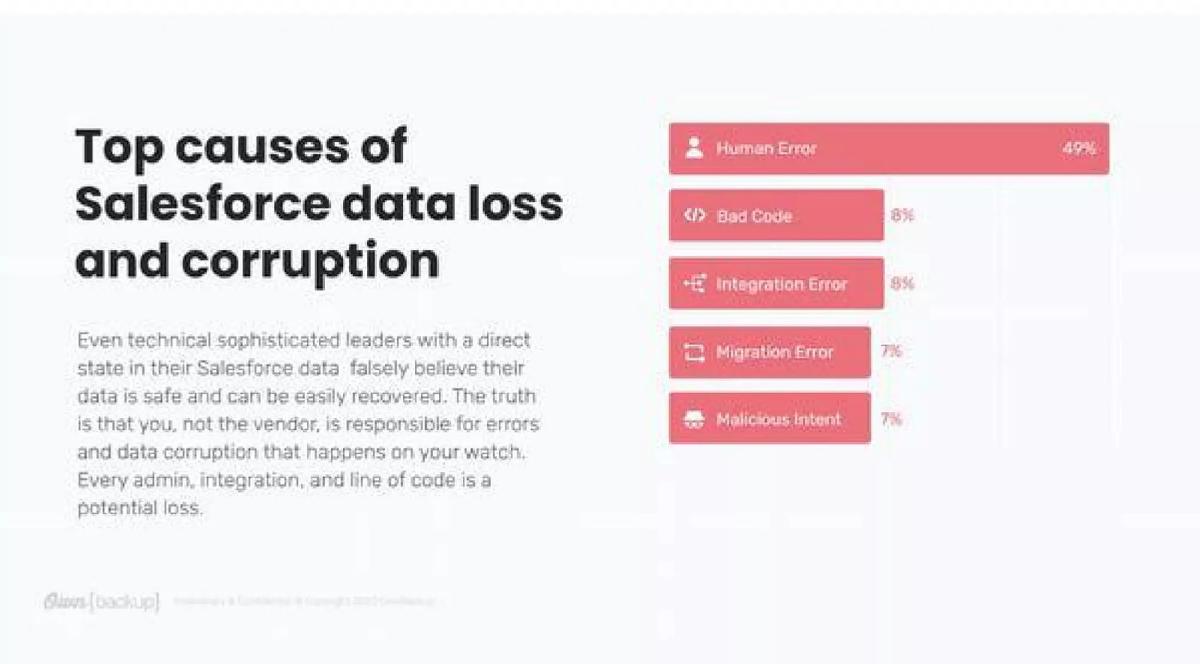
- The deck identifies human error as the primary driver of data loss, accounting for 49% of incidents (Slide 6).
- OwnBackup leverages a direct quote from Salesforce's own documentation to validate the need for third-party backup (Slide 7).
- The company demonstrates massive social proof with 350 five-star reviews, which they claim is 4.5x more than their nearest competitor (Slide 12).
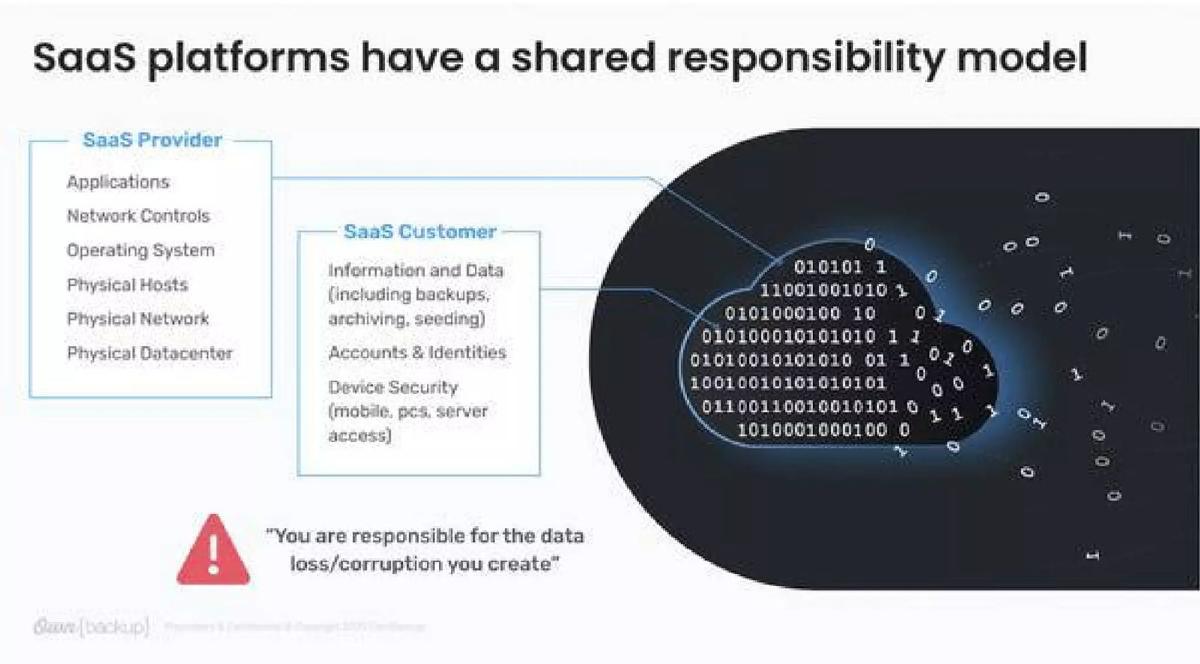
- The 'Shared Responsibility Model' is used as the core educational hook to explain why cloud data isn't automatically safe (Slide 5).
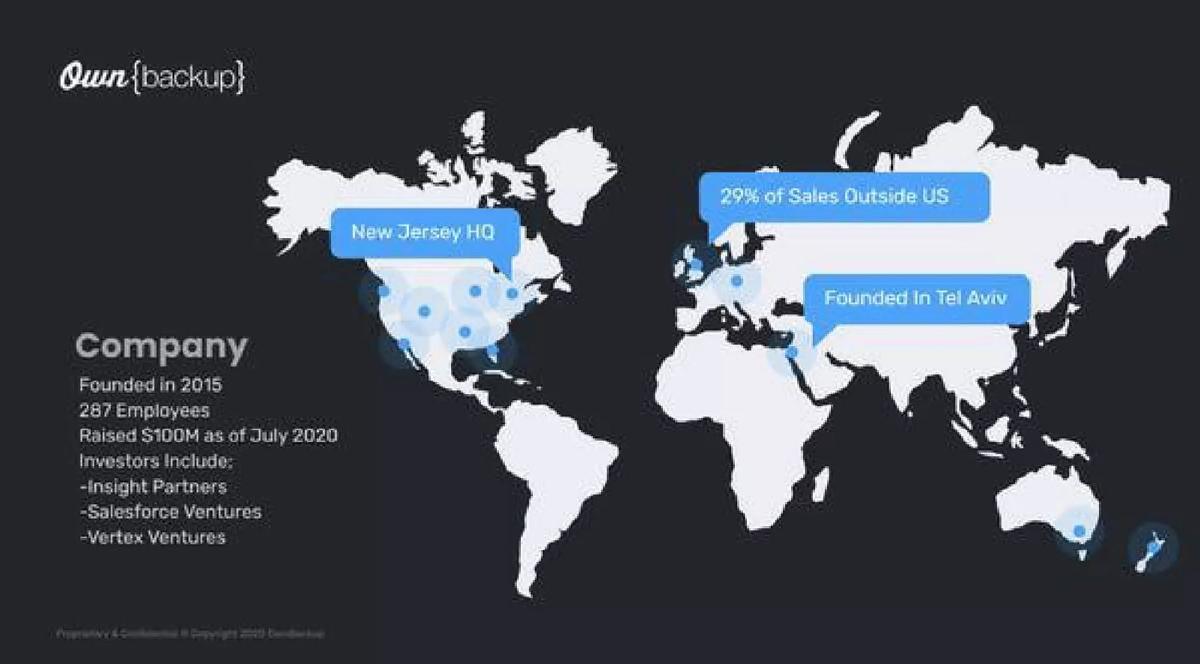
- The deck highlights a global footprint with 29% of sales occurring outside the US and an HQ in New Jersey (Slide 2).
- Future growth is predicated on moving beyond Salesforce into platforms like Slack, ServiceNow, and Microsoft Dynamics (Slide 15).
- The team slide features 11 executive leaders but notably lacks individual bios or previous company logos (Slide 16).
- Customer retention is described as 'industry leading,' though specific churn or NRR percentages are omitted (Slide 13).
The Strategic Context of OwnBackup
The OwnBackup investor deck from December 2020 represents a company that has moved past the 'prove it' stage and into the 'scale it' stage. At the time of this deck, the company was already a dominant force within the Salesforce ecosystem. The narrative is not about whether the technology works, but about how much larger the opportunity is beyond their initial niche. With over $500 million raised to date according to catalogue facts, this deck served as the bridge between being a high-growth startup and a pre-IPO powerhouse.
Slides 1-2: The Foundation and Global Footprint
Slide 1 is a standard title page featuring CEO Sam Gutmann and the date December 2020. The visual language is dark, professional, and tech-focused, showing the OwnBackup cloud interacting with various data icons, including Salesforce and Sage.
Slide 2 provides a 'Company' snapshot. It establishes immediate credibility by stating they were founded in 2015, have 287 employees, and had already raised $100M as of July 2020. The map visualizes their global reach, noting that 29% of sales come from outside the US and highlighting their dual roots in New Jersey and Tel Aviv. Listing heavy-hitting investors like Insight Partners and Salesforce Ventures right at the start signals to new investors that the 'smart money' is already in the cap table.
Slides 3-7: Defining the Problem and the 'Shared Responsibility' Gap
Slide 3 presents the company's core belief: 'No company operating in the cloud should ever lose data.' This is a classic vision statement that sets a high bar for the product's necessity.
Slide 4 introduces the challenge with a punchy headline: 'It’s a Cloud, Not a Fortress.' This begins the process of dismantling the common misconception that SaaS data is automatically backed up by the provider.
Slide 5 is perhaps the most important educational slide in the deck. It explains the SaaS Shared Responsibility Model . It draws a clear line between what the provider handles (Applications, Network, Physical Datacenter) and what the customer is responsible for (Information and Data, Accounts & Identities). The red warning icon with the quote 'You are responsible for the data loss/corruption you create' is a powerful use of 'Fear, Uncertainty, and Doubt' (FUD) to justify the product's existence.
Slide 6 quantifies the risk. It lists the top causes of Salesforce data loss, with Human Error leading at 49%, followed by Bad Code (8%), Integration Error (8%), Migration Error (7%), and Malicious Intent (7%). By showing that nearly half of all data loss is caused by the users themselves, OwnBackup makes its service feel like an essential insurance policy.
Slide 7 provides the ultimate 'social proof' by quoting the Salesforce Trailblazer Community . When the platform you are protecting explicitly recommends using a 'partner backup solution' because their own tools aren't comprehensive enough, the sales cycle for a third-party vendor like OwnBackup becomes significantly shorter.
Slides 8-11: The Product Solution and Governance
Slide 8 transitions into the solution with the tagline 'Run in the Cloud, Never Fall Down.' It uses a 3D isometric stack to show how OwnBackup sits beneath Salesforce to provide Backup, Archiver, and Sandbox Seeding services.
Slide 9 breaks down the core 'Backup' product. It highlights four key features: Automated Backups (no maintenance required), Intelligent Monitoring (anomaly detection), Super Easy Comparisons (visualizing data loss), and Precision Repair (restoring specific records). Notably, it mentions that customers can pick their storage platform, showing logos for AWS and Azure , which appeals to enterprise IT departments with existing cloud preferences.
Slide 10 focuses on 'Streamline governance and compliance.' This moves the value proposition from 'insurance' to 'operations.' By mentioning HIPAA, GDPR, and CCPA , OwnBackup positions itself as a tool for the legal and compliance departments, not just the IT team. Features like 'Rock Solid Archives' and 'Custom Retention Policies' are high-value needs for regulated industries like finance and healthcare.
Slide 11 introduces 'Enhanced Sandbox Seeding.' This is a brilliant 'expand' play. Sandbox seeding allows developers to use real-world data in testing environments safely. By shortening release cycles and securing data during the dev process, OwnBackup moves 'upstream' into the software development lifecycle (SDLC), making their tool useful for developers, not just admins.
Slides 12-14: Traction and Market Dominance
Slide 12 is the 'Traction' slide. It shows a hockey-stick growth curve of customers from 2015 to 2020, ending near the 3,000 mark. It reiterates their status as the #1 platform on the AppExchange and highlights that they have 4.5x more five-star reviews than their next closest competitor. This level of dominance makes it very difficult for an investor to say no to the market leader.
Slide 13 reinforces this with a logo wall of 'Proven customer success.' High-profile names like Zoom, Crocs, Michigan State University, and Adecco show that the product scales from mid-market to massive enterprises. The text claims 'industry leading customer retention metrics,' though it stops short of providing the actual numbers.
Slide 14 uses a pie chart to illustrate 'early market dominance in a huge addressable market.' The chart shows a tiny sliver representing 'Today' and a massive blue area representing the future. It explicitly states that while Salesforce was a great starting point, the vision includes Microsoft, Workday, and ServiceNow.
Slides 15-17: The Future Vision and Team
Slide 15 is the 'Vision' slide. It features a 4x4 grid of logos including Slack, Atlassian, HubSpot, Okta, and Zendesk . The headline 'Salesforce data protection is just the beginning !!!' (notably using three exclamation points) makes the company's ambitions clear. They want to be the 'single pane of glass' for all enterprise SaaS data.
Slide 16 introduces the 'Executive Team.' It features 11 individuals, led by CEO Sam Gutmann and CTO Ariel Berkman. While the slide lacks the 'pedigree logos' (e.g., 'Ex-Google' or 'Ex-Salesforce') often seen in earlier-stage decks, the sheer size of the leadership team—including a General Counsel, CIO, and Chief People Officer—indicates a mature organization ready for public markets.
Slide 17 is a simple 'Thank You' slide, concluding the 17-slide deck.
What Works in the OwnBackup Deck
1. The 'Shared Responsibility' Education: Many founders fail to explain why their product is necessary if a giant like Salesforce already exists. OwnBackup handles this perfectly by using Salesforce's own documentation to prove that Salesforce doesn't want to be responsible for your data errors. This creates an immediate, logical 'need' for the product.
2. Massive Social Proof: The comparison on Slide 12—stating they have 4.5x more reviews than the nearest competitor—is a 'killer' metric. In a crowded SaaS market, being the undisputed community favorite is a powerful moat.
3. Logical Expansion Path: The deck doesn't just say 'we will grow.' It shows how . By moving from simple backups to archiving, then to sandbox seeding, and finally to other SaaS platforms (Slide 15), the company demonstrates a clear path to becoming a multi-billion dollar platform.
What is Missing from the OwnBackup Deck
1. Specific Financials: For a December 2020 deck, the lack of ARR (Annual Recurring Revenue) or NRR (Net Revenue Retention) is surprising. While they mention 'industry leading' retention, sophisticated investors would want to see the actual percentage (e.g., 120%+ NRR).
2. Competitive Landscape: Beyond a vague mention of having more reviews than 'the next closest competitor,' the deck does not name or analyze other players in the space (like Spanning or Druva). A later-stage deck usually benefits from a 'Why We Win' slide that breaks down technical advantages over specific rivals.
3. The 'Ask': There is no slide detailing how much capital is being raised or how it will be allocated. This suggests the deck may have been used for general investor relations or as a teaser before a formal data room was opened.
What a Founder Should Copy
1. Use the 'Ecosystem Play': If you are building a tool for a specific platform (Salesforce, Shopify, AWS), use the platform's own words to validate your existence. Find the gaps in their 'Terms of Service' and build your pitch around those gaps.
2. Visualizing the 'Expand' Strategy: Slide 8 and Slide 15 are excellent examples of how to show a product roadmap visually. Instead of a list of features, they use a 'stack' and a 'logo grid' to show how they will capture more of the customer's budget over time.
3. Quantify Your Dominance: Don't just say you are the best. Find a metric where you are significantly ahead of the competition—whether it's reviews, patents, or integrations—and highlight the 'X-factor' (e.g., '4.5x more than the next competitor').
Final Verdict: This deck is a masterclass in positioning. It takes a seemingly 'boring' utility—data backup—and turns it into a high-stakes, multi-platform enterprise necessity. By focusing on the human error of the user rather than the technical failure of the cloud, OwnBackup created a market that didn't exist a decade prior.
Frequently asked questions
- What is the core problem OwnBackup solves according to the deck?
- The deck argues that while SaaS providers manage the infrastructure, the customer is responsible for the data itself. Slide 5 explicitly states, 'You are responsible for the data loss/corruption you create.' It highlights that 49% of data loss is caused by human error, creating a massive security gap that Salesforce's native tools do not fully address.
- How does OwnBackup demonstrate market leadership?
- They use a combination of quantitative and qualitative metrics on Slide 12. They show a steep growth curve reaching nearly 3,000 customers by 2020 and highlight their status as the #1 rated solution on the AppExchange with 350 five-star reviews. They also emphasize their relationship with Salesforce Ventures as a key investor.
- What is the 'Single Pane of Glass' strategy mentioned in the deck?
- On Slide 15, OwnBackup reveals its long-term vision: to move beyond Salesforce and become the centralized data protection layer for all enterprise SaaS. The slide lists logos for Atlassian, Google Workspace, HubSpot, Slack, and Workday, indicating that their technology is built to be platform-agnostic in the future.
- Does the deck include financial projections or a specific 'Ask'?
- No. This version of the deck omits detailed financial spreadsheets, revenue figures (ARR/MRR), and a specific funding ask. As a later-stage deck from December 2020, it focuses more on market positioning, vision, and proof of dominance rather than early-stage unit economics.
- Who are the key investors mentioned in the presentation?
- Slide 2 lists Insight Partners, Salesforce Ventures, and Vertex Ventures as existing investors. The deck notes that as of July 2020, the company had already raised $100M, positioning this specific deck for a subsequent, much larger growth round.