Building on Salesforce or Shopify on a Pitch Deck: Show
If you sell through another company's app marketplace, investors want proof the platform brings customers and a plan if it changes the rules.
Building on Salesforce or Shopify on a Pitch Deck: Show Your Rank, Your Share of the Platform, and Your Way Out
Many software startups sell through a bigger company's platform: an app on the Shopify App Store, a product listed on the Salesforce AppExchange, an integration in Microsoft's or Atlassian's marketplace. The platform brings ready buyers and trust, which makes early sales cheaper. It also gives one outside company power over your product, your listing and sometimes your price. Investors therefore ask two questions together: is the platform really bringing you customers, and what happens if it builds your feature itself or changes its rules? This guide looks at three companies that put a platform at the centre of their pitch, OwnBackup, Youreka and Vajro, and at how well each slide answers both questions.
TL;DR
Show three things. First, your standing inside the platform, with a source: rank in the marketplace, partner tier, or a programme you were picked for. Youreka lists 'Top 2% of all ISV partners on the Salesforce AppExchange'; Vajro says '#1 Mobile App Builder in Shopify'. Second, how much of the platform's customer base you have reached and how much is left; OwnBackup draws this as a pie chart of the Salesforce ecosystem with a thin 'Today' slice. Third, your plan if the platform becomes a limit, such as other platforms with the same problem. OwnBackup names 'Microsoft, Workday, ServiceNow'. Add revenue or customer numbers wherever you can; a rank alone doesn't show income.
Three slides that present a platform channel
Each slide is read at full size. Quotes are exact.
OwnBackup go to market slide — slide 14
Backup and data protection for cloud software, starting with Salesforce. Market slide (2020 copyright).
OwnBackup deck, slide 14. Exact stored slide matched to this analysis.
Our analysis: The only slide in the set that addresses dependence and a path beyond the platform.
Evidence and limitation: Room inside the platform drawn; other platforms named; no numbers on the chart; 'dominance' not measured.
What a founder can adapt: Label the pie's size and your share, and date the first new platform.
Supporting analysis
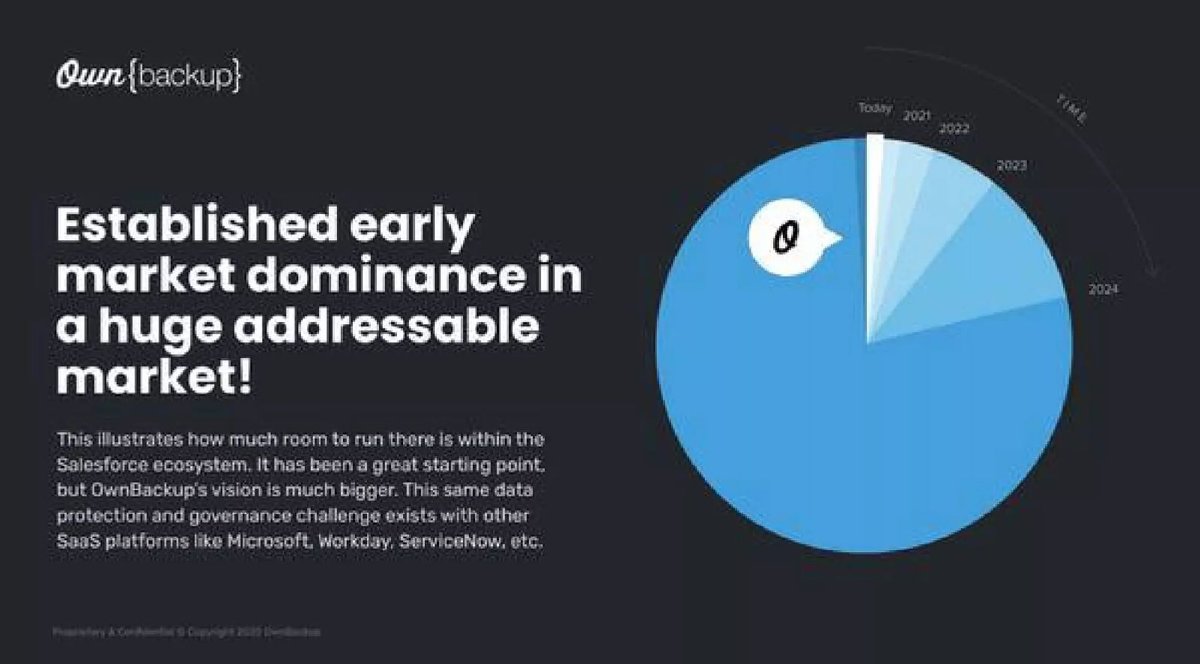
What the deck claims: "Established early market dominance in a huge addressable market!"; "how much room to run there is within the Salesforce ecosystem"; "other SaaS platforms like Microsoft, Workday, ServiceNow"; pie chart with a thin 'Today' slice and slices for 2021 to 2024.
Presentation choice: Shows how to size growth inside the platform and name where else the product can go.
When it does not fit: An unlabelled pie and an unmeasured 'dominance' claim.
Mobile forms app for field workers built on Salesforce. Ecosystem slide (undated).
Youreka deck, slide 11. Exact stored slide matched to this analysis.
Our analysis: Strong standing with one real business result, all inside one platform.
Evidence and limitation: Rank, partner role and revenue growth given; ranking measure, revenue base and platform risk not stated.
What a founder can adapt: Source the ranking and give the revenue base.
Supporting analysis
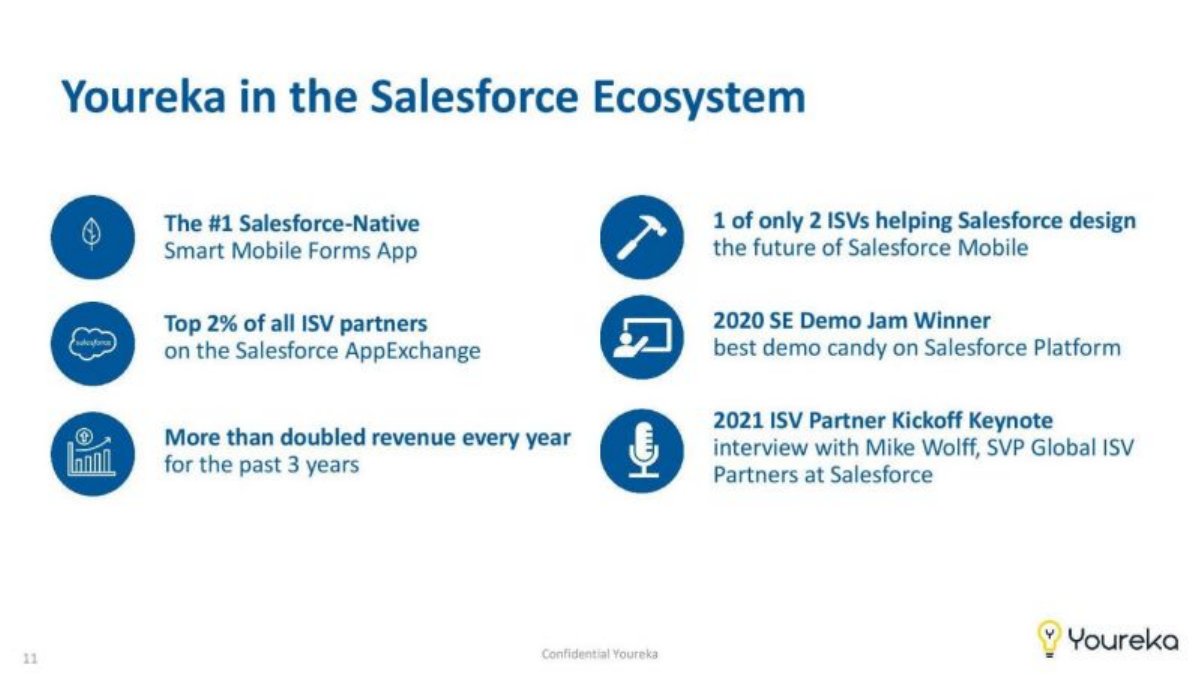
What the deck claims: "Top 2% of all ISV partners on the Salesforce AppExchange"; "More than doubled revenue every year for the past 3 years"; "1 of only 2 ISVs helping Salesforce design the future of Salesforce Mobile"; demo award and keynote interview.
Presentation choice: Shows how a close partner role and a revenue result support a platform claim.
When it does not fit: A slide where every item depends on the same platform with no word on risk.
No-code mobile app builder for Shopify shops. Introduction slide (undated).
Vajro deck, slide 3. Exact stored slide matched to this analysis.
Our analysis: Clear about channel and price, thin on proof.
Evidence and limitation: Platform, rank and prices on one slide; no source for rank, no customer count or revenue, no platform risk.
What a founder can adapt: Add paying merchants and the share of sales from the Shopify App Store.
Supporting analysis
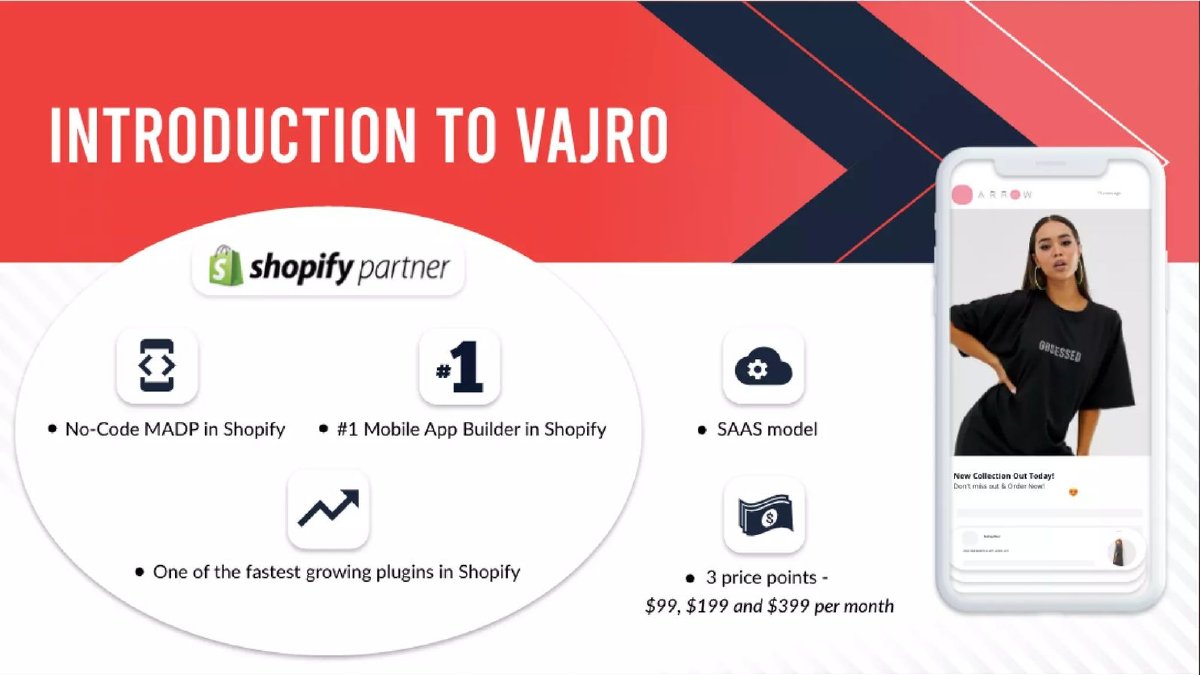
What the deck claims: 'shopify partner'; "#1 Mobile App Builder in Shopify"; "One of the fastest growing plugins in Shopify"; "3 price points - $99, $199 and $399 per month".
Presentation choice: Shows how prices beside the platform let a reader estimate the customers needed.
When it does not fit: '#1' and 'fastest growing' without a measure.
Standing, business result, room in platform, risk and path beyond.
Example
Standing shown
Business result
Room in platform
Platform risk addressed
Path beyond platform
OwnBackup
'Dominance' (unmeasured)
No
Pie chart, no numbers
Indirectly
Microsoft, Workday, ServiceNow named
Youreka
Top 2% of ISV partners; partner roles
Revenue doubled yearly for 3 years
No
No
No
Vajro
Partner badge; '#1' (no source)
Prices only
No
No
No
Key Takeaways
Name the platform and say how customers find you through it.
Give your rank or partner tier, with where it comes from.
Show the share of the platform's customers you have reached.
Back the claim with revenue or customer counts, not only badges.
Name the platform risk and say what reduces it.
Say whether you can grow beyond the platform, and how.
Prepare your platform-channel slide
Answer these before writing the slide.
Path. How do customers find you through the platform?
Share. What share of your customers or revenue comes through it?
Standing. What is your rank or tier, by what measure, from what source?
Room. How many of the platform's customers could buy, and how many do?
Risk. What could the platform change, and what limits the damage?
Beyond. Which other platform or channel comes next, and when?
Copyable framework: "[x]% of customers via [platform]; [rank] by [measure]; [m] of [n] possible customers; next: [platform 2] in [period]."
Illustrative example 1 — written by us
Before: "#1 Mobile App Builder in Shopify"
After: "#1 mobile app builder on the Shopify App Store by [measure], [month year]; [n] paying merchants."
What improved: Our illustrative rewrite of Vajro's line. Bracketed details are not stated on the slide.
The question this guide answers
This guide answers one founder question: our product is built on and sold through another company's platform, such as Salesforce or Shopify. How do I present that so investors see a strong channel rather than a dangerous dependence?
Our partnerships guide covers presenting partners in general, and our channel partners draft covers resellers and distributors who sell your product for you. Our competition guide mentions platforms as possible competitors. None of them answers how to present an app-marketplace business: which proof of standing to show, how to size the opportunity inside the platform, and how to address the risk that the platform changes its rules or copies you. That is this guide's subject.
How we chose and read the examples
We searched extracted text across the library for AppExchange, Shopify App Store, ISV partner, app marketplace and related phrases, and kept slides where a private company presented a platform as central to its sales. We set aside Shopify's own investor decks, which come from a listed company and describe the platform from the owner's side. We set aside Evervault's competitive advantage slide, which names partnerships with Intel and Microsoft but describes support and co-selling rather than selling through a marketplace.
We kept three slides with distinct approaches: OwnBackup's market slide (room left inside Salesforce's customer base, plus other platforms), Youreka's 'Youreka in the Salesforce Ecosystem' slide (rank, partner standing and growth) and Vajro's introduction slide (Shopify partner status, rank and prices). OwnBackup's slide carries a 2020 copyright line; the other two show no date. Each was rendered from the source deck and read at full size. Any calculations are ours. We did not check any claim against outside sources.
Why investors probe platform businesses
The channel can be excellent. A marketplace puts your product in front of buyers who already use the platform and trust its listings. Installation is often a click, billing may run through the platform, and the platform's own sales team sometimes recommends partners. That can make customer acquisition much cheaper than selling alone.
The ceiling is set by the platform. You can only sell to the platform's customers, so the market is the share of them with your problem, not the whole industry. Investors want that number sized honestly.
The rules can change. A platform can change its fees, its review process, its ranking or its programme terms. It can also build a similar feature and offer it free. Investors don't expect you to remove that risk, but they expect you to name it and show something that limits it: deep integration, a different customer, a lead the platform would find hard to copy, or a path to other platforms.
Badges are cheap. Partner tiers and 'top' rankings can depend on criteria the reader doesn't know. Without revenue or customer counts beside them, they show standing, not a business.
Room inside the platform, and a way beyond it: OwnBackup
OwnBackup, a company that backs up data held in cloud software, has a slide headed 'Established early market dominance in a huge addressable market!'. The text reads: 'This illustrates how much room to run there is within the Salesforce ecosystem. It has been a great starting point, but OwnBackup's vision is much bigger. This same data protection and governance challenge exists with other SaaS platforms like Microsoft, Workday, ServiceNow, etc.' On the right, a large pie chart has a thin white slice marked 'Today' with OwnBackup's logo beside it, followed by wider slices labelled 2021, 2022, 2023 and 2024, and an arrow marked 'TIME'.
This is the only slide in the set that faces dependence directly. It treats Salesforce as 'a great starting point', which tells the reader that the platform was the first channel, and then names three other platforms where the same problem exists. That answers the investor's worry about a ceiling: if Salesforce's customer base runs out or the relationship sours, the product has somewhere else to go. The pie chart also makes the point that most Salesforce customers are not yet customers, so growth inside the first platform is not finished.
The chart has no numbers. A reader can't tell what the whole pie represents (all Salesforce customers, or only those who might buy backup), what share 'Today' is, or whether the future slices are plans or forecasts. The headline claims 'market dominance', but nothing on the slide measures OwnBackup against rivals. And the expansion to Microsoft, Workday and ServiceNow is stated as a vision, with no product, customer or timing for any of them. Adding the size of the pie, OwnBackup's current customer count within it and the first new platform with a date would turn the picture into evidence.
Standing and growth inside one platform: Youreka
Youreka, a mobile forms app for field workers built on Salesforce, has a slide headed 'Youreka in the Salesforce Ecosystem'. Six items are arranged in two columns: 'The #1 Salesforce-Native Smart Mobile Forms App', 'Top 2% of all ISV partners on the Salesforce AppExchange', 'More than doubled revenue every year for the past 3 years', '1 of only 2 ISVs helping Salesforce design the future of Salesforce Mobile', '2020 SE Demo Jam Winner best demo candy on Salesforce Platform' and '2021 ISV Partner Kickoff Keynote interview with Mike Wolff, SVP Global ISV Partners at Salesforce'. (ISV means independent software vendor: a company that builds products on another company's platform.)
The slide shows standing inside the platform in several ways. 'Top 2% of all ISV partners' is a ranking against every company selling on AppExchange. Helping design 'the future of Salesforce Mobile' and appearing at a Salesforce partner keynote suggest the platform sees Youreka as a partner rather than a target. That matters for the copying risk: a platform is less likely to replace a partner it is working with on its own roadmap, though it is never impossible. Crucially, one item is a business result, revenue more than doubling each year for three years, which stops the slide being only a list of badges.
The sources and bases are missing. 'Top 2%' doesn't say by what measure (revenue, installs, reviews) or who ranked it. '#1 Salesforce-Native Smart Mobile Forms App' is a narrow category, and the slide doesn't say who decided the ranking. The revenue growth has no starting figure, so doubling could be from a small or large base. And the slide shows no plan if Salesforce changes direction; every item depends on the same platform. A founder copying this slide should keep the business result and add the ranking's source and one line on the platform risk.
Partner badge, rank and price: Vajro
Vajro, a no-code mobile app builder for online shops, has a slide headed 'INTRODUCTION TO VAJRO'. On the left, inside a circle under a 'shopify partner' badge: 'No-Code MADP in Shopify', '#1 Mobile App Builder in Shopify' and 'One of the fastest growing plugins in Shopify'. On the right: 'SAAS model' and '3 price points - $99, $199 and $399 per month'. A phone shows an example shop app.
The useful part is the combination of platform and price on one slide. A reader learns where customers come from (Shopify merchants), how Vajro ranks there, and what each customer pays. Price points matter for a platform business because they set how many of the platform's customers you need: at $99 to $399 a month, the number of merchants required to reach meaningful revenue is easy to estimate.
Like Youreka, the claims lack sources. '#1 Mobile App Builder in Shopify' and 'One of the fastest growing plugins' don't say by what measure, over what period or according to whom. The 'shopify partner' badge is available to many developers, so on its own it says little. There's no customer count, no revenue and no mention of the risk that Shopify could offer its own app builder. An investor would want at least the number of paying merchants and the share of Vajro's sales that come through the Shopify App Store.
What to put on a platform-channel slide
The platform and the path. Name the platform and say how customers find you: marketplace search, the platform's sales team, partner referrals, or your own sales.
Standing, with a source. Rank, partner tier or programme membership, and what each is based on: 'ranked #3 by installs in [category], [month]'.
Business results. Paying customers, revenue, or growth, with a base. A badge without a number reads as decoration.
Room in the platform. The number of the platform's customers who could buy, and how many you have.
Platform risk. One honest line on what could change (fees, rules, a competing feature) and what limits the damage.
Beyond the platform. If you plan to reach other platforms or sell directly, name the first one and when.
Common traps
Rank without a source. '#1' or 'top 2%' that doesn't say by what measure or who ranked it.
Badges in place of revenue. Partner logos and awards with no customer or income figure.
The whole industry as the market. Sizing the market as every company in the sector when you can only reach the platform's customers.
Silence on the risk. Investors will raise platform dependence anyway; not mentioning it suggests you haven't thought about it.
Expansion as a fact. Other platforms listed as if supported when they are only a plan.
Where this belongs in the deck
Put the platform channel on the go-to-market slide, with your standing and the path customers take. Put the room-in-platform figure on the market slide, as OwnBackup does. Put the platform risk either on the competition slide (if the main worry is the platform copying you) or in a risks section, and keep the answer short. Business results belong on the traction slide, with a reference to the platform share of them.
A template you can adapt
Channel: '[x]% of new customers come through [platform]'s marketplace; [y] paying customers.'
Standing: '[Rank / tier] in [category] by [measure], [source, date].'
Room: '[n] [platform] customers have [problem]; we serve [m].'
Risk: 'If [platform] [changes / builds X], we [reason it limits damage].'
Next: '[Second platform] in [period].'
What these examples can and cannot show
These three slides show how founders presented a business built on another company's platform. They can't show whether the rankings were accurate, whether the platforms stayed supportive, or whether OwnBackup's expansion to other platforms happened. We did not check any claim against outside sources.
Treat them as patterns. OwnBackup sizes the room inside the platform and names a way beyond it, but with no numbers. Youreka shows standing and one real business result, but no sources and no answer to the risk. Vajro pairs the platform with prices, but backs its rank with nothing.
Common mistakes
Unsourced rank. '#1' or 'top 2%' without a measure or source.
Badges only. Partner logos and awards with no customer or revenue figure.
Industry as market. Sizing beyond the customers the platform can reach.
Risk unmentioned. No word on fees, rules or the platform building the feature.
Expansion as fact. Other platforms listed as supported when only planned.
Diagnostic checklist
Platform and customer path named.
Rank or tier with source.
Customers or revenue shown.
Room in platform sized.
Platform risk and next channel stated.
Frequently asked questions
Will investors avoid a company that depends on one platform?
Not necessarily; many large software companies started on one platform. They want to see that the platform brings customers efficiently and that you understand the risk.
Should I show the platform's logo?
Yes, if you are an official partner, but pair it with a measured result. A logo alone suggests a relationship without showing what it delivers.
How we chose these examples
Corpus: published pitch deck teardowns on StartupFundraising.com. Founder-uploaded private decks are excluded.
Selection (2026-10-01): we searched extracted text for AppExchange, Shopify App Store, ISV partner and app marketplace phrases; set aside Shopify's own investor decks (listed company) and Evervault's partnership slide (co-selling, not a marketplace); kept three private-company slides with distinct approaches.
Review: the three slides were rendered from the source decks on 2026-10-01 and read in full at full size against company, deck and page number (editorial model review, with AI assistance in drafting; not human-reviewed). No claim was checked against outside sources.