Youreka’s 15-slide Series A deck from 2021 presents a compelling case for a verticalized SaaS solution built entirely within the Salesforce ecosystem. The company addresses the 'Skills Gap'—the loss of institutional knowledge as 10,000 baby boomers retire daily—by providing AI-powered mobile assistants for field technicians. With a reported 300% year-over-year ARR growth and a roster of enterprise clients like Shell, P&G, and Volvo, the deck focuses heavily on traction and strategic alignment with Salesforce. While it lacks a specific 'Ask' slide and detailed financial projections, the streng…
Key takeaways
- The company reported 300% year-over-year ARR growth at the time of the Q1-2021 presentation (Slide 2).
- Youreka positions itself as a solution to the 'Skills Gap,' noting that 10,000 experienced workers retire every day (Slide 3).
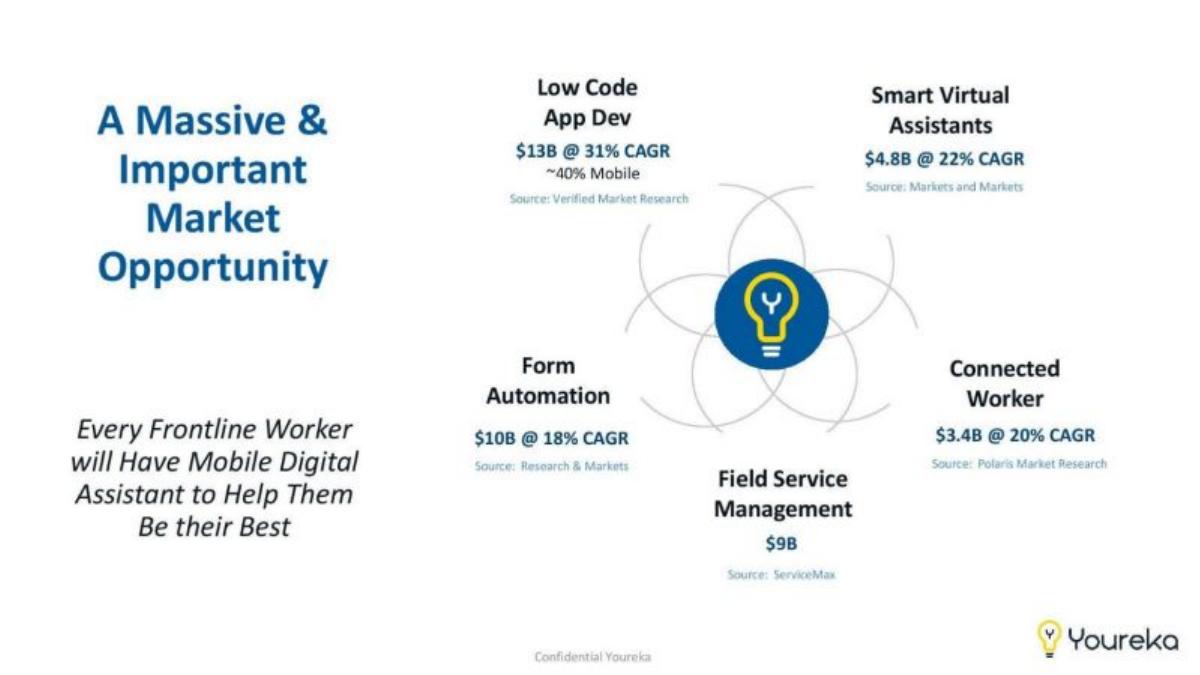
- The total addressable market is framed as a convergence of five sectors, including a $13B Low Code App Dev market and a $10B Form Automation market (Slide 4).
- The product is 100% Salesforce-native, filling gaps in the Salesforce Field Service platform specifically in execution and amplification (Slide 8).
- The deck lists high-profile enterprise clients including Shell, Volvo, P&G, and Duke Health (Slide 9).
- Youreka claims to be in the top 2% of all ISV partners on the Salesforce AppExchange (Slide 11).
- The competitive matrix highlights '100% Salesforce Native' and 'Offline' capabilities as primary differentiators (Slide 12).
- The leadership team features executives with exits to Vista Equity ($550M) and experience at IBM Cloud and Microsoft (Slide 13).
The Opportunity Overview
Slide 1: Title Slide
The deck opens with a clean, blue-branded title slide. It identifies Youreka as a "Digital Assistant for Frontline Workers." The subtitle explicitly states this is an "Opportunity Overview (Series A)" for "Q1-2021." The branding is consistent with the lightbulb logo that persists throughout the deck.
Slide 2: Executive Summary
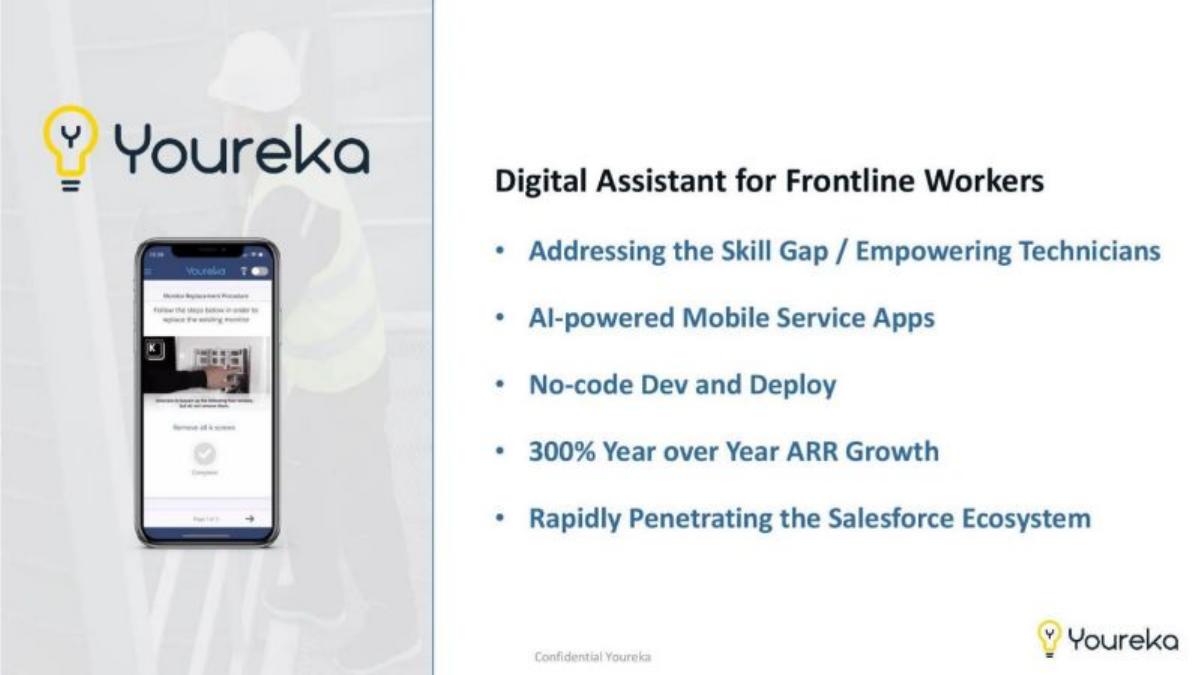
This slide functions as a high-level summary of the investment thesis. It lists five key bullet points: Addressing the Skill Gap, AI-powered Mobile Service Apps, No-code Dev and Deploy, 300% Year over Year ARR Growth, and Rapidly Penetrating the Salesforce Ecosystem. A mobile mockup on the left shows a "Monitor Replacement Procedure" interface, grounding the abstract claims in a concrete product use case.
Slide 3: The Problem - The Skills Gap
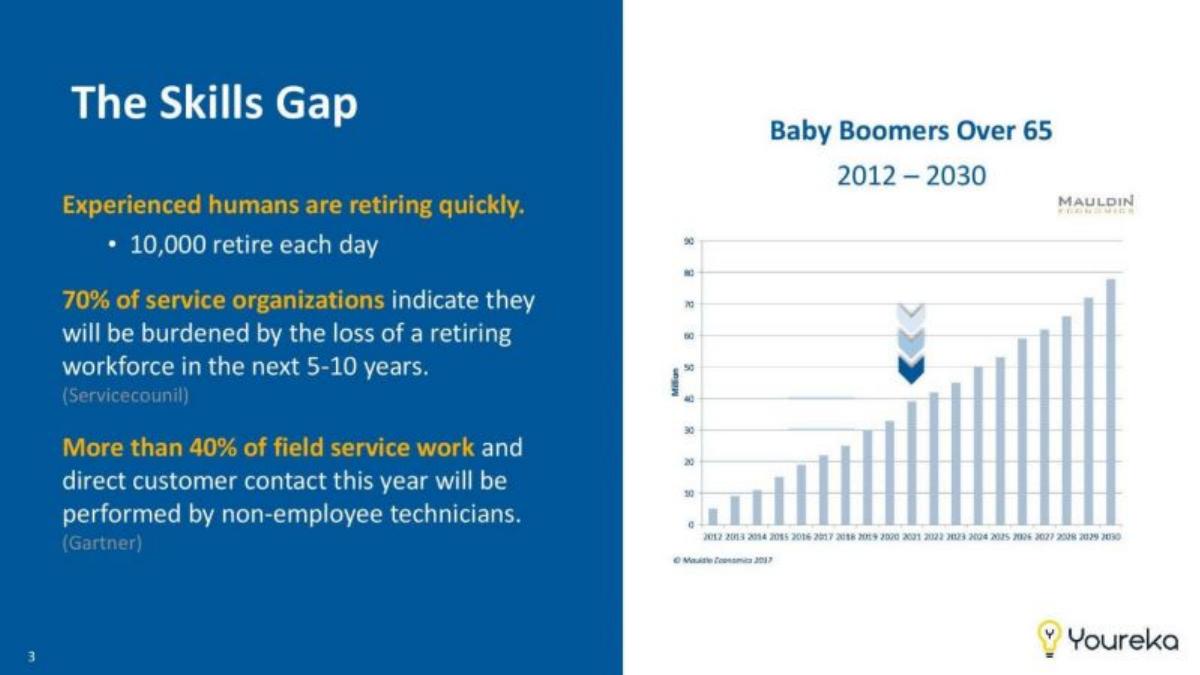
Youreka identifies a macro-economic trend as its primary tailwind. The slide states that "10,000 retire each day" and cites a ServiceCouncil report that 70% of service organizations will be burdened by the loss of a retiring workforce in the next 5-10 years. A chart from Mauldin Economics shows the projected growth of the US population over 65 through 2030, emphasizing the urgency of capturing institutional knowledge digitally.
Slide 4: Market Opportunity
The market is presented as a convergence of five distinct categories. Youreka provides figures and CAGRs for each: Low Code App Dev ($13B @ 31% CAGR), Smart Virtual Assistants ($4.8B @ 22% CAGR), Connected Worker ($3.4B @ 20% CAGR), Field Service Management ($9B), and Form Automation ($10B @ 18% CAGR). The central message is that every frontline worker will eventually require a mobile digital assistant.
Slide 5: Product Evolution - The Stepwise Journey
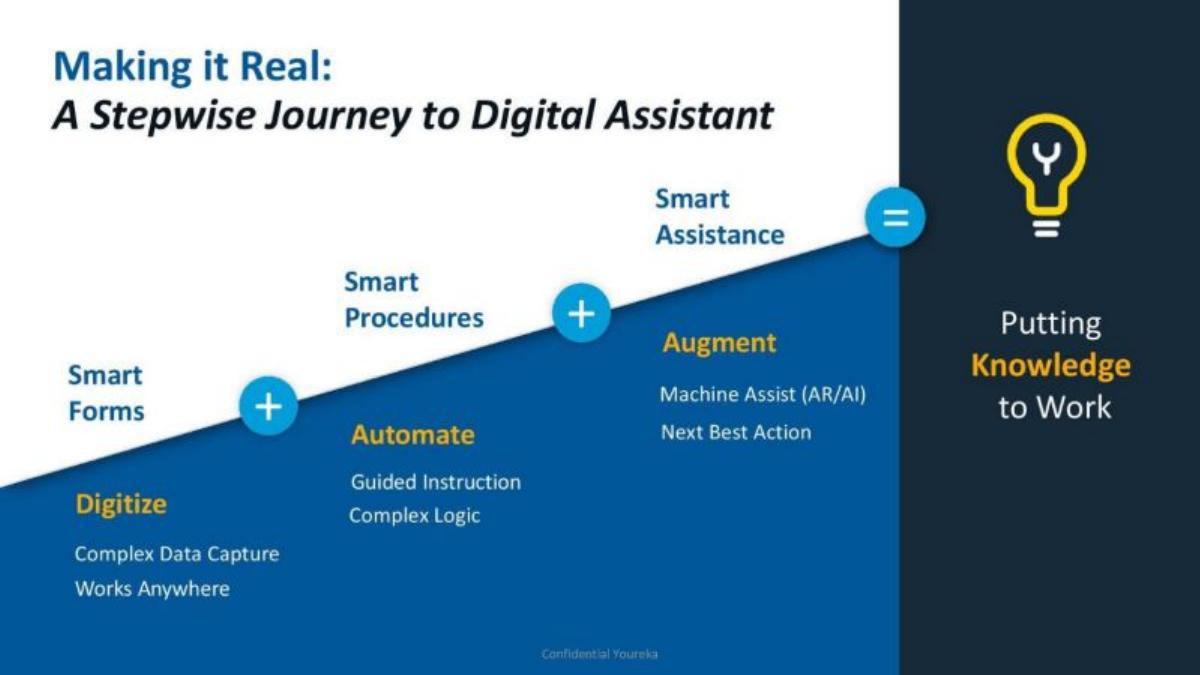
This slide explains the product's functional depth. It illustrates a progression from "Smart Forms" (Digitize) to "Smart Procedures" (Automate) and finally to "Smart Assistance" (Augment). The end goal is defined as "Putting Knowledge to Work." This helps investors understand that Youreka is more than just a digital checklist; it is a logic engine for complex field tasks.
Slide 6: No-code Development at Scale
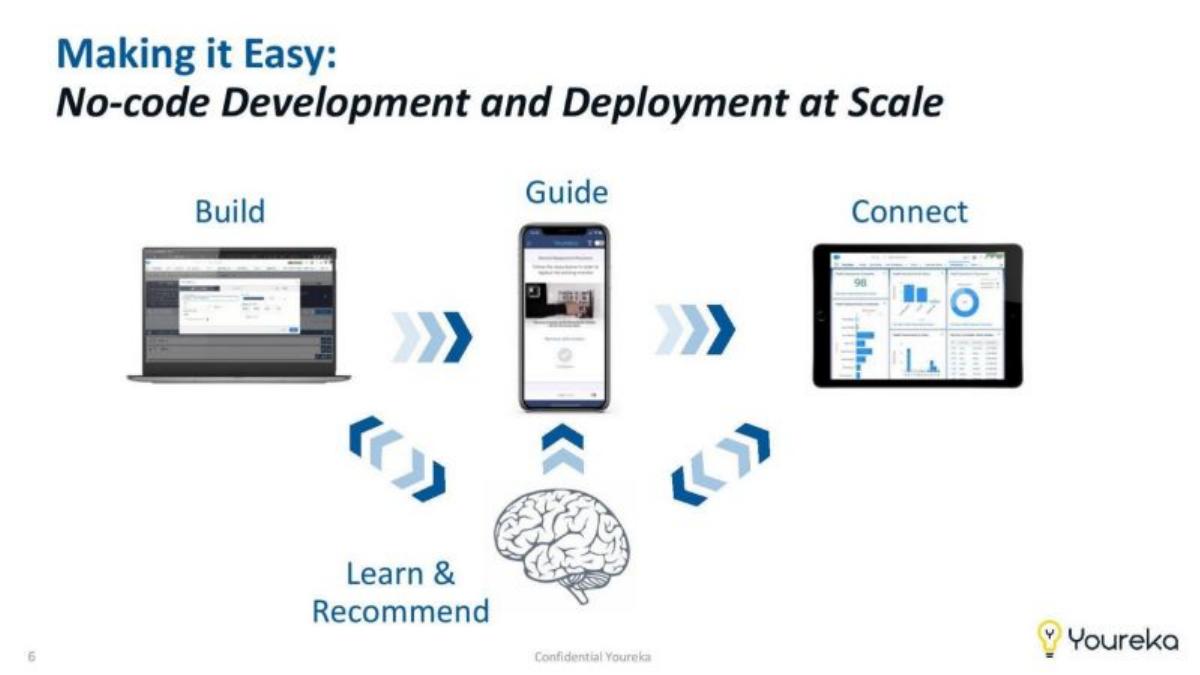
The technical value proposition is centered on ease of use. The slide shows a four-part cycle: Build (on a laptop), Guide (on a mobile device), Connect (to Salesforce dashboards), and Learn & Recommend (represented by a brain icon). This emphasizes the "No-code" aspect mentioned in the summary, suggesting that business users, not just developers, can deploy these tools.
Slide 7: Industry Verticals
Youreka showcases its versatility across five sectors: Health & Life Sciences, Utilities, Oil & Gas, Public Sector, and Manufacturing. Below the industry headers, it lists common use cases that apply across the board, such as Health, Safety & Environment Checklists, Guided Maintenance, Equipment Inspections, and Quotes/Estimates.
Slide 8: Salesforce Ecosystem Integration
This is a critical slide for a native application. It shows how Youreka complements Salesforce Field Service. While Salesforce handles "Dispatch & Enable" (scheduling, assets, contracts), Youreka handles "Execute & Amplify" (guided procedures, dynamic forms, AI/AR). It explicitly states the product is "100% on Platform" and works "On/Off-line."
Slide 9: Enterprise Traction
The "Logo Slide" is impressive for a Series A. It lists major entities including Duke Health, IQVIA, Dominion Energy, Shell, TSA, Volvo, and P&G. The inclusion of the "Oil & Gas Supermajor" and "Major Public Utility" as placeholders suggests ongoing or highly sensitive contracts with other massive entities.
Slide 10: Use Cases & Economics
This slide provides qualitative and quantitative depth to the traction. It highlights four specific examples: a Health Insurance company using 800 nurses for 1800-point assessments; P&G upskilling 900 junior resources; a Major Public Utility deploying to 150 workers for safety inspections; and the UK Government/IQVIA deploying a COVID program to 7,000 health workers in 6 weeks. Note: The specific ARR figures for these accounts are redacted in the provided slide image.
Slide 11: Salesforce Partnership Status
To reinforce their market position, Youreka lists their accolades within the Salesforce world. They claim to be the "#1 Salesforce-Native Smart Mobile Forms App" and in the "Top 2% of all ISV partners." They also mention being a 2020 SE Demo Jam Winner and featured in the 2021 ISV Partner Kickoff Keynote.
Slide 12: Competitive Landscape
The competitive matrix compares Youreka against five categories: Low Code Mobile App Dev Players, Other Dynamic Forms Players, Mobile AR/AI Point Solutions, Mobile App Wrappers, and Custom Mobile App Builds. Youreka claims a full set of features (100% Salesforce Native, Offline, No Code, AI/AR, etc.) while showing competitors as having only partial or no coverage in those areas.
Slide 13: The Team
The team slide highlights significant enterprise software experience. CEO Bill Karpovich is credited with driving a $550M sale of Sonatype to Vista Equity. Other team members have backgrounds at IBM Cloud, Microsoft, DocuSign, and Accenture. Founder Dan Bergner is noted for having 12 years of product development experience specifically on the Salesforce platform.
Slide 14: Closing Slide
A simple "Thank you" slide with the company logo and the lightbulb motif. No contact information or call to action is visible on this specific slide.
Slide 15: BestPitchDeck.com Promotion
This is a non-company slide provided by the catalogue source and does not contain Youreka-specific information.
What Works in the Youreka Deck
Ecosystem Alignment: The deck does an excellent job of proving that Youreka isn't just a tool, but a necessary extension of a massive platform (Salesforce). By showing exactly where they fit in the Salesforce Field Service stack (Slide 8), they mitigate the risk of being Sherlocked by the platform owner while highlighting a clear path to market.
Macro-Problem Framing: Starting with the "Skills Gap" (Slide 3) gives the product a sense of inevitability. It moves the conversation from "we have a cool app" to "the world is losing its experts and needs a way to replace their brains with software."
High-Velocity Traction: Citing 300% ARR growth and a 6-week deployment for 7,000 users (Slide 10) provides the "proof of work" required for a Series A. The logos are not just startups; they are global conglomerates, which suggests the product can handle enterprise-grade security and scale.
What is Missing from the Youreka Deck
The Ask: There is no slide detailing how much capital is being raised in this specific round, the valuation target, or the planned use of funds. While the catalogue facts state $8M was raised, a standard pitch deck usually includes a slide outlining how that capital will be allocated (e.g., 50% Sales/Marketing, 30% R&D).
Financial Projections: While the deck mentions past growth (300% ARR), it lacks a forward-looking chart showing projected revenue, burn rate, or profitability milestones over the next 18-24 months.
Unit Economics: There is no mention of Customer Acquisition Cost (CAC), Lifetime Value (LTV), or churn rates. For a Series A SaaS company, these metrics are usually expected to prove the efficiency of the sales engine.
What a Founder Should Copy
The Stepwise Journey (Slide 5): Founders building complex products should copy this visualization. It explains how a customer starts with a simple use case (Digitize) and grows into more advanced features (Augment). This is a great way to show both a low barrier to entry and a high ceiling for expansion revenue.
The Complementary Stack Diagram (Slide 8): If you are building in an ecosystem (AWS, Shopify, Salesforce), show exactly where you sit in relation to the parent platform. This slide likely answered the "Why wouldn't Salesforce just build this?" question before it was even asked.
The Use Case Deep Dive (Slide 10): Instead of just listing logos, Youreka explains the specific problem, the user count, and the speed of deployment for their best customers. This makes the traction feel much more tangible to an investor.
Frequently asked questions
- How much did Youreka raise with this deck?
- According to the catalogue facts, Youreka raised $8M in a Series A round in 2021. The deck itself is labeled as an 'Opportunity Overview (Series A) Q1-2021' on the cover slide.
- What is Youreka's core value proposition?
- Youreka acts as a 'Digital Assistant for Frontline Workers.' It uses no-code, AI-powered mobile apps to help field technicians perform complex tasks, effectively bridging the skills gap created by a retiring workforce. As shown on slide 5, it moves users from simple digitization (Smart Forms) to augmentation (Smart Assistance).
- What is the significance of being 'Salesforce Native' in this deck?
- It is the central pillar of their go-to-market strategy. Slide 8 and 11 emphasize that being 100% native allows them to integrate seamlessly with Salesforce Field Service. This reduces friction for existing Salesforce customers and allows Youreka to leverage Salesforce's own sales motion, as evidenced by their 'Top 2%' ISV status.
- Who are Youreka's main customers?
- The deck highlights several major enterprise accounts across five key industries: Health & Life Sciences (Duke Health, IQVIA), Utilities (Dominion Energy), Oil & Gas (Shell), Public Sector (TSA), and Manufacturing (Volvo, P&G).
- What metrics are used to prove traction?
- The primary metric highlighted is 300% year-over-year ARR growth (Slide 2). Additionally, the deck mentions doubling revenue every year for the past three years and winning the 2020 SE Demo Jam (Slide 11).