Yoroomie is a mobile-only marketplace targeting the millennial demographic to facilitate shared rentals. The deck emphasizes a shift from property-centric listings to person-centric matching, allowing users to search for roommates regardless of whether they already have a property. A key differentiator is the integrated 'Roomie Rent' feature, which enables peer-to-peer and tenant-to-landlord payments, with the company taking a 1% fee on landlord transactions. The deck reports strong early engagement, citing 1,000 users and 1,225 conversations within the first two weeks of launch. While the de…
Key takeaways
- The platform is mobile-only and specifically targets the millennial demographic for shared rentals (Slide 2).
- Yoroomie differentiates itself by focusing on connecting people rather than just listing properties (Slide 2).
- The revenue model relies on a 1% transaction fee for rent payments made to landlords through the app (Slide 5).
- Initial traction metrics show 1,000 users and 10,600 views achieved within the first two weeks (Slide 6).
- The go-to-market strategy focuses on the LA Metro area with specific partnerships at UCLA and USC (Slide 4).
- The product includes a 'Block' feature and in-app messaging to discuss lifestyles and values (Slide 3).
- The team identifies as 'Technopreneurs,' consisting of two co-founders, a mobile developer, and a product designer (Slide 8).
- The deck omits a specific funding ask, valuation, or detailed use of proceeds (Slide 9).
Yoroomie Pitch Deck Analysis
Yoroomie is a mobile-first marketplace designed to address the friction in the shared rental market. By prioritizing the 'roommate' over the 'room,' the platform attempts to bridge the gap between social networking and real estate. The deck is concise, focusing heavily on the user experience and early engagement metrics rather than long-term financial modeling.
Slide 1: Title Slide
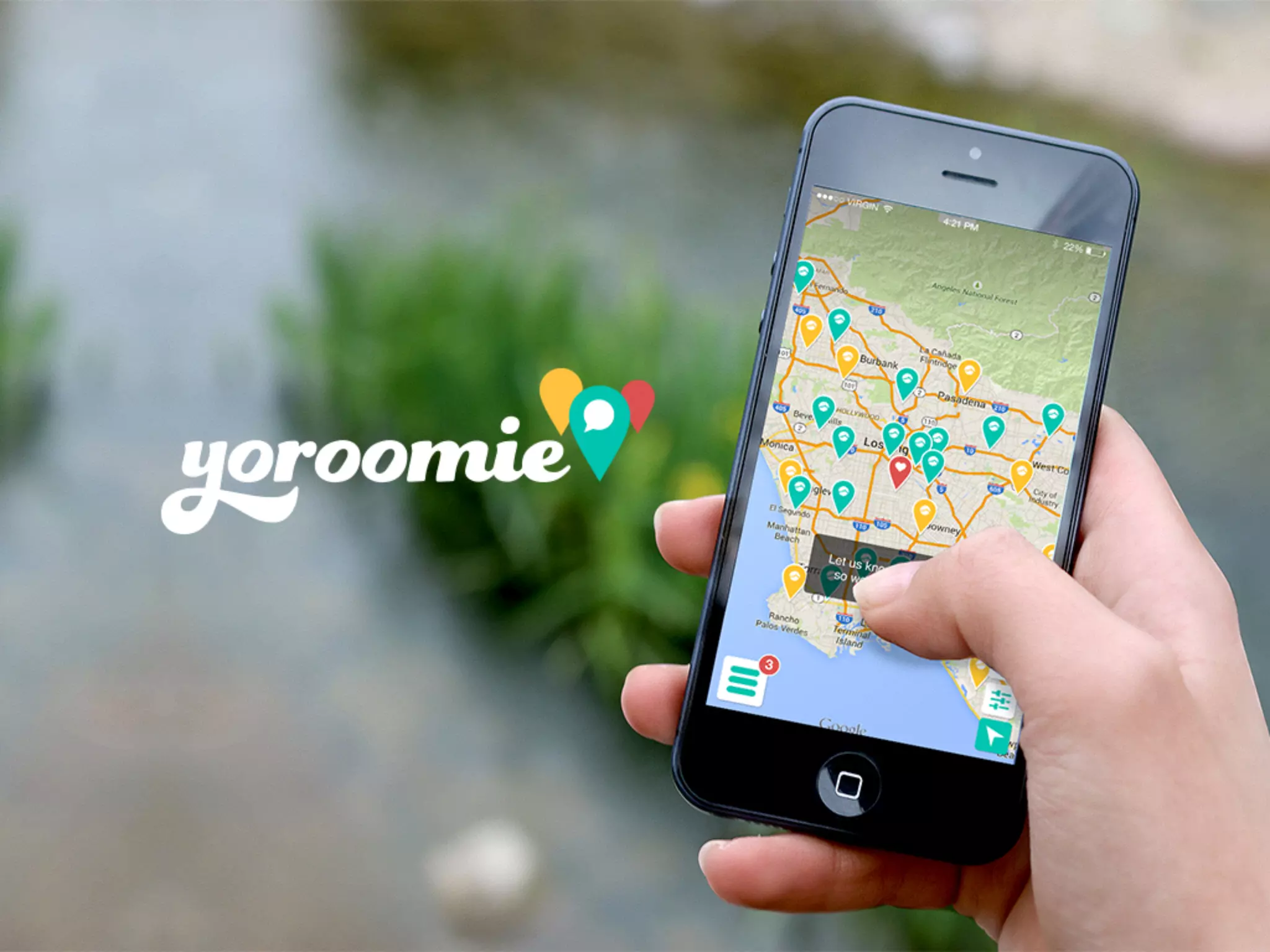
The opening slide features the Yoroomie logo and a high-resolution image of the app in use on a smartphone. The visual shows a map interface with numerous pins across a metropolitan area (Los Angeles), immediately establishing the product as a location-based mobile tool. The branding is colorful and friendly, signaling a consumer-facing, millennial-focused product.
Slide 2: Yoroomie To The Rescue
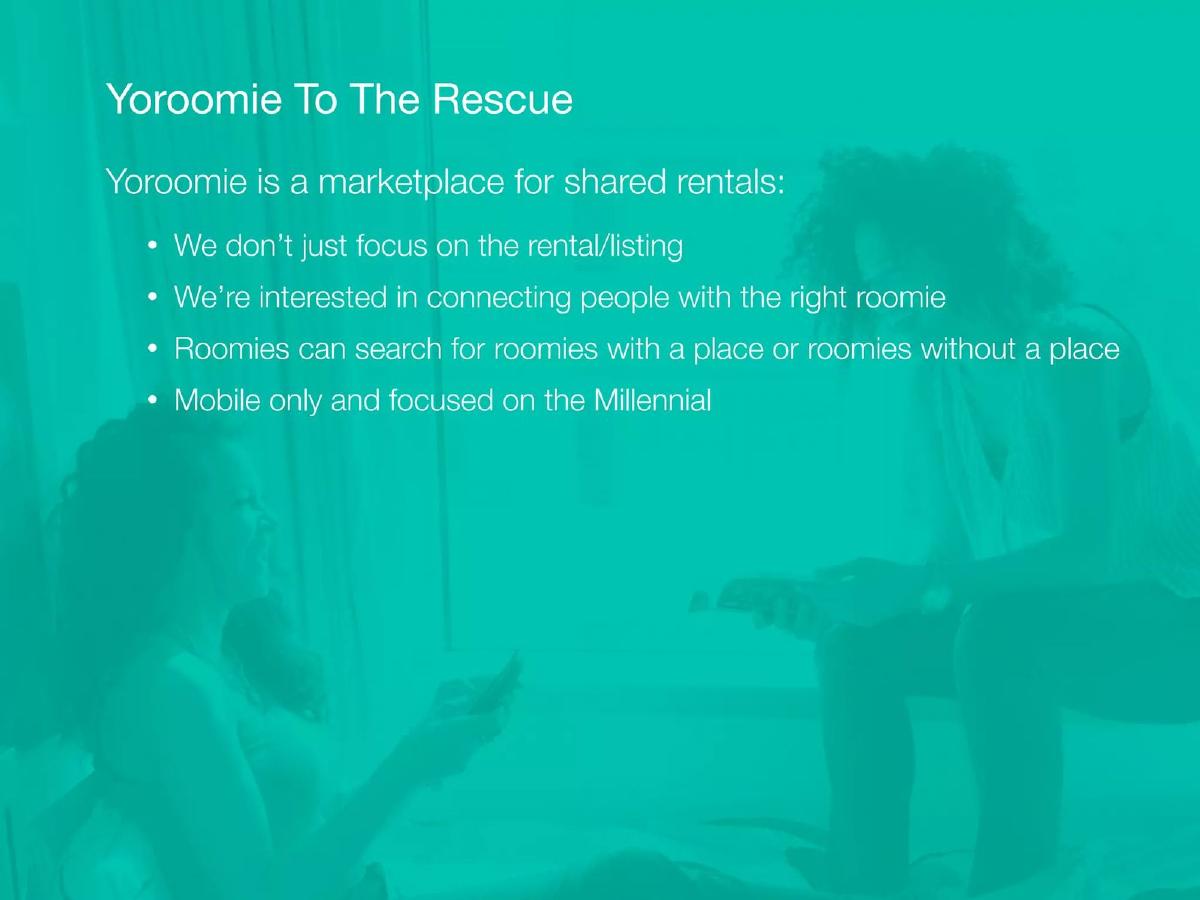
This slide defines the company's mission and core differentiation. It describes Yoroomie as a "marketplace for shared rentals." The founders make four key claims: they focus on the person rather than the listing, they connect people with the "right roomie," they allow searches for people with or without a place, and they are "Mobile only and focused on the Millennial." This slide successfully identifies the gap in traditional rental platforms like Craigslist or Zillow, which are often property-centric rather than personality-centric.
Slide 3: The Product
Slide 3 showcases the user interface, specifically the messaging component. The text states that "Roomies message one another to discuss shared interests, values, and compatible lifestyles." The visual includes a mockup of a chat between 'Kim Smith' and another user, highlighting a 'Block' feature for safety. This emphasizes the social nature of the platform, positioning it as a safe space for vetting potential living partners before committing to a lease.
Slide 4: How We Will Reach Roomies
The go-to-market strategy is split between digital and local channels. The deck lists Facebook, Twitter, Retargeting, SEO, and BuzzFeed as primary digital drivers. More importantly, it specifies a "Local Growth Teams" approach with an "Initial focus on LA Metro." The slide includes logos for UCLA and USC , indicating a strategy to capture the high-density student demographic through university partnerships and grassroots events. This localized approach is a standard playbook for two-sided marketplaces to achieve liquidity.
Slide 5: Revenue Model
Yoroomie introduces "Roomie Rent" as its primary monetization engine. The slide explains that users can transfer payments to roommates or landlords. The specific take rate is defined: "Yoroomie receives 1% of every transaction paid to landlords." The mockups show a clean payment interface with fields for 'Pay Roomie' and 'Pay Landlord.' By embedding the financial transaction into the social discovery app, Yoroomie attempts to capture value throughout the entire lifecycle of the rental agreement.
Slide 6: Our First Two Weeks
This is the traction slide, providing data from the immediate post-launch period. The figures cited are: 1,000 Users, 1,104 Pins created, 10,600 Views, and 1,225 Conversations started. These metrics are impressive for a fourteen-day window, particularly the conversation count, which suggests that users are not just browsing but actively engaging with one another. The 1:1 ratio of pins to users suggests that almost every early adopter was active in listing their needs or their space.
Slide 7: Yoroomie in the Press
To establish social proof, the deck highlights three media mentions: Product Hunt, Built in Los Angeles, and the San Francisco Business Times. While no specific quotes or dates are provided, these logos suggest that the startup gained early visibility in both the tech community and regional business press.
Slide 8: Our Team
The team slide introduces four individuals: Mike Williams (CEO/Co-Founder), Ben Collins (CTO/Co-Founder), Marc Precilla (Mobile/Front End), and Aure Gimon (Product Design). The text describes them as "Technopreneurs" and "Former Founders and Developers." The slide emphasizes domain expertise and a passion for building scalable tech, though it lacks specific details on their previous successful exits or specific companies they worked for.
Slide 9: Contact Slide
The deck concludes with the company logo and a contact email: hello@yoroomieapp.com . There is no final summary of the investment opportunity or a call to action regarding a specific funding round.
What Works in the Yoroomie Deck
Clear Differentiation: The deck clearly explains why it is different from existing rental sites by focusing on the 'roommate' search rather than the 'apartment' search. · Integrated Monetization: The 'Roomie Rent' feature provides a logical way to monetize a social platform. By facilitating the actual rent payment, they move from a discovery tool to a utility. · Strong Early Traction: The metrics from the first two weeks (Slide 6) provide a compelling snapshot of user engagement and product-market fit. · Focused Geography: By targeting the LA Metro and specific universities like UCLA and USC, the founders show they understand how to build density in a marketplace.
What is Missing from the Yoroomie Deck
The Ask: The most significant omission is the lack of a funding request. There is no mention of how much capital is being raised, the valuation, or the specific milestones the team intends to reach with the investment. · Unit Economics: While the 1% fee is mentioned, there is no data on the Customer Acquisition Cost (CAC) or the Lifetime Value (LTV) of a user. A 1% fee on rent is relatively low, so the deck needs to demonstrate how they will achieve the volume necessary for profitability. · Competitive Landscape: The deck does not mention competitors like Roomi, SpareRoom, or even the looming presence of Facebook Marketplace and Craigslist. Investors would want to know how Yoroomie plans to defend its position. · Financial Projections: There are no forward-looking statements regarding revenue growth, user scaling, or the path to break-even.
Founder Takeaways
Lead with Traction: If you have a successful launch, use those early numbers to prove engagement. Yoroomie’s 'First Two Weeks' slide is the strongest part of their deck because it shows active usage. · Define the Revenue Stream Early: Don't wait until the end of the deck to explain how you make money. Yoroomie ties its revenue model directly to a product feature (Roomie Rent), which makes the monetization feel like a natural extension of the user experience. · Hyper-Local Focus: For marketplaces, trying to launch nationally is often a mistake. Yoroomie’s focus on the LA Metro and specific colleges is a smart way to demonstrate a repeatable growth playbook. · Don't Forget the Ask: A pitch deck is a fundraising tool. Always include a slide that specifies how much you are raising and what you will do with the money. Leaving this out forces the investor to do extra work to understand the deal.
Frequently asked questions
- How does Yoroomie make money?
- Yoroomie utilizes a transaction-based revenue model. According to slide 5, the app facilitates rent transfers between roommates and to landlords. While peer-to-peer transfers are mentioned, the primary stated revenue source is a 1% fee collected on every transaction paid to landlords through the platform.
- What is the primary value proposition for users?
- The value proposition is person-centric roommate matching. Slide 2 explains that unlike traditional listing sites, Yoroomie allows users to search for roommates who already have a place or those who are also looking for one, focusing on shared interests and lifestyle compatibility rather than just the physical rental unit.
- What early traction did the company demonstrate?
- Slide 6 highlights 'Our First Two Weeks,' reporting 1,000 users, 1,104 pins created, 10,600 views, and 1,225 conversations started. This data suggests high initial engagement and a high ratio of conversations to users (1.22 per user) immediately following the launch.
- What is the geographic focus of the startup?
- The company's initial growth strategy is hyper-local. Slide 4 explicitly states an 'Initial focus on LA Metro.' This is supported by planned partnerships with local universities like UCLA and USC, and a grassroots program involving local events and sponsorships.
- Who are the founders and what is their background?
- The team consists of Mike Williams (CEO/Co-Founder) and Ben Collins (CTO/Co-Founder), supported by Marc Precilla (Mobile/Front End) and Aure Gimon (Product Design). Slide 8 describes them as 'Technopreneurs' and former founders with domain expertise in building scalable tech solutions.