The Youmove.me deck, dating from early 2013, outlines a solution for the fragmented European travel market. The company identified a specific pain point: the need to navigate multiple websites (DBahn, Trenitalia, Lufthansa, etc.) to plan a single cross-border trip. Their solution focused on a multimodal routing algorithm and a unique 'address-to-link' feature for businesses. While the deck successfully communicates a clear problem and a diversified revenue model—including API fees, e-ticketing commissions, and geo-localized ads—it suffers from being pre-product. With '10 weeks to go' until MV…
Key takeaways
- The problem slide uses a specific user journey from Milan to Berlin to illustrate the complexity of using fragmented transport providers (Slide 2).
- The product offers a unique B2B feature allowing shops to generate custom links (youmove.me/your address) to help customers find them (Slide 3).
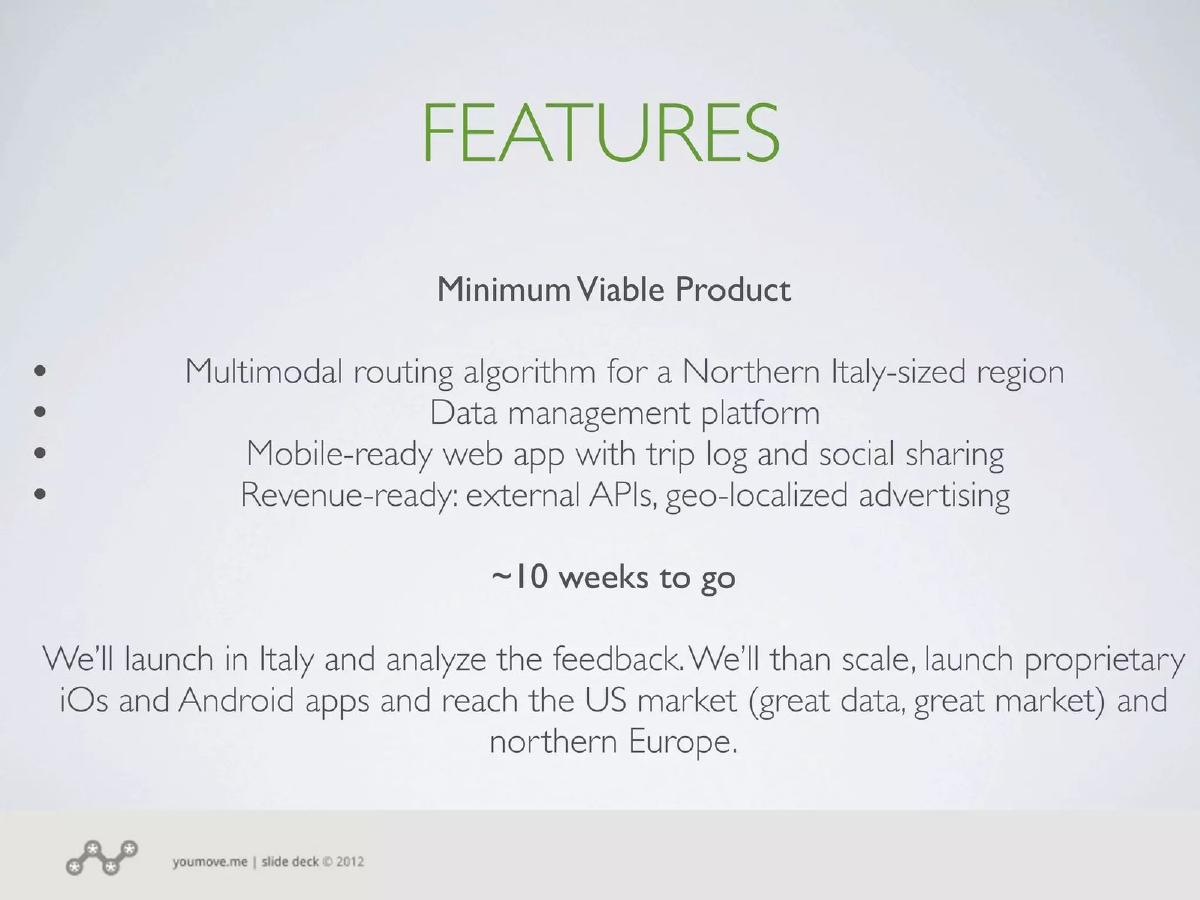
- Technical development was focused on a multimodal routing algorithm initially scoped for a 'Northern Italy-sized region' (Slide 4).
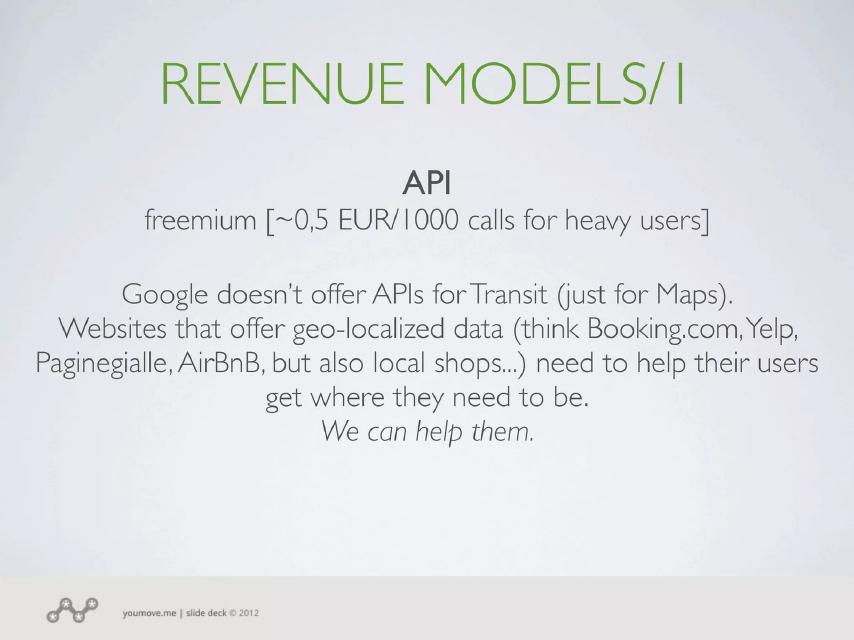
- The revenue model is three-pronged: API calls ($ per 1000 calls), e-ticketing commissions, and AdWords-integrated geo-localized advertising (Slide 5 and 6).
- The competitive analysis claims superiority over Google and Traveline by offering 'User preferences optimization' and 'Innovative transportation' (Slide 7).
- The team section is notably absent of founders, instead highlighting two academic advisors from Politecnico di Milano (Slide 8).
- The company previously won a 25k EUR grant from Telecom Italia's Working Capital program in November 2012 (Slide 9).
- The deck explicitly states that a lack of capital is slowing down their ability to scale beyond the initial MVP (Slide 9).
Introduction and Vision
The Youmove.me pitch deck, produced around February 2013, represents an early-stage attempt to solve the fragmentation of the European transportation sector. At the time, 'MaaS' (Mobility as a Service) was an emerging concept, and the founders sought to position themselves as a social, multimodal layer sitting on top of existing transit infrastructure. The deck is concise, spanning 18 slides (with 9 provided for this analysis), and focuses heavily on the technical challenge of routing and the potential for localized monetization.
Slide 1: Title and Contact
The opening slide introduces the brand with the tagline "moving social." It identifies Simone Lini as the CEO and provides a direct contact email. The logo, featuring interconnected wheels or nodes, reinforces the concept of a network or a journey with multiple stops, which aligns with the multimodal nature of the product.
Slide 2: The Problem Statement
The problem is framed through a specific, relatable use case: a trip from Milan (Corso Sempione) to Berlin (Marienplatz). The slide lists the various entities a user must currently interact with to plan this trip: DBahn, Trenitalia, AirBerlin, ATM, BVG, Alitalia, and Lufthansa. By listing these specific brands, the deck emphasizes the friction of the current user experience, concluding that the process is "complicated and time consuming." This is a classic 'hair on fire' problem for frequent European travelers.
Slide 3: The 'Even Easier' Solution
This slide introduces a secondary value proposition aimed at businesses. It proposes a URL structure—youmove.me/your address—that shops and venues can use to provide directions to customers. By positioning itself as a link-shortener for physical locations, Youmove.me attempts to solve a distribution problem: how to get the routing tool into the hands of users at the moment of intent. The slide notes there are "a lot of physical addresses on the internet," suggesting a large top-of-funnel opportunity for their routing engine.
Slide 4: Features and Roadmap
Slide 4 defines the Minimum Viable Product (MVP). The core technical asset is a "Multimodal routing algorithm for a Northern Italy-sized region." Other features include a data management platform, a mobile-ready web app with social sharing, and revenue-ready external APIs. Crucially, the slide states they are "~10 weeks to go" from launch. The roadmap moves from Italy to Northern Europe and finally the US, citing better data availability in the American market as a primary driver for international expansion.
Slide 5 & 6: Revenue Models
The deck provides a detailed look at how the company intends to make money. Slide 5 uses a flow chart to show three distinct channels: 1. B2B API: Charging other websites for geo-localized data on a per-1000-calls basis. 2. E-Ticketing: Taking a commission percentage on tickets sold through the platform (referencing MobiRev as an example). 3. Advertising: Using user profiles and geotags to serve targeted ads via the AdWords platform. Slide 6 elaborates on these, emphasizing that geo-localized advertising will be "accurately targeted" based on user data.
Slide 7: Competitive Landscape
The competition slide uses a standard feature-comparison matrix. Youmove.me compares itself against Traveline, Google, TripGo, and Cityway. The company claims to be the only player offering "User preferences optimization," "API access," "Innovative transportation," and "E-ticketing interface" all in one package. While it acknowledges that Google and Traveline handle urban and medium-long distance trip planning, it suggests those incumbents lack the integrated ticketing and preference-based optimization that Youmove.me provides.
Slide 8: Advisors and Academic Backing
Interestingly, the deck lacks a traditional 'Team' slide showing the full-time staff. Instead, Slide 8 highlights two advisors from Politecnico di Milano: Giorgio Patrini and Professor Nicola Gatti. The slide mentions they are "Currently Recruiting MSc Comp. Eng. interns for the algorithm." This suggests the company was heavily reliant on academic partnerships for its core R&D and was still in the process of building out its technical team at the time of the pitch.
Slide 9: Current Status and The Ask
The final slide in this set, titled "Where Are We At?", provides the company's traction to date. In November 2012, they won a 25k EUR grant from Telecom Italia's Working Capital program. They are currently working out of the Talent Garden in Milan. The slide is remarkably honest about their situation, stating that the grant was enough for the MVP, but "lack of capital is slowing us down." They conclude by stating they are actively looking for seed funding, partners, and early adopters.
What Works in This Deck
Specific Problem Framing: By using the Milan-to-Berlin example, the founders move away from abstract concepts and show exactly why a user would need their service. It highlights the cross-border and cross-modal complexity that was a significant gap in 2013 travel tech.
Clear Monetization Strategy: Many early-stage consumer apps struggle to explain how they will make money. Youmove.me provides a clear, three-pronged approach that targets both B2B (API) and B2C (Ads/Ticketing) revenue streams.
Honesty Regarding Constraints: The admission that a lack of capital was slowing them down is a double-edged sword, but in a seed-stage pitch, it creates a clear 'why now' for investors. It shows the founders are aware of their burn and the limitations of grant funding.
What Is Missing from This Deck
Founder Biographies: While the CEO is named on the first slide, there is no information about his background, previous successes, or why he is the right person to lead this venture. The reliance on advisor slides suggests a potential gap in full-time senior technical leadership.
Unit Economics: While the revenue models are listed, there are no projections for Customer Acquisition Cost (CAC) or Lifetime Value (LTV). For a business model that relies partly on $ per 1000 API calls, understanding the cost of maintaining the data and the algorithm is vital.
Data Sourcing Strategy: Multimodal routing is notoriously difficult because it requires clean, real-time data from dozens of different providers who are often reluctant to share it. The deck mentions "great data" in the US, but doesn't explain how they will secure data rights from the fragmented European providers listed on Slide 2.
Lessons for Founders
Use the 'Address-as-a-Link' Tactic: The idea of creating a simple URL for businesses (youmove.me/address) is a smart way to generate organic traffic. Founders building tools that require user input should look for ways to 'pre-fill' that data through simple, shareable links.
Academic Validation: If your startup is pre-product and pre-revenue, leveraging the credentials of a respected university (like Politecnico di Milano) can provide necessary technical credibility. However, this should supplement, not replace, a strong core team slide.
The '10 Weeks to Go' Trap: Stating exactly how many weeks are left until launch is risky. If a founder uses this deck for more than a month, the timeline becomes outdated and suggests a lack of progress. It is often better to use quarters (e.g., 'Launching Q2') to provide more buffer and longevity to the pitch materials.
Frequently asked questions
- What was the primary problem Youmove.me aimed to solve?
- The company targeted the 'complicated and time-consuming' process of planning travel that requires multiple modes of transport and different providers. Slide 2 highlights that a traveler going from Milan to Berlin currently has to check individual sites for trains (DBahn, Trenitalia), local transit (ATM, BVG), and airlines (Alitalia, Lufthansa) to find the best route.
- How did Youmove.me plan to generate revenue?
- According to Slides 5 and 6, the business model included charging websites for geo-localized data via API ($ per 1000 calls), earning a percentage commission on e-ticketing services through partners like MobiRev, and utilizing geo-localized advertising based on user profiles and geotags to serve targeted ads via the AdWords platform.
- What was the status of the product at the time of the pitch?
- The product was in the pre-launch phase. Slide 4 notes they were approximately '10 weeks to go' from a Minimum Viable Product (MVP). The initial scope was a mobile-ready web app featuring a multimodal routing algorithm limited to a Northern Italy-sized region, with plans to later launch native iOS and Android apps.
- Who was involved in the project according to the deck?
- The deck identifies Simone Lini as the CEO on the title slide. However, the 'Advisors' slide (Slide 8) focuses on academic support from Politecnico di Milano, specifically Giorgio Patrini (PhD researcher) and Professor Nicola Gatti. The slide also mentions they were actively recruiting interns to help build the algorithm.
- What were the company's expansion plans?
- Slide 4 outlines a phased rollout: first launching in Italy to gather feedback, then scaling to Northern Europe, and eventually reaching the US market. The founders believed the US market offered 'great data' and a 'great market' for their multimodal routing technology.