YouMap is a geospatial platform designed to allow communities to build and manage their own maps. The deck highlights early viral success, citing 20,000 unique visitors and 12-minute average session times. The business model is diversified, proposing revenue through data sales to giants like Facebook and Yahoo, a SaaS freemium model, and targeted advertising. While the deck succeeds in showing product-market fit through its 'pilot maps' (Yoga, Bitcoin, 3D Printing), it lacks a clear competitive analysis and detailed financial projections. The $1 million ask is earmarked specifically for build…
Key takeaways
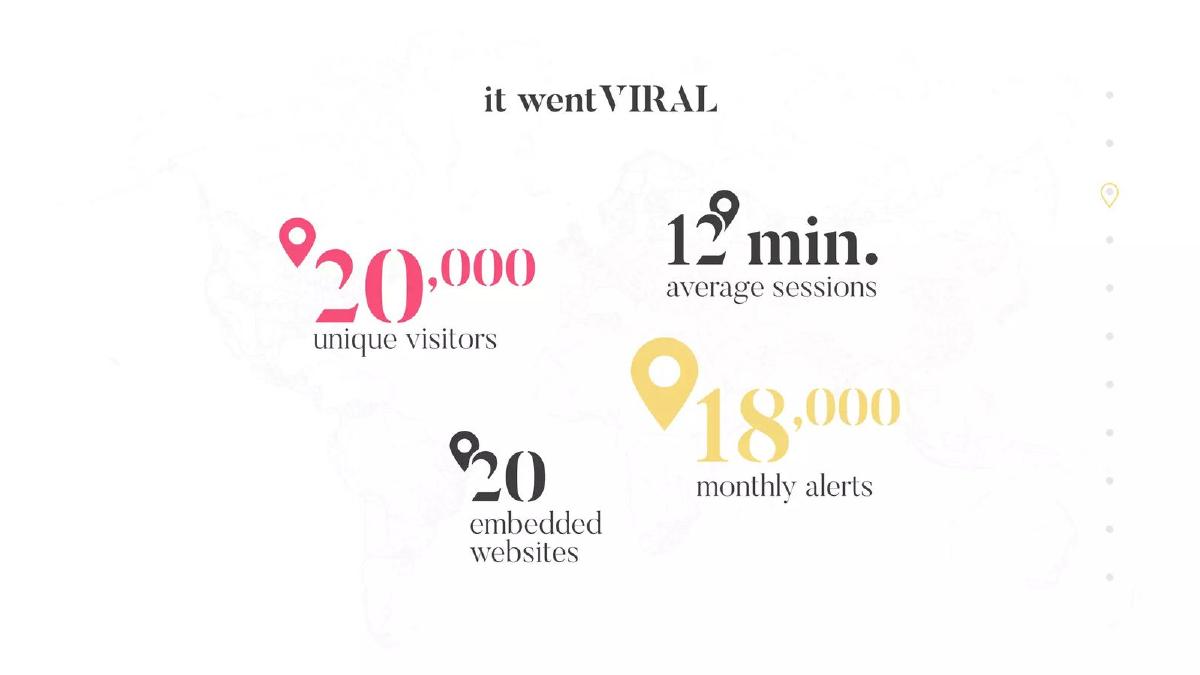
- The startup claims early viral traction with 20,000 unique visitors and 18,000 monthly alerts (Slide 3).
- User engagement is high, with an average session duration of 12 minutes reported on Slide 3.
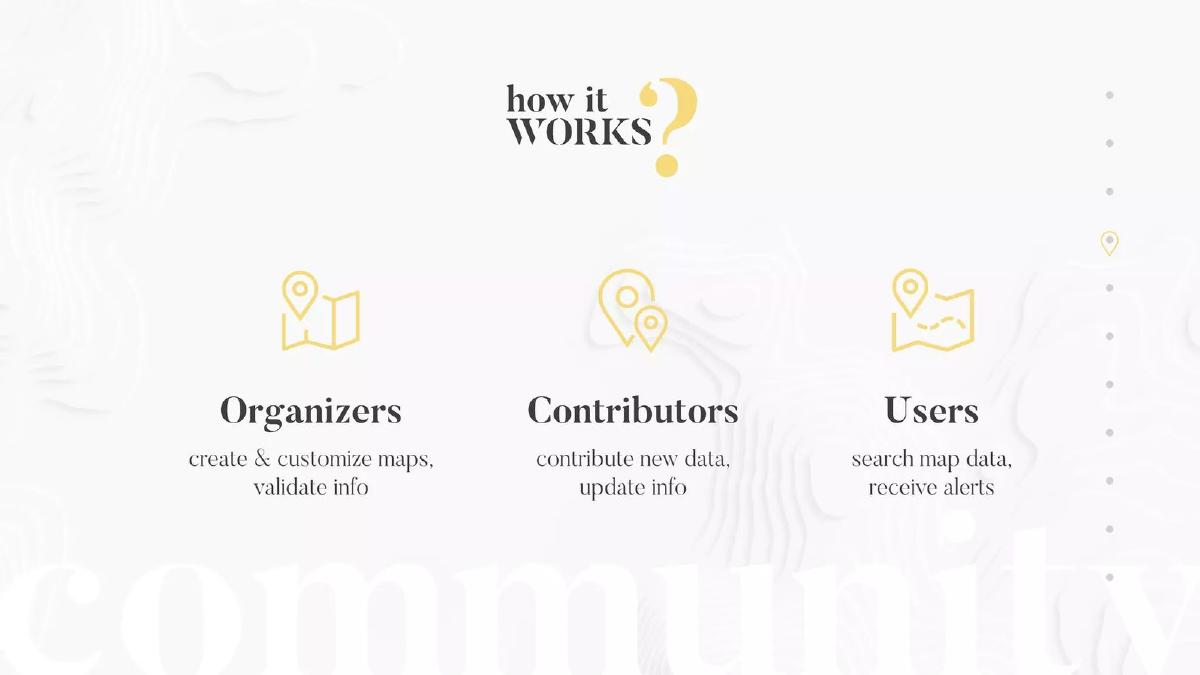
- The platform segments its ecosystem into three distinct roles: Organizers, Contributors, and Users (Slide 4).
- Revenue strategies include selling unique geospatial data to companies like Yandex, Yahoo, and Facebook (Slide 8).
- The go-to-market strategy involved generating 500 organizer leads during a pre-launch phase (Slide 6).
- The roadmap shows a three-year progression from initial mapping in Israel (2012) to a planned discovery engine in late 2015 (Slide 9).
- The team consists of three co-founders (CEO, COO, CTO) and one advisor, though professional backgrounds are not detailed (Slide 10).
- The company is seeking $1 million to build out their 'Service Platform' (Slide 11).
The YouMap Pitch Deck Analysis
YouMap enters the geospatial market with a pitch focused on the power of community-curated data. Rather than competing directly with the infrastructure of Google or Apple Maps, YouMap positions itself as a platform for niche, high-engagement community maps. The deck is 11 slides long, following a clean, minimalist aesthetic that prioritizes high-level metrics and conceptual frameworks over dense technical specifications.
Slide 1: Title and Mission
The cover slide introduces the company name, YouMap, and its core value proposition: "build, launch and grow community maps." It identifies Rose Waters as the Founder. The branding is simple, featuring a logo with two map pins connected by a line, suggesting a social or network-based approach to geography. The presence of a "do not distribute" watermark suggests this was a confidential document intended for a specific investor audience.
Slide 2: The Origin Story
Titled "how it Started," this slide is purely visual, showing a laptop displaying a map with several pins over a city landscape. The caption "then..." serves as a narrative bridge to the traction slide. It establishes that the product is already functional and has moved beyond the conceptual stage.
Slide 3: Viral Traction and Engagement
This is the most critical slide in the early part of the deck. It uses large typography to highlight four key metrics: 20,000 unique visitors , 12 min. average sessions , 20 embedded websites , and 18,000 monthly alerts . The 12-minute session time is particularly notable for a mapping application, suggesting that users are not just looking for directions but are actively consuming or contributing content within the community maps.
Slide 4: The Ecosystem Roles
Slide 4, "how it WORKS?", breaks down the platform's user base into three categories:
Organizers: The power users who create, customize, and validate map information. · Contributors: The community members who add new data and update existing info. · Users: The general audience who search map data and receive alerts.
This structure demonstrates a clear understanding of the network effects required to keep a community-driven platform alive.
Slide 5: Value Proposition by Segment
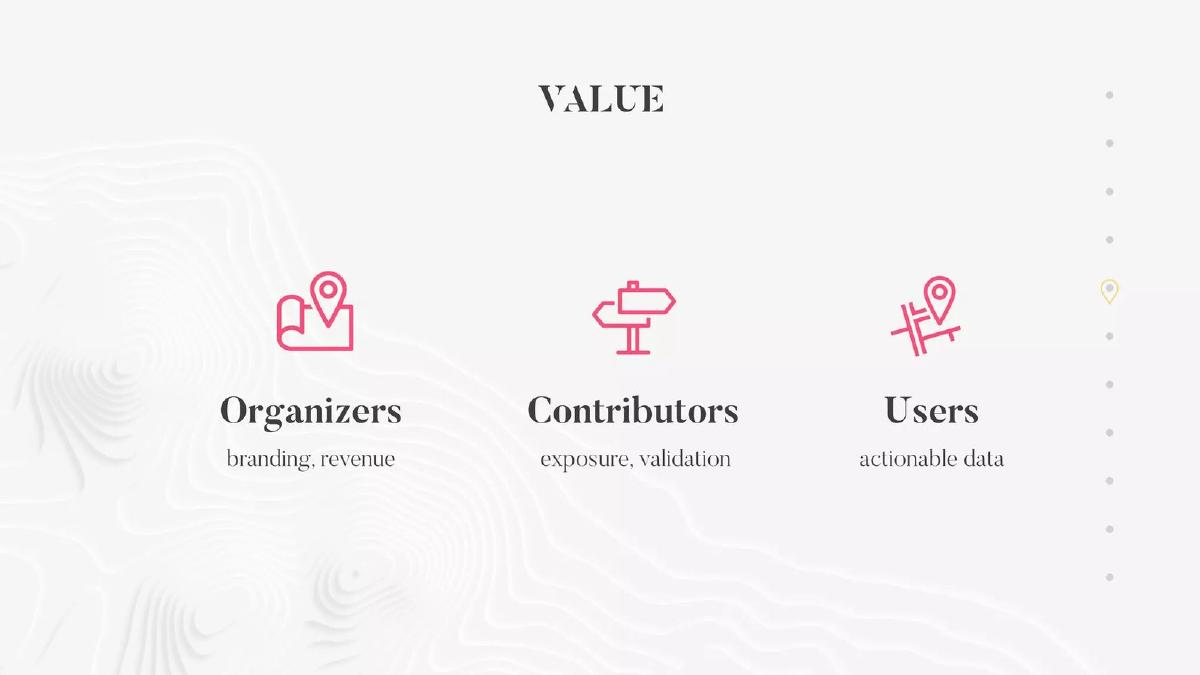
Following the ecosystem breakdown, Slide 5 explains the "VALUE" for each group. Organizers get branding and revenue ; Contributors get exposure and validation ; Users get actionable data . This slide is important because it hints at how YouMap will incentivize the labor-intensive task of data entry and moderation.
Slide 6: Go-to-Market Strategy
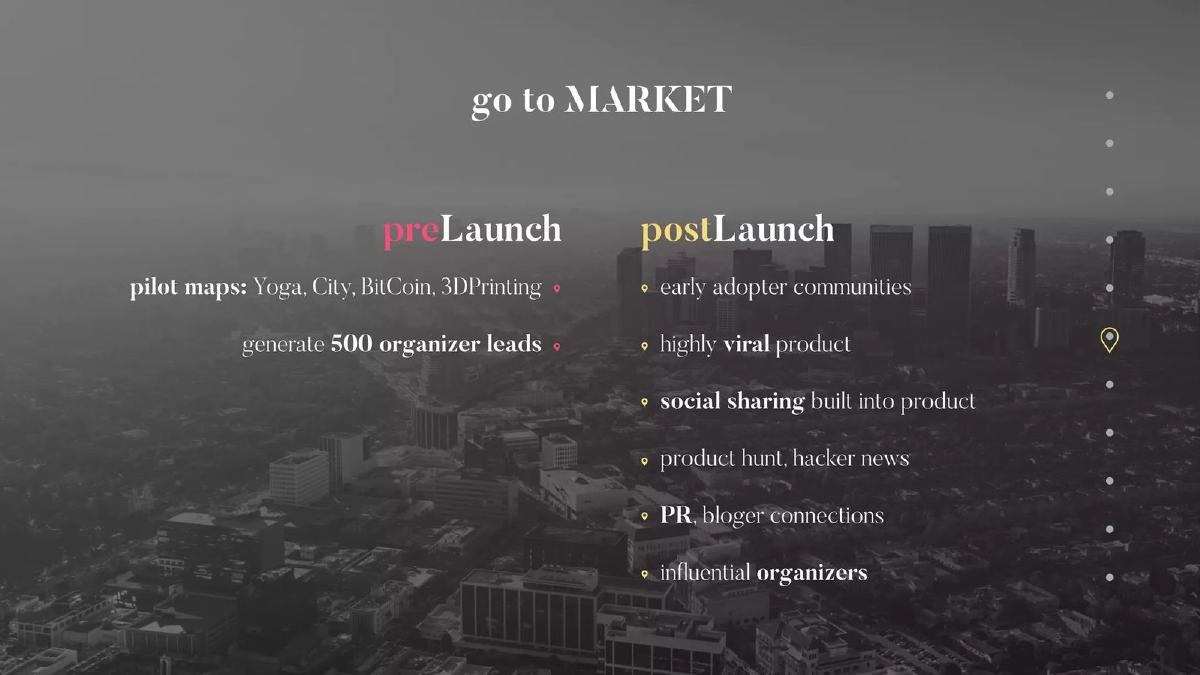
The "go to MARKET" slide divides the strategy into pre-launch and post-launch phases. The pre-launch phase highlights pilot maps in diverse niches: Yoga, City, Bitcoin, and 3D Printing. It also claims the generation of 500 organizer leads . The post-launch strategy relies on viral product features, social sharing, and launches on platforms like Product Hunt and Hacker News, as well as leveraging "influential organizers."
Slide 7: Market Potential and Use Cases
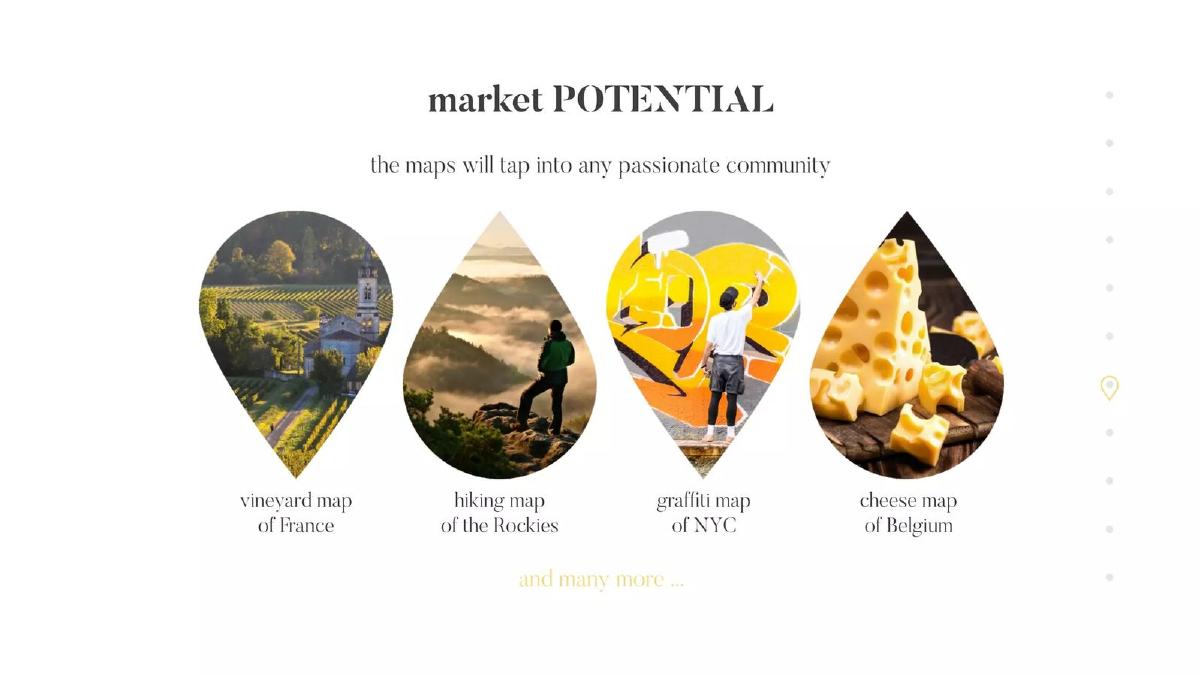
Slide 7 uses visual examples to show the breadth of the platform. It lists a vineyard map of France , a hiking map of the Rockies , a graffiti map of NYC , and a cheese map of Belgium . By showcasing these specific, high-passion niches, YouMap argues that its market potential is limited only by the number of "passionate communities" that exist globally.
Slide 8: The Business Model
The "BUSINESS MODEL opportunities" slide is quite ambitious, listing four distinct revenue streams:
Data: Selling unique, up-to-date data to major players like Yandex, Yahoo, and Facebook. · Referral Program: Taking a cut when users take action (e.g., applying for a job or registering for a class) via a map pin. · S.A.A.S.: A freemium model offering premium features like private maps and custom branding. · Targeted Advertising: Mobile and web distribution for advertising campaigns and premium listings.
While comprehensive, the deck does not provide any current revenue figures or projections for these streams.
Slide 9: The Roadmap
The "TIMELINE" slide shows a history starting in May 2012 with "mapped in Israel." It moves to November 2014 for pilots, March 2015 for the self-service platform, June 2015 for mobile, and November 2015 for the "discovery engine." This suggests the deck was likely produced in early to mid-2015, during the transition to the self-service model.
Slide 10: The Team
The team slide features Rose Waters (CEO), William Third (COO), and Margaret Thatch (CTO), along with advisor Mark Williams. The use of map pins for headshots is a nice thematic touch, but the slide lacks any biographical information. Investors typically want to see "why this team," including past exits, relevant industry experience, or technical pedigree, none of which are present here.
Slide 11: The Ask
The final slide is the "SEEKING" slide. It asks for $1 million to build the Service Platform . It includes contact information for Rose Waters. The ask is clear, though it lacks a breakdown of how the $1 million will be allocated (e.g., engineering vs. marketing vs. operations).
What Works in the YouMap Deck
The deck excels at demonstrating engagement . In a world where most apps struggle with retention, a 12-minute average session time (Slide 3) is a powerful signal that the content is sticky. The decision to lead with traction rather than a theoretical problem/solution framework helps build immediate credibility.
The segmentation of the market (Slide 7) is also effective. By showing widely different use cases—from cheese to graffiti—the founders demonstrate that the platform is a horizontal tool that can scale across vertical interests. This makes the "Market Potential" argument feel more tangible than a generic TAM/SAM/SOM slide.
What is Missing from the YouMap Deck
The most glaring omission is a Competitor Analysis . The geospatial market is crowded, ranging from giants like Google Maps to niche players like Foursquare (at the time) or specialized GIS software. YouMap does not explain how it prevents a larger social network from simply adding "community map" features to their existing platforms.
Additionally, the Team Slide is weak. While the founders are identified, their qualifications are entirely absent. In a seed round, investors are often betting more on the founders' ability to execute than the current product, making this a missed opportunity to build trust.
Finally, there is no Financial Slide . While the business model lists four ways to make money, there is no indication of which one is currently working or what the unit economics look like. Without a burn rate or a revenue forecast, the $1 million ask feels somewhat arbitrary.
Founder Takeaways
Founders should copy the visual consistency of this deck. The use of the map pin motif throughout the slides creates a cohesive brand identity. The traction-first approach is also a winning strategy for companies that already have a live product; it forces the investor to deal with the reality of the data before they can find reasons to doubt the concept.
However, founders should avoid the lack of context found in the team and ask slides. Always provide a high-level "use of funds" breakdown and ensure your team's "superpowers" are clearly stated. If you are asking for $1 million, you need to show that you have the specific expertise to turn that capital into a scalable "Service Platform."
Frequently asked questions
- What is the core problem YouMap is solving?
- While the deck does not have a dedicated 'Problem' slide, it implies that existing maps lack the granular, community-specific data that passionate groups need. By allowing 'Organizers' to create custom maps for niches like 'graffiti in NYC' or 'cheese in Belgium,' YouMap aims to capture hyper-local data that general-purpose mapping tools like Google Maps might overlook.
- How does YouMap plan to make money?
- According to Slide 8, the company has a four-pronged monetization strategy: selling up-to-date community data to major tech platforms, a referral program for local actions (like job applications), a SaaS freemium model for private or branded maps, and highly targeted advertising campaigns including premium listings.
- What kind of traction has the company achieved so far?
- Slide 3 and Slide 6 detail their traction. They report 20,000 unique visitors, 20 embedded websites, and 18,000 monthly alerts. They also successfully ran pilot maps for specific communities including Yoga, City, Bitcoin, and 3D Printing, which helped them generate a lead list of 500 potential map organizers.
- Who are the founders of YouMap?
- The team slide (Slide 10) lists Rose Waters as Co-founder & CEO, William Third as Co-founder & COO, and Margaret Thatch as Co-founder & CTO. Mark Williams is listed as an Advisor. The deck provides photos and titles but omits their previous professional experience, education, or specific technical achievements.
- What is the specific funding request?
- YouMap is seeking $1 million. As stated on Slide 11, these funds are intended to 'build the Service Platform.' This aligns with their timeline on Slide 9, which suggests a transition from manual pilots to a self-service web and mobile platform and eventually a discovery engine.