Yuengling's Ice Cream Corp presented this 506c Private Placement deck in November 2016 to raise up to $5 million. The company, which relaunched in 2014 after a nearly 30-year hiatus, focuses heavily on its historical connection to the Yuengling brewery family while operating as a separate entity. The deck emphasizes successful retail penetration, listing major partners like Walmart, Stop & Shop, and Wegmans. The investment structure is specific, offering units of 8% convertible promissory notes and warrants with a $10,000 minimum investment. While the deck excels at demonstrating distribution…
Key takeaways
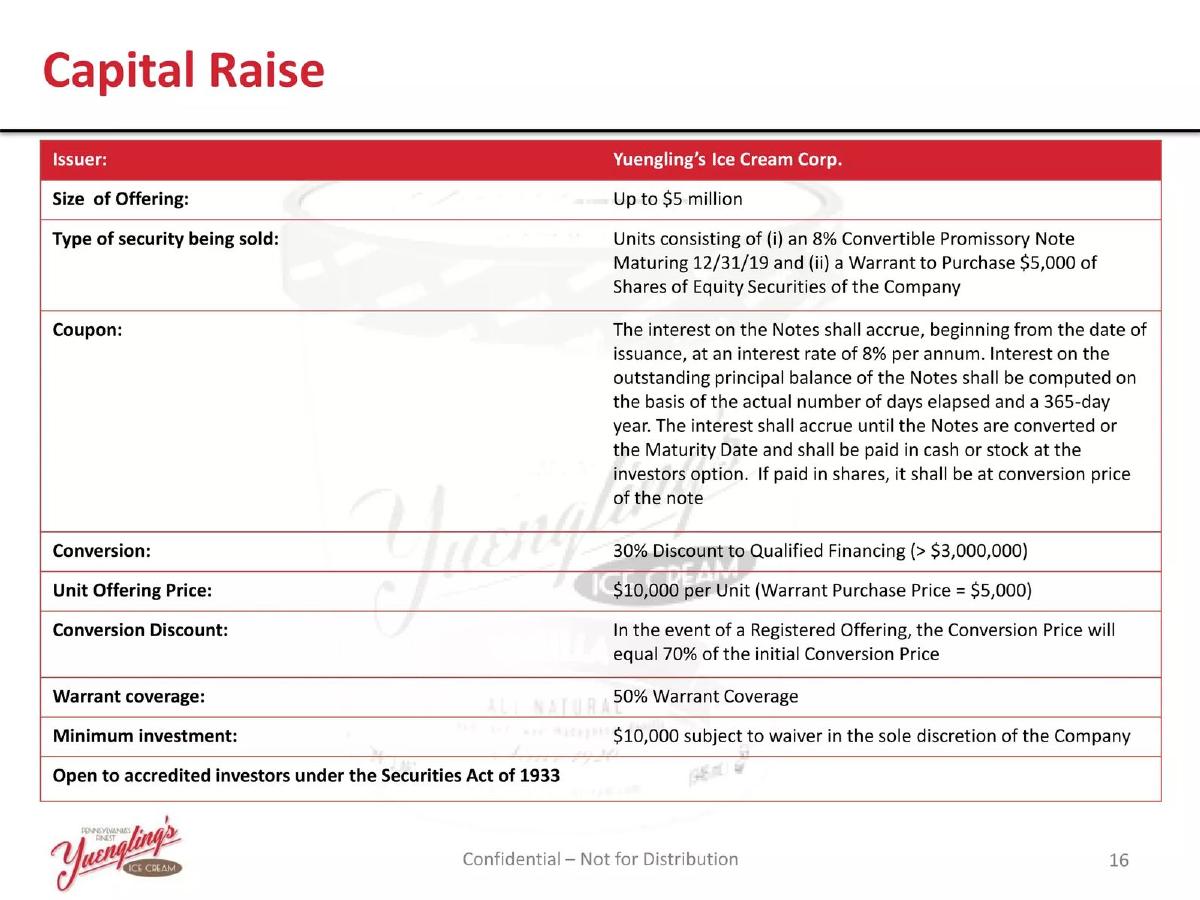
- The company is raising up to $5 million through a 506c private placement consisting of 8% convertible promissory notes and warrants (Slide 16).
- Yuengling's Ice Cream was originally founded in 1920 to support the Yuengling brewery during Prohibition and was relaunched in 2014 by David Yuengling (Slide 4).
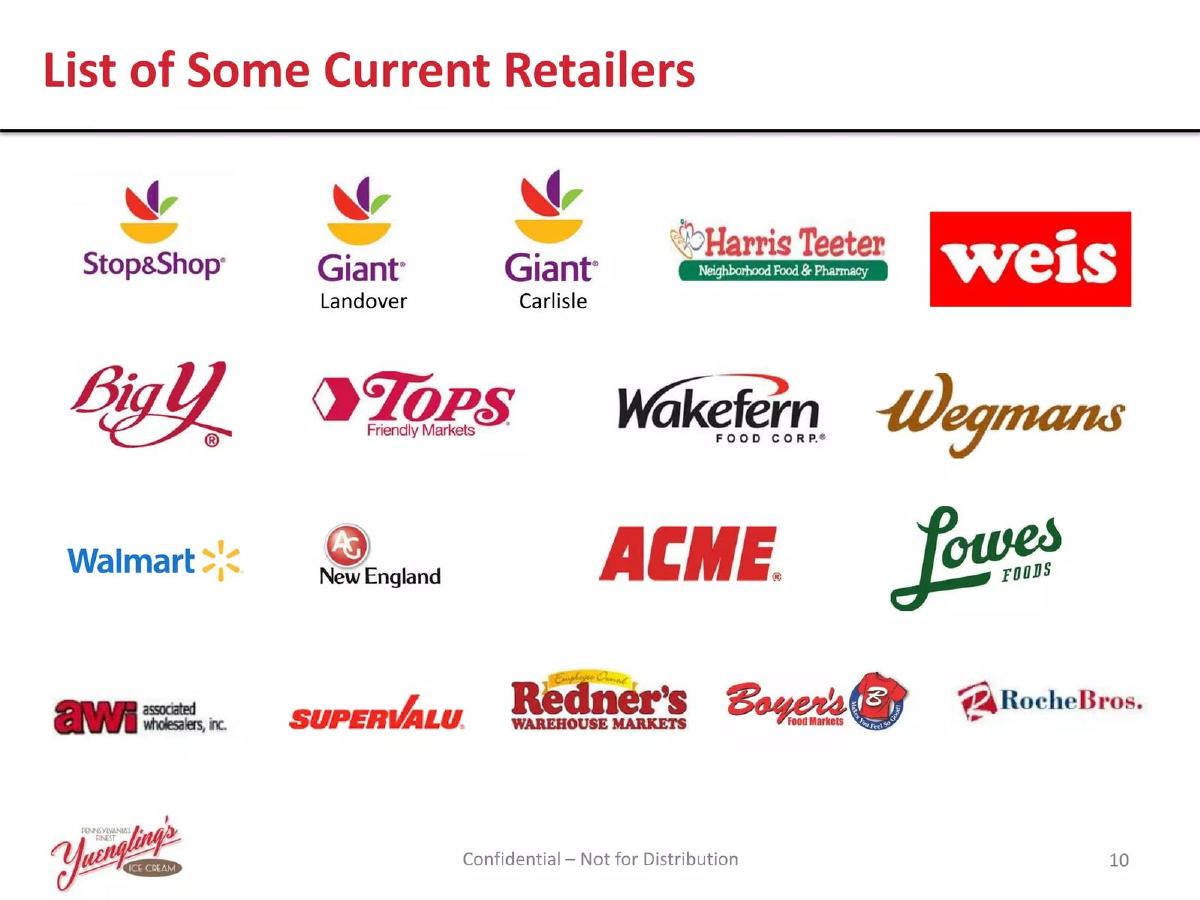
- The brand has secured distribution in major national and regional retailers including Walmart, Wegmans, Stop & Shop, and Acme (Slide 10).
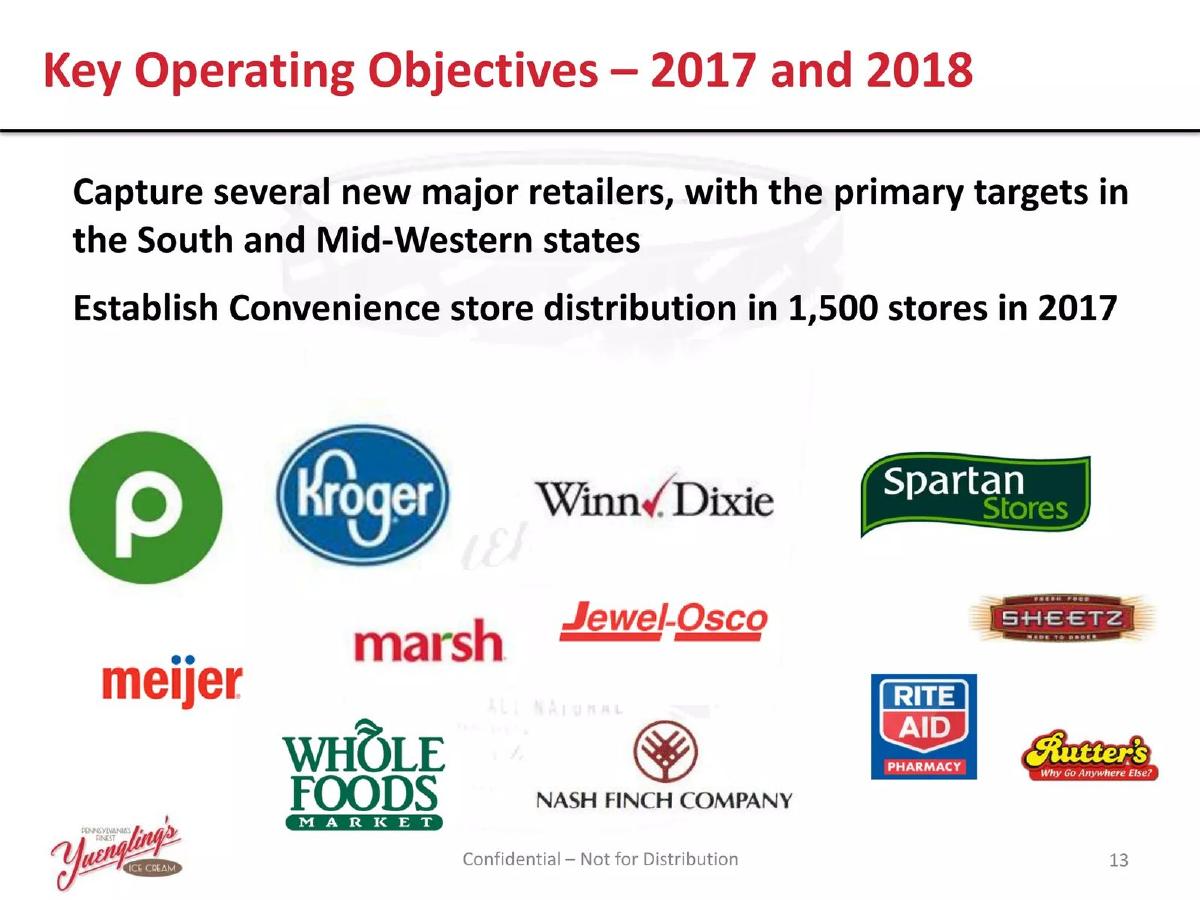
- Operating objectives for 2017-2018 included expanding into the South and Mid-West and establishing distribution in 1,500 convenience stores (Slide 13).
- The investment terms include a 30% conversion discount to qualified financing of greater than $3 million (Slide 16).
- The management team features deep industry experience, specifically COO Robert Carlson, who held executive roles at Ben & Jerry's and Friendly Ice Cream (Slide 19).
- The deck outlines a four-phase operating strategy, moving from brand development to outward expansion and shelf space maximization (Slide 7).
Introduction and Brand Heritage
Slide 1: Title Slide
The presentation opens with the recognizable Yuengling's Ice Cream logo, emphasizing its identity as 'Pennsylvania's Finest.' The slide explicitly states the purpose of the deck: a '506c Private Placement' dated November 2016. This immediately signals to the reader that this is a formal investment solicitation aimed at accredited investors under specific SEC regulations.
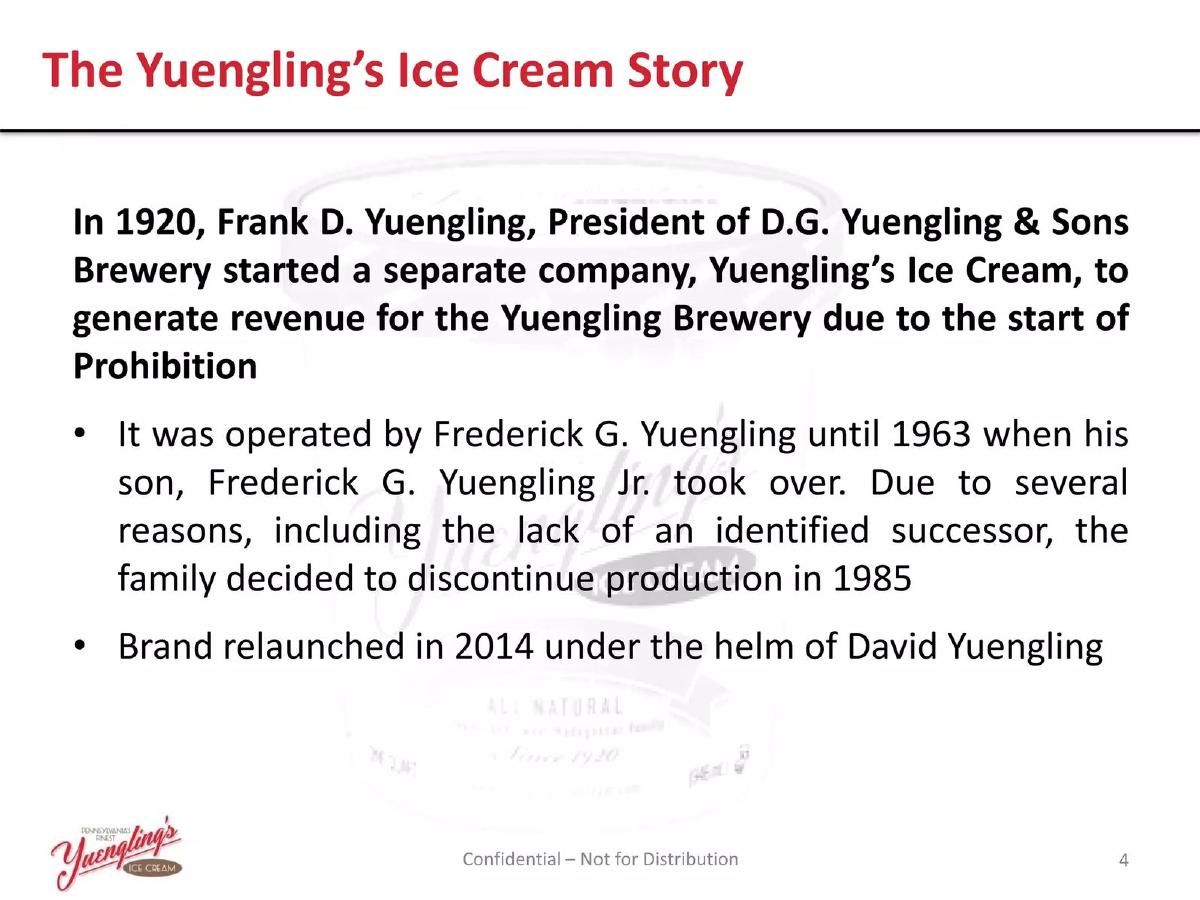
Slide 4: The Yuengling's Ice Cream Story
This slide establishes the brand's 'origin story,' which is a critical asset for a consumer packaged goods (CPG) company. It notes the company was founded in 1920 by Frank D. Yuengling to sustain the brewery during Prohibition. The slide provides a timeline: operated by the family until 1963, discontinued in 1985 due to a lack of a successor, and relaunched in 2014 by David Yuengling. By grounding the company in nearly a century of history, the deck attempts to mitigate the risk typically associated with a 'startup,' framing it instead as a brand revival.
Strategic Roadmap and Market Traction
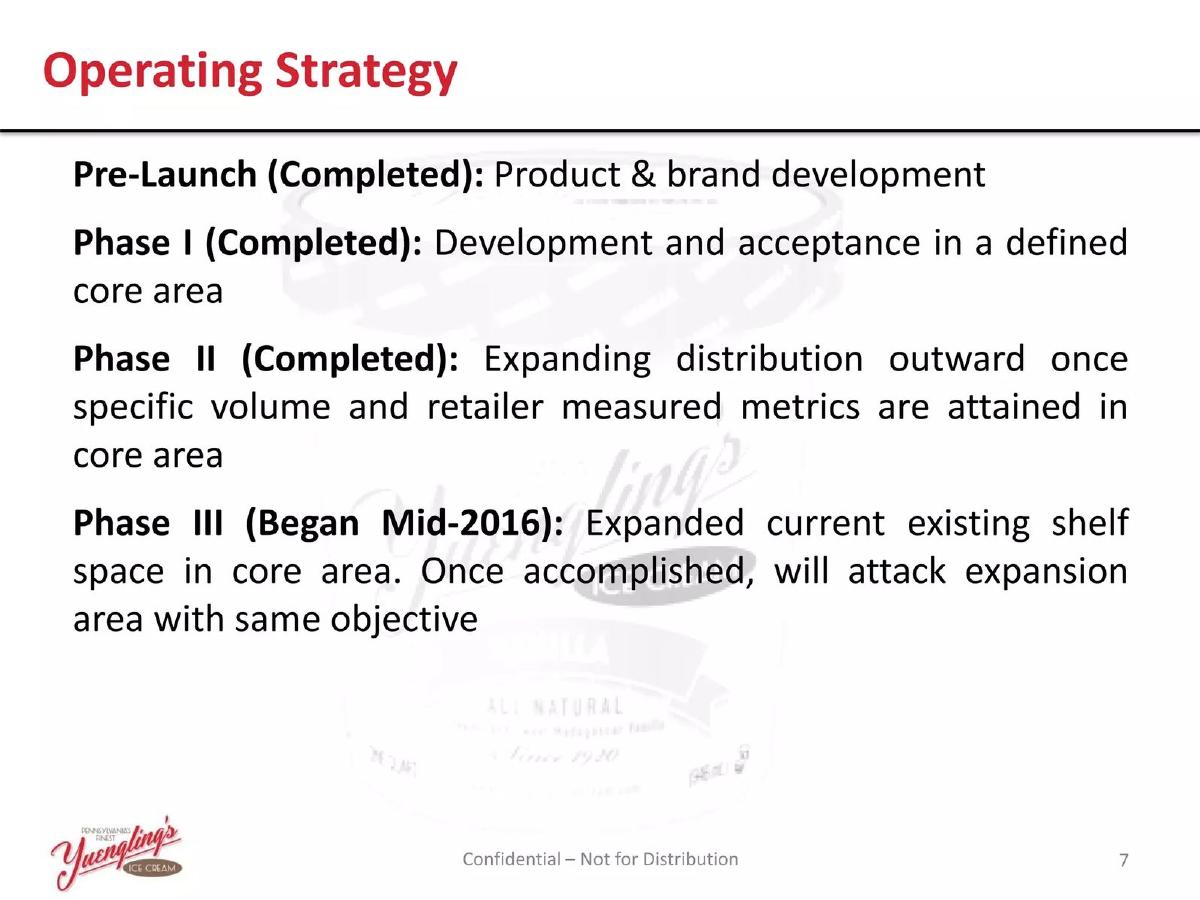
Slide 7: Operating Strategy
The company outlines a four-phase growth plan. As of the deck's publication, Phases Pre-Launch, I, and II are marked as 'Completed.' These phases covered brand development, core area acceptance, and initial outward expansion. Phase III, which began in Mid-2016, focuses on expanding existing shelf space in the core area and attacking new expansion areas. This slide is functional but lacks specific dates for the completed phases, which would have helped investors understand the velocity of the relaunch.
Slide 10: List of Some Current Retailers
This is arguably the strongest slide in the deck for a CPG investor. It features a 'logo wall' of major grocery and retail partners. The presence of Walmart, Wegmans, Stop & Shop, and Harris Teeter serves as powerful social proof. It demonstrates that the product has already passed the rigorous vetting processes of national category buyers. The inclusion of wholesalers like AWI and Supervalu further illustrates a mature supply chain infrastructure.
Slide 13: Key Operating Objectives – 2017 and 2018
The deck shifts from past achievements to future goals. The primary objectives are geographic expansion (South and Mid-West) and channel diversification (Convenience stores). The slide sets a specific target: 'Establish Convenience store distribution in 1,500 stores in 2017.' The logos of Kroger, Whole Foods, Meijer, and Sheetz indicate the high-profile targets the company was pursuing. However, the slide does not explain the specific 'how'—such as the marketing spend or slotting fees required to enter these new markets.
Investment Terms and Leadership
Slide 16: Capital Raise
This slide provides a detailed term sheet for the $5 million offering. The structure is a unit offering consisting of an 8% convertible promissory note and warrants. Key terms include a maturity date of 12/31/19, a 30% conversion discount for qualified financing over $3 million, and a $10,000 minimum investment. This level of transparency is excellent for a private placement deck, as it allows potential investors to immediately assess if the deal structure fits their portfolio requirements.
Slide 19: Executive Management Team
The management slide highlights three key figures. David Yuengling (President) leans on his family connection and 15 years of consulting experience. Robert C. Bohorad (CFO) brings 20+ years of experience and a Wharton MBA. The standout bio is Robert Carlson (COO), whose 29+ years in the ice cream industry—including leadership roles at Ben & Jerry's and Friendly's—provides the necessary domain expertise to manage a national scale-up. The bios are text-heavy but effective at establishing credibility.
Analysis of the Deck
What Works Well
The deck effectively leverages brand equity. By highlighting the 1920 origin, the company differentiates itself from generic new entrants in the premium ice cream space. The 'Current Retailers' slide (Slide 10) is a masterclass in building credibility; seeing Walmart and Wegmans logos side-by-side tells an investor that the product is viable at scale. Furthermore, the inclusion of a detailed term sheet (Slide 16) shows a high degree of professional preparation and respect for the investor's time.
What Is Missing
The most glaring omission in the provided slides is a detailed financial performance section. While the deck mentions 'retailer measured metrics' in the strategy slide, it does not show actual revenue growth, gross margins, or burn rate. For a $5 million raise, investors typically expect to see unit economics—specifically, the cost of goods sold (COGS) versus the wholesale price. There is also no mention of the competitive landscape. The premium ice cream market is dominated by giants like Unilever (Ben & Jerry's) and Nestlé (Häagen-Dazs), yet the deck does not address how Yuengling's intends to defend its shelf space against these incumbents.
What a Founder Should Copy
Founders in the CPG space should emulate the way Yuengling's presents its distribution wins. Instead of just saying 'we are in many stores,' they showed the logos of the most recognizable retailers, which carries significantly more weight. Additionally, the clear breakdown of the 'Operating Strategy' into phases (Slide 7) is a good way to show a logical progression of business maturity. Finally, the use of a COO with deep, direct industry experience (Slide 19) is a vital strategy for founders who may be coming from outside the specific industry they are entering.
Conclusion
The Yuengling's Ice Cream Corp deck is a solid example of a 'Growth Stage' CPG presentation. It successfully moves the narrative from 'family legacy' to 'national distribution powerhouse.' While the lack of financial data in these specific slides is a hurdle, the strength of the retail partnerships and the experience of the COO make a compelling case for a brand that has successfully navigated the transition from a regional relaunch to a serious market contender.
Frequently asked questions
- Is Yuengling's Ice Cream the same company as the brewery?
- No. Slide 4 clarifies that while Frank D. Yuengling (President of the brewery) started the ice cream company in 1920 to generate revenue during Prohibition, it was a separate company. The brand was discontinued in 1985 and relaunched in 2014 under David Yuengling. It operates as Yuengling's Ice Cream Corp, distinct from D.G. Yuengling & Sons Brewery.
- What are the specific terms of the $5 million capital raise?
- According to Slide 16, the offering consists of units including an 8% convertible promissory note maturing on 12/31/19 and a warrant to purchase $5,000 of equity securities. The minimum investment is $10,000. There is a 30% conversion discount for future qualified financing rounds exceeding $3 million.
- What is the company's strategy for growth beyond 2016?
- Slide 13 outlines 'Key Operating Objectives' for 2017 and 2018, which include targeting major retailers in the South and Mid-Western states. A specific goal was set to establish distribution in 1,500 convenience stores in 2017, targeting chains like Sheetz, Rutter's, and Wawa (implied by logos).
- Who is leading the company's operations?
- The executive team (Slide 19) is led by President David Yuengling, who has a background in computer consulting. Crucially, the operations are managed by COO Robert Carlson, who brings over 29 years of experience from major brands including Ben & Jerry's, Friendly Ice Cream, and Brigham's Ice Cream.
- Where is the product currently sold?
- Slide 10 lists current retailers, which include high-profile names such as Walmart, Stop & Shop, Giant, Harris Teeter, Weis, Big Y, Tops, Wakefern, Wegmans, Acme, and Lowes Foods. This indicates a strong existing footprint in the Mid-Atlantic and Northeast regions prior to the 2016 raise.