Yuga Labs’ pitch deck is a masterclass in scaling a niche cultural phenomenon into a diversified media and technology conglomerate. By the time this deck was circulated in early 2022, the company had already achieved significant market dominance, with BAYC collections accounting for 10% of all OpenSea volume (Slide 28). The narrative focuses on moving beyond profile picture (PFP) NFTs toward a 'MetaRPG' where APECoin serves as the unifying currency for an app-store-like marketplace (Slide 64). The deck outlines a highly aggressive monetization roadmap, projecting hundreds of millions in reven…
Key takeaways
- The company positions BAYC as a starting point for a broader ecosystem including gaming, streetwear, and events (Slide 2).
- Visual proof of community engagement is prioritized, showing real-world merchandise, food trucks, and events (Slide 15).
- Yuga Labs claims a massive market share, stating BAYC collections represent 10% of total OpenSea volume (Slide 28).
- The core future product is a 'MetaRPG' featuring land ownership, resource management, and interoperable NFT characters (Slide 55).
- APECoin is introduced as the central economic engine for a planned marketplace and metaverse (Slide 64).
- The roadmap includes two separate metaverse land sales, each projected to generate $178.2M in primary sales revenue (Slide 87).
- Secondary sales for BAYC and MAYC in 2021 were projected at $106.7M (Slide 87).
- The deck lacks a formal team slide or a specific breakdown of the $450M 'ask' and its allocation across the 10 slides provided.
The Vision: From JPEG to Ecosystem
The Yuga Labs deck, updated in February 2022, represents a pivotal moment in the NFT cycle. It was designed to convince Tier-1 VCs that a collection of digital illustrations was actually the foundation for the next major computing platform. The narrative arc moves quickly from 'what we did' to 'what we are building next.'
Slide 1: Title Slide
The cover is minimalist, featuring the Yuga Labs logo. The footer contains the URL 'yugalabs.io', a 'Last Updated February 2022' timestamp, and a 'Confidential & Proprietary' warning. This sets a professional, corporate tone that contrasts with the 'Ape' branding usually associated with the founders.
Slide 2: The Next Frontier
This slide serves as the thesis statement. It explicitly states that 'BAYC is just the beginning.' It lists five key growth areas: Expanding IP (New + Acquired), New Utility, New Product Development, Breaking Metaverse Boundaries, and New Verticals. The inclusion of 'Acquired' IP is notable, foreshadowing their eventual acquisition of the CryptoPunks and Meebits collections. The mention of 'Streetwear' and 'Events' signals an intent to become a lifestyle brand, not just a tech company.
Slide 15: Community Proof
This is a visual collage slide. Instead of charts, Yuga Labs uses 'social proof.' The slide features photos of a BAYC-branded food truck, custom sneakers, a 'Skate Bored' skateboard, physical stickers in urban environments, and crowds at 'Ape Fest.' This demonstrates that the brand has escaped the digital screen and achieved real-world cultural relevance, which is a key metric for IP-based businesses.
Slide 28: Market Dominance
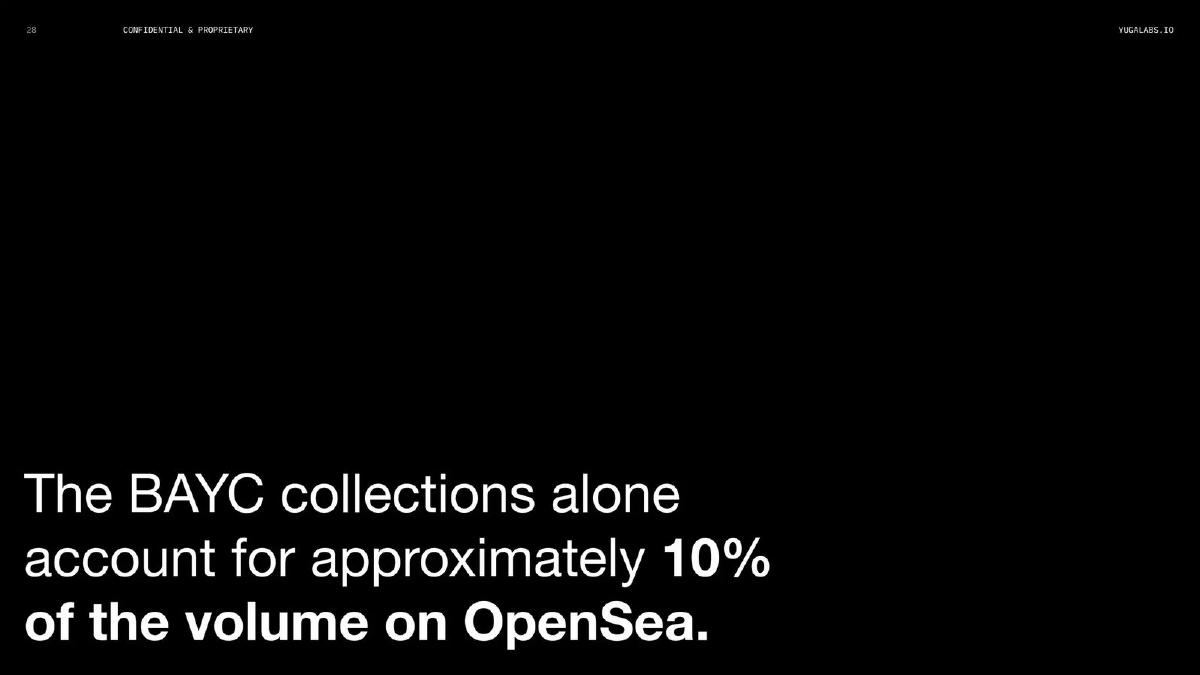
This is the most traditional 'traction' slide in the set. It contains a single, powerful sentence: 'The BAYC collections alone account for approximately 10% of the volume on OpenSea.' In a market as fragmented as NFTs, claiming a double-digit share of the primary marketplace's total volume is a significant indicator of liquidity and demand.
Slide 45 & 46: The Philosophical Hook
Slide 45 features a 'Matrix-style' background with the text 'If we aren't already living in a simulation that is.' Slide 46 follows up with: 'The thing is, we already have examples of people gathering online, forming lifelong friendships, and kicking ass.' These slides are designed to build rapport with investors who are 'metaverse-native.' It frames the company's mission as a social necessity rather than just a financial opportunity.
Slide 55: The Product (MetaRPG)
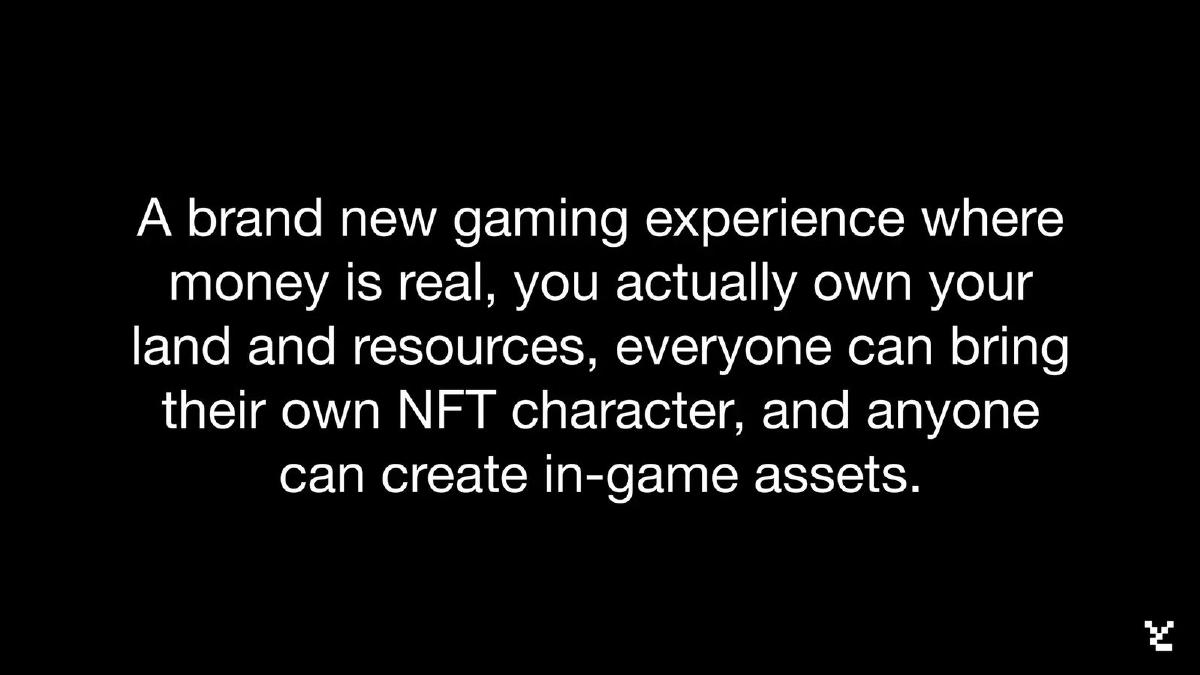
Here, the deck defines the future product. It describes a 'brand new gaming experience' characterized by four pillars: real money (crypto), ownership of land/resources, interoperability (bring your own NFT), and user-generated content (anyone can create assets). This is a direct challenge to 'walled garden' games like Roblox or Fortnite, positioning Yuga Labs as the open-source alternative.
Slide 64: The Economy (APECoin)
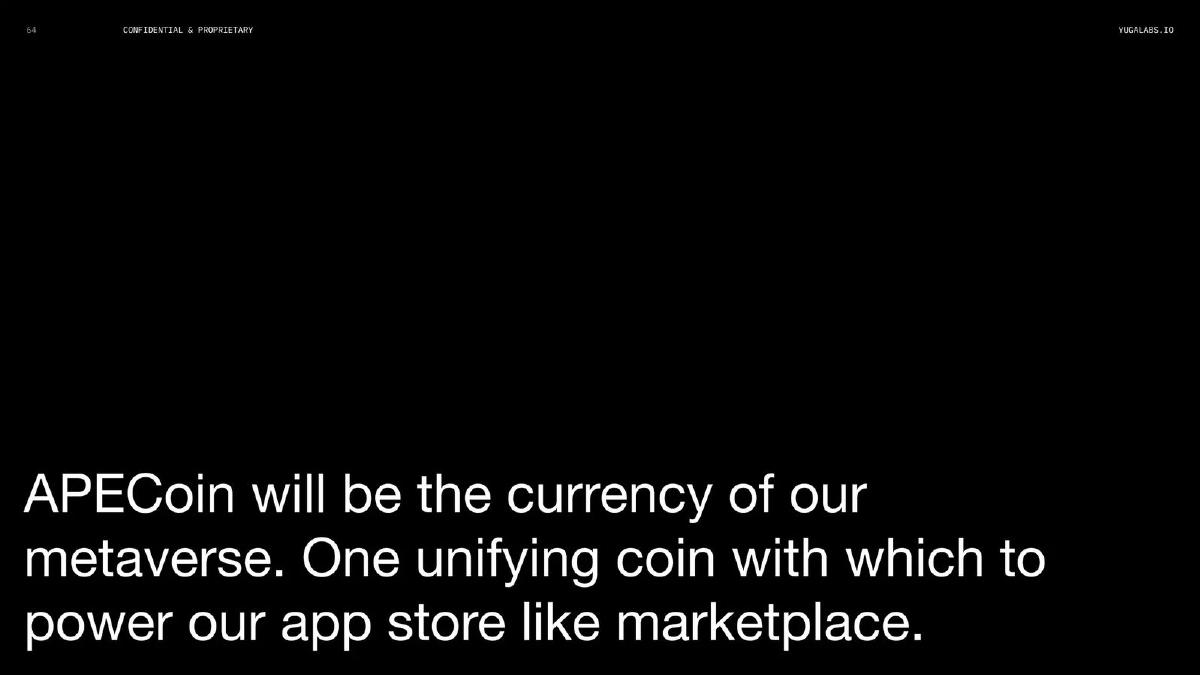
This slide introduces the tokenomics. It states that 'APECoin will be the currency of our metaverse.' Crucially, it describes the goal as an 'app store like marketplace.' This suggests that Yuga Labs intends to take a percentage of all economic activity within their ecosystem, moving their revenue model from one-off sales to platform-level taxation.
Slide 72: The Land Sale
This slide connects the gaming vision to immediate revenue. It announces that the 'MetaRPG will launch with a land sale.' It includes a cosmic visual and notes that 'land plots will correspond to real land in our game.' This was the precursor to the 'Otherside' launch, which became one of the largest events in NFT history.
Slide 87: The Roadmap and Projections
This is the 'money slide.' It provides a detailed timeline for 2022 with specific revenue projections. Key figures include:
January: BAYC vs. MAYC App Store Game. · March: APE Token and Metaverse 1-100k Land Sale ($178.2M Primary / $10.9M Secondary). · May: Airdropping Kodas ($2.3M Secondary). · August: The Trial of Jimmy the Monkey + Metaverse 101k-200k Land Sale ($178.2M Primary / $8.5M Secondary). · September: Mecha Ape launch ($50M Projected Net Rev). · 2021 Totals: $106.7M in projected secondary sales for BAYC/MAYC.
The roadmap shows a relentless pace of monetization, projecting over $400M in revenue for 2022 alone.
What Works in the Yuga Labs Deck
1. Massive Market Share: The claim of 10% OpenSea volume (Slide 28) is a 'mic drop' moment. It proves that they aren't just one of many projects; they are the market leader. 2. Tangible Community: The use of physical artifacts (Slide 15) proves that the IP has 'legs.' Investors love to see brands that customers are willing to tattoo on their bodies or put on food trucks. 3. Clear Monetization: Unlike many 'Web3' pitches that are vague about how they make money, Slide 87 is incredibly specific. It maps out exactly which months will generate hundreds of millions of dollars.
What is Missing
1. Team Slide: In the 10 slides provided, there is no mention of the founders (Gargamel, Gordon Goner, etc.) or their backgrounds. For a $450M raise, the 'who' is usually as important as the 'what.' 2. The Ask: There is no slide detailing how much they are raising or what the valuation is. While the source listing mentions $450M from a16z, the slides themselves don't disclose the terms. 3. Technical Architecture: The deck promises a massive 'MetaRPG' but provides no details on the engine, the development team, or how they will handle the technical hurdles of thousands of concurrent users in a blockchain environment.
Founder's Guide: What to Copy
The 'Vision to Revenue' Bridge: Founders should copy how Yuga Labs connects a high-level vision (the Metaverse) to a concrete revenue event (the Land Sale). They don't just say 'we will build a game'; they say 'we will sell land in March to fund the game.' Social Proof over Charts: If you have a cult-like following, show it. The collage on Slide 15 is more effective than a line chart of Twitter followers because it shows high-intent engagement. Platform Ambition: Don't just pitch a product; pitch an ecosystem. By framing APECoin as an 'app store' currency, Yuga Labs shifted their valuation from a 'content studio' to a 'tech platform.'
Frequently asked questions
- What is the primary business model proposed in the deck?
- The model is built on three pillars: primary NFT sales (like the $178.2M land sales), secondary market royalties (projected at over $100M for 2021), and the utility of APECoin within a proprietary marketplace. Yuga Labs aims to move from being an NFT creator to a platform operator, similar to an 'app store' for the metaverse.
- How does Yuga Labs define its 'Metaverse' strategy?
- They describe it as a 'MetaRPG' where money is real and users own their land and resources. Unlike closed systems, they emphasize interoperability, claiming users can 'bring their own NFT character' into the experience. This is supported by a massive land sale strategy to bootstrap the virtual economy.
- What metrics does the deck use to prove traction?
- Rather than DAU or MAU, the deck uses market volume and cultural penetration. The standout figure is Slide 28, which claims BAYC accounts for 10% of OpenSea's total volume. They also use a collage of real-world community artifacts—skateboards, sneakers, and physical gatherings—to prove brand loyalty.
- What are the projected revenue streams for 2022?
- Slide 87 outlines several major events: two land sales totaling approximately $356M in primary revenue, a 'Mecha Ape' launch projected at $50M, and a 'MechaDog' monetization plan at $16M. These are supplemented by ongoing secondary sales and airdrops like 'Kodas'.
- Is there a clear exit strategy or 'ask' in the deck?
- In the 10 slides provided, there is no explicit 'ask' slide detailing the $450M round or a specific exit strategy. The deck functions more as a vision document and a revenue roadmap, focusing on the scale of the ecosystem rather than the mechanics of the investment round.