Zapata AI’s SPAC presentation marks a strategic evolution, positioning the firm as the leader in 'Industrial Generative AI.' The deck argues that while 'Big Tech' focuses on general-purpose, costly, and often unreliable LLMs, Zapata uses quantum-inspired mathematics to create smaller, more accurate models for industrial applications like race strategy and manufacturing scheduling. With a $331M raise through Andretti Acquisition Corp., the company emphasizes its deep scientific bench—boasting 24 PhDs and 85,000 citations—and its ability to compress models like GPT2-XL to run with 300x fewer to…
Key takeaways
- The company positions itself as 'The Industrial Generative AI Company' to differentiate from general-purpose LLMs (Slide 1).
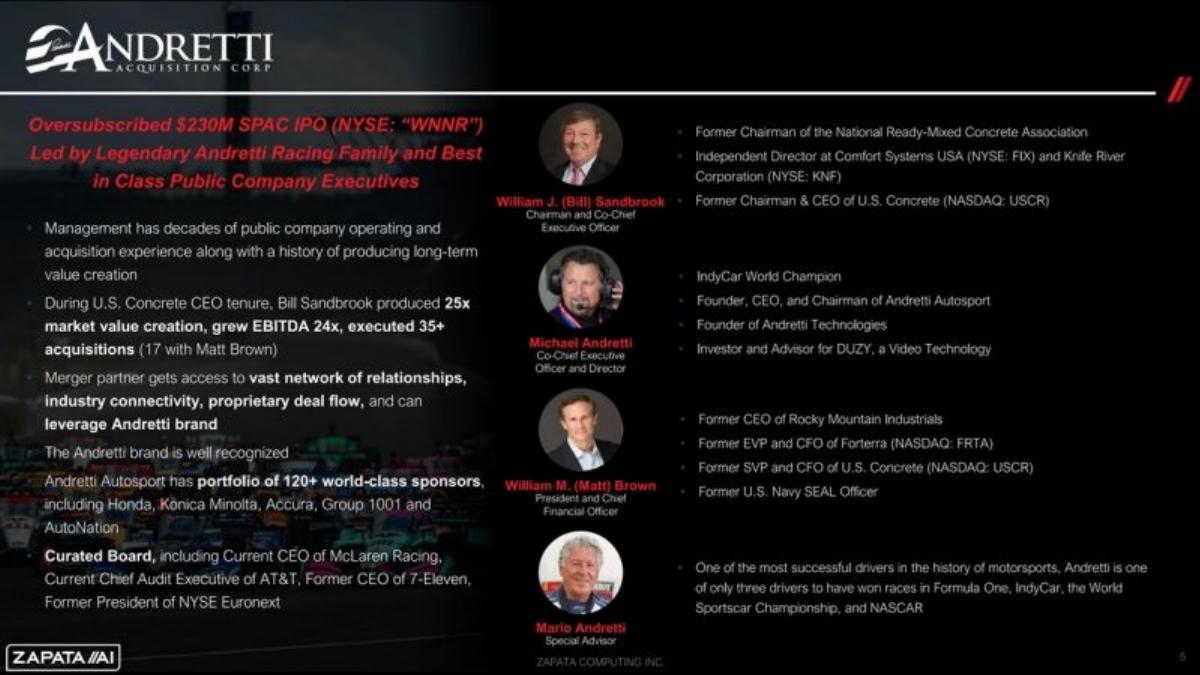
- The SPAC partner, Andretti Acquisition Corp., brings a $230M oversubscribed IPO and a network of 120+ world-class sponsors (Slide 5).
- Zapata identifies key LLM failures including inconsistency, high costs, and a lack of utility for numerical problems (Slide 7).
- The technical edge is 'Quantum Science,' which offers superior generalization and expressibility without requiring quantum hardware (Slide 11).
- Model compression results show a compressed GPT2-XL requires 300x fewer tokens for the same performance (Slide 13).
- Industrial use cases include 'virtual sensors' for tire degradation and race strategy for Andretti Autosport (Slide 15).
- A BMW case study shows Zapata's GEO algorithm tied or outperformed state-of-the-art solvers in 71% of configurations (Slide 17).
- The total addressable market for Generative AI software and adjacencies is estimated at $1.3T by 2032 (Slide 21).
The Industrial Pivot: Zapata AI’s SPAC Narrative
Zapata AI’s pitch deck for its SPAC merger with Andretti Acquisition Corp. is a masterclass in repositioning. Originally known as Zapata Computing, a pure-play quantum software firm, the company rebranded to Zapata AI to capitalize on the generative AI boom. This deck, consisting of 28 slides (14 of which are analyzed here), serves as the definitive argument for why quantum-inspired mathematics is the missing link in enterprise AI. It moves away from the theoretical future of quantum hardware and focuses on the immediate 'Industrial' applications of their proprietary algorithms.
Slide 1: Title and Branding
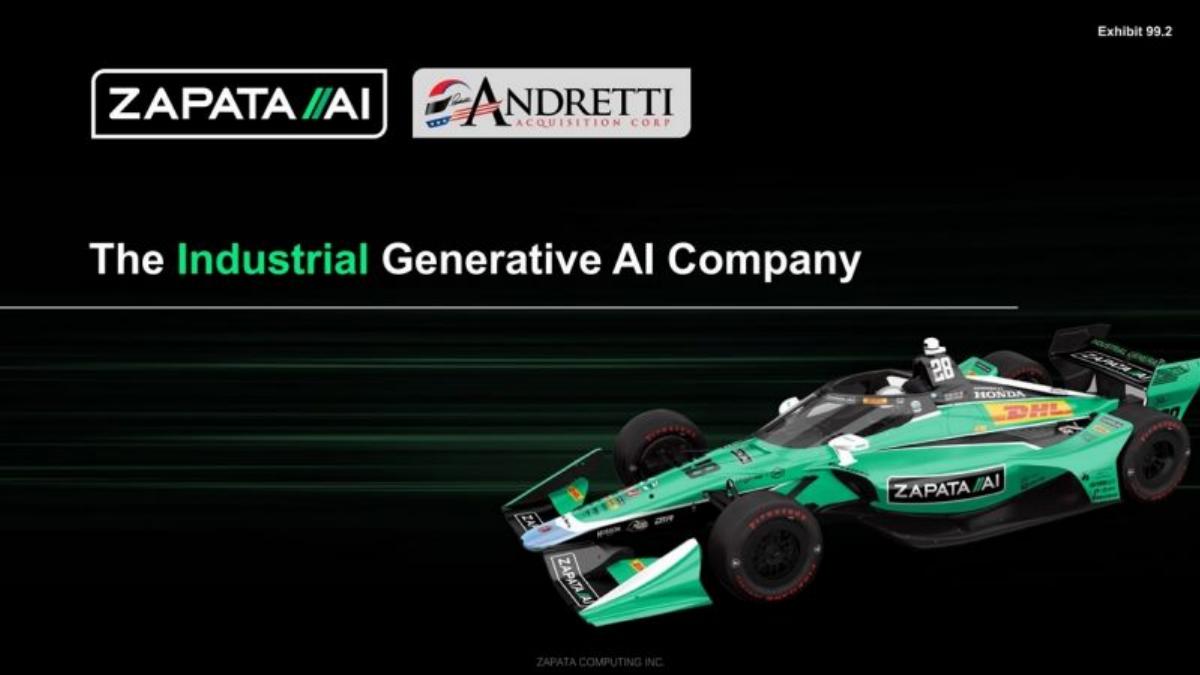
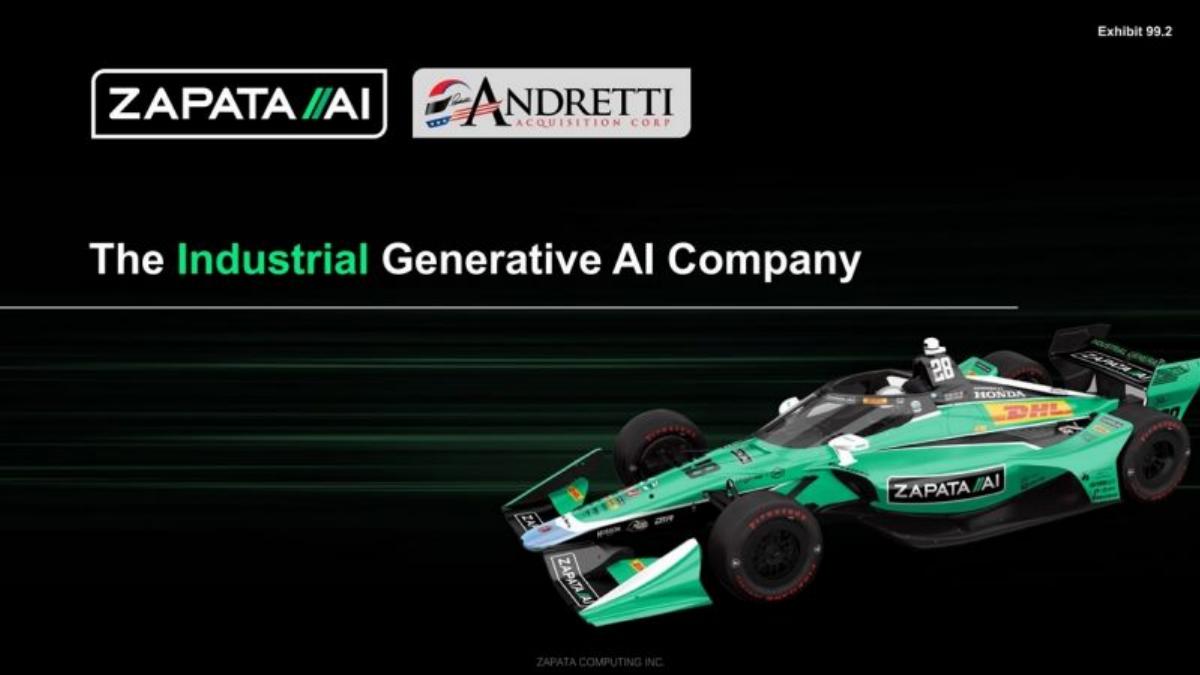
The cover slide establishes the core identity: 'The Industrial Generative AI Company.' It features the Zapata AI logo alongside the Andretti Acquisition Corp. logo. The visual of an Andretti race car reinforces the 'Industrial' and high-performance nature of the brand, signaling that this is not a chatbot company but a firm dealing with complex, real-world physics and engineering problems.
Slide 2: Cautionary Notes
This is a standard legal disclaimer for a public filing. It covers the use of data, the nature of the business combination, and the fact that the presentation is for informational purposes only. It explicitly mentions that Andretti intends to file a registration statement on Form S-4 with the SEC.
Slide 5: The SPAC Partner - Andretti Acquisition Corp.
This slide focuses on the credibility of the merger partner. It highlights an 'Oversubscribed $230M SPAC IPO' led by the 'Legendary Andretti Racing Family.' Key personnel listed include William J. Sandbrook (Chairman and Co-CEO), Michael Andretti (Co-CEO), and Mario Andretti (Special Advisor). The slide emphasizes their track record, noting that Sandbrook produced 25x market value creation during his tenure as CEO of U.S. Concrete. The message is clear: Zapata is partnering with proven public company executives and a brand with 120+ world-class sponsors.
Slide 7: The Problem with General Generative AI
Zapata identifies the 'hallucination' and cost problems of current LLMs. Using news clippings from sources like CNBC and Vice, the slide categorizes issues into 'Inconsistent' (fake cases, bad at math), 'Too Big (And Costly)' (extraordinary costs, carbon footprint), and 'Other Challenges' (data privacy, model security, and a focus on language rather than numerical data). This sets the stage for a specialized solution.
Slide 9: Defining Industrial Generative AI
This slide uses a side-by-side comparison to differentiate 'Generative AI' (Big Tech) from 'Industrial Generative AI' (Zapata). While Big Tech is 'unreliable' and 'trained on general data,' Zapata is 'accurate' and 'trained on customer-specific data.' Crucially, it notes that while language models are 'not useful for numerical problems,' Zapata’s models 'translate numerical data into accurate prose' and leverage quantum generative models for statistical advantages.
Slide 11: The Quantum Advantage Without the Hardware
This is a pivotal technical slide. It claims that 'Quantum statistics for AI are superior to classical statistics—and don’t require quantum hardware.' It defines two areas of outperformance: Generalization (better at extrapolating missing information) and Expressibility (a greater range of possible solutions). A diagram shows the 'Quantum Model' distribution encompassing a larger area than the 'Classical Model,' suggesting a more robust solution space.
Slide 13: Model Compression and Efficiency
To address the 'Too Big' problem mentioned earlier, Zapata presents data on model compression. The slide features two charts showing that 'Compressed models are more accurate than uncompressed models of the same size.' The headline figure is that a 'Compressed GPT2-XL requires 300x fewer tokens to achieve the same performance as GPT2-XL.' This is a direct appeal to enterprise buyers concerned with the high OpEx of running large models.
Slide 15: Case Study - Andretti Autosport
The deck moves from theory to practice with a race analytics example. It describes 'virtual sensors' that predict behavior that cannot be measured directly, such as tire degradation. The slide maps these racing use cases to 'Analogous Use Cases' in broader industry: tire degradation maps to supply chain/manufacturing, race strategy maps to finance/utilities, and predictive modeling maps to insurance/IT. This demonstrates the horizontal potential of their vertical expertise.
Slide 17: Case Study - BMW Manufacturing
A second case study focuses on optimizing worker schedules at BMW manufacturing plants. The slide shows a heat map where Zapata’s 'GEO algorithm' tied or outperformed state-of-the-art solvers in 71% of configurations. This was done in collaboration with the MIT Center for Quantum Engineering, adding academic weight to the commercial claim.
Slide 19: The Value Proposition
This slide summarizes the offering into four pillars: Faster & Cheaper Models (1000x speed-up on complex models), More Accurate Models (novel solutions to enterprise problems), Proprietary Techniques (globally competitive patent portfolio), and Platform (full-stack development in customer-controlled environments). It emphasizes that models are trained on customer data within the customer's private environment.
Slide 21: Market Opportunity (TAM)
Zapata presents an 'enormous potential TAM.' Citing Bloomberg Intelligence, it identifies a $1.3T Total Addressable Market by 2032. It further breaks down the 'Value of potential disruption for enterprise' using McKinsey data, estimating a $2.6T to $4.4T P&L impact across functions like Sales & Marketing ($760B) and Software Engineering ($580B). Zapata identifies its own Serviceable Obtainable Market (SOM) at $366B.
Slide 23: Go-To-Market Strategy
The strategy is split into 'Establish Category & Thought Leadership' (white papers, Gartner 'Cool Vendor' status, Forbes features) and 'Build Brand Through Customer Success Stories.' It lists key verticals: Automotive, Chemicals, Defense, Energy, Finance, Logistics, and Pharma. Logos for Andretti, BMW, Insilico Medicine, and Foxconn are displayed as evidence of expansion in key verticals.
Slide 25: The Team and Investors
The team slide is heavy on academic and industry credentials. CEO Christopher Savoie, Ph.D., is credited as the inventor of the NLU behind Apple’s Siri. CTO Yudong Cao, Ph.D., has 2.4K+ citations. The company boasts 60 employees, 41 scientists/engineers, and 24 PhDs. It also lists $64M raised to date from blue-chip investors like BASF, Bosch, Comcast Ventures, and Merck. The Board of Directors includes figures from Google, Honeywell, and the former President of NYSE Euronext.
Slide 28: Closing Slide
The final slide is a simple, clean display of the Zapata AI logo against a dark, high-tech background, maintaining the consistent branding used throughout the deck.
What Zapata AI Does Well
The deck excels at bridging the gap between 'Deep Tech' and 'Business Value.' Quantum computing is notoriously difficult to explain to generalist investors, but by framing it as a tool for 'Industrial Generative AI,' Zapata makes the technology tangible. They focus on outcomes—300x fewer tokens, 71% better scheduling, tire degradation prediction—rather than just the underlying math. The use of high-profile industrial logos like BMW and Foxconn provides immediate 'social proof' that their complex algorithms work in the real world.
What Is Missing
While the deck is strong on technical validation and market size, it is light on detailed financial projections and unit economics. As a SPAC presentation, one might expect more granular detail on revenue growth, customer acquisition costs (CAC), and lifetime value (LTV), especially given the 'SaaS' business model mentioned in the catalogue. Additionally, while it mentions a 'Platform,' there is little visual evidence of the software interface itself, leaving the 'how' of the user experience somewhat a mystery. The competitive landscape is also largely ignored, other than a broad dismissal of 'Big Tech' LLMs.
What Founders Should Copy
Founders in complex technical spaces should emulate Zapata’s 'Analogous Use Case' strategy (Slide 15). If you have a niche or highly technical product, showing how a success in one vertical (like IndyCar racing) translates to a massive horizontal market (like Logistics or Finance) is a powerful way to expand your TAM in an investor's mind. Furthermore, the 'Problem/Solution' framing on Slide 9 is a perfect example of how to position against dominant market incumbents by highlighting their specific weaknesses (cost, privacy, numerical inaccuracy) and presenting your product as the surgical alternative to their 'one-size-fits-all' approach.
Frequently asked questions
- What is 'Industrial Generative AI' according to Zapata?
- Zapata defines Industrial Generative AI as models that are accurate, trained on customer-specific data, and optimized for speed and cost. Unlike general LLMs that focus on language, Zapata’s approach translates numerical data into accurate prose and leverages quantum generative models for statistical advantages over classical machine learning. This is specifically designed for private enterprise environments where data privacy and numerical accuracy are paramount.
- Does Zapata AI require a quantum computer to run its software?
- No. A key value proposition stated on slide 11 is that their quantum statistics for AI are superior to classical statistics and 'don’t require quantum hardware.' They use quantum-inspired methods and proprietary algorithms built from quantum expertise that can run on classical high-performance computing infrastructure, making the technology deployable today without waiting for fault-tolerant quantum hardware.
- How does Zapata AI improve the efficiency of Large Language Models?
- Zapata utilizes model compression techniques. According to slide 13, they can compress models to reduce compute costs and speed up runtimes. Their data shows that a compressed version of GPT2-XL is more accurate than an uncompressed model of the same size and requires 300x fewer tokens to achieve the same performance level as the original GPT2-XL.
- Who are the key customers and partners mentioned in the deck?
- The deck highlights several high-profile industrial and enterprise partners. These include Andretti Autosport (for race analytics and tire degradation), BMW (for manufacturing plant scheduling optimization), and mentions of collaborations or case studies involving Insilico Medicine, Foxconn, and the MIT Center for Quantum Engineering. Their board and leadership also have ties to companies like Apple, Google, and Merck.
- What is the financial background of the SPAC merger?
- Zapata AI merged with Andretti Acquisition Corp. (NYSE: WNNR), which had an oversubscribed $230M SPAC IPO. The deck notes that before this transaction, Zapata had raised $64M in venture capital from investors including Comcast Ventures, Honeywell, and BASF. The catalogue facts indicate the total amount raised through the SPAC process was approximately $331M.