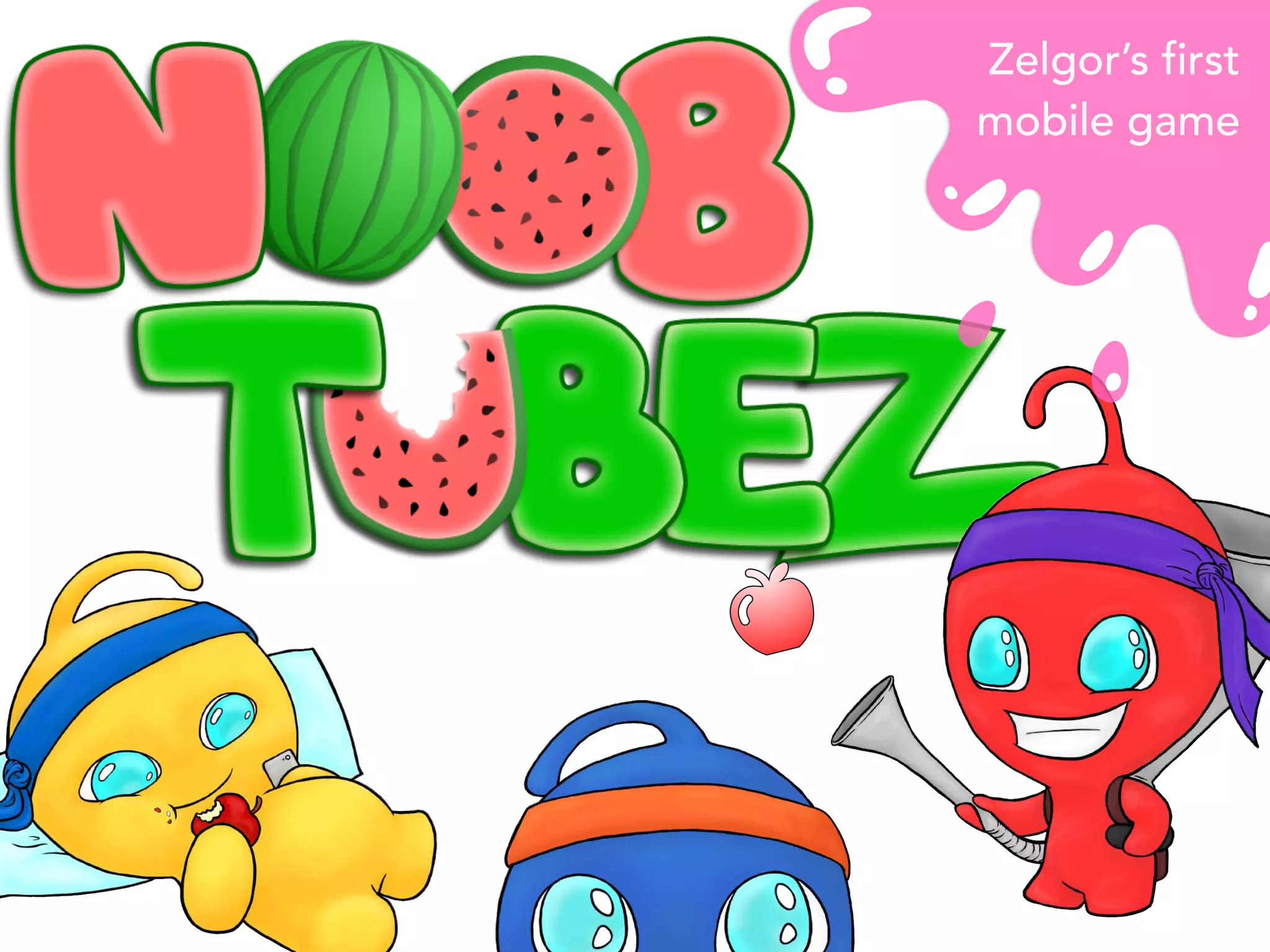
Zelgor’s pitch deck for its debut mobile game, Noob Tubez, is a study in leveraging social proof over technical depth. The deck describes the game as a hybrid of dodgeball and map-based strategy, targeting three distinct gamer personas. However, the presentation lacks standard venture metrics like User Acquisition costs, Lifetime Value, or a specific current funding ask. Instead, it leans on a 'Zelgor's DNA' slide that lists heavyweights like Tim Draper, Nolan Bushnell, and Shawn Fanning. While the business model outlines a 'no banner ads' approach focused on sponsored territories, the deck l…
Key takeaways
- The deck introduces 'Noob Tubez' as Zelgor's first mobile game on slide 1.
- Successful games are defined by three elements: Unique Feel, Excellent Game Structure, and Discoverability, according to slide 2.
- The gameplay is described on slide 3 as 'Dodgeball meets map-based strategy games' involving squad building and territory battles.
- Target audiences are segmented into casual, younger, and core gamers on slide 4.
- The business model on slide 5 explicitly rejects banner and pop-up ads in favor of sponsored territories and in-app purchases.
- Slide 6 reveals a highly pedigreed advisor list including Nolan Bushnell (Atari), Shawn Fanning (Napster), and Joe Abrams (MySpace).
- The company raised $250k in a Seed Round 1 between August 2012 and September 2013, as noted on slide 6.
- The deck omits a specific 'Ask' slide, current valuation, or detailed roadmap for the next development phase.
Slide-by-Slide Analysis
Slide 1: Title Slide
The opening slide introduces the game title, Noob Tubez , and identifies it as Zelgor’s first mobile game . The visual style is heavily illustrative, featuring three character designs (the 'Noobs') in red, blue, and yellow. The branding uses a playful, bubble-letter font with fruit motifs (watermelon), signaling a casual, perhaps younger-skewing aesthetic. There is no mention of the parent company's mission or the specific purpose of the deck on this slide.
Slide 2: Building Better Games
This slide attempts to establish a philosophical framework for the studio's development process. It lists three 'key elements' for successful games: 1. Unique Feel, 2. Excellent Game Structure, and 3. Discoverability . To add authority to these claims, the slide includes a quote from Nolan Bushnell, Founder of Atari : 'All the best games are easy to learn and difficult to master.' This is a classic 'appeal to authority' tactic, setting the stage for the team's credentials later in the deck.
Slide 3: Excellent Game Structure
Zelgor defines their gameplay as 'Dodgeball meets map-based strategy games.' The slide uses four bullet points to describe the player experience: unlocking new Noobs for a squad, an 'easy to pick up' food fight arcade game, territory battles for social incentives, and a combination of immediate and long-term goals. While it describes the 'what,' it lacks the 'how.' There are no screenshots of the user interface or the map-based strategy elements, leaving the actual mechanics to the reader's imagination.
Slide 4: Target Audience
The audience is broken down into three personas, each illustrated with a character. Casual gamers are defined by short sessions and divided attention. Younger gamers are noted for playing during class and free time. Core gamers are defined by long-term retention ('days, months, and years'). This is a very broad targeting strategy; usually, investors prefer to see a primary 'beachhead' demographic rather than a claim that the game is for everyone from casual to core players.
Slide 5: Business Model
The monetization strategy is split into current and future opportunities. The game is Free to Download with in-app purchases for 'key items.' A notable point is the commitment to 'No Banner or Pop-up Ads,' which were common at the time of this deck's creation. Instead, they propose 'Sponsored Territories and Quests.' Future opportunities include platform licensing, expansion to PC and Console, and merchandising. This suggests the founders view 'Noob Tubez' as an IP play rather than just a single software product.
Slide 6: Zelgor’s DNA
This is the 'Team' slide, though it focuses heavily on external validation. John Fanning Jr. is listed as Founder and CEO, supported by a core team of four (Marketing, Product, Game Design, and Development). The 'Investors' and 'Advisors' columns are the most prominent, featuring high-profile names like Tim Draper , Larry Sonsini , Nolan Bushnell , and Shawn Fanning . The slide also notes Past Financials of $250k from a Seed Round 1 spanning Aug. 2012 to Sept. 2013. This slide serves as the primary credibility driver for the entire pitch.
What Zelgor Does Well
The deck excels at social proof . By securing advisors like the founders of Atari and Napster, Zelgor communicates that they have access to top-tier industry knowledge and networks. This is often enough to get a first meeting, even if the product details are sparse. The clear rejection of intrusive banner ads in the business model also shows a forward-thinking approach to user experience that was relatively progressive for the early 2010s mobile market.
The visual consistency is also a strength. The use of custom character illustrations throughout the deck helps to sell the 'IP' (Intellectual Property) aspect of the business. It makes the company feel like a creative studio rather than just a group of developers, which aligns with their stated goals of merchandising and cross-platform expansion.
What is Missing from the Deck
The most glaring omission is actual gameplay footage or UI mockups . For a mobile game pitch, seeing the 'map-based strategy' in action is critical to understanding if the 'dodgeball' mechanic actually works. Without these, the 'Excellent Game Structure' slide remains purely theoretical.
Furthermore, there is no 'Ask' slide . We know they raised $250k in the past, but the deck does not state how much they are looking for now, what the valuation is, or what the specific milestones for the next round of funding will be. There is also a complete lack of market analysis . While they mention target audiences, they don't provide data on the size of the mobile strategy market or identify direct competitors like Clash of Clans or other territory-based games that were dominant during that era.
Finally, the deck lacks unit economics . There are no projections for Customer Acquisition Cost (CAC) versus Lifetime Value (LTV). In the highly competitive mobile gaming space, showing a path to profitable user acquisition is usually a requirement for institutional investors.
Founder Takeaways
Leverage your network: If you have high-profile advisors, give them a dedicated column. The 'Zelgor's DNA' slide is the strongest part of this deck because it suggests the founders are 'insiders' in the tech world. · Define your 'No': Zelgor’s explicit stance against banner ads is a strong positioning statement. It tells investors what kind of brand you are building and what user experience you value. · Show, don't just tell: While the illustrations are nice, a gaming deck needs to show the game. If you are pitching a 'unique feel,' you need to provide evidence of that feel through screenshots or video links. · Be specific about the audience: Claiming to target casual, young, and core gamers simultaneously is often a red flag. It suggests a lack of focus. Pick a primary audience and explain why your game is the perfect fit for them first. · Include the 'Ask': Never leave an investor wondering what you want. Every deck should conclude with a clear statement of the capital required and what that capital will achieve (e.g., 'Seeking $1M to reach 100k DAU').
Frequently asked questions
- What is the core gameplay loop of Noob Tubez?
- According to slide 3, the game combines a 'food fight arcade game' with a 'battle for territories.' Players unlock new characters (Noobs) for their squad and engage in map-based strategy. The deck claims this provides a mix of immediate satisfaction through arcade play and long-term goals through territory acquisition.
- How does Zelgor plan to monetize without traditional ads?
- Slide 5 states the game will be free-to-play with in-app purchases for 'key items.' Uniquely, they plan to avoid banner and pop-up ads, opting instead for 'Sponsored Territories and Quests' and 'Sponsored Items and Power-ups,' suggesting a native advertising or brand integration strategy.
- Who are the notable investors and advisors involved with Zelgor?
- Slide 6 lists a significant roster of tech veterans. Investors include Tim Draper (DFJ) and Larry Sonsini. The advisory board features Nolan Bushnell (Founder of Atari), Shawn Fanning (Co-founder of Napster), Joe Abrams (Co-founder of MySpace), and Kai Huang (Co-founder of RedOctane).
- What is the target demographic for the game?
- Slide 4 identifies three groups: Casual gamers (short sessions, divided attention), Younger gamers (playing in free time and in class), and Core gamers (playing for days, months, and years). The deck attempts to position the game as having broad appeal across different engagement levels.
- What financial information is disclosed in the deck?
- The only financial data provided is on slide 6 under 'Past Financials.' It indicates a $250k Seed Round 1 that took place from August 2012 to September 2013. The deck does not state how much capital is currently being sought or the company's burn rate.