Gaming Business Model Slides: 8 Real Pitch Deck Examples
How gaming startups show who pays: players buying in-game items, operators sharing gaming revenue, studios paying for tools, and virtual currency splits.
Gaming Business Model Slide: Players, Operators or Studios?
In gaming, the person playing is often not the person paying. Money can come from players buying items, from operators who share their revenue, or from studios paying for tools. The eight slides below show how gaming startups explained who pays them and on what basis.
TL;DR
Say who pays and on what basis. Bragg names the payer (casino operators) and the basis (a share of gross gaming revenue). Incymo gives prices: $199 per scenario and about $4k per game per month. Slides that only say "free-to-play" or "dual monetization" leave investors to guess how much players spend.
Gaming business model slides from real pitch decks
Each example shows the slide above its analysis and links to the full teardown. Slides with a clear payer and basis come first. Claims are as shown on the slides; comments and calculations are ours.
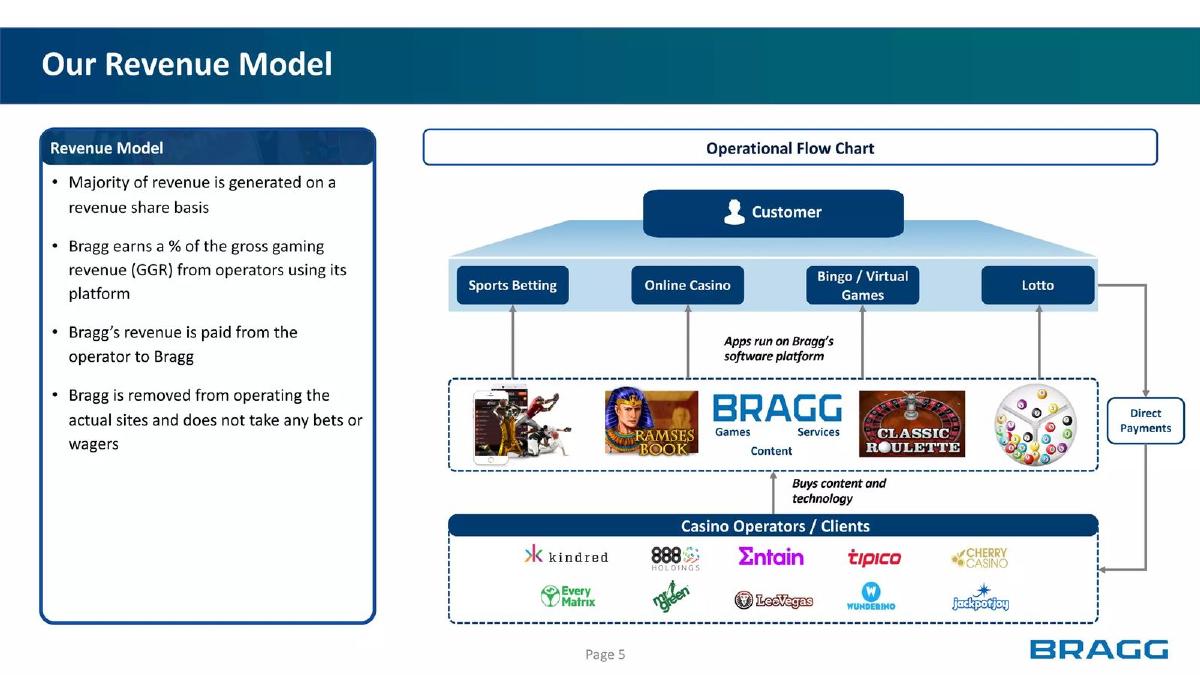
Bragg Gaming Group business model slide — slide 6
Casino and betting content and platform supplier to online operators.
Bragg Gaming Group deck, slide 6. Exact stored slide matched to this analysis.
Our analysis: B2B revenue share: operators pay a percentage of gross gaming revenue.
Evidence and limitation: Payer, basis and flow of money are all clear, and it says what Bragg does not do (take bets). The percentage share isn't shown, and "majority" means some revenue comes from other arrangements that aren't described. The logos don't say which operators pay or how much.
What a founder can adapt: "Operators pay us [X]% of GGR on our content; [Y]% of revenue is revenue share."
Supporting analysis
What the deck claims: "Our Revenue Model." "Majority of revenue is generated on a revenue share basis." "Bragg earns a % of the gross gaming revenue (GGR) from operators using its platform." "Bragg's revenue is paid from the operator to Bragg." "Bragg is removed from operating the actual sites and does not take any bets or wagers." A flow chart shows customers using operators' sports betting, casino, bingo and lotto apps that "run on Bragg's software platform", with operator logos including Kindred, 888, Entain and LeoVegas.
Presentation choice: An investor can see who pays and why Bragg's revenue rises with operators' play.
When it does not fit: Naming a revenue share without the typical rate.
AI tools that help game studios increase in-game monetization.
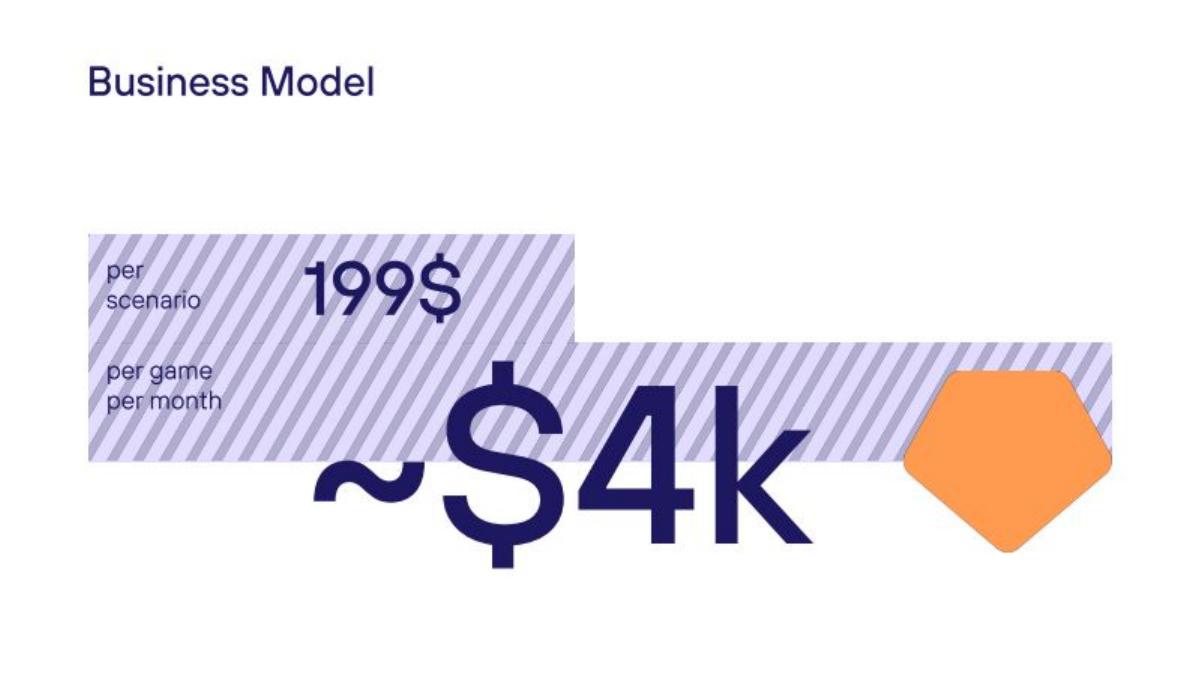
Incymo.ai deck, slide 6. Exact stored slide matched to this analysis.
Our analysis: B2B pricing: a fee per unit and a typical monthly spend per game.
Evidence and limitation: Two prices on one slide and nothing else. It doesn't say who the buyer is (implied by the deck: game studios), what a scenario is, or how the two prices relate. Our calculation: $4,000 ÷ $199 ≈ 20, so the monthly figure would equal about 20 scenarios a month if it were built that way; the slide doesn't say it is.
What a founder can adapt: "Studios pay $[X] per [unit]; a typical game uses [n] a month = $[Y]."
Supporting analysis
What the deck claims: "Business Model." "per scenario 199$." "per game per month ~$4k."
Presentation choice: Prices make spend per customer easy to estimate.
When it does not fit: Two prices without saying how they connect.
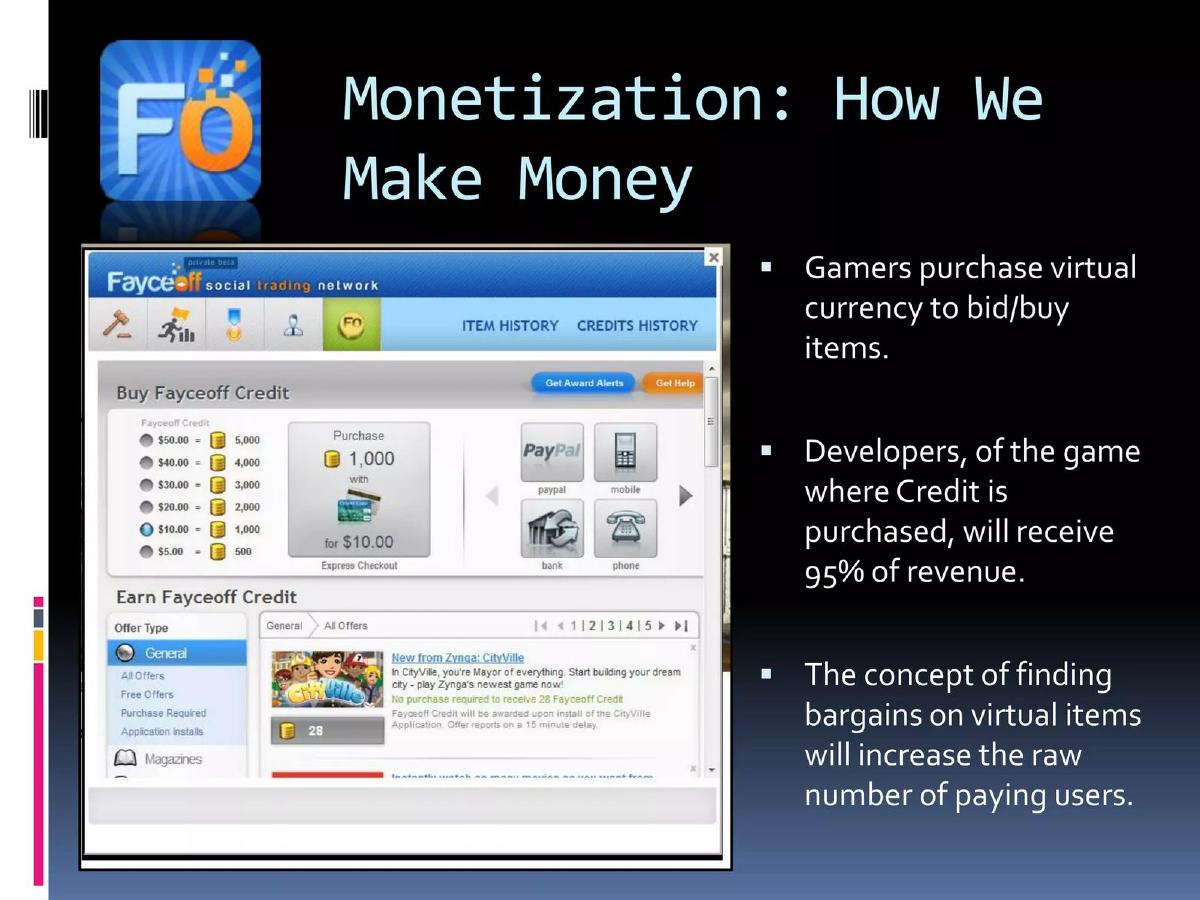
Fayceoff deck, slide 5. Exact stored slide matched to this analysis.
Our analysis: Virtual currency sale with a stated revenue split.
Evidence and limitation: Payer (gamers), what they buy (credits) and a price list (1 credit = 1 cent on every pack shown). The split is stated from the developer's side: 95% to developers. Our reading: that leaves at most 5% for Fayceoff before payment costs, but the slide doesn't state Fayceoff's share or who pays payment fees. The last bullet is a hope, not a result.
What a founder can adapt: "Players buy credits at $[X] per [n]; we keep [Y]% after developer share and payment fees."
Supporting analysis
What the deck claims: "Monetization: How We Make Money." "Gamers purchase virtual currency to bid/buy items." "Developers, of the game where Credit is purchased, will receive 95% of revenue." "The concept of finding bargains on virtual items will increase the raw number of paying users." A screenshot shows credit packs from "$5.00 = 500" to "$50.00 = 5,000".
Presentation choice: Shows the split, which decides how much of each purchase the company keeps.
When it does not fit: Giving the partner's share without your own net share.
TouchSpin deck, slide 4. Exact stored slide matched to this analysis.
Our analysis: Player-paid model described by its mechanics.
Evidence and limitation: Names the model (free-to-play with in-app purchases) and what players buy (coins, premiums, power-ups). The 60% and 90% figures describe mobile games generally, with no source or date shown, and are not TouchSpin's own numbers. No price, share of paying players or spend per player is shown.
What a founder can adapt: "[X]% of players pay; average $[Y] a month from payers; coin packs $[Z]–$[W]."
Supporting analysis
What the deck claims: "Business Model." "Game Revenues derived mainly from F2P IAP." "F2P provide more than 60% of mobile rev and 90% of app downloads." "In-Game Economy Optimized to Monetize." "Coin and Premium Purchases to stay in the game." "PowerUps and Premiums add fun and burn coins." "Ongoing Features and Levels releases extend engagement."
Presentation choice: Explains what players spend on and why they keep spending.
When it does not fit: Industry statistics in place of your own player economics.
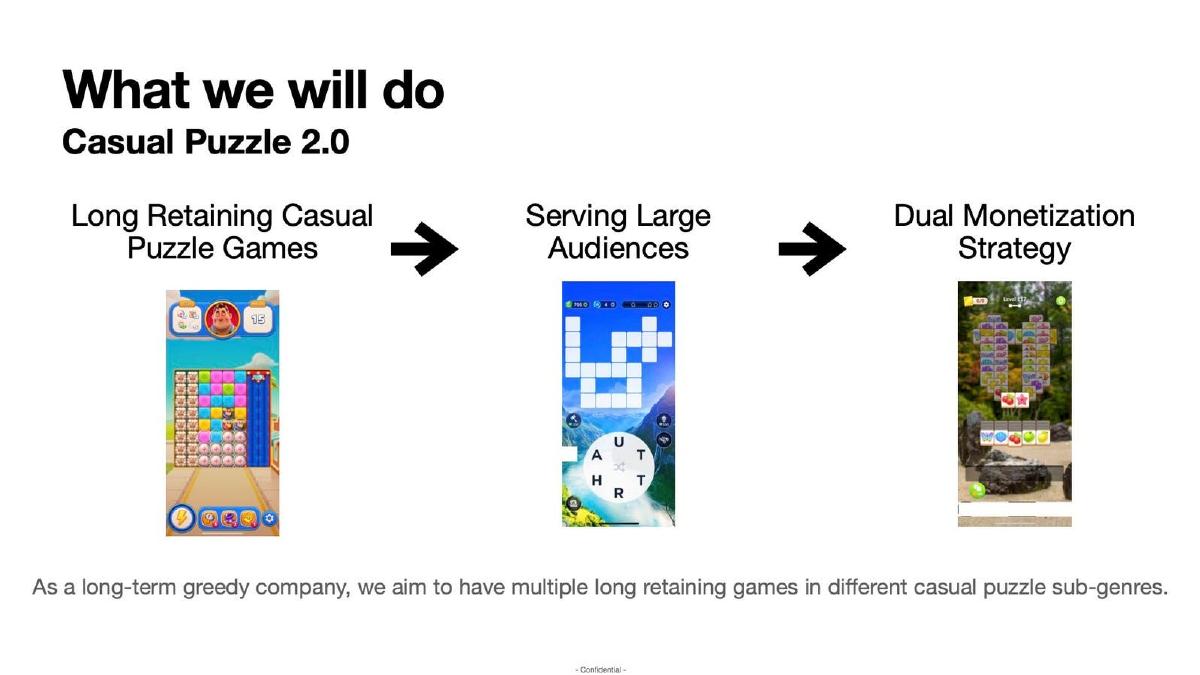
Agave Games deck, slide 3. Exact stored slide matched to this analysis.
Our analysis: Strategy slide that names the monetization approach without detail.
Evidence and limitation: Weaker example as a business model slide. It names "dual monetization" but doesn't say what the two sources are on this slide; the deck's competition slide (p5) places Agave between in-app advertising and in-app purchase, which suggests those two. No prices, ad rates or mix are shown.
What a founder can adapt: "Revenue from in-app purchases ([X]%) and ads ([Y]%); target $[Z] per daily player."
Supporting analysis
What the deck claims: "What we will do. Casual Puzzle 2.0." "Long Retaining Casual Puzzle Games" → "Serving Large Audiences" → "Dual Monetization Strategy." "As a long-term greedy company, we aim to have multiple long retaining games in different casual puzzle sub-genres."
Presentation choice: Links retention to monetization, which is the right logic for casual games.
When it does not fit: A label like "dual monetization" without saying what the two are.
Platform that runs live operations and monetization for game studios, and manages older games.
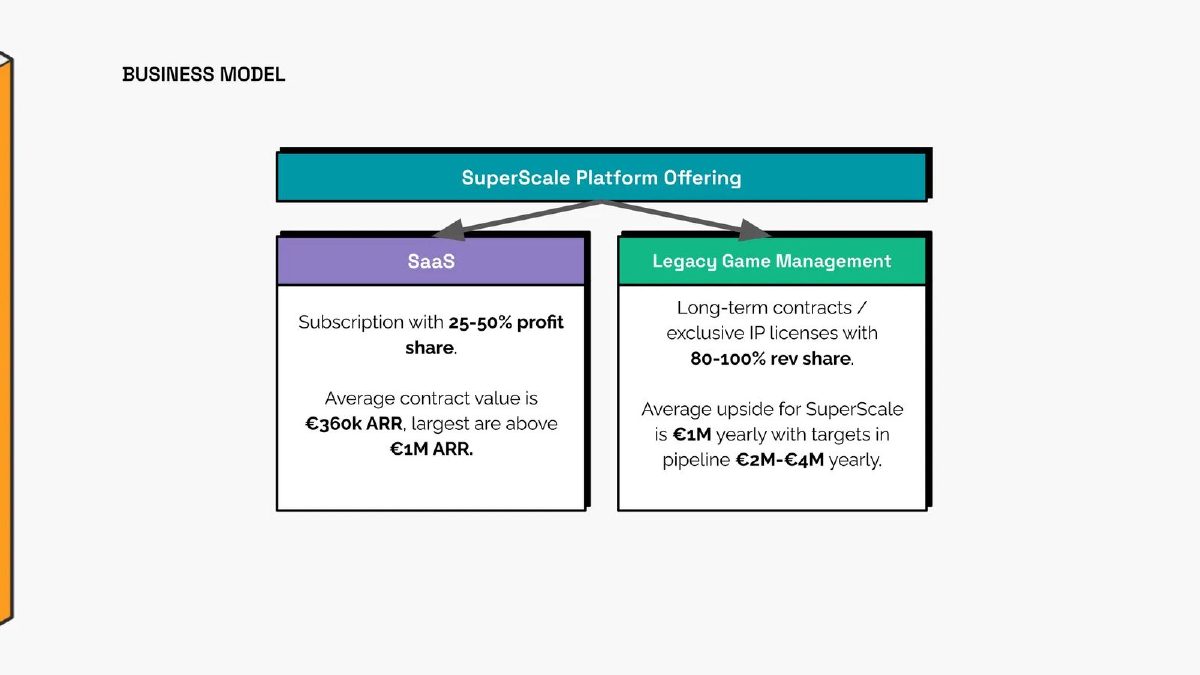
SuperScale deck, slide 11. Exact stored slide matched to this analysis.
Our analysis: B2B: studios pay a subscription plus a share of profit, or hand over most of a legacy game's revenue under a licence.
Evidence and limitation: Claimed: average contract value €360k ARR and largest above €1M; average upside €1M a year. Planned: pipeline targets of €2M-€4M a year. The number of contracts isn't shown, so total revenue can't be worked out. The two offers use different bases (profit share and revenue share), and neither says what costs SuperScale bears.
What a founder can adapt: "Studios pay [X]% of [base]; average contract €[Y] ARR across [n] contracts."
Supporting analysis
What the deck claims: "Business Model." "SuperScale Platform Offering." SaaS: "Subscription with 25-50% profit share." "Average contract value is €360k ARR, largest are above €1M ARR." Legacy Game Management: "Long-term contracts / exclusive IP licenses with 80-100% rev share." "Average upside for SuperScale is €1M yearly with targets in pipeline €2M-€4M yearly."
Presentation choice: It is the only slide here with contract sizes, so an investor can estimate revenue per customer.
When it does not fit: Profit-share and revenue-share ranges side by side without saying which base is which or how many contracts there are.
Conquerors of the Realm business model slide — slide 22
Pre-launch mobile strategy game.
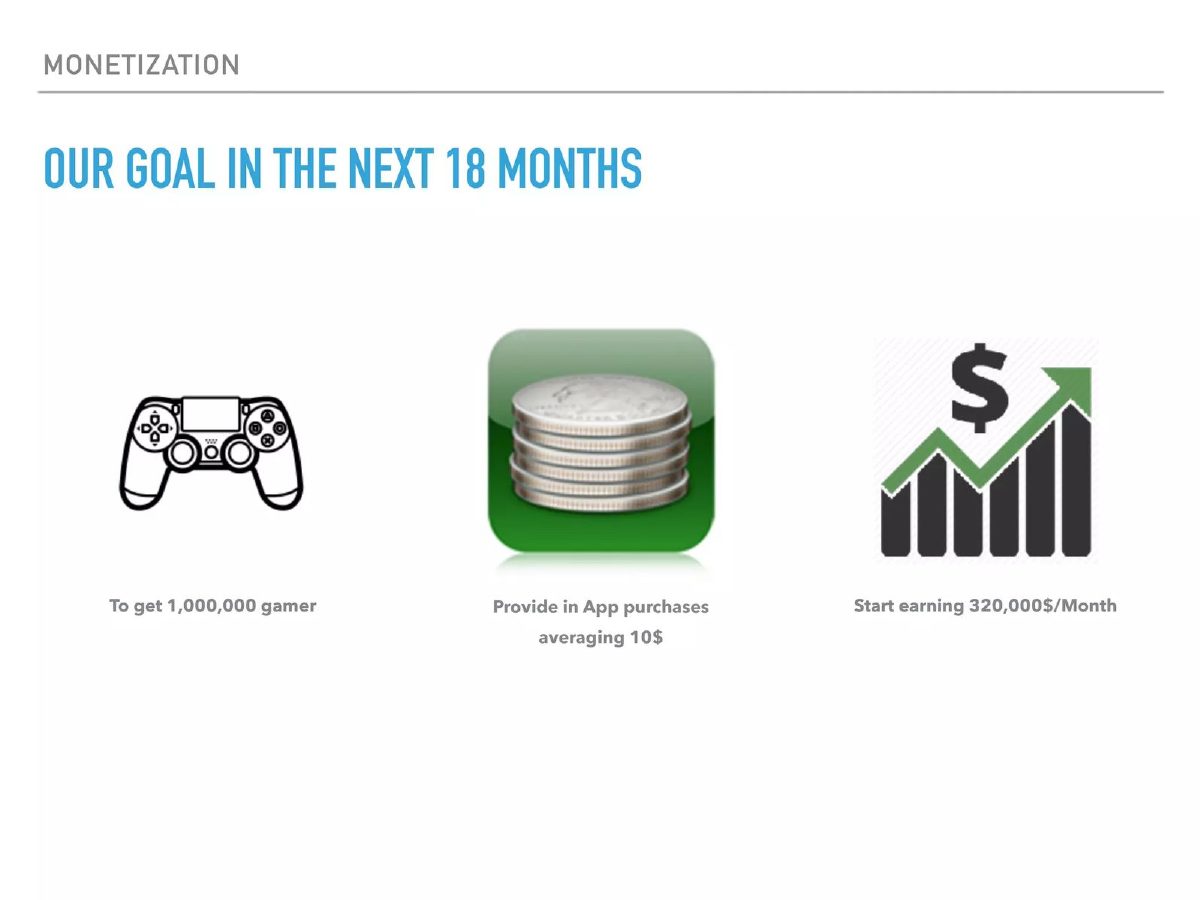
Conquerors of the Realm deck, slide 22. Exact stored slide matched to this analysis.
Our analysis: Consumer free-to-play: a target user base times an assumed paying rate and spend.
Evidence and limitation: All three numbers are planned. Our calculation: $320,000 ÷ $10 = 32,000 payers, 3.2% of 1,000,000, close to the 3.5% industry rate on p21. The industry figures have no source on either slide.
What a founder can adapt: "Plan: [X] players × [Y]% paying × $[Z] a month = $[R]; industry paying rate [Y]% ([source, year])."
Supporting analysis
What the deck claims: "Monetization." "Our goal in the next 18 months." "To get 1,000,000 gamer." "Provide in App purchases averaging 10$." "Start earning 320,000$/Month." The deck's previous slide (p21) adds: "only 3.5% spend money on in app purchases with each of them spending on average about 9.39$/app/month."
Presentation choice: The inputs are shown, so an investor can test the plan by changing any one of them.
When it does not fit: Presenting a target revenue without saying it is a goal, or citing an industry rate with no source.
Mobile game built around collectible characters called Noobs.
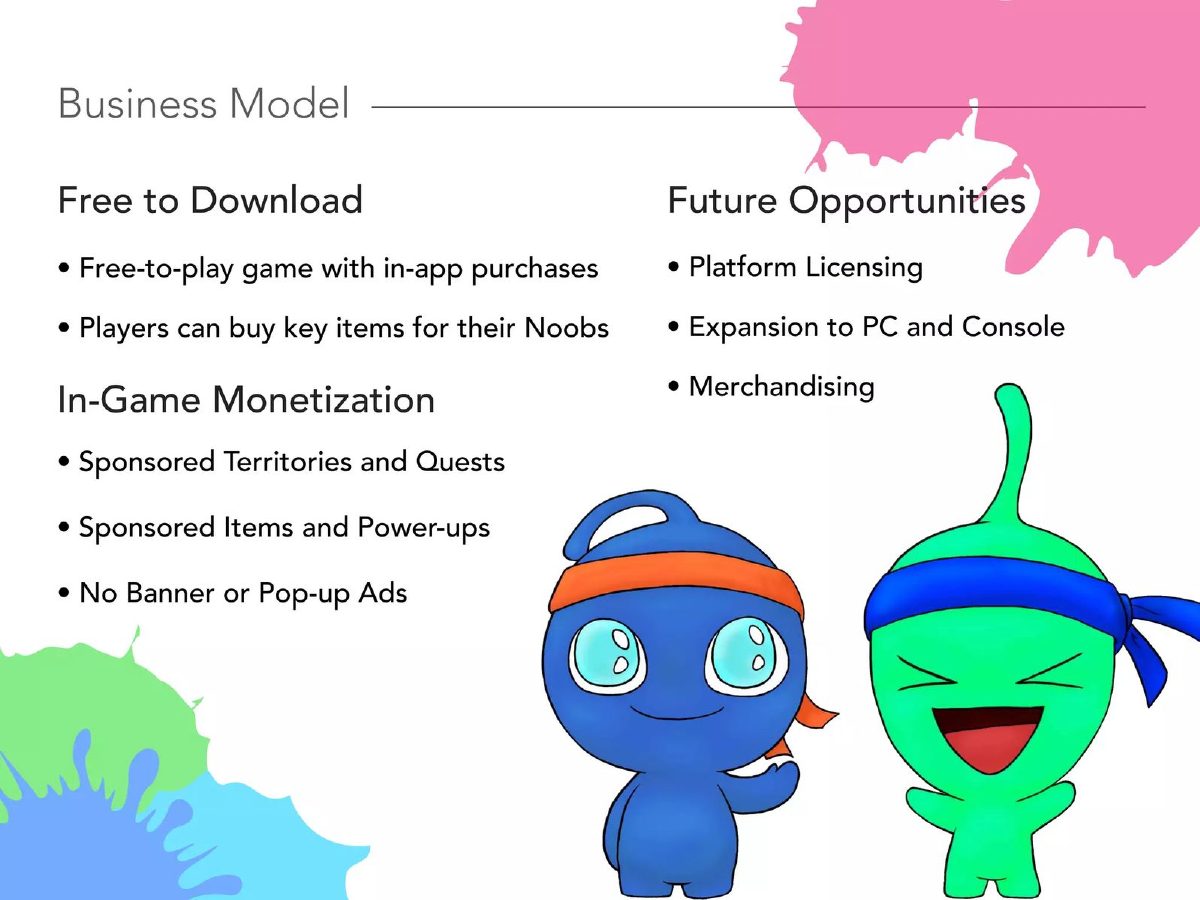
Zelgor deck, slide 9. Exact stored slide matched to this analysis.
Our analysis: Consumer free-to-play with in-game sponsorship instead of display ads.
Evidence and limitation: No figures. Payers are named in two groups (players and sponsors) and future streams are kept apart from current ones, but there is no price, paying rate or expected split.
What a founder can adapt: "Players buy [item] at $[X]; sponsors pay $[Y] per [quest]; we expect [Z]% of revenue from players."
Supporting analysis
What the deck claims: "Business Model." "Free to Download." "Free-to-play game with in-app purchases." "Players can buy key items for their Noobs." "In-Game Monetization": "Sponsored Territories and Quests", "Sponsored Items and Power-ups", "No Banner or Pop-up Ads." "Future Opportunities": "Platform Licensing", "Expansion to PC and Console", "Merchandising."
Presentation choice: Clear about who could pay and what it won't do (banner ads).
When it does not fit: Listing streams without saying which one carries the business.
Which kind of gaming business model slide answers which question.
Approach
Example
Answers
Leaves open
Revenue share with operators
Bragg
Payer, basis, money flow
The percentage
Fee per unit + monthly spend
Incymo.ai
Prices
Buyer, how prices connect
Virtual currency with split
Fayceoff
Price list, partner share
Own net share
Free-to-play mechanics
TouchSpin
What players buy
Any player economics
Named strategy only
Agave Games
Direction
Sources, prices, mix
Key Takeaways
Name the payer: player, operator, studio or advertiser.
State the basis: item purchase, revenue share, subscription or fee per unit.
Give a price, share or split as a number.
Industry statistics about free-to-play are context, not your own results.
If you take a share, say of what: gross gaming revenue, purchases or net revenue.
Write your gaming business model slide
Answer these before you design the slide.
Payer. Who pays: players, operators, studios or advertisers?
Basis. What is payment based on: item purchases, a revenue share, a subscription or a fee per unit?
Rate. What is the price, percentage or split? If you take a share, of what?
Players. For player spending: what share of players pay, and how much?
Net. After partner shares and platform or payment fees, what do you keep?
Copyable framework: [Payer] pays [rate] on [basis]; after [partner/platform shares] we keep [X]%, about $[Y] per [player/customer] a month.
Illustrative example 1 — written by us
Before: "Game Revenues derived mainly from F2P IAP. F2P provide more than 60% of mobile rev."
After: "[X]% of monthly players buy coins; payers spend $[Y] a month on average; we keep [Z]% after app store fees."
What improved: Our illustrative rewrite of TouchSpin's slide; bracketed text is a placeholder, not company fact.
What's different about gaming business models
Consumer games usually earn from a small share of players who buy items or from ads shown to everyone. Business-to-business gaming companies (platforms, content suppliers and tools) earn from operators or studios through revenue shares or fees. The slide should make clear which of these the company is.
What investors check
Who pays and whether they are the player. What the payment is based on. The price, rate or split as a number. For player spending, how many players pay and how much.
How we read each slide
We quote the text on the stored slide images and mark our own arithmetic as ours. We have not checked any figure on the slides. Slide numbers follow our teardown pages, which can differ from page numbers printed on the slide (Bragg's slide 6 is printed "Page 5"). All five images were already stored and were reused on 2026-09-26.
Plans versus results: label which one you are showing
Conquerors of the Realm's monetization slide is headed "Our goal in the next 18 months": "To get 1,000,000 gamer", "Provide in App purchases averaging 10$" and "Start earning 320,000$/Month". Every number on it is a target. The previous slide in the same deck gives the industry context it rests on: "only 3.5% spend money on in app purchases with each of them spending on average about 9.39$/app/month."
Our calculation: $320,000 a month divided by $10 is 32,000 paying players, which is 3.2% of one million. So the plan is built from the industry paying rate applied to a user goal. That is a reasonable way to frame a plan, and the slide is easy to check because the three inputs are all shown. What it is not is evidence: no player has yet paid, and the 3.5% and $9.39 figures are market averages with no source on the slide. A pre-launch game should say this plainly and show the arithmetic, as Conquerors does, rather than dress a target as a forecast.
SuperScale, by contrast, puts a measured-looking figure next to a target: "Average contract value is €360k ARR, largest are above €1M ARR" sits beside "targets in pipeline €2M-€4M yearly." The first is a claim about signed contracts; the second is a pipeline goal. Keeping the two in separate sentences, as the slide does, lets an investor weigh them differently.
Revenue share in B2B gaming: say the base and who keeps what
Two slides in this guide take a share. Bragg earns a percentage of operators' gross gaming revenue but doesn't give the percentage. SuperScale gives ranges: "Subscription with 25-50% profit share" for its software offer and "80-100% rev share" on long-term contracts or exclusive licences for legacy games it manages.
The two SuperScale ranges are on different bases. A share of profit depends on the studio's costs; a share of revenue does not. An 80-100% revenue share also implies SuperScale is close to taking over the game's income, which reads more like buying or licensing the game than serving a customer. The slide doesn't say how the remaining share is paid or what costs SuperScale carries in return. An investor would ask for one worked example: a real game, its monthly revenue, and what SuperScale kept.
For your own slide, state the base (gross gaming revenue, net revenue after platform fees, or profit), the typical rate rather than only a range, and one real contract. If a range is wide, say what moves a deal from one end to the other.
Consumer games: list the streams, then rank them
Zelgor's slide lists a model and three groups of streams: "Free-to-play game with in-app purchases" where "Players can buy key items for their Noobs"; in-game monetization through "Sponsored Territories and Quests" and "Sponsored Items and Power-ups" with "No Banner or Pop-up Ads"; and future opportunities in platform licensing, PC and console, and merchandising.
Separating current streams from future ones is useful, and the promise of no banner ads is a clear product choice. But the slide has no prices, paying rate or split between player purchases and sponsorship, so an investor can't tell which stream carries the business. A line such as "we expect most revenue from item purchases; sponsorship is upside" would rank them, even before launch.
Across all eight slides, the pattern is the same. The slides investors can use name the payer, give a price or rate, and say whether the number is a result, a claim or a plan. The weaker slides list streams or label a model and stop there.
Questions to answer before an investor asks
Who pays, and are they the person playing? In consumer games the answer is usually a minority of players, plus advertisers or sponsors. In business-to-business gaming it is an operator, a studio or a publisher. Say it in the first line of the slide.
What is the payment based on? A purchase, a subscription, a fee per unit, or a share of someone else's revenue or profit. If it is a share, name the base and give the typical rate, not only a range. Bragg, Incymo and SuperScale show three different bases, and each is easier to judge once the base is stated.
How many pay, and how much? For player spending, give the share of monthly players who buy and the average spend of those who do. For business customers, give the number of contracts and the average contract value. SuperScale gives the average but not the count; Conquerors gives the rate and spend but only as a plan.
What do you keep? App stores, payment providers, operators and licensors all take a cut. A slide that shows gross player spending without the share that reaches the company overstates revenue. State your net share after these fees.
Is each number a result, a claim or a plan? Label it. Pre-launch games can still show a clear plan with its inputs, as Conquerors does; what they should not do is let a target read like a result.
Common mistakes
Model label without numbers. "Free-to-play" or "revenue share" needs a rate or price.
Industry stats as your results. Market-wide free-to-play figures are context only.
Share without a base. Say whether a percentage is of gross gaming revenue, purchases or net revenue.
Partner share without your own. State what you keep after partner and platform fees.
Diagnostic checklist
Payer named.
Basis of payment stated.
Price, rate or split as a number.
Base of any percentage stated.
Your net share after partner and platform fees.
Frequently asked questions
What should a gaming business model slide show?
Who pays, on what basis and at what rate. Bragg: operators pay a percentage of gross gaming revenue; the slide would be stronger with the percentage.
Is saying "free-to-play" enough?
No. It says players don't pay to start. Investors also want to know how many players pay and how much, as TouchSpin's slide leaves open.
How we chose these examples
Corpus: published pitch deck teardowns on StartupFundraising.com. Founder-uploaded private decks are excluded.
Selection (2026-09-26): we searched teardown slide text for business-model and monetization wording together with gaming terms, reviewed about twenty slides and kept five. We kept five rather than add weaker slides. Update (2026-10-01): we searched again, read original deck pages and added SuperScale p11, Conquerors of the Realm p22 (with p21 as context) and Zelgor p9.
Excluded: Brag House p12 and Ingyre p12 (no stored image and no deck file available to render), Good Gaming p11 (token sales), Jago Studios p9 (publishing strategy, not payment), Agave Games p5 (used only as context for p3). Also not used (2026-10-01): Duelo p10 (wagering commissions, a betting model rather than gaming), Brag House p12 again (company is now publicly listed: Nasdaq TBH, IPO priced 5 March 2025 per its SEC prospectus), SuperScale's other deck p11 (same slide as the one used).
All five images were already stored and were viewed and matched to company and slide on 2026-09-26. Slide numbers follow our teardown pages.
New images for SuperScale, Conquerors of the Realm and Zelgor were rendered from the original deck files and viewed on 2026-10-01. Figures are quoted from the slides and not independently verified. Calculations are ours and marked as such.
Review: AI model review on 2026-09-26 and 2026-10-01. No person has yet completed an editorial review of this page. We make no claim that any slide caused a fundraising outcome.