Zentist’s 9-slide deck is a masterclass in brevity, though it leaves significant gaps in technical detail. The presentation focuses heavily on the 'why now' by highlighting a $60 billion out-of-pocket dental market and the lack of price transparency in existing tools like Yelp and Zocdoc. While the deck successfully demonstrates early traction—citing 64% month-over-month growth and 160 clinics onboarded—it notably lacks a formal 'Ask' slide, a detailed business model, or a competitive landscape analysis beyond a single screenshot. Despite these omissions, the clear visual storytelling regardi…
Key takeaways
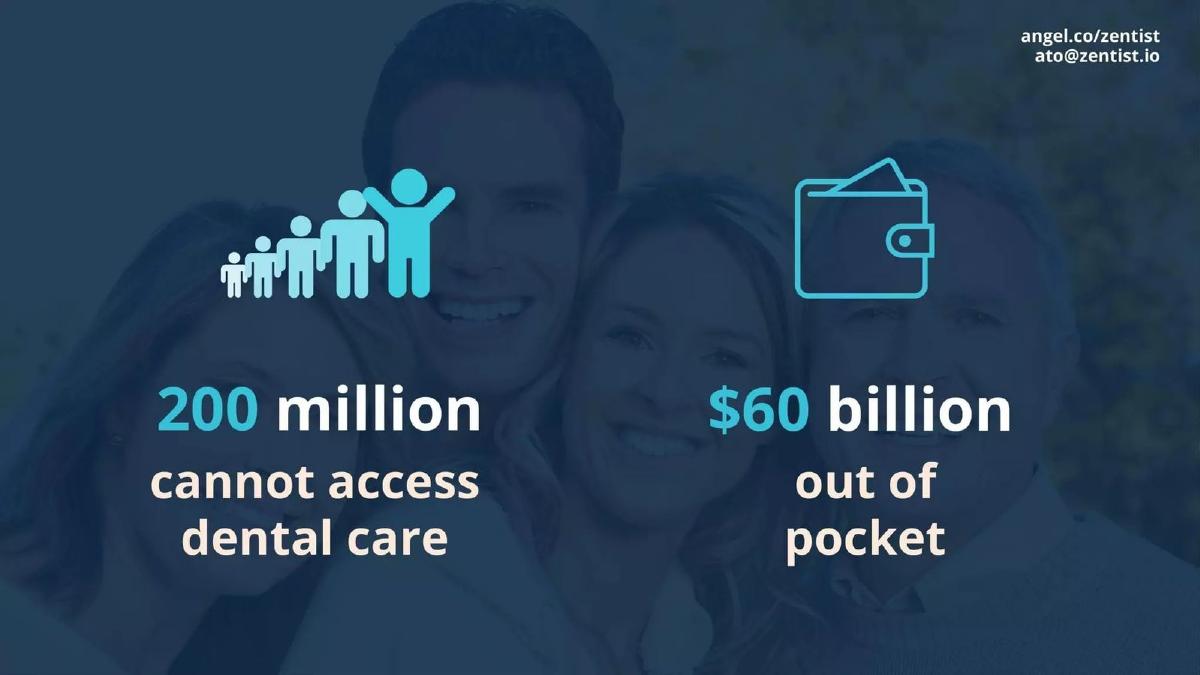
- The deck identifies a massive market gap where 200 million people lack dental care access and $60 billion is spent out-of-pocket (Slide 2).
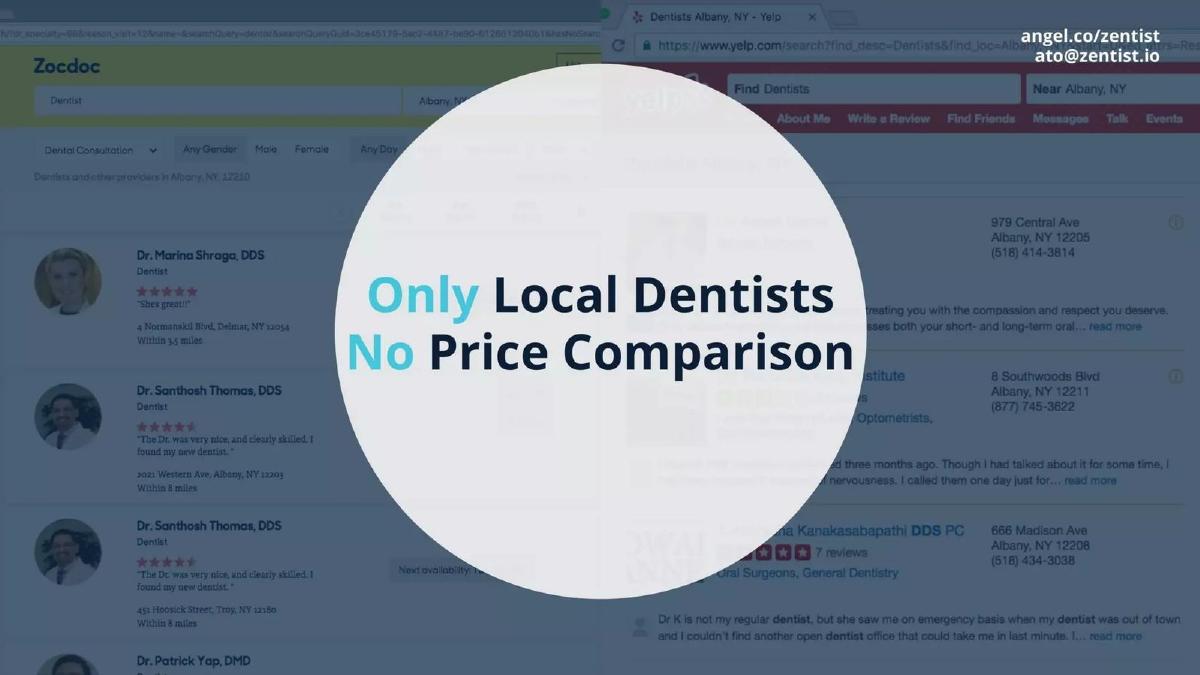
- Existing platforms like Zocdoc and Yelp are criticized for providing local search without price comparison (Slide 3).
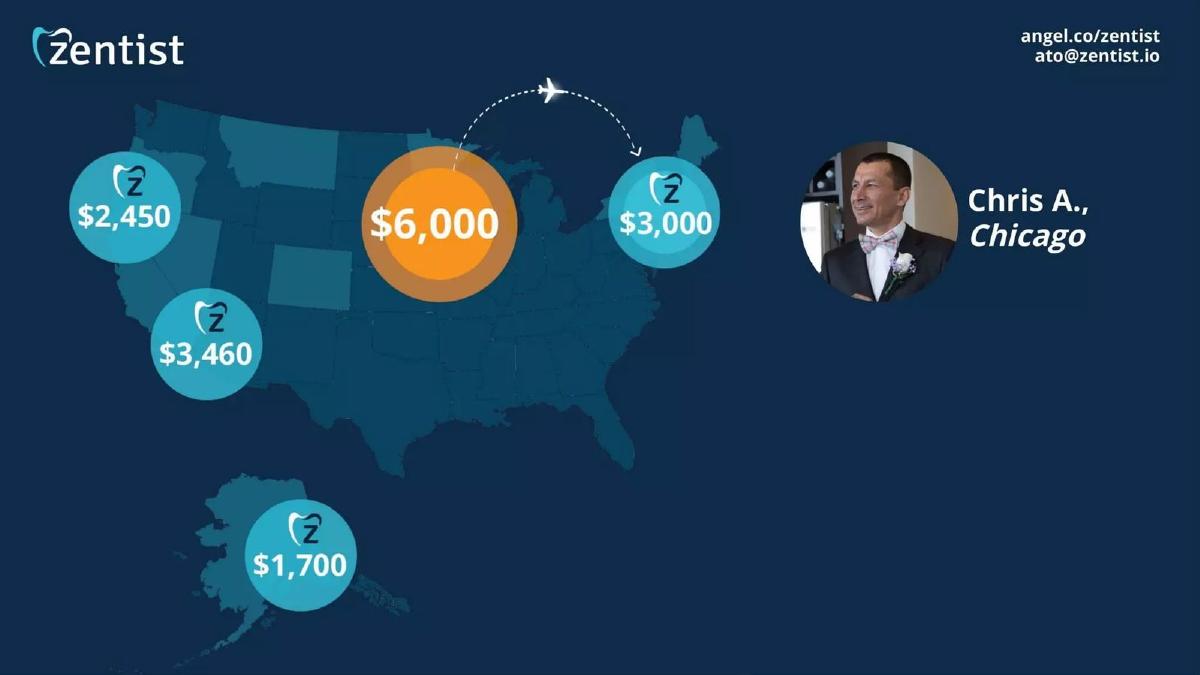
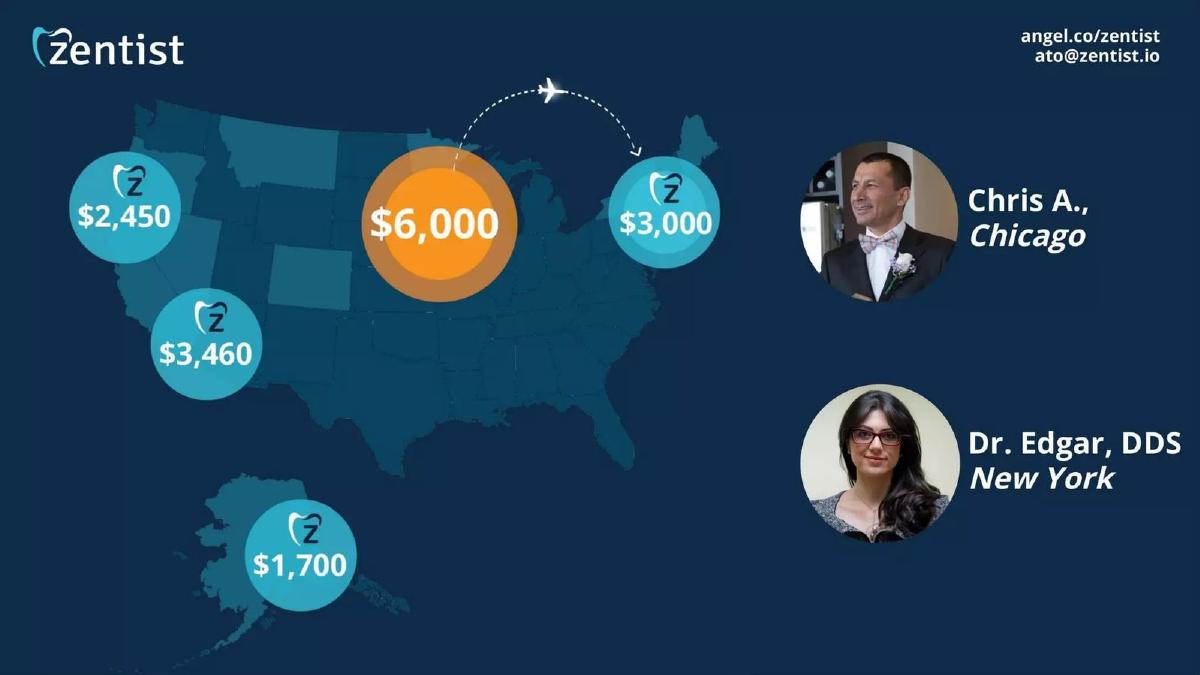
- The platform uses price arbitrage to show how a procedure costing $6,000 in Chicago can be found for $1,700 in Alaska or $3,000 in New York (Slide 4).
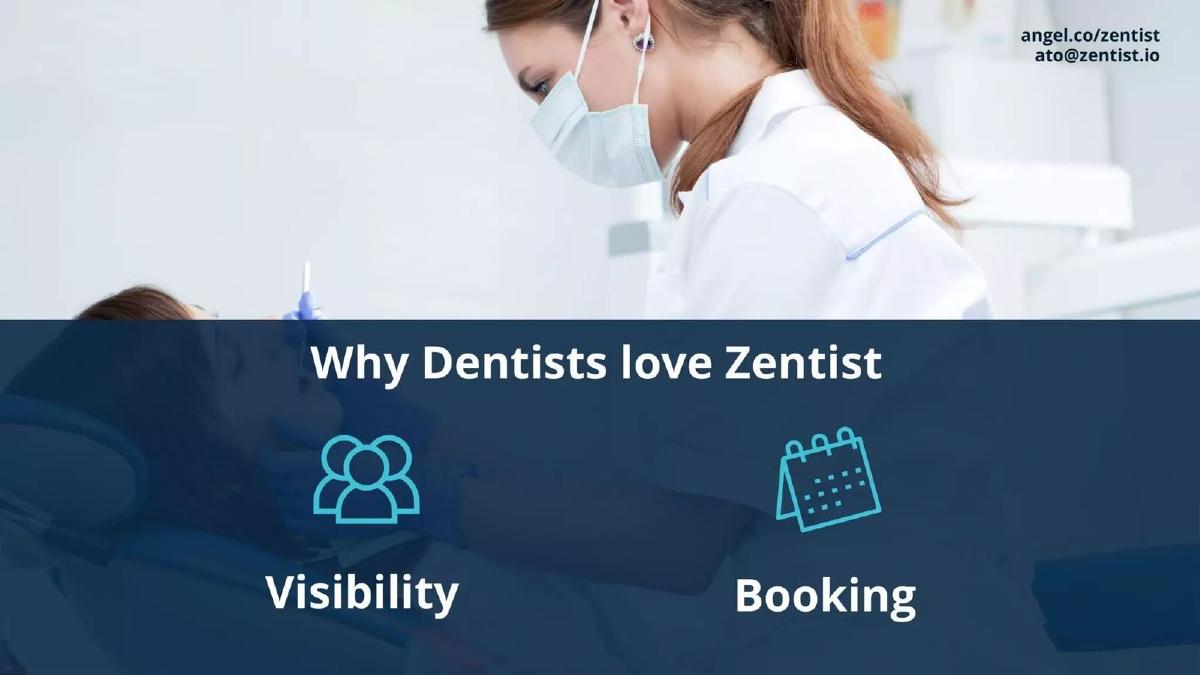
- Dentist value proposition is simplified to two core pillars: Visibility and Booking (Slide 6).
- Traction is the deck's strongest point, showing a 64% month-over-month growth rate reaching $300K (Slide 7).
- The company achieved a milestone of 160 dental clinics onboarded at the time of the presentation (Slide 8).
- The team slide highlights prior experience with Nurafzo, claiming 100K patients a year and $20M in annual revenue (Slide 9).
- The deck completely omits a financial 'Ask' or a breakdown of how the $10.9M would be allocated (Slide 9).
The Zentist Teardown: Selling Transparency in a $60B Market
Zentist entered the market at a time when 'Uber for X' and marketplace transparency were the dominant investment themes. Their 9-slide deck is remarkably lean, focusing almost entirely on the pain point of dental costs and the immediate traction they achieved. While the catalogue listing describes them as an insurance billing platform powered by machine learning, this specific deck leans heavily into the consumer-facing price comparison and booking aspect of the business.
The Hook: Market Failure and Price Arbitrage
Slide 1: Title Slide The deck opens with a high-resolution lifestyle image and the tagline: "Find high-quality and affordable dental care." It is a consumer-centric opening that establishes the brand as a solution for patients rather than a back-office tool for dentists. The contact information for Ato Kasymov is clearly visible in the top right corner.
Slide 2: The Problem This slide uses two massive figures to anchor the pitch: "200 million cannot access dental care" and "$60 billion out of pocket." By highlighting the out-of-pocket spend, Zentist signals to investors that there is a massive, inefficient market where consumers are forced to pay directly, making them highly sensitive to price—and thus likely to use a comparison tool.
Slide 3: The Gap in Current Solutions Zentist takes a direct shot at incumbents like Zocdoc and Yelp. The slide features a blurred screenshot of these platforms with the overlay: "Only Local Dentists, No Price Comparison." This identifies the specific feature gap Zentist intended to fill. It argues that knowing a doctor is 'near you' is useless if you cannot afford the procedure.
The Solution: Visualizing the Savings
Slide 4 & 5: The Arbitrage Model These slides are the core of the 'Solution' section. Using a map of the United States, Zentist illustrates a case study of 'Chris A. from Chicago.' A procedure that costs $6,000 in Chicago is contrasted with Zentist-sourced prices: $2,450 in the West, $3,000 in the Northeast, and a low of $1,700 in Alaska. Slide 5 adds 'Dr. Edgar, DDS' from New York, completing the marketplace picture by showing both the patient and the provider. This visualizes the 'why'—patients will travel to save thousands of dollars, and dentists in lower-cost areas will accept lower fees to fill their chairs.
Slide 6: The Provider Value Proposition Titled "Why Dentists love Zentist," this slide is light on text. It lists two icons: "Visibility" and "Booking." This suggests that Zentist acts as a lead-generation engine for dentists, helping them find patients outside of their immediate local geography who are shopping specifically on price.
Traction and Team
Slide 7: The Growth Curve This is the 'money slide.' It shows a line graph from May to September with a steep upward trajectory. The key figures are "64% MoM" (Month-over-Month) growth and a final data point of "$300K." The deck does not specify if this $300K is Monthly Recurring Revenue (MRR) or Gross Merchandise Value (GMV) of bookings, a common ambiguity in early-stage decks designed to spark conversation.
Slide 8: Supply Side Validation To prove the marketplace has two sides, slide 8 simply states: "160 Dental Clinics Onboarded." For a Series A, this number demonstrates that the founders can sell to healthcare providers, which is notoriously difficult. It provides the necessary social proof to back up the growth claims on the previous slide.
Slide 9: The Team The final slide introduces Ato Kasymov (Team Lead) and Manny Kurbonali (Growth Lead). Rather than listing schools or past tech companies, they highlight their experience with "Nurafzo Diagnostic Center." The metrics provided for Nurafzo—100K patients a year and $20M in annual revenue—are intended to prove that the founders understand the unit economics and operational scale of the healthcare industry.
What Works in the Zentist Deck
Clarity of the Problem: By using the $60 billion out-of-pocket figure, Zentist immediately justifies why a price comparison tool needs to exist. They aren't just building a 'better Yelp'; they are tackling a financial crisis for 200 million people.
Visual Proof of Concept: The map showing price variations (Slide 4) is a highly effective way to explain a complex market inefficiency. It requires no explanation to understand that a $4,300 price difference for the same procedure is a business opportunity.
Momentum: The 64% MoM growth figure is the strongest possible signal for a Series A investor. It suggests that the founders have found 'product-market fit' and now simply need capital to pour into the engine.
What is Missing from the Zentist Deck
The 'Ask': There is no slide detailing how much money is being raised or what the milestones for the next 18 months look like. While this information is often handled in the verbal pitch, its absence in the deck makes the presentation feel incomplete as a standalone document.
Business Model: The deck never explains how Zentist makes money. Do they take a percentage of the booking? Do dentists pay a subscription? Is there a fee for insurance processing? For a $10.9M round, investors would typically require a clear breakdown of the take-rate and unit economics.
Technology/Product Depth: The catalogue description mentions "high tech machine learning algorithms" and "end to end insurance claims processing." None of this appears in the deck. The deck sells a travel-for-dentistry marketplace, while the company eventually became a B2B billing platform. This suggests either a massive pivot shortly after the deck was made or a failure to communicate the technical 'moat' in the slides.
Competitive Landscape: Beyond a passing mention of Yelp and Zocdoc, there is no analysis of other dental-specific competitors or how Zentist protects its market share once the incumbents inevitably add price transparency features.
What a Founder Should Copy
The 'One Big Number' Approach: Slide 8 is a great example of how to use a single, undeniable metric to create impact. "160 Dental Clinics Onboarded" is much more powerful than a bulleted list of minor achievements.
Minimalist Design: The deck uses high-quality imagery and very little text. This forces the audience to listen to the founder rather than reading the slides. It prevents 'death by bullet point' and keeps the energy high.
Founder-Market Fit: If you have operated a business in the same sector, lead with those numbers. The mention of the $20M revenue at their previous diagnostic center likely gave investors the confidence that these weren't just 'tech kids' but experienced healthcare operators.
Final Thoughts
The Zentist deck is a 'teaser' deck. It is designed to get the first meeting by proving a massive market and immediate traction. However, for a Series A, it is unusually light on the 'how.' Founders should use this as a template for the visual style and problem-definition slides, but should ensure they include the missing financial and technical details for a full investor presentation.
Frequently asked questions
- What is the primary problem Zentist aims to solve?
- Zentist targets the lack of affordability and transparency in the dental industry. According to slide 2, 200 million people cannot access dental care, leading to $60 billion in out-of-pocket expenses. The deck argues that current search tools only show location and reviews, failing to provide the price comparisons necessary for patients to make informed financial decisions.
- How does Zentist demonstrate its value proposition to dentists?
- On slide 6, Zentist simplifies the benefit for providers into 'Visibility' and 'Booking.' By placing dentists on a platform that emphasizes price transparency and comparison, it helps them attract patients who are specifically looking for affordable care, while streamlining the administrative burden of the booking process.
- What traction metrics did Zentist use to secure funding?
- The deck relies on three primary metrics: growth rate, revenue, and provider count. Slide 7 shows a 64% month-over-month growth trajectory, peaking at $300K (presumably GMV or revenue, though not specified). Slide 8 confirms they had successfully onboarded 160 dental clinics, proving the supply side of their marketplace.
- Who are the founders and what is their background?
- The deck features Ato Kasymov (Team Lead) and Manny Kurbonali (Growth Lead). Their credibility is tied to 'Nurafzo Diagnostic Center,' which slide 9 credits with handling 100K patients a year and generating $20M in annual revenue, suggesting the founders have significant experience in healthcare operations.
- What is missing from the Zentist pitch deck?
- The deck is missing several standard venture components: a specific 'Ask' (how much they are raising), a detailed business model (how they take a cut), a competitive matrix, and a product roadmap. It functions more as a high-level teaser than a comprehensive business plan.