AccuRx’s Series B deck, used to raise $38M in 2021, centers on an incredible traction story: 96% of UK GP practices and 60% of the UK population reached. The narrative moves from a simple 'two-click' SMS tool for doctors to a vision of a unified 'communication record' that subsumes traditional medical records. The deck avoids complex financial modeling in favor of high-level market opportunities, such as moving from a £100m 'task efficiency' market to a £5bn 'improved patient outcomes' market. By showcasing rapid product deployment—like launching video consultations in under 72 hours—AccuRx p…
Key takeaways
- AccuRx achieved a 96% penetration rate among UK GP practices, reaching 130k weekly active staff as of May 2021 (Slide 8).
- The company has messaged over 36 million unique patients, representing more than 60% of the UK population (Slide 8).
- The product vision aims to replace traditional medical records with a comprehensive 'communication record' aggregated across all providers (Slide 5).
- Technical execution is highlighted by the ability to build and deploy a video consultation product to 3,500 practices in under 72 hours (Slide 11).
- The company identifies a massive valuation leap from the £100m task efficiency market to a £5bn market focused on improved patient outcomes (Slides 16-17).
- Internal culture is a core pillar of the pitch, boasting a 9.2 Peakon engagement score and only 3 voluntary departures during a period of rapid growth (Slide 12).
- The 'AccuRx Web' product has already expanded beyond GPs into 11% of NHS trusts with more than 50 weekly active users each (Slide 14).
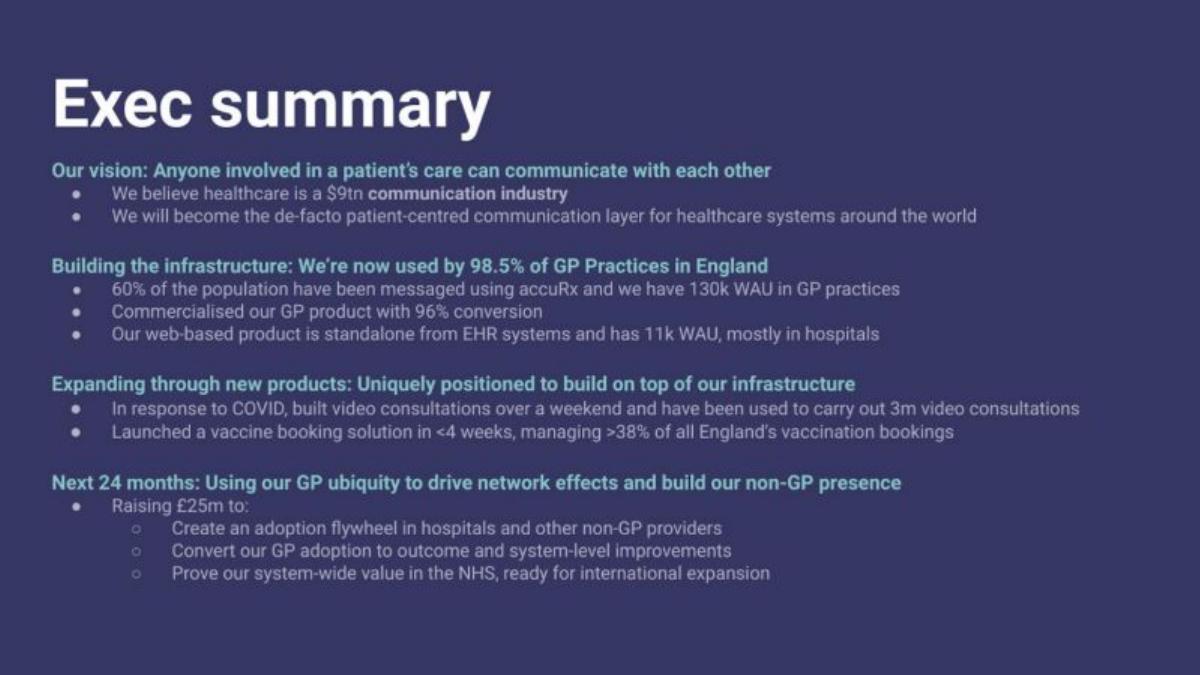
- The funding ask is clearly defined as £25m to execute on three specific strategic goals (Slide 13).
The Series B Narrative: From Utility to Infrastructure
AccuRx’s Series B deck is a masterclass in showing, not just telling. By 2021, the company had already achieved what most health-tech startups only dream of: near-total market saturation in a primary care setting. This deck isn't about proving that doctors want to text patients; it's about proving that AccuRx is the only platform capable of connecting the entire British healthcare system. The narrative is structured around a transition from a simple 'task efficiency' tool to a 'system-wide infrastructure' that could eventually replace the traditional medical record.
The Vision and the Problem
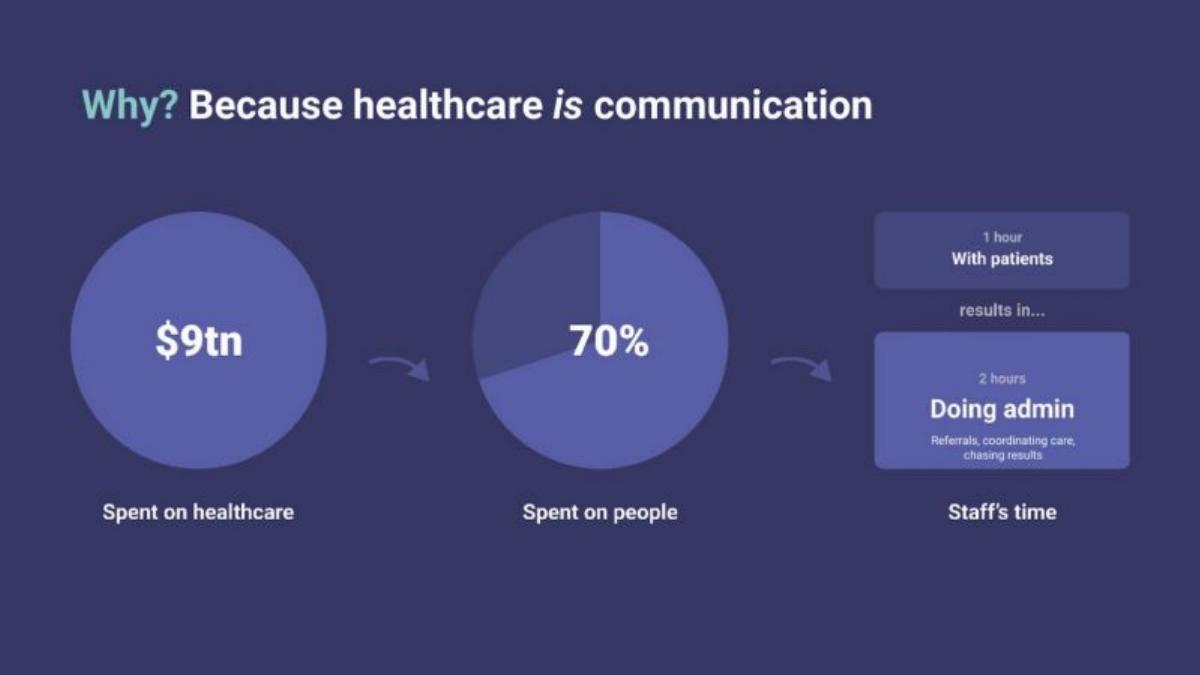
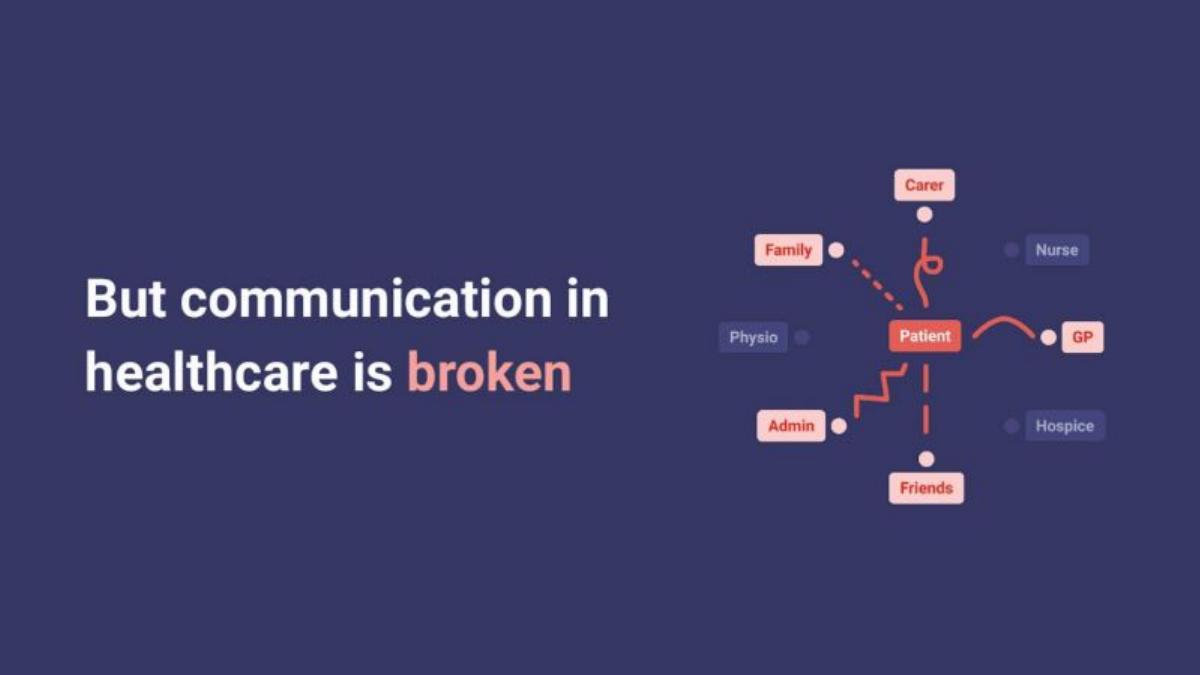
Slides 1-5 establish the 'Why' and the 'Vision.' Slide 3 presents a stark reality of modern medicine: for every one hour spent with patients, staff spend two hours doing admin. They frame this as a communication problem, noting that 70% of the $9tn spent on healthcare globally is spent on people. The vision (Slide 4) is a circular ecosystem where the patient is at the center, surrounded by a ring of carers, nurses, GPs, and family members who can all communicate seamlessly. Slide 5 introduces the most ambitious part of the pitch: the 'communication record.' By aggregating conversations across providers, AccuRx intends to create a data layer that 'subsumes the medical record,' positioning themselves as the primary interface for healthcare data.
Building the Infrastructure and Traction
Slides 6-9 focus on the current state of the business. Slide 7 shows the product in action, emphasizing that it takes only 'two clicks' for a GP to message a patient. This simplicity is the engine behind the growth shown on Slide 8. The metrics here are staggering for a Series B company: 96% of UK GP practices are users, with 130,383 weekly active staff as of May 2021. Even more impressive is the reach: they have messaged 36,243,706 unique patients, which accounts for over 60% of the UK population. Slide 9 reinforces this quantitative success with qualitative 'love' from users, featuring testimonials from GPs who claim the tool has 'revolutionised' their practice and even 'saved my life' by reducing overtime.
Product Agility and Team Culture
Slides 10-12 highlight the company's execution capabilities. Slide 11 uses the example of video consultations to prove technical speed, noting the feature was built and deployed in under 72 hours to 3,500 practices during the pandemic. This wasn't just a hack; it became the first self-service product awarded a national contract. Slide 12 focuses on the 'world-class, diverse team.' In a competitive talent market, AccuRx highlights its 5.0 Glassdoor rating, a 9.2 Peakon engagement score, and the fact that they had only 3 voluntary departures while growing to 95 employees. They also explicitly track diversity, noting that 53% of the team and 29% of the engineering team are people of marginalised genders.
The Strategy: Moving Up the Value Chain
Slides 13-17 outline the 'Ask' and the future roadmap. AccuRx was seeking £25m to execute three goals. Goal One (Slides 14-15) is about creating an 'adoption flywheel' beyond GPs. They show early success with 'AccuRx Web,' which is already in 11% of NHS trusts. They also introduce 'Record Access,' allowing any clinician to view a GP record in real-time, with 98% coverage currently in testing. Goal Two (Slides 16-17) is the financial heart of the deck. It illustrates a move from the £100m 'task efficiency' market to the £5bn 'improved patient outcomes' market. This involves moving beyond simple messaging into 'behaviour change programmes' for chronic diseases like asthma and COPD.
The International Play
Slide 18 addresses the 'Why now' and 'Why the UK.' AccuRx argues that the NHS is the perfect laboratory to prove their core product because of its single-payer structure and lack of provider competition. By fixing communication in the NHS first, they believe they will be 'ready for international expansion' into markets with different incentives. This slide serves to de-risk the investment for those worried about the company being 'trapped' in the UK market, suggesting that the NHS is a feature, not a bug, of their development strategy.
What AccuRx Does Exceptionally Well
The strength of this deck lies in its inevitability . When a company can point to 96% market penetration (Slide 8), the question for investors shifts from 'Will this work?' to 'How big can this get?' AccuRx handles this shift by moving the goalposts from a messaging app to a data infrastructure play. Their use of 'Example one' (Slide 11) to show rapid deployment is a brilliant way to demonstrate that their high penetration isn't just a fluke of timing, but a result of superior engineering and product management. Furthermore, the focus on 'Staff's time' (Slide 3) as the primary unit of waste in healthcare is a highly relatable and quantifiable problem that resonates with both clinicians and treasury departments.
What is Missing from the Deck
Despite the incredible traction, the deck is noticeably light on unit economics and revenue figures . While they mention the size of the markets they are targeting (£100m and £5bn on Slides 16-17), they do not disclose their current Annual Recurring Revenue (ARR), Churn (though they mention low staff attrition), or Customer Acquisition Cost (CAC). Given the 96% penetration, one might assume CAC is low, but for a Series B, investors usually expect a deeper dive into the 'money in, money out' mechanics. Additionally, there is no competitor slide . While they may feel they have no direct competitors in the UK GP space, there are certainly other clinical communication tools and EHR (Electronic Health Record) giants that might view AccuRx's 'communication record' vision as a threat.
What Other Founders Should Copy
Founders should emulate AccuRx’s 'Goal-Oriented Ask' (Slide 13). Instead of just saying they are raising £25m for 'growth,' they break it down into three specific strategic objectives. This gives investors a clear framework for how success will be measured in the next 24 months. Another key takeaway is the 'Traction as a Foundation' approach. AccuRx doesn't lead with the vision; they lead with the fact that they have already won the GP market. This gives them the 'right to win' the more ambitious 'communication record' and 'patient outcomes' markets. Finally, the inclusion of culture metrics (Slide 12) as a core part of the pitch is increasingly important. Showing high engagement and low attrition proves that the company can scale its most important asset—its people—without breaking the internal engine.
Frequently asked questions
- What is AccuRx's primary value proposition for doctors?
- AccuRx focuses on extreme administrative efficiency. According to Slide 3, healthcare staff spend two hours on admin for every one hour spent with patients. AccuRx solves this by making it take only 'two clicks' for a GP to send a message to a patient, significantly reducing the time spent on referrals, coordinating care, and chasing results.
- How did AccuRx expand beyond simple SMS messaging?
- The deck highlights 'Example one: Video consultations' on Slide 11, which was built and deployed in under 72 hours to 3,500 practices. This demonstrated that their infrastructure could support various communication modalities beyond text, eventually leading to their first national contract for a self-service product.
- What is the 'Communication Record' mentioned in the vision?
- On Slide 5, AccuRx proposes that every patient will have a communication record aggregated across all providers. They claim this will eventually 'subsume the medical record,' suggesting that the history of interactions between patients, GPs, specialists, and carers is a more valuable and dynamic data set than static clinical notes.
- How does AccuRx plan to monetize its massive user base?
- The deck outlines a strategy of 'moving up the value chain' on Slides 16 and 17. While they currently operate in a £100m market for 'task efficiency,' they are targeting a £5bn market for 'improved patient outcomes.' This includes building behavior change programs for medication adherence and automating chronic disease reviews.
- Why is the UK NHS considered the ideal starting market for AccuRx?
- Slide 18 explains that the NHS provides a unique 'single payer' environment where it is easier to realize system-level savings. Additionally, the 'capitation' model in primary care incentivizes efficiency, and because providers are not competing, they are more willing to collaborate using a shared communication platform.