Selling to the NHS or Councils: Go-to-Market Slide Examples
The NHS and UK councils are paid for from public money, but each trust, GP practice or council buys for itself.
Selling to the NHS or Local Councils: Show Who Buys, How, and How Fast
Six slides from four UK startups that sell to the NHS or to local councils: Accurx, Patchwork Health, PatientSchedulingApp and CareAtHomeService.Tech. For each, we record which organisation actually buys, how the deck says it gets chosen, how fast it expects to add new buyers, and what the slide leaves for an investor to ask.
TL;DR
Public money doesn't mean one buyer. The NHS is funded nationally, but GP practices, hospital trusts and regional bodies each make their own purchases, and every council in the UK runs its own contracts. A go-to-market slide for this market should name the organisation that signs (the buying unit), say how you get chosen (a pilot, a formal tender, an existing contract you can buy through, or a free start that turns paid), give the time it takes to win one, and show how you grow inside each buyer once you are in.
The slides here each show part of that. CareAtHomeService.Tech's page 11 is the only one that states a pace: its plan assumes "one new local authority every five months" because of "existing contracts and procurement process". Patchwork Health's page 5 shows three NHS customers that started with one module and later "procured" more. Accurx's page 35 argues that the NHS's single payer makes it the best place to prove the product, and its page 15 shows the result: use in 96% of GP practices. PatientSchedulingApp's pages 10 and 11 describe the obstacle (tools adopted only where "someone at that hospital or Trust knows the team") and its answer: start with one basic admin task.
NHS and council go-to-market slides from real pitch decks
Each example records the buyer the slide names, the route and pace it describes, and what to copy or avoid. "Our calculation" marks arithmetic we did; the slides don't state it.
Accurx go to market slide — slide 35
UK messaging software for GP practices and hospitals. 2021 deck; goals section.
Accurx deck, slide 35. Exact stored slide matched to this analysis.
Our analysis: Turns the shape of the NHS into a reason to start there.
Evidence and limitation: Three reasons, each tied to how the system pays or rewards providers; no system-level contract named.
What a founder can adapt: Name the organisation that would pay for system-level savings and where that sale stands.
Supporting analysis
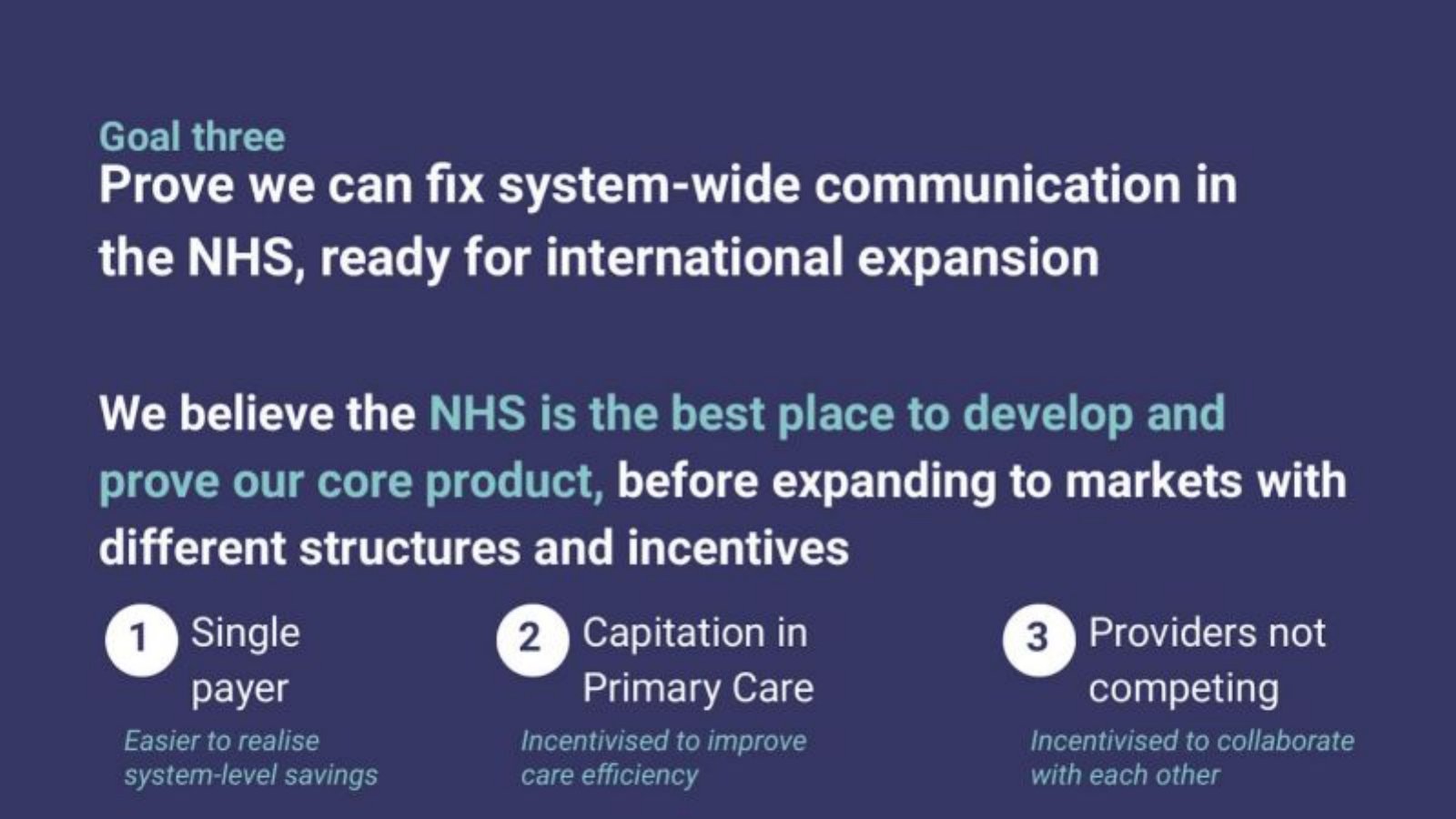
What the deck claims: "We believe the NHS is the best place to develop and prove our core product, before expanding to markets with different structures and incentives": single payer, capitation in primary care, providers not competing.
Presentation choice: It explains adoption in terms of the buyer's own incentives.
When it does not fit: Don't treat "single payer" as a single buyer.
Same deck. Traction page that shows the buying unit reached so far.
Accurx deck, slide 15. Exact stored slide matched to this analysis.
Our analysis: Shows the GP practice is the unit Accurx has won.
Evidence and limitation: Practice share and weekly staff stated; page 18 adds "In April 2021, 96% of practices converted to one or more paid modules."
What a founder can adapt: Give revenue per practice beside the share.
Supporting analysis
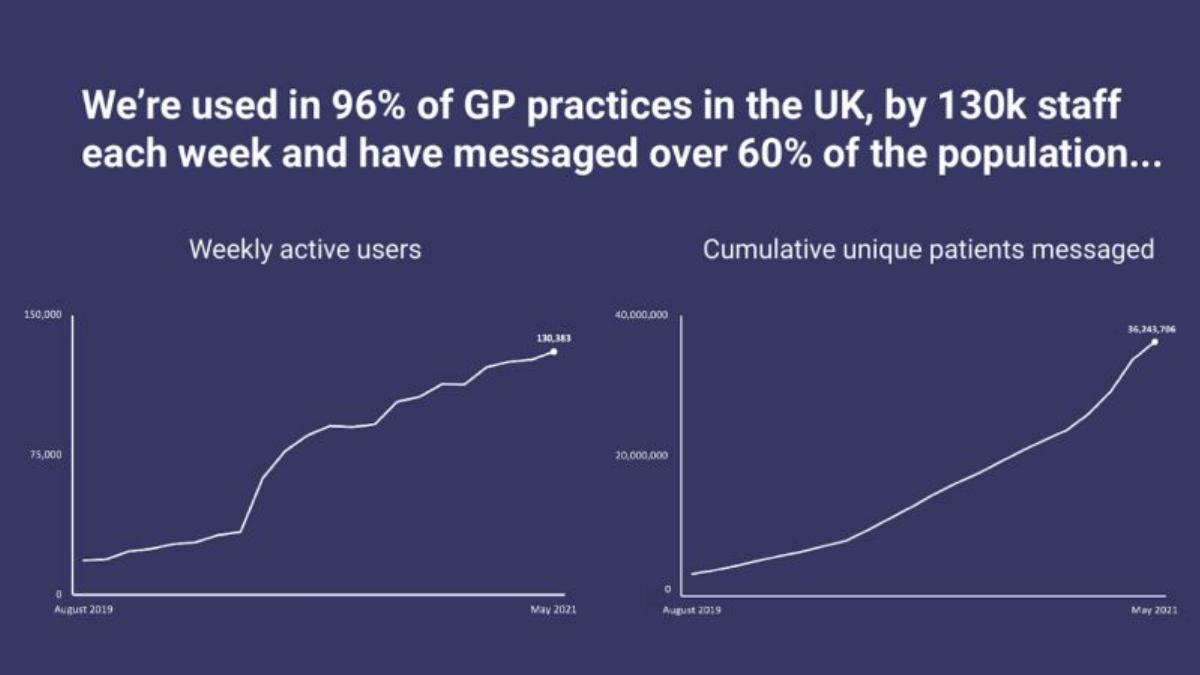
What the deck claims: "We're used in 96% of GP practices in the UK, by 130k staff each week and have messaged over 60% of the population"; weekly active users and cumulative patients messaged, August 2019 to May 2021.
Presentation choice: Reach in the buying unit is the base for any wider NHS sale.
When it does not fit: Don't let practice reach stand in for a system contract.
UK hospital staffing software. Expansion page with three NHS case studies.
Patchwork Health deck, slide 5. Exact stored slide matched to this analysis.
Our analysis: The clearest view of growth inside public buyers.
Evidence and limitation: Dated starts and named modules; no contract values; both chart circles unlabelled, 2025 is a forecast.
What a founder can adapt: Add contract values and months from first module to the next.
Supporting analysis
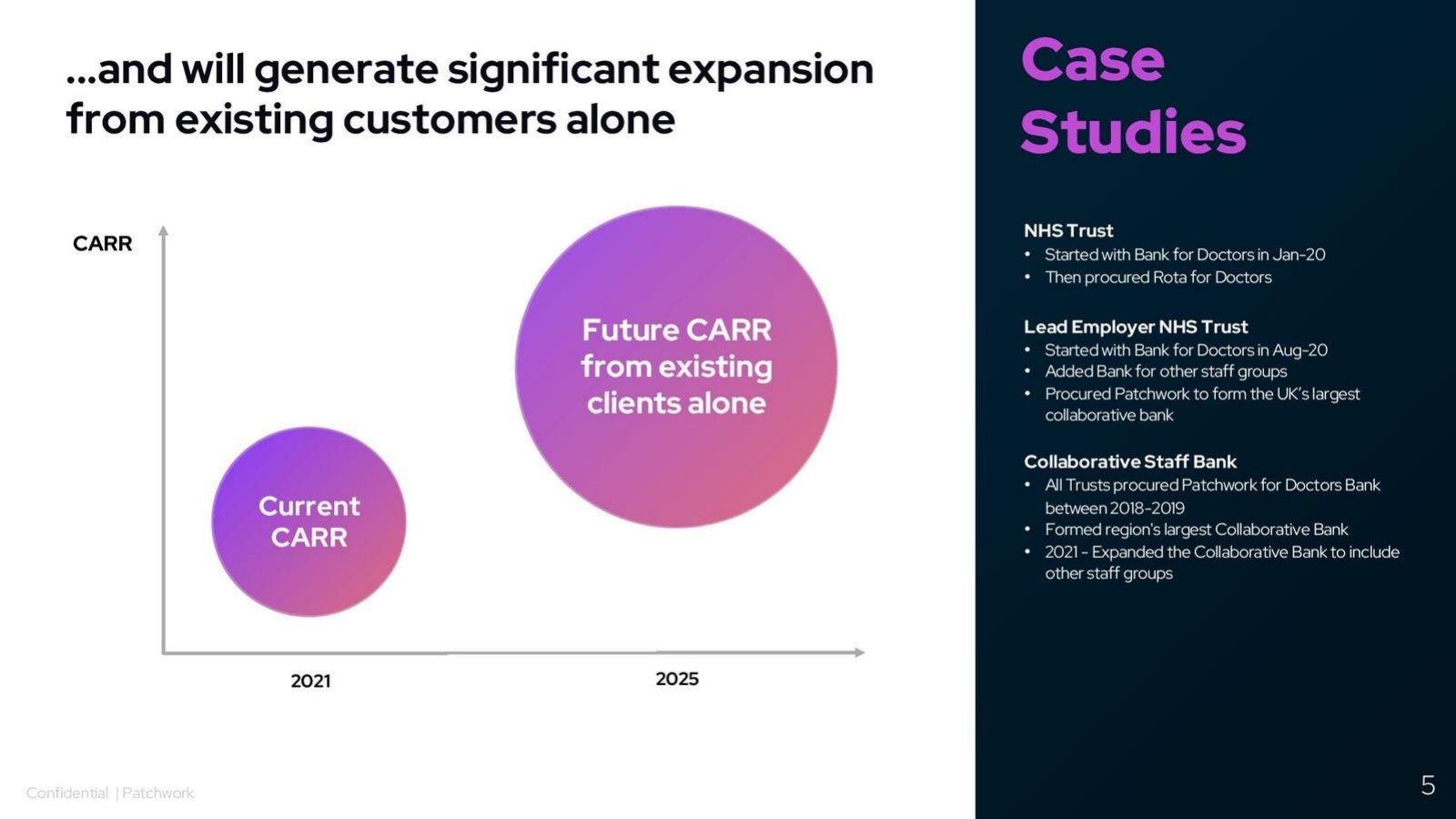
What the deck claims: Trust started with Bank for Doctors in Jan-20, "Then procured Rota for Doctors"; lead employer trust started Aug-20 and added other staff groups; trusts "procured Patchwork for Doctors Bank between 2018-2019" and expanded in 2021. Chart: "Current CARR" 2021 vs "Future CARR from existing clients alone" 2025.
Presentation choice: "Procured" shows each addition went through the buyer's process.
When it does not fit: Don't draw a forecast at the same weight as current revenue.
CareAtHomeService.Tech go to market slide — slide 11
UK home-care matching app paid partly by councils. Deck file dated April 2018.
CareAtHomeService.Tech deck, slide 11. Exact stored slide matched to this analysis.
Our analysis: The only slide here with a stated pace and a reason.
Evidence and limitation: Our calculation: about 2.4 councils a year. The pace is a forecast resting on one pilot.
What a founder can adapt: Say what counts as pilot success and when it ends.
Supporting analysis
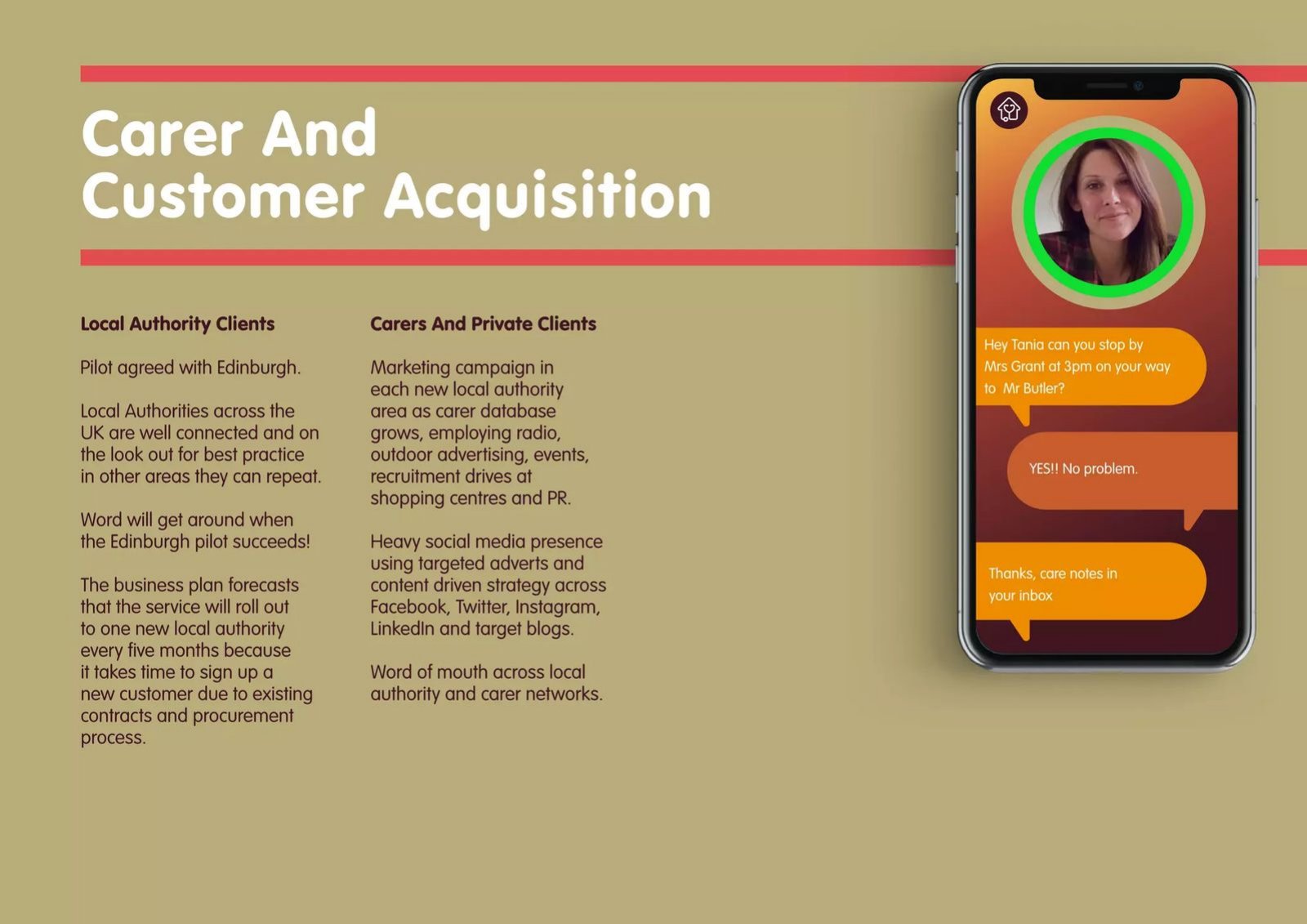
What the deck claims: "Pilot agreed with Edinburgh"; "roll out to one new local authority every five months because it takes time to sign up a new customer due to existing contracts and procurement process."
Presentation choice: An investor can test the pace against the revenue plan.
When it does not fit: Don't rely on "word will get around" as the channel.
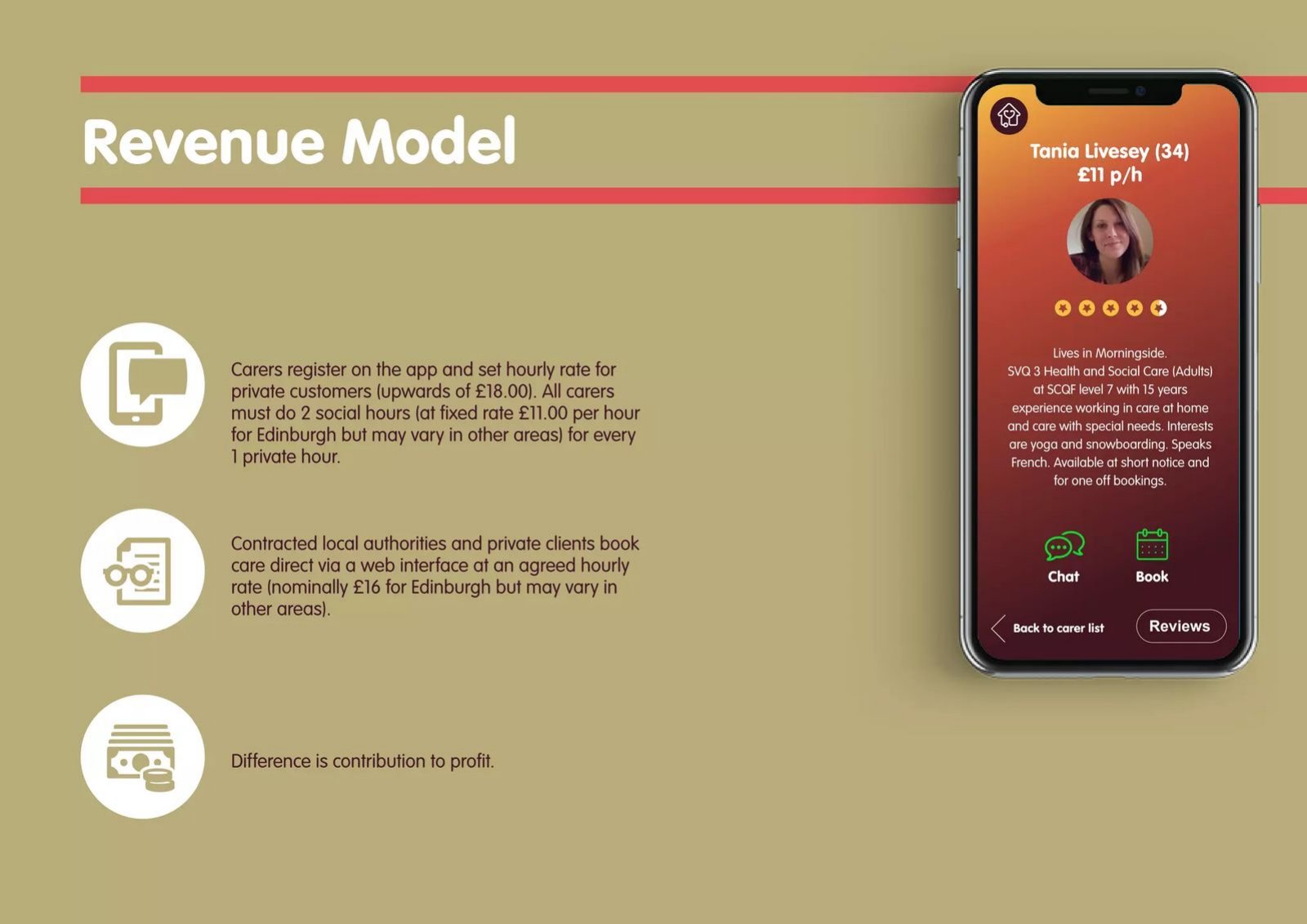
CareAtHomeService.Tech go to market slide — slide 8
Same deck. Revenue model page with council pricing.
CareAtHomeService.Tech deck, slide 8. Exact stored slide matched to this analysis.
Our analysis: Gives the price per public buyer that the pace needs.
Evidence and limitation: Our calculation: £5 an hour, about 31% of £16, before other costs.
What a founder can adapt: Add expected hours per council.
Supporting analysis
What the deck claims: Councils book "at an agreed hourly rate (nominally £16 for Edinburgh but may vary in other areas)"; carers paid "fixed rate £11.00 per hour for Edinburgh" for social hours; "Difference is contribution to profit."
Presentation choice: Pace times hours times margin makes a checkable model.
When it does not fit: Don't present one council's rate as national.
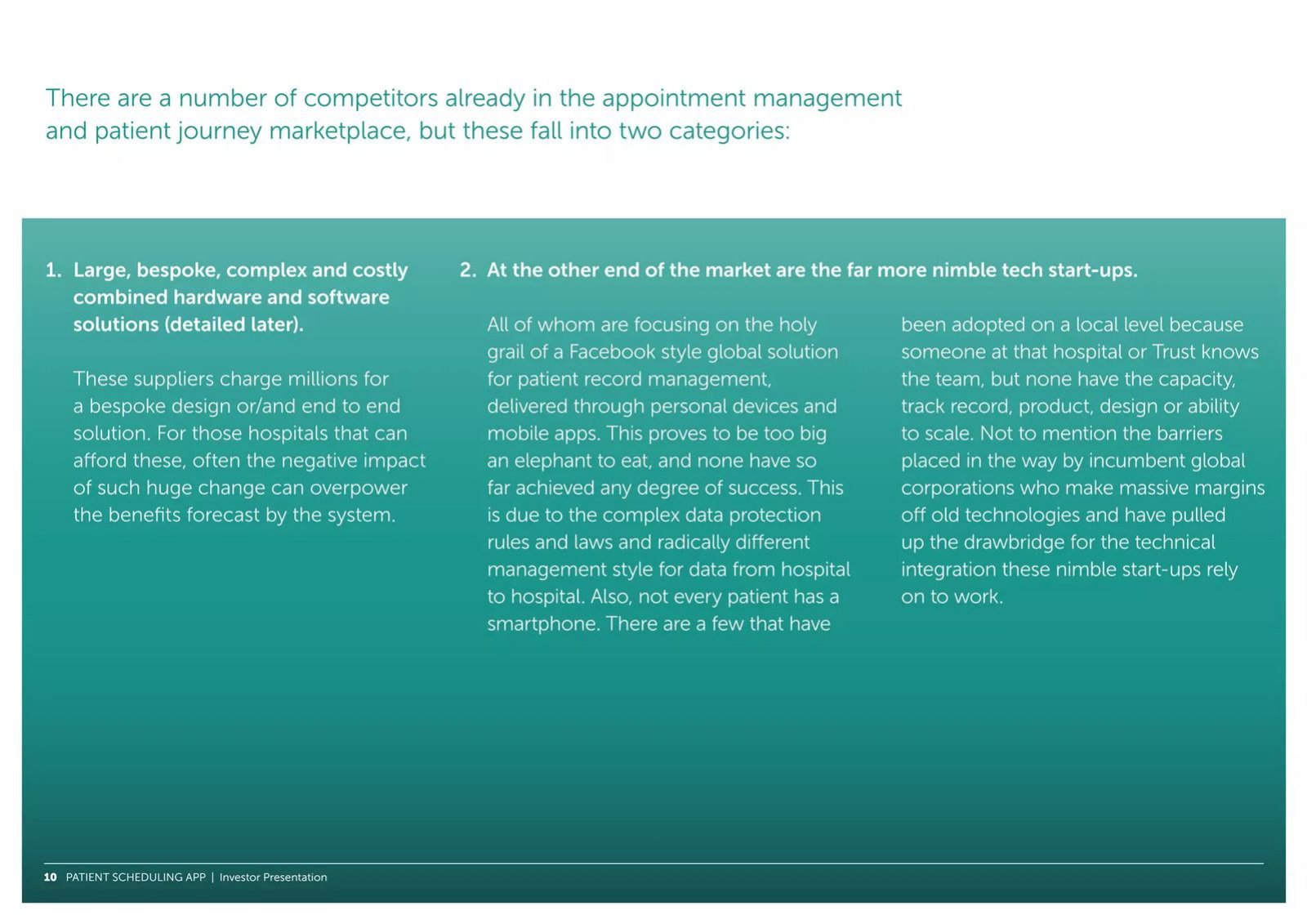
PatientSchedulingApp go to market slide — slide 10
UK hospital appointment app, early deck. Competitor page; page 11 gives the entry plan.
PatientSchedulingApp deck, slide 10. Exact stored slide matched to this analysis.
Our analysis: Names a real pattern but not the way past it.
Evidence and limitation: Describes the barrier and a narrow first task; no buyer, route or evidence for a second trust.
What a founder can adapt: Name the first buyer in the hospital and what a second trust needs to see.
Supporting analysis
What the deck claims: Start-ups "adopted on a local level because someone at that hospital or Trust knows the team, but none have the capacity, track record, product, design or ability to scale". Page 11: start with "a basic admin function for the hospital".
Presentation choice: A warning that describing the barrier isn't a plan.
When it does not fit: Don't stop at the diagnosis.
Columns report what each slide states or leaves out; checks are our calculations.
Example
Buying unit named
Route described
Pace stated
Price or value
Accurx p35
NHS as a system (funder)
Prove at home, then abroad
No
No
Accurx p15
GP practices (96%)
Free use, then paid (p18)
No
No
Patchwork Health p5
Trusts and groups of trusts
First module, then procured more
Dated starts only
No (circles unlabelled)
CareAtHomeService.Tech p11
Local authorities
Pilot, then roll out
One every 5 months
See p8
CareAtHomeService.Tech p8
Local authorities
Agreed hourly rate
No
£16 vs £11 (£5, our calc.)
PatientSchedulingApp p10
Hospitals and trusts
Narrow admin task first (p11)
No
No
Key Takeaways
Name the buying unit: practice, trust, council or regional body. "The NHS" is the funder, not the customer you sign.
State the pace. CareAtHomeService.Tech plans one new council every five months, about 2.4 a year (our calculation), and says why.
Show what happens after the first contract. Patchwork Health's three cases each start with one module and add others.
If you argue for starting in the NHS, say what it proves. Accurx's page 35 gives three reasons tied to how the system pays.
Turn local word of mouth into a plan. PatientSchedulingApp says local adoption by acquaintance doesn't scale; say what replaces it.
Give the price each buyer pays and your margin. CareAtHomeService.Tech's £16 council rate against £11 carer pay leaves £5 an hour (our calculation).
Build your public-sector go-to-market slide
Fill in each line with your own figures, and keep the labels if the numbers are confidential.
Buying unit. Which organisation signs (practice, trust, council, regional body) and how many you target first.
Route. Free start, pilot, below-threshold contract, approved-supplier list or tender, for each customer so far.
Time to contract. Months from first contact to signature, and how many deals that is based on.
Pace. New buyers per year you plan, and the reason for that pace.
Expansion. What existing buyers added, when, and the contract value.
Price and margin. What each buyer pays and what you keep.
Copyable framework: We sell to [buying unit] ([count] in our first region). [N] signed so far via [route], [months] months from first contact to contract (median of [n] deals). Plan: [x] new buyers a year because [reason]. Existing buyers added [module] after [months] months; average contract [value]; margin [x]%.
Illustrative example 1 — written by us
Before: We sell to the NHS. Rapid national rollout.
After: We sell to hospital trusts (12 in our first region). 3 signed via pilot then direct contract, 7 months to contract (median of 3). Plan: 4 new trusts a year, limited by contract renewal dates.
What improved: Our illustrative rewrite; figures are invented for the example. It names the buying unit, the route, the time to contract with its sample and a reasoned pace.
The question this guide answers
Founders selling software or services to the NHS or to UK councils hear the same worries from investors: the buyer is slow, the buying rules are strict and the budget can disappear. Our general go-to-market guide covers a version of this for US school districts, where BusRight chose to sell to transportation directors rather than whole school boards. Our sales-cycle guide covers how to measure cycle length for any business. This guide answers a narrower question that neither covers: when your customer is part of a UK public system, what should the go-to-market slide say about who buys, how they buy and how quickly you can add more of them?
The answer matters because the obvious way to describe this market is wrong. A slide that says "we sell to the NHS" invites the investor to picture one huge contract. In practice a GP practice, a hospital trust and a regional body may each decide separately, and a council in Edinburgh doesn't buy because a council in Leeds did. The useful slide makes the buying unit, the route and the pace visible, so the investor can judge the plan rather than the size of the system.
How we chose and read the examples
We searched the extracted text of the deck library for NHS, trust, local authority, procurement and tender, then kept private companies whose slides say something about how they win public buyers. Six slides from four decks qualified. All four companies were private when their decks were made. Every slide was rendered from the original deck file and read at full size; quotes are as printed.
The set is small because few decks in the library address this market directly, and we didn't add weaker examples to make it bigger. Two of the decks (Accurx and Patchwork Health) belong to companies that later raised large rounds; the other two are early decks whose plans we can't check against what happened. We treat every plan and forecast below as the company's claim, not as a result.
One funder, many buyers: naming the unit that signs
Accurx's page 35, from a 2021 deck whose charts run to May 2021, is headed "Prove we can fix system-wide communication in the NHS, ready for international expansion". It says: "We believe the NHS is the best place to develop and prove our core product, before expanding to markets with different structures and incentives." Three reasons follow: "Single payer" ("Easier to realise system-level savings"), "Capitation in Primary Care" ("Incentivised to improve care efficiency") and "Providers not competing" ("Incentivised to collaborate with each other"). Accurx announced a £27.5 million Series B in September 2021.
The page is useful because it treats the shape of the system as an asset, not an obstacle, and explains why in terms of who pays and what they are rewarded for. Capitation means GP practices are paid a fixed amount per registered patient, so time saved is money kept. That is a reason a practice would adopt a tool, stated in the buyer's own economics.
What it leaves open is the step between the practices that use Accurx and the system that would pay for system-level savings. "Single payer" describes who funds the NHS; it doesn't say which organisation would sign a system-wide contract, or whether one has. Accurx's own traction page answers the first half. Its page 15 says "We're used in 96% of GP practices in the UK, by 130k staff each week and have messaged over 60% of the population", with weekly active users and cumulative patients messaged charted from August 2019 to May 2021, and page 18 adds: "In April 2021, 96% of practices converted to one or more paid modules." So the buying unit so far is the GP practice. A reader can see the next step is a different buyer, and the slide should name it.
Growing inside each buyer: module by module
Patchwork Health, which makes staffing software for hospitals, puts three case studies on page 5 beside a chart of "Current CARR" in 2021 and a larger "Future CARR from existing clients alone" in 2025 (CARR is contracted annual recurring revenue). The cases read: "NHS Trust: Started with Bank for Doctors in Jan-20; Then procured Rota for Doctors." "Lead Employer NHS Trust: Started with Bank for Doctors in Aug-20; Added Bank for other staff groups; Procured Patchwork to form the UK's largest collaborative bank." "Collaborative Staff Bank: All Trusts procured Patchwork for Doctors Bank between 2018-2019; Formed region's largest Collaborative Bank; 2021 - Expanded the Collaborative Bank to include other staff groups." Business Insider published Patchwork's Series B deck in August 2022, reporting a $24 million raise.
This is the clearest picture in the set of how a public buyer grows once you are in. Each case names the type of buyer (a single trust, a lead employer trust, a group of trusts), the first module, a dated start, and the word "procured" for later additions. That word matters: it tells the reader each expansion went through the trust's buying process rather than being a free upgrade.
The weakness is the chart. Neither circle has a value, and the 2025 circle is a forecast drawn as if it were a measurement. The cases also give no contract values or time between first module and second purchase, which is what an investor needs to judge the expansion claim. Adding "months from first module to second" and the contract value for each case would turn three stories into evidence.
Stating the pace of winning new public buyers
CareAtHomeService.Tech's deck (file dated April 2018) describes an app matching home carers with people who need care, paid partly by councils. Page 11, "Carer And Customer Acquisition", has a column headed "Local Authority Clients": "Pilot agreed with Edinburgh. Local Authorities across the UK are well connected and on the look out for best practice in other areas they can repeat. Word will get around when the Edinburgh pilot succeeds! The business plan forecasts that the service will roll out to one new local authority every five months because it takes time to sign up a new customer due to existing contracts and procurement process."
This is the only slide in the set that commits to a rate of winning public buyers and gives a reason for it. One council every five months is about 2.4 a year (our calculation), a pace an investor can test against the revenue forecast. Naming existing contracts as the brake is also honest: a council already paying a care provider has to wait for that contract to end or be reopened before it can buy something new.
Two things weaken it. The pace is a forecast built on a single pilot that, on this slide, hasn't yet succeeded, so the slide should say what a successful pilot means and when it ends. And "word will get around" is a hope, not a channel; the slide doesn't say who at the next council will hear about Edinburgh or how.
The deck's page 8, "Revenue Model", supplies the price per buyer that makes the pace meaningful. Councils and private clients "book care direct via a web interface at an agreed hourly rate (nominally £16 for Edinburgh but may vary in other areas)". Carers do "2 social hours (at fixed rate £11.00 per hour for Edinburgh but may vary in other areas) for every 1 private hour", and "Difference is contribution to profit." On those Edinburgh figures, each council hour leaves £5, about 31% of the £16 rate (our calculation, before any other costs). Paired with page 11, a reader can build a simple model: how many council hours each new authority brings, multiplied by £5, arriving at one new authority every five months.
When adoption depends on who you know
PatientSchedulingApp, which planned a hospital appointment and patient-journey app, uses page 10 to describe competitors in two groups. Large suppliers sell "Large, bespoke, complex and costly combined hardware and software solutions" that "charge millions". Start-ups have struggled: "There are a few that have been adopted on a local level because someone at that hospital or Trust knows the team, but none have the capacity, track record, product, design or ability to scale." Page 11 gives its own approach: "the short-term objective being to build loyalty and trust through the effective handling of a basic admin function for the hospital", followed by a long-term vision covering the whole patient journey.
These pages put a common pattern into words. Many NHS tools get their first users through a clinician or manager who knows the founders, and that first use rarely spreads by itself to the next trust. The deck is right to name it. Starting with one narrow, low-risk task is also a sensible way to get through a hospital's approval process.
What the pages don't do is explain how PatientSchedulingApp will avoid the trap it describes. They don't name the first buyer within the hospital, the route to a contract or the evidence a second trust would need. The deck's later page 29 does name a budget holder, and our buying-roles guide covers that page, but the go-to-market claim on pages 10 and 11 stays general. Use this pair as a warning: describing the barrier isn't a plan to cross it.
Comparing the four approaches
The four decks show four different first steps into a public system. Accurx got wide use among GP practices and then charged them, so its first buyer is a practice, and its argument for the system as a whole is still to come. Patchwork Health started with one module in a trust and sold more modules through the trust's buying process. CareAtHomeService.Tech started with a council pilot and planned to add councils at a fixed pace. PatientSchedulingApp planned to start with one admin task inside a hospital.
None of these is the right answer for every company. A free tool that clinicians can start using on their own gets wide quickly but then has to persuade each practice to pay. A pilot gets a paying customer but can take months to reach and may not lead to a contract. Selling through an existing approved-supplier list, where public bodies can buy without running a full tender, can shorten the time to a contract, though none of these four slides mentions one. Whichever you choose, the slide should say which it is, because investors judge the time to revenue, the cost of each win and the risk of stalling differently for each.
Procurement law sets the outer limits. Across much of the UK (Scotland has its own rules), most public purchases above set thresholds now follow the Procurement Act 2023, which came into force in February 2025; the UK government publishes guidance on how its procedures work. You don't need to explain the law on a slide. You do need to say whether your contracts so far were below the thresholds, bought through an existing approved route or won in a competitive process, because that tells the investor how repeatable they are.
What to put on your slide
Name the buying unit and how many exist: GP practices, hospital trusts, councils or regional bodies, with the count you are targeting first. If several levels are involved, say which one signs and which one only uses the product, as our buying-roles guide explains.
Name the route for each customer so far: free start converted to paid, pilot, direct contract below the tender threshold, approved-supplier list or competitive tender. Then give the time from first contact to signed contract, with how many deals it is based on.
State the pace you plan and why: "one new council every five months, because existing care contracts must expire" is far more useful than "rapid national rollout". If you have expansion inside existing buyers, show it as Patchwork Health does, with dates and the module or service added, and add the contract values.
Finally, give the price each buyer pays and your margin. CareAtHomeService.Tech's page 8 shows how little space this needs. If figures are confidential, keep the labels and units on the slide so investors know what to ask for.
Common mistakes
"We sell to the NHS". Name the trust, practice or council that signs.
No pace. Say how many new public buyers a year and why.
Pilot treated as a contract. State what success means and what follows it.
Forecast drawn as fact. Label future revenue as a forecast, with its basis.
Route left out. Say whether each contract was a pilot, tender or approved route.
Barrier without a plan. If you name an adoption barrier, show how you cross it.
Diagnostic checklist
The buying unit and its count are named.
The route to each contract so far is stated.
Time to contract is given with its sample size.
A planned pace of new buyers is stated with a reason.
Expansion inside existing buyers is dated and valued.
Price per buyer and margin are shown or labelled.
Frequently asked questions
Is the NHS one customer?
No. It is funded nationally, but GP practices, hospital trusts and regional bodies make their own purchases. Accurx's slides show wide use among GP practices, which is a different sale from a system-wide contract.
How do I show a slow procurement process without scaring investors?
State the pace and the reason. CareAtHomeService.Tech plans one new council every five months because existing contracts must run out first, which an investor can test.
Should I show expansion inside trusts?
Yes, with dates, the module added and the value. Patchwork Health's three cases show the structure; contract values would make it evidence.
Is a council pilot traction?
It is a start. Say whether it is paid, when it ends, what counts as success and what contract follows.
Do I need to explain procurement law on the slide?
No. Say whether each contract was below the threshold, through an existing approved route or won by tender. The Procurement Act 2023 has applied to most covered purchases since February 2025.
How we chose these examples
Selection (2026-10-02): earlier screening found that existing guides mention slow public buying only in passing (BusRight and Paper on US school districts in the general go-to-market guide). We searched the corpus index (docs/seo/artifacts/corpus-search) for NHS, trust, local authority, procurement and tender, and checked the published and draft guides for any page that answers how to show the buying unit, route and pace for UK public buyers. None did.
Six pages from four original deck files were rendered and read at full size: Accurx 15 and 35, Patchwork Health 5, CareAtHomeService.Tech 8 and 11, PatientSchedulingApp 10 (page 11 read for context). Accurx page 18 was read for the paid-module sentence. Wrykr's NHS market page was not used because the healthcare market guide already covers it.
Eligibility was judged at each deck's date; all four companies were private when their decks were made. Round details come from the Business Insider and British Business Bank pages listed in sources. Every example was written with AI assistance and checked by editorial model review against the slide images; no human review is claimed. Figures are as printed; arithmetic is ours and labelled.